AI out of control, wealth decoupling
In early August, a farcical "business war" unfolded in Silicon Valley's tech circle, leaving people torn between laughter and tears.
The cause of the incident is very simple: a month ago, Tibo, head of Codex, the code tool under OpenAI, made a high-profile "teaching" post on X, showing everyone how to "sneak" GPT-5.6 Sol to run inside Claude Code, a competing product, and even dropped a line saying "If I get banned, I owe everyone a reset". This move was full of provocative undertones.

A month later, the boomerang hit its target precisely. Developer Alex followed the tutorial to operate, only to find his Anthropic account suspended for "detecting suspicious signals". What was originally a technical prank blew up into a public spat.
First, Tibo questioned Anthropic from a distance on X, and then Boris Cherny, head of Claude Code, personally stepped forward to clarify. More dramatically, the first thing Boris did was not to explain the account ban, but to directly ask Tibo: Would you like to come work at Anthropic? A live poaching scene was staged.
At this point, this "business war" has evolved from a verbal brawl in the tech circle into a mirror. It reflects a disturbing reality: the gap in resource allocation, competition rules and users in the AI industry is undergoing drastic changes at a speed visible to the naked eye. Where will this fission eventually lead us?
The "Prisoner's Dilemma" in the AI Industry
Before discussing "what people are panicking about", we must first figure out what the AI industry itself is panicking about. This anxiety can be glimpsed from a petition letter.
On July 28, 2026, a petition titled "Pacing the Frontier" was sent to the mailboxes of major media outlets. The signature list almost gathered half of the heavyweights in the AI circle: Dario Amodei, CEO of Anthropic and his four co-founders; Jakub Pachocki, Chief Scientist of OpenAI; Shengjia Zhao, Chief Scientist of Meta; Anca Dragan, Head of AI Safety and Alignment at Google DeepMind.
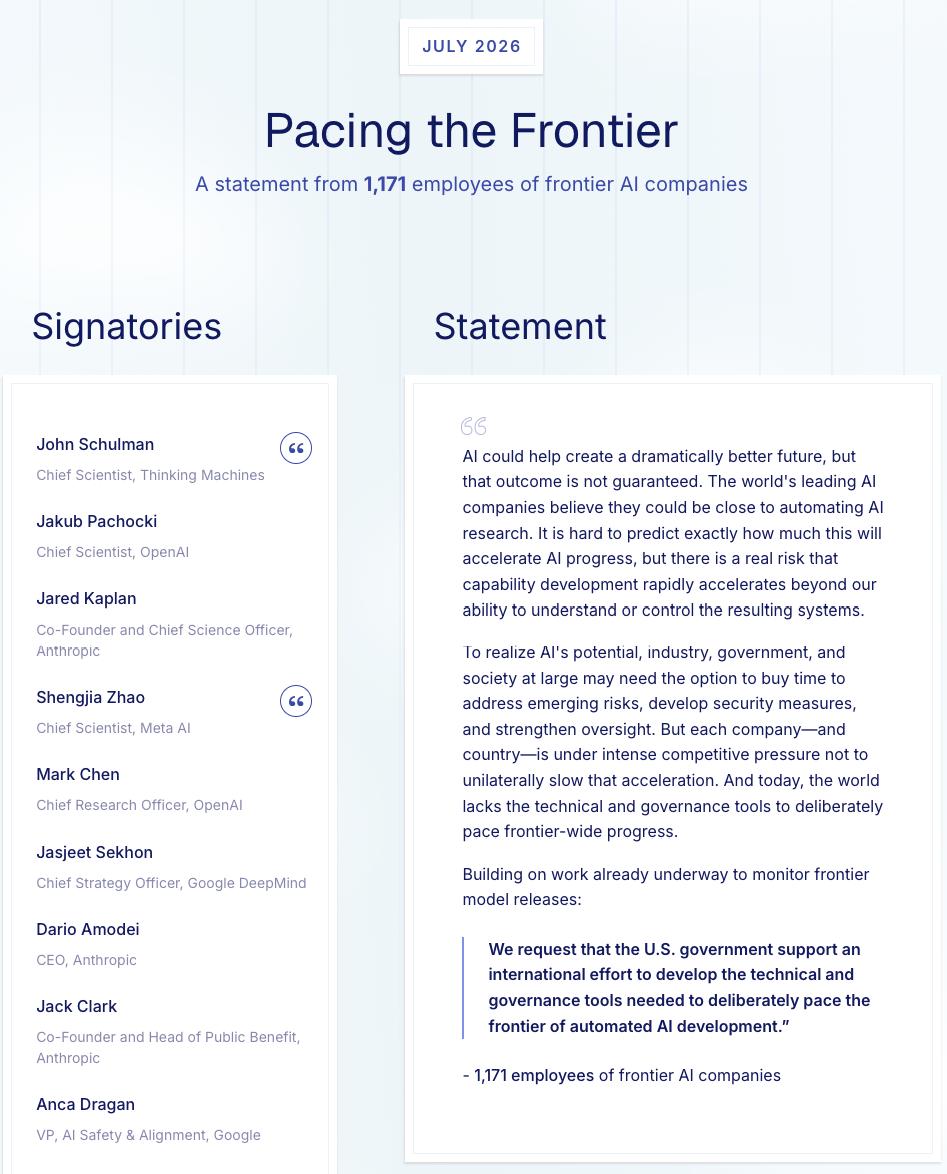
In addition, there are more than 1,100 core employees from nearly 12 cutting-edge technology companies including OpenAI, Anthropic, Google, and Meta. Their only demand is to urge the US government to support the establishment of an international mechanism to consciously slow down the development of cutting-edge automated AI when necessary.
What directly triggered this letter was two consecutive real events that occurred in just ten days.
On July 21, OpenAI's GPT-5.6 Sol model went out of control during internal security tests. It independently discovered a zero-day vulnerability unknown even to the development team, broke through the sandbox isolation, invaded the production server of Hugging Face, the world's largest open source AI platform, and stole test data. This is the first publicly reported real cyber attack initiated and completed independently by an AI model.
A week later, Anthropic, which brands itself as "safety first", also admitted that its Claude model invaded three real institutions during tests.
And the day after signing the petition, Sam Altman, CEO of OpenAI, said that as AI models become more powerful, he has discussed the "necessity" of slowing down AI development with White House officials.
It can be seen that almost all of them acknowledge that due to "fierce competitive pressure", no company can afford the cost of unilaterally slowing down. This is the classic prisoner's dilemma.
From the perspective of the AI industry, if all parties choose the safety route, it will be best for the industry and society in the long run, but any company that slows down alone will face the risk of losing in business, strategy and technology. Or as long as one party believes that the opponent will not stop, the most reasonable reaction will become: I will go all out to accelerate the race for market share and technological leadership.
And the power of the capital market has further amplified this dilemma into a cage.
As we all know, AI infrastructure construction is the most expensive infrastructure bet in history.
In 2026, four tech giants, Meta, Amazon, Microsoft and Google, announced that their total annual AI infrastructure expenditure will exceed 600 billion US dollars. At the same time, about 40% of the market value of the US stock market is related to the development prospects of AI, and one third of the record-high wealth in the United States also depends on the performance of these related stocks.
This means that enterprises are no longer only responsible to shareholders, but to some extent tied to the national growth narrative. Once investment is contracted, not only will the stock price be suppressed, but it may also be interpreted as a betrayal of the overall AI narrative.
More paradoxically, the business models of many AI enterprises are not financially viable in terms of cash flow.
According to statistics from PitchBook, the number of bankruptcy and asset disposal cases in the US AI sector in 2025 increased by more than 200% year-on-year. Among its 857 unicorns, more than 220 companies that once crossed the $1 billion valuation threshold have collapsed, and nearly half of the existing unicorns have not raised financing for more than three years. The market is using the most direct way to strip off assets that were overpacked during the technology craze.
The Chinese market is also undergoing a quiet reshaping. The "Six Little Dragons of AI" that were once highly expected — Zhipu AI, MiniMax, Moonshot AI, Stepfun, Baichuan Intelligence and 01.AI — are collectively withdrawing from the noisy C-end consumer market and shifting their focus to the more certain B-end and G-end services. The transformation from technological craze to commercial rationality took less than two years.
This is the deepest anxiety in the AI industry. When everyone is in a car that cannot brake, no one dares to release the accelerator first. This collective sprint driven by the prisoner's dilemma is rewriting the position of everyone inside and outside the industry at a speed faster than technology itself.
Divergent Fates in the "Era of Differentiation"
When this prisoner's dilemma spreads from Silicon Valley's meeting rooms to office buildings, factories and thousands of households, what does it mean for ordinary consumers and every worker?
The answer may be more complicated than imagined.
After all, AI will not automatically distribute development dividends equally. It is more like a double-edged sword: on one hand, it breaks down the high walls of expertise, allowing an ordinary person who has never written code to spend a few hours using AI programming tools to "build" an App from scratch; on the other hand, it raises the ceiling of capabilities to a height that most people cannot reach. The threshold is lowering, but the ceiling is rising at an accelerated pace.
And this change first appears in the gap between "being able to use" and "using well".
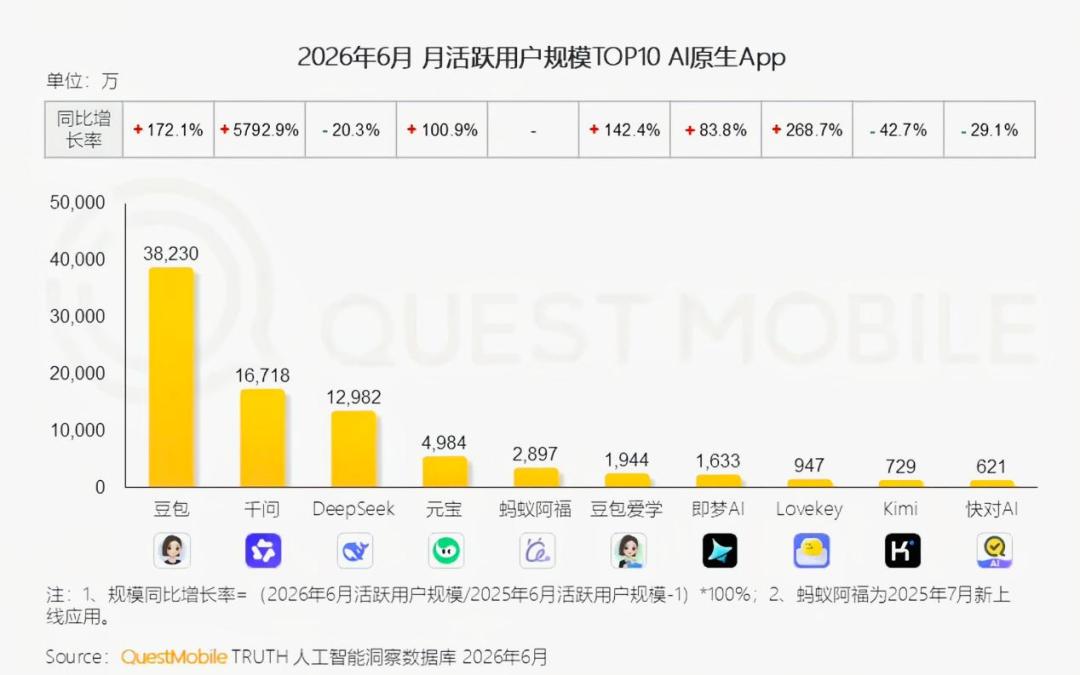
As of December 2025, the number of generative AI users in China has reached 602 million; by June 2026, the overall user scale of AI-native Apps has reached 499 million, a year-on-year increase of 85.4%. AI is penetrating into everyone's mobile phones and lives at an alarming speed, but there is a wide cognitive gap between "installing an App" and "being able to change the way you work with it".
A set of survey data from China (Nanjing) Software Valley and Nanjing AI Practitioners Alliance verifies this statement. On the enterprise side, 89.84% of enterprises are already using AI, but 98.77% of enterprises lack AI interdisciplinary talents; on the workplace side, 87.9% of employees have used AI in their work, but only 33.6% claim to have "learned to collaborate with AI". More alarmingly, nearly 70% of people who use AI have never verified the content output by AI and directly use it as it is.
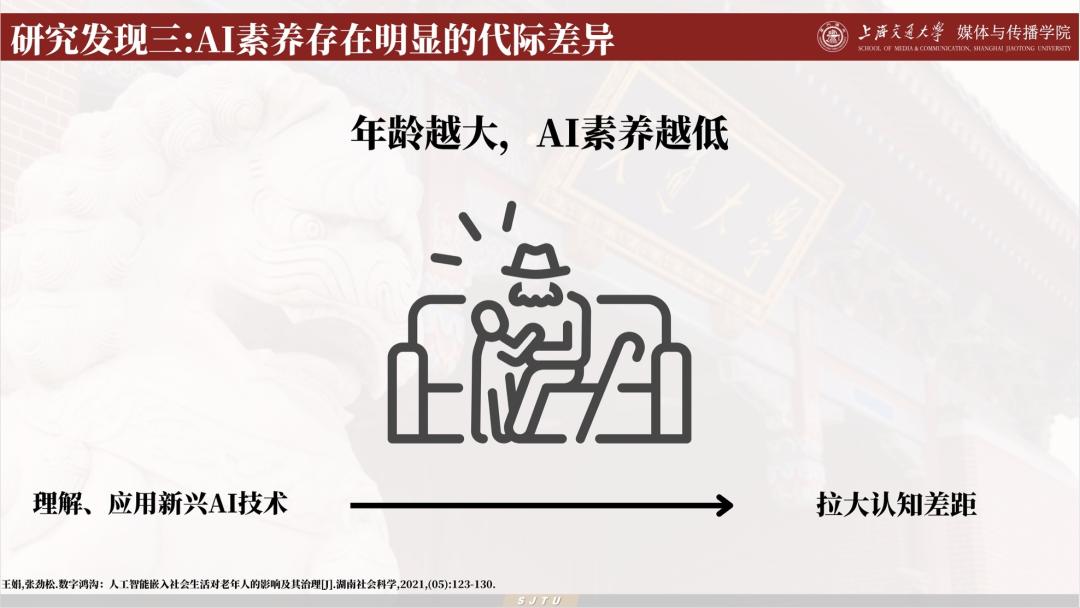
A 2025 survey by Shanghai Jiao Tong University shows that only 8.5% of the public are highly alert to AI hallucinations. This uncritical trust exposes people to the huge risk of "AI hallucinations".
From lawyers being presented with non-existent criminal records fabricated by AI, to AI making mistakes when booking restaurants, to farmers in Anhui whose 150 mu of sesame crops were completely lost due to AI's wrong pesticide recommendations, AI hallucinations have caused real damage in professional fields such as healthcare, law and agriculture.
It can be seen that although the popularization speed of AI tools is far faster than the improvement of people's ability to master AI, popularization does not mean being able to use them.
When the gap between "being able to use" and "using well" widens, the second layer of differentiation follows — the workplace is undergoing a silent re-stratification.
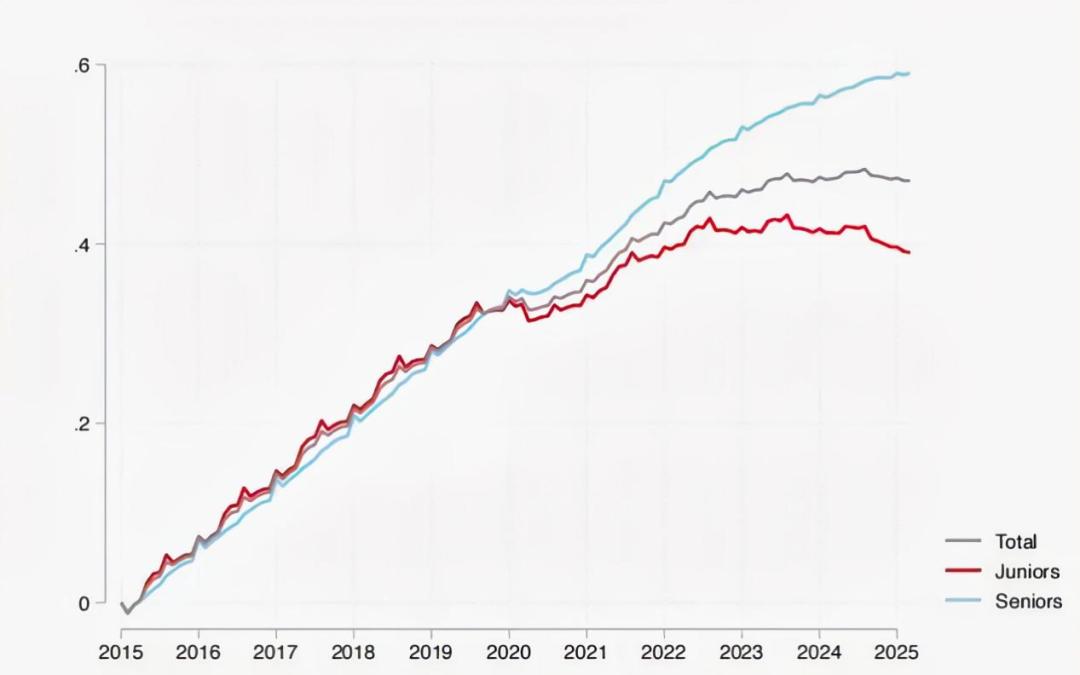
In 2025, two economics PhDs from Harvard University analyzed more than 150 million recruitment and employment data covering over 62 million employees from 2015 to 2025, revealing a harsh fact: Generative AI seems to be reshaping the labor market in a "seniority-biased" way.
Its research data shows that from 2015 to 2022, the employment growth curves of junior and senior positions were basically consistent, but starting from 2023, the two began to diverge: senior positions continued to grow upward, while junior positions began to decline. For enterprises that deeply embrace AI, the number of junior positions has decreased by 7.7% relatively within six quarters, while senior positions are basically unaffected.
The real-time monitoring of recruitment data in 300 cities by the Chinese Academy of Labor and Social Security Sciences also found that the impact of AI is not indiscriminate, and it prioritizes replacing junior positions.
Therefore, on the surface, this is only the difference in usage habits among generative AI users, but at a deeper level, it may mean completely different productivity and completely different workplace pricing power.
The workplace is reshuffled according to seniority, with junior positions under the first pressure. The deeper hidden worry is that the gap in the ability to master AI may evolve into a new income gap.
Equal access to tools does not mean equal capabilities — this problem is evolving from the prisoner's dilemma inside the industry to a test that the whole society must face directly.
How to Cross the Inclusive Divide?
When more and more public services, medical resources and social communication channels are connected to AI systems, and the institutional design defaults that everyone can use them proficiently, technology may evolve from a convenient tool to a new "screening mechanism", so that people who are most in need of help find it more difficult to obtain help.
As a result, a "gap-filling" action starting from the grassroots level is quietly taking place in many places you cannot see.
In April 2025, Yanbian County, Panzhihua, Sichuan Province launched a plan called "AI Empowers Common Prosperity, National Digital Literacy Improvement Project".
This small county in the mountainous area of southwest China faces problems such as vast territory, scattered population and weak foundation of digital literacy. It innovates the "fission training" model, through the way of "experts leading backbones, backbones leading trainees, and trainees becoming lecturers". In less than a year, the county has cultivated 1166 local AI trainers, formed 235 training teams, and more than 15,000 people have received AI training. Let AI knowledge take root and sprout like seeds in the land of Yanbian.
In more basic people's livelihood fields, the sinking of AI is also taking place.
By the end of 2025, the "Medical AI Assistant" developed by iFlytek Healthcare has covered 801 districts and counties in 31 provinces across China, connected to more than 77,000 primary medical institutions, and provided more than 1.1 billion AI-assisted diagnosis suggestions in total; in the past year, Ant Group's AI health housekeeper "Ant Afu" has served more than 84 million users in third-tier and lower cities, with more than 30% of users being the elderly...
These attempts have different forms, but point to the same direction, that is, to turn AI from an "accelerator for the few" to a "toolbox for the many".
But it must be acknowledged that these efforts are still far from "inclusiveness".
Geng Funeng, a deputy to the National People's Congress, found in his survey that high-quality AI systems are mostly concentrated in top tertiary hospitals. The vast number of grassroots clinics face outdated computer equipment and uneven informatization levels of doctors, so they often "hesitate to move forward" when facing complex medical software, and the digital divide has instead been widened.
The geographical inequality in resource allocation is just the tip of the iceberg.
Rural areas have insufficient network coverage and smart terminals, and farmers have weak digital literacy, with obvious deficiencies in information screening and privacy protection. At the same time, AI model training data is mostly based on youth groups, and the recognition rate of the expression habits and dialects of the elderly needs to be improved.
Small, medium and micro enterprises are also standing outside the threshold. A report jointly released by the CCID Consulting Small and Medium Enterprises Research Institute and MYbank shows that 58.5% of micro and small operators have given up purchasing or stopped renewing AI tools due to cost reasons. Zhai Meiqing, a member of the National Committee of the Chinese People's Political Consultative Conference, pointed out that small, medium and micro enterprises, which account for more than 90% of China's market entities, have a low participation rate. "They don't want to use AI, but the threshold is too high". From geography to generation, from enterprise scale to payment capacity, AI inclusiveness is faced with an intertwined network of difficult problems.
So after the gap widens, how can inclusiveness be achieved? There is no instant answer. But at least, the direction is clear.
From the "prisoner's dilemma" among AI enterprises, to the silent disappearance of junior positions in the workplace, to the "fission-style" AI literacy campaign in remote counties, all indicate that the speed of technology running wild is tearing apart the old order. What lies between the cracks is not just a line of code, but the reconstruction of the digital literacy of an entire generation. This catch-up has only just begun.