The humanoid craze is ebbing, scenarios are king.
In August 2026, the embodied intelligence industry stands at a delicate juncture.
On one side is the explosive growth of data. Figures from market research firm Omdia show that global shipments of humanoid robots reached around 18,000 units in 2025, marking a year-on-year increase of roughly 508%; in the first half of 2026, China's output of humanoid robots has exceeded 40,000 units, with the full-year figure projected to surpass 100,000 units.
China has become one of the world's fastest-growing embodied intelligence markets.
On the other side lies the harsh reality. At actual operation sites such as factories, power stations and shopping malls, robots face far stricter tests than they do at exhibition booths. An engineer in charge of intelligent transformation at an automotive plant told us: "They look like top-tier pros in demo videos, but become total noobs once they enter the workshop. Apart from being good for attracting leaders to visit and take photos, they are far less cost-effective than a skilled worker when you actually calculate the economic returns."
This stark contrast of "soaring on the report forms, gathering dust in the workshops" reveals the cruelest truth of the 2026 embodied intelligence industry: humanoid robots are only the "shell" of embodied intelligence, while the "scenarios" across thousands of industries are the "soul" that animates this shell. When the tide recedes, enterprises that only raised financing by "showing off skills" and "gait algorithms" are left naked in the market, while players who truly understand "scenario-defined products" are quietly reaping huge profits.
Who exactly does the trillion-yuan market belong to?
Before talking about the future, we must clarify the concepts. This is the biggest cognitive misunderstanding in the industry, and also the root of investment risks.
Even calculated based on the booming growth rate in the first half of 2026, the narrow "humanoid robot" market in China will only reach around 3.4 billion yuan in size for the whole year, and is expected to exceed 20 billion yuan by 2030. This scale is even smaller than the monthly revenue of a leading new energy vehicle enterprise.
The "trillion-yuan blue ocean" that is widely discussed in the capital market never refers to the hardware itself, but the broader "embodied intelligence" market.
According to the latest forecast from IDC, the global market size of intelligent robot hardware will approach 30 billion US dollars in 2026, and China's user expenditure on embodied intelligent robots will exceed 11 billion US dollars, maintaining a rapid growth rate of nearly 120%. Chinese service and consumer robot manufacturers will account for more than 85% of global shipments, and are the core leading force driving global growth. In terms of segmented categories, IDC predicts that China's humanoid robot market will reach nearly 1.3 billion US dollars in 2026, doubling year on year; the quadruped robot market will exceed 700 million US dollars, the educational companion robot market will exceed 1 billion US dollars, and the cleaning robot market will be close to 3.4 billion US dollars.
From the perspective of the global humanoid robot market, the "Humanoid Robot Market – Global Forecast to 2035" released by MarketsandMarkets points out that the global humanoid robot market size is expected to grow from 5.41 billion US dollars in 2026 to 50.27 billion US dollars in 2035, with a compound annual growth rate of 28.1% from 2026 to 2035. The Asia-Pacific region will occupy more than 50% of the market share.
What is more critical is the structure of the market. Among the segmented tracks, industrial robots take the largest market share, followed by service robots, and special robots account for a certain proportion. Although humanoid robots currently account for the smallest share, they have the fastest growth rate and are widely regarded as the biggest growth engine in the future.
Why are we still firmly bullish on the industry at this 2026 time node?
Because the industrial logic has undergone a fundamental reversal.
In the past, when we talked about robots, we were referring to precision machinery.
Now, when we talk about embodied intelligence, we are referring to "physical AI".
Morgan Stanley recently published a report analyzing that China's humanoid robot industry has entered the early stage of commercialization, and the industry focus is shifting from technical demonstration to real commercial value creation.
The "2026 White Paper on the Development of the Intelligent Robot Industry" released by PwC in July 2026 further points out that current intelligent robots have formed a clear division of three major product forms based on scenario demands: industrial robotic arms focus on standardized operations at fixed stations; wheeled/quadruped robots, relying on their advantages of efficient movement and terrain adaptation, are deployed on a large scale in mobile scenarios such as warehouse inspection and catering distribution, and are the core main force for short-term commercial implementation; humanoid robots adapt to human infrastructure and operating tools, and release unique value for special scenarios such as nursing and flexible assembly.
Actions taken by industry giants show that hardware cost reduction has entered a stage of "extreme pressure".
As Tesla widely introduces the integrated die-casting process and mature electric vehicle supply chain into the robotics field, the hardware BOM (Bill of Materials) cost is plummeting.
In 2026, the average manufacturing cost of a general-purpose humanoid robot has dropped to one third of its level in 2023. Hardware is only a carrier, and the real output value comes from service fees of "software, operation and maintenance, and data", which constitutes the main body of the trillion-yuan market.
The "2026 Global Embodied Intelligence Commercial Implementation Report" released by Yiou Think Tank points out that in this early stage of 2026, with extreme hardware cost performance, rapid iteration cycles and huge domestic shipment volume, Chinese enterprises have steadily occupied more than half of the global embodied intelligence market share. As the industry crosses the first commercialization inflection point in 2029, the discourse power of Chinese enterprises in the global supply chain (production capacity of motors, reducers and lead screws) will be converted into stronger bargaining power. The report predicts that by 2035, Chinese enterprises will steadily occupy 55% of the global market share, with the total annual revenue expected to reach more than 66.2 billion US dollars, and truly realize the transformation from "global robot manufacturing factory" to "global leader in the embodied intelligence ecosystem".
The scenario pyramid: who exactly is making the money?
After clarifying the market boundaries, you will find that the so-called trillion-yuan track is never built by selling tens of thousands of humanoid robots, but scattered in specific demands in factory workshops, power station towers, shopping mall stalls, and thousands of households.
Sorting these demands by willingness to pay and implementation difficulty, what is hidden in the pyramid is the real cash flow of the industry.

Industrial manufacturing is the highest-value sector at the moment. Although nearly 20% of the 18,000 global shipments in 2025 went to automotive and electronics production lines, the actual implementation status is far less impressive than the data suggests.
BYD is trying to develop a "internal circulation" path through self-developed "Yaoshunyu" robots — it plans to deploy 20,000 units internally within the year to dilute R&D costs, while UBTech partners with NIO to introduce the Walker S series into vehicle assembly plants for component transportation. At the same time, with its 20-second high-precision quality inspection implemented at a flat panel workshop in Nanchang, the cumulative output of Intelligent Robots has reached 15,000 units; Unitree Robotics has sold 11,000 units of a single product, verifying the feasibility of large-scale mass production. Although the strict requirements for stability in industrial scenarios are still the "efficiency climbing period" that the whole industry must go through, the deep integration between automotive enterprises and robotics enterprises has become the most mainstream mode for industrial implementation.
Special operations support a high-gross-profit market relying on "risk aversion premium". The 6.8 billion-yuan procurement order issued by State Grid in 2026 is highly symbolic. The orders for 5,000 quadruped robots, 500 humanoid live-working robots and 3,000 dual-arm inspection robots indicate that the special power scenario has entered the stage of large-scale procurement.
Enterprises such as IAMROBOT and State Grid Intelligence have captured 85% of the market share in the power grid inspection field with technical barriers deeply integrated with the "Guangming Power Large Model". In contrast, although CITIC Heavy Industries is also following up on related businesses, the industry generally reflects that in extreme environments such as UHV towers and underground utility tunnels, the difficulty of adapting to non-standard operations remains a high threshold.
Commercial services show a brutal differentiation between traffic and space efficiency. Among the largest shipment base at present, Dobot's "popcorn robot" and Pudu's delivery robot have formed clear business models at fixed points, and the former's daily sales at Shanghai K11 Shopping Center are even 20% higher than that of manual stalls.
However, attempts in complex and open scenarios have repeatedly failed. A humanoid shopping guide robot in a chain supermarket was moved to the warehouse due to navigation failure rate and voice interaction problems, exposing the shortcomings of existing technologies in "zero-sample generalization ability". As the judgment cited by the Economic Information Daily points out, the focus of current commercialization is returning to tracks with higher fault tolerance rates such as cultural tourism, logistics sorting and security technology.
Household consumption remains the "longest slope" that is visible but not yet accessible. Although the pre-sale orders of UBTech's U1 series have exceeded 13,000 units, and Unitree Robotics' products have also caused a stir in the C-end market, most of the real scenarios are limited to programming education and geek hobbies.
The general consensus in the industry is that the core value of humanoid robots currently still lies in special scenarios such as nursing and flexible assembly. It will take a long time before they can truly enter ordinary households and become "nanny robots" — the industry consensus clearly points out that household scenarios have extremely high requirements for the ability to adapt to unstructured environments. In addition, the entry price is far beyond the budget of ordinary household appliances, and the maintenance cost often amounts to thousands of yuan. Leading enterprises can only pre-position themselves in segmented fields such as companionship, health care and commercial reception to accumulate strength for the future C-end competition.
Beneath the prosperity, there are "growing pains" that must be faced directly
Behind the 508% growth rate data is a more complex reality in factory workshops. On one side are the trillion-yuan market forecasts, and on the other side are pragmatic discussions from the front line of the industrial chain about "unfavorable cost accounting".
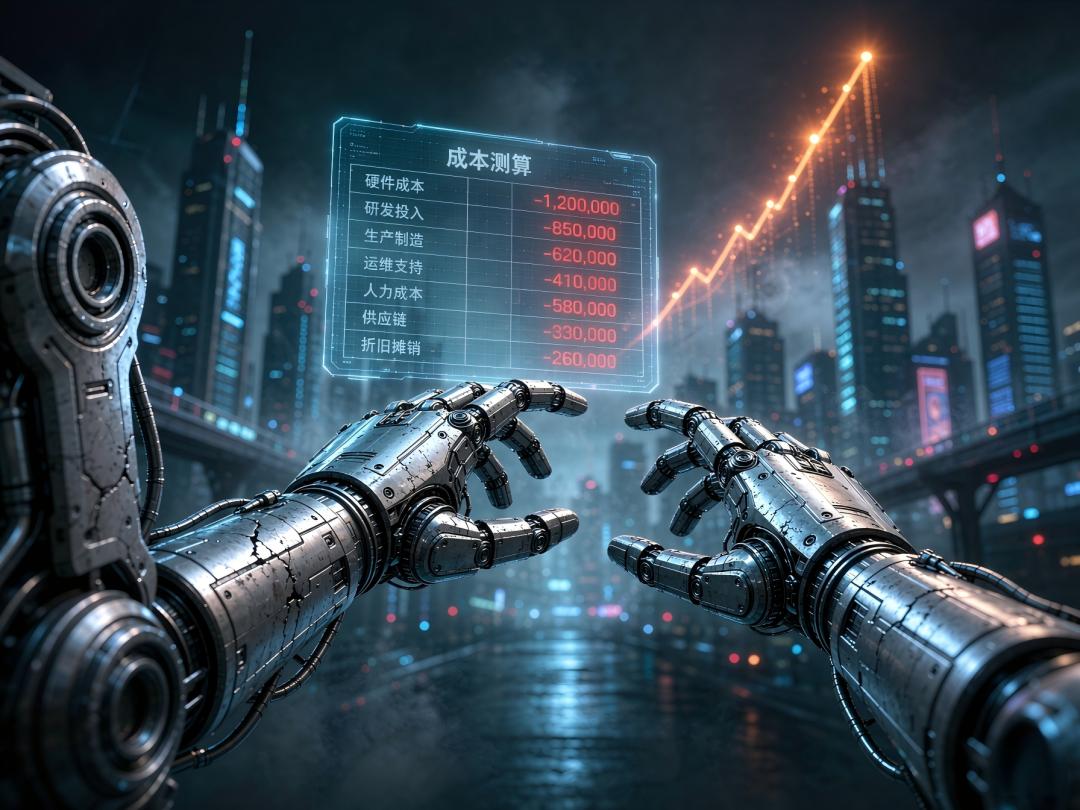
Cost remains the heaviest mountain standing in the way of large-scale implementation. Morgan Stanley recently raised its sales forecast to 28,000 units based on the rapid decline in hardware costs, but for most small and medium-sized manufacturing enterprises, the starting price of 200,000 to 300,000 yuan for an industrial-grade humanoid robot is still a luxury.
Surveys show that "overly long return on investment cycle" is the biggest concern of purchasers. Unless you have the internal drive to produce tens of thousands of units per year like BYD, it is still difficult to make the math work. Buying the hardware is only the beginning, and subsequent operation and maintenance, energy consumption and software iteration all test the cash flow of enterprises.
More difficult to solve than cost is the "generalization" dilemma of technology. Intelligent Robots has realized 20-second high-precision quality inspection at the flat panel workshop in Nanchang, but this ability is often built on the training of massive specific data. Once separated from the preset environment and facing the non-standard industrial site, the performance of the robot is often greatly reduced.
The "real-scenario practical training" promoted by the national and local co-built humanoid robot innovation center is precisely designed to allow algorithms to self-evolve through massive data in the real physical world, which not only requires time, but also massive computing power investment.
At the same time, the strict requirements of industrial customers for "reliability" are becoming the touchstone for testing product quality. The PwC white paper points out that the requirement for the continuous operation success rate of equipment in industrial scenarios is usually above 99%.
Enterprises generally admit that embodied intelligent robots still struggle to cope with non-standard operation scenarios, and "there is cost pressure in large-scale implementation" has become the industry consensus. In the real working conditions intertwined with dust, oil pollution and electromagnetic interference, any unexpected shutdown may mean losses to the entire production line.
Behind all this, the talent gap has become an invisible ceiling restricting the acceleration of the industry.
The "2026 Insight Report on Talent Supply and Demand Trends in the Robotics Field" released by Liepin Big Data Research Institute points out that the number of new jobs in the robotics field in the past year increased by 75.26% year on year, and the average annual salary for recruitment reached 328,000 yuan; for compound technical backbones in the industry who "understand algorithms, understand real machines, and have completed high-value projects", the annual salary has been pushed up to the million-yuan level. Although major universities have set up related majors one after another, the talent training cycle is destined to be calculated in years. This imbalance between supply and demand, to a certain extent, slows down the speed of technology iteration and scenario implementation.
The key to breaking the situation is to shift from selling hardware to providing services
When hardware convergence becomes a given fact, the competition focus of the industry will inevitably shift to the back end. Simply relying on selling robot hardware that costs hundreds of thousands of yuan obviously cannot meet the strict market scrutiny on ROI at present.
Tesla outlined a new profit prospect at its latest earnings call: the future main revenue of Optimus will not rely on hardware sales, but on a "skill store" similar to the mobile app store. Users can download skill packs for robots such as cooking, massage or equipment maintenance, and manufacturers will share revenue with developers.
This idea tries to turn one-time hardware transactions into continuous service subscriptions, fundamentally changing the valuation logic of the industry. In China, Huawei relies on its full-stack AI capabilities to lay out the underlying software ecosystem, trying to play the role of the Android system, and lower the threshold for application development through a unified operating system.
This competition for ecological positions makes the strategic value of vertical integration increasingly prominent. The reason why BYD dares to set an annual internal production target of tens of thousands of units comes from its deep control over the supply chain.
From self-developed core components to using its own factories for scenario verification, this "internal circulation" model not only dilutes R&D costs, but also builds a high moat in data accumulation. In response, Tesla is trying to introduce the mature integrated die-casting process of the automotive industry