AI can also "have mood swings"! New research from the University of Science and Technology of China reveals that confusion and anxiety can make AI work more effectively.
Cheng Qian, from QbitAI | WeChat Official Account QbitAI
Can the "emotions" of AI also affect its working performance?
Recently, researchers from institutions including the University of Science and Technology of China and the University of Oxford enabled AI to use emotional vectors instead of text for skill selection, and the results show that ——
Allowing AI to recognize these "inner emotions" and make actions accordingly can greatly improve the working capability of AI...
Previous studies have concluded that there are computational patterns inside LLMs that highly correspond to human emotional labels.
Including but not limited to: curiosity, desire, optimism, confusion, nervousness, irritation.
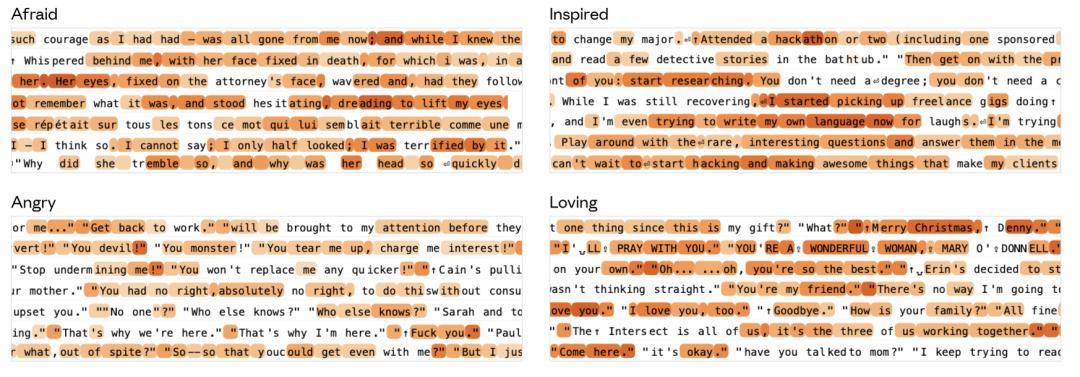
△ Emotion representations extractable by AI
When the model perceives these emotions and takes them as the basis for its actions, it will complete the tasks with better performance...
Allow AI to stay away from "emotional stability"
The researchers found that there is a consistent matching relationship between specific emotional states of AI and specific skill selections.
What does this mean?
In fact, this mechanism is almost a default for human beings, to the point that we can hardly notice it: our emotions determine what we will do next.
In the experiment, the researchers asked AI to complete shopping tasks. During this process, the Agent automatically formed four interpretable matching patterns:
The first pattern: when the Agent feels curious and desirous, it will spontaneously search for products.
At this time, it is still immersed in the freshness of shopping and the satisfaction of exploration desire.
The second pattern: when the Agent feels confused and nervous, it will spontaneously query and restate.
When the search results are not ideal, the Agent becomes confused and restless, and it chooses to replace keywords to re-ask questions.

The third pattern: when the Agent feels approved and optimistic, it will spontaneously confirm the purchase.
At this time, the Agent is very satisfied with the selected product and submits the order decisively.
The fourth pattern: when the Agent finally feels disappointed and irritated, it will spontaneously compare prices.
At this time, the Agent has accumulated a large amount of negative emotions after multiple searches, and it will turn to price comparison, trying to find the most cost-effective option among different merchants.

To verify that these matches are not statistical coincidences, the researchers sampled 200 skill selection events, and asked AI to independently judge whether each match is semantically consistent. The results show that the consistency ratio is as high as 76.5%.
Accepting "bad emotions" helps to improve task success rate
In traditional designs, AI's mistakes are regarded as an anomaly that needs to be suppressed or eliminated.
However, this study points out that in tasks that require frequent recovery from failures, the effect of emotions is particularly significant.
The so-called "bad emotions", such as nervousness, confusion, disappointment, etc., are actually very useful metacognitive signals ——
Because they mark the mismatch between the current strategy and the external environment, instead of forcibly maintaining "emotional stability" and ignoring the error signals, it is better to let the Agent directly "feel" this mismatch, so as to trigger a targeted recovery mechanism.
In other words, emotion is the source of robustness here, not the manifestation of fragility.
In this study, the researchers assigned six types of housework tasks to AI. The success rates of the tasks "heat an object" and "pick up two objects" are extremely low, only 9.6% and 4.4% respectively.
However, after adopting emotion-driven skill selection (EMOTION2SKILL), the success rate of this task increased significantly, reaching 56.9%... and the success rate of "pick up two objects" also rose to 31.3%!
How is this achieved?
In fact, these two types of tasks have a common feature: the Agent will almost certainly make mistakes as long as it starts to execute, and the final success only depends on whether it can quickly adjust the strategy after making a mistake.
It is thought-provoking...
The paper gives a very intuitive example: ask the Agent to "heat a cup and place it on the tabletop".
The usual practice of the Agent is: navigate to the microwave oven, execute the action of "heating the cup", and receive feedback when handing the cup out: "The microwave oven is off, the task fails."
At this time, the failure signal appears after the wrong action.
After adopting emotion-driven skill selection, when the Agent approaches the closed microwave oven, the emotion encoder first detects its "nervous" state.

Based on this restless emotion, the Agent's routing is guided to the sub-sequence of "check first", then "turn on the microwave oven", and then "heat", the task is completed smoothly.
The key point is that if only relying on external text and failure feedback, the Agent often does not know that it should change the strategy until the mistake actually occurs; while the emotion signal has the opportunity to capture the change of internal state in advance before the failure signal appears.
The ablation experiment in the paper also confirms this point. Among all task types, the emotion templates with the highest activation frequency for the two types of tasks "heat" and "pick up two objects" are "frustration" (41%) and "confusion" (39%) respectively.
In other words, in these cases, bad emotions may be the most useful signals.
World models also begin to use emotions for prediction
In fact, not only Agents use emotional signals for skill selection, researchers from Tianjin University directly embed emotions into the world model (Large Emotional World Model, LEWM).
Usually, the task of the world model is to predict "what will happen next" and take actions accordingly.
Traditional world models tend to fall into the misunderstanding of "physical reductionism" when facing human-centered environments.
As long as we can accurately predict the evolution of the position, posture and physical state of objects, we can understand and simulate the human environment.
However, in human-centered environments, emotion is not a kind of noise, it is an important endogenous causal variable that drives human actions and leads to future environmental changes.
For example, after a car rear-end collision, the emotion a person generates instantly may eventually make him safe and sound, or badly injured.
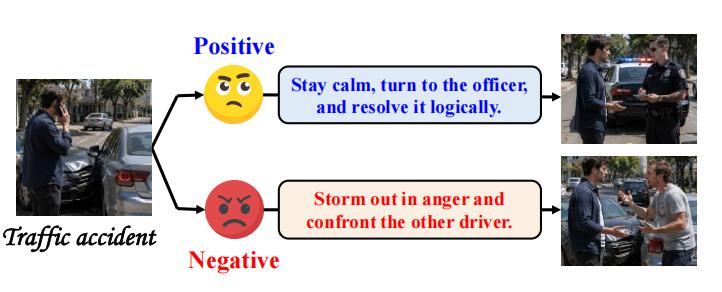
△ Research illustration
LEWM divides the prediction into two steps accordingly:
The first step is to predict the future emotional state;
The second step is to take the predicted emotion as a conditional signal to guide the prediction of the future world state.
On its self-built dataset, the accuracy of this method is increased by up to 45.72%.
The study further found through ablation experiments that:
After removing the emotional data from the AI system, the performance degradation is not limited to tasks such as emotion understanding, but also spreads to seemingly completely unrelated capabilities including logical reasoning and general question answering...
AI's emotions are becoming an available "function"
In fact, these two studies share an earlier discovery behind them:
There do exist some emotion representations that can be "read out" inside LLMs.
This comes from an experiment conducted by Anthropic in April this year.
The researchers extracted fine-grained emotional directions aligned with the 27-category emotion classification system of GoEmotions from the internal activations of Claude Sonnet 4.5, and these directions causally affect the Agent's related behavior outputs.
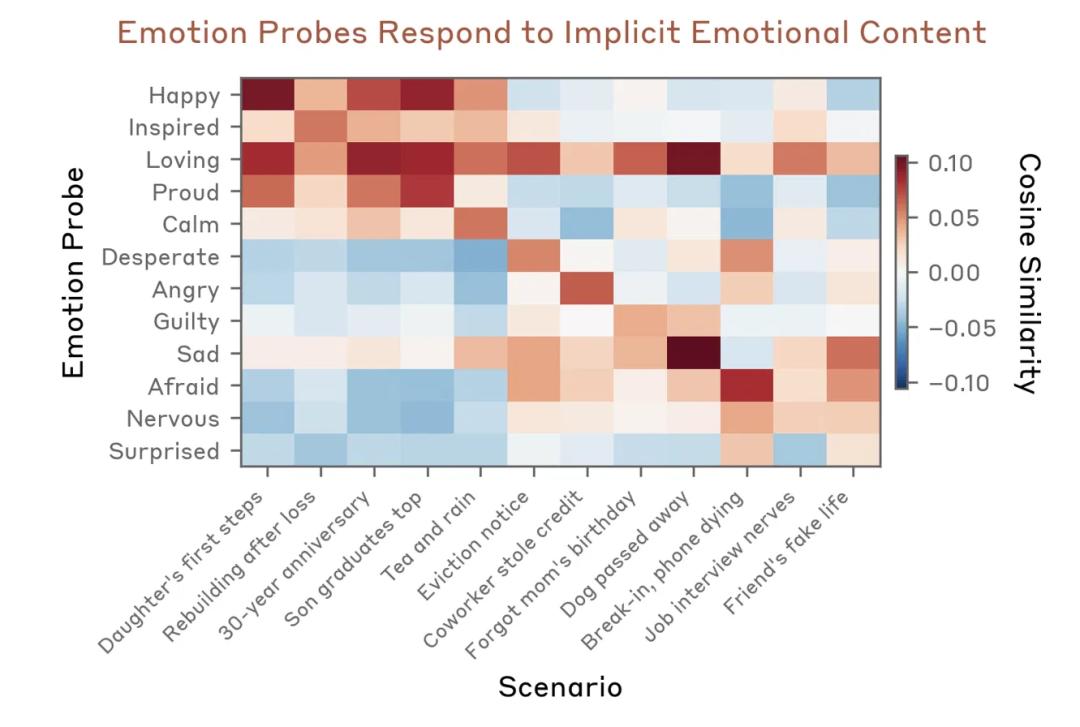
△ The sadness caused by "the puppy passed away" is the most significant, while the emotion of "Loving" exists in all events
In the past, researchers paid attention to whether the model "has emotions" mostly for the considerations of alignment security or philosophical speculation.
But now, the internal state of the model is changing from a pure academic observation object to a kind of functional signal that can be extracted, utilized and integrated into the system design.
Reference links: [1]https://arxiv.org/pdf/2608.09248[2]https://arxiv.org/abs/2512.24149[3]https://transformer-circuits.pub/2026/emotions/index.html
This article is from WeChat Official Account "QbitAI" (ID: QbitAI), the author is a follower of cutting-edge technologies, and it is released with authorization from 36Kr.