AI is mass-producing "ghosts"
In the first week of August, U.S. fashion group Tapestry held its second AI Summit at its New York headquarters. Tapestry is not a household name, but its brands Coach and Kate Spade are familiar to many people.
In the past, to figure out customers' preferences, Tapestry mainly relied on in-person research. Researchers would send questionnaires to real respondents, conduct interviews, and sometimes even visit customers' homes to see how they dress in daily life and what styles of clothes they keep in their wardrobes.
At this summit, the company's consumer insights team showcased a group of very special "customers".
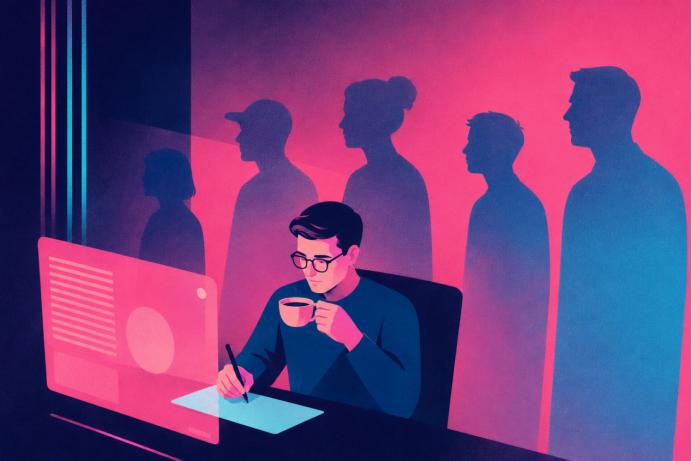
These "customers" are AI-generated virtual personas created by Tapestry based on accumulated historical consumer research data. They simulate young consumers in the United States and China. When Tapestry plans to test new products, pricing or marketing campaigns, it can first let these virtual personas answer questions, or chat with them directly just like running a focus group, to observe how young consumers might react.
A reporter also chatted with one of the AI customers on site. The conversation spanned from shopping to daily life, and this non-existent "girl" even told the reporter that she had been worried about the job market recently.
Kate Spade, a brand under Tapestry, has also deployed these AI customers in staff training. Store employees can have voice conversations directly with AI "customers" to practice introducing products and responding to customer inquiries. After the simulated sales session ends, the AI will also score the employee's performance.
These AI customers were designed to be used as virtual characters from the very beginning, but the same "persona creation" capability has been exploited to generate batches of hidden, unethical "ghosts".
AI Ghosts in the Shadows
U.S. colleges and universities have already become one of the scenarios most severely affected by "AI ghosts".
In recent years, a large number of so-called "ghost students" have emerged in U.S. community colleges. They are not real students at all, but accounts registered by fraud rings using stolen identities, or even completely fabricated identities. In the school system, these accounts have names, student IDs, select courses and submit assignments just like ordinary online students, making them almost indistinguishable from real learners.
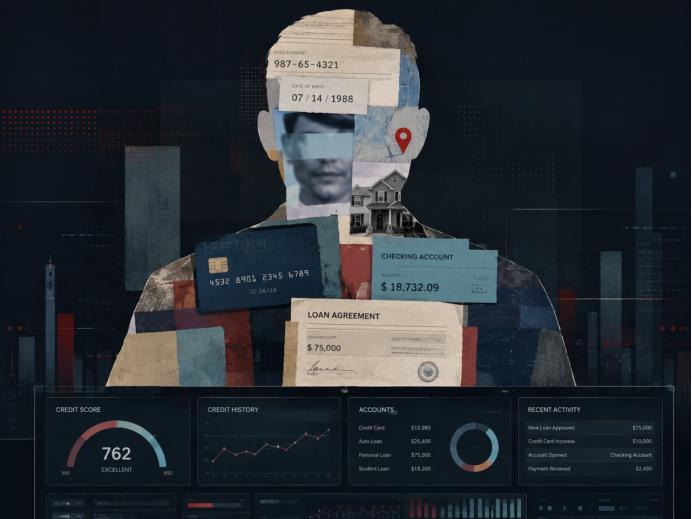
Sneaking into the school system successfully is only the first step.
To wait for financial aid to be disbursed, scammers have to make these fake students act as real learners.
As a result, these "ghost students" log into online courses regularly, complete assignments, participate in class interactions, and reply to teachers when necessary. In the pre-AI era, pulling off this fraud required scammers to operate each fake identity manually, but now almost all of this work can be directly handed over to AI.
AI has made it far easier for one person to control a huge number of fake identities simultaneously, and the number of fake identities a single person can maintain has grown exponentially.
One of the hardest-hit regions is California. In 2024, the California Community Colleges system received around 1.2 million fraudulent applications, and 223,000 fake registrations were eventually confirmed. Some schools even encountered situations where fake students filled up all seats in popular online courses, leaving real students who wanted to take the classes unable to enroll.
As for the financial aid, a large amount of real money has been defrauded through these schemes.
The U.S. Department of Education stated that in 2025, over $1 billion in student aid fraud had been blocked through enhanced verification measures, including applications using AI bots to impersonate students. For fraud rings, as long as a "student" can successfully pass the school's verification and complete a period of online courses, they stand a chance of cashing out a large sum of real money.
Similar "ghosts" have also started to appear in the job recruitment market.
This year, U.S. AI model evaluation company Arena encountered a very strange job applicant. The resume looked normal, the interview proceeded smoothly, and the candidate even passed the technical interview hosted by engineers. But when the company was about to formally offer the position, the person suddenly disappeared. Arena later suspected that from the resume to the interview, they might have been interacting with a fake identity completely packaged by AI.
This is deeply unsettling: if this "AI" chooses to do so, it can formally start working. No one will ever know who the human behind the persona is, or how many such AI ghosts are already mixed into the workforce under the control of that human.
This kind of incident has become so common that the recruitment industry has started to track it specifically. U.S. IT research and consulting firm Gartner surveyed 3,000 job applicants, 6% of whom admitted to having participated in interview fraud. Gartner predicts that by 2028, 1 out of every 4 job applicant profiles worldwide may be fake.
Some "ghosts" in the financial industry even "live a normal life" for several years before being used to defraud money.
As early as more than 20 years ago, there was a fraud method called "synthetic identity fraud". Scammers would take partial real identity information, such as social security numbers and dates of birth, and pair them with fake names, photos and addresses to piece together a person that does not exist in reality. Then this "person" would open accounts, apply for credit cards and loans. Some fraud rings would even make repayments on time first to build up a good credit history, and then cash out all the credit at once once the credit limit is high enough.
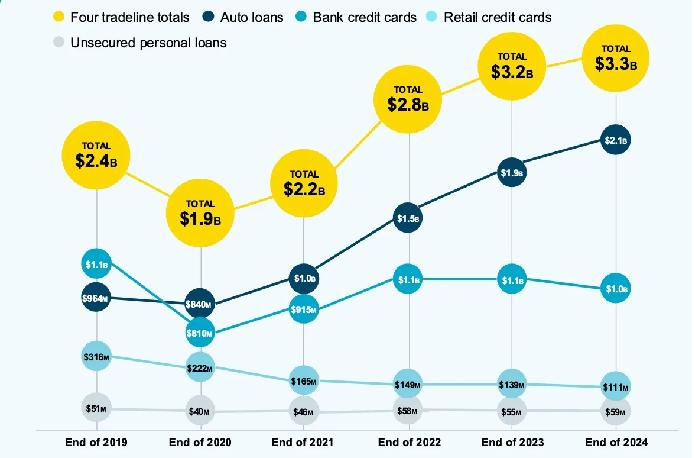
AI has made this entire process much simpler. Steps that used to require manual preparation one by one can now be generated in batches. Even video and voice verification can be handled with the help of AI tools.
By the end of 2024, the credit risk that U.S. lending institutions were exposed to from synthetic identity fraud had reached $3.3 billion. U.S. credit reporting agency TransUnion also lists generative AI as a key reason for the continued expansion of this type of fraud.
The Legitimate Commercialization of "AI Persona Creation"
Meanwhile, under the sun and outside the shadows, "persona creation" has been openly developed into a legitimate business.
Aaru, a U.S. AI market research company, provides virtual consumer services for enterprises.
I believe most of you have filled out questionnaires for others at some point, right?
In the past, if a company wanted to know whether a certain group of people would buy a new product, it had to recruit real people to complete questionnaires, interviews or focus groups. Aaru, on the other hand, generates a large number of virtual consumers of different ages, incomes and life backgrounds based on real demographic and consumption data, and lets these "people" answer the same questions.
When Aaru first started looking for clients, it liked to demonstrate on site how reliable these virtual personas are.
It would ask clients to provide a research question that had already been answered by real people and whose results were already known, then have hundreds of thousands of virtual consumers answer the same question again.
The results proved that the traditional research results obtained by researchers through great efforts to reach real people are very close to the results simulated by AI today, which makes this solution highly convincing.
Later, these virtual consumers began to be used in more scenarios. Publishing houses use them to test book cover designs, beverage companies test different flavors on them, and investment institutions will observe the choices of simulated consumers before acquiring a company. Political groups even use them to test political candidates and policy proposals.
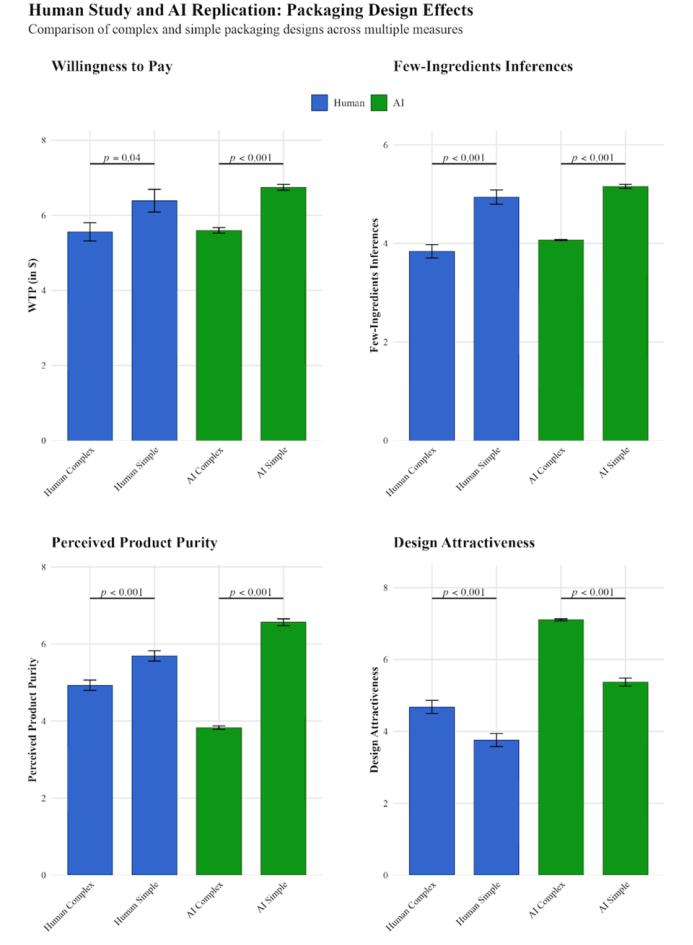
Caption: Comparison of scores given by real people and AI for simple and complex packaging designs
By the end of 2025, Aaru's valuation had reached $1 billion.
Another U.S. AI startup, Simile, has a different approach to the "AI ghost" business.
It creates a "digital twin" for a real person based on the massive amount of responses and materials that person has left in the past.
When new questions come up later, you don't necessarily need to find the real person every time. You can ask their AI twin first.
CVS, the U.S. chain pharmacy and healthcare giant, has already applied this method to more than 400,000 real respondents. It used 2.9 million responses provided by these people in the past to generate digital twins, then repeatedly compared the AI's answers with the real people's responses. The highest consistency rate in some tests reached 95%.
From a human perspective, each of our answers is actually far less "random" and "unpredictable" than we think.
Gallup, the long-established U.S. polling and consulting firm, has also deployed more than 1,000 digital twins at once to conduct research on policies, corporate and social trends.
Capital is also very optimistic about this business. At the end of July this year, Simile completed a $200 million financing round with a valuation of $2 billion; just five months earlier, it had closed its previous $100 million financing round.
The most direct reason why enterprises are willing to use virtual consumers is time saving. A round of questionnaires or interviews in traditional market research usually takes several weeks. AI consumers can be queried at any time. After a campaign plan is revised, you can test it immediately, without having to recruit a new batch of respondents every time.
Simile's enterprise clients pay between $150,000 and several million dollars per year for this service.
Of course, it is not yet possible to completely replace real people. Companies like CVS still carry out real-person research, and they constantly use real responses to verify the credibility of the AI. But the trend of "AI ghosts" replacing the general public with indistinct individual identities has already taken shape.
As the virtual consumer business matures, "AI ghosts" are starting to be applied in more industries.
In February this year, life sciences consulting firm Lumanity launched the AI virtual character platform EMULaiTOR, which specifically generates virtual patients, doctors and personnel responsible for drug reimbursement decisions for pharmaceutical companies. Pharmaceutical companies can talk to these virtual personas first to test how to present drug information more clearly, what questions doctors might ask, and where patients might have concerns. This system has been tested for about a year before its official launch, and has been used in real projects of multiple pharmaceutical companies.
In the legal industry, even jurors now have AI equivalents.
In June this year, U.S. legal tech company Courtroom launched AI juror and AI judge simulation services. Lawyers can run a mock trial in the "ghost court space" before the real trial, to observe how "jurors" from different backgrounds will react.
Courtroom claims that the simulation accuracy of this system exceeds 90%, and large U.S. law firms and Fortune 1000 companies have already used it in real cases such as product liability and patent infringement disputes.
Prove That You Are Actually a Human
After "AI ghosts" enter real business operations, the boundary between humans and AI is becoming increasingly blurred. What is more troublesome is that the "ghosts" in the cybercrime ecosystem are deliberately impersonating real people.
As a result, schools, companies and online platforms have to re-solve a very basic problem — how to confirm that there is a real carbon-based human being on the other side of the screen.
U.S. colleges and universities, who have been repeatedly scammed, have been forced to implement increasingly strict identity verification measures, which are almost as rigorous as interrogating aliens.
In April this year, the U.S. Federal Student Aid system added real-time fraud screening to all FAFSA financial aid applications, and around 300,000 previously submitted applications were selected for re-verification. In June, the U.S. House of Representatives passed the No Aid for Ghost Students Act, which requires continued screening of suspicious financial aid applications.
Recruitment companies have also had to move part of their processes back offline.
After Arena encountered the fake job applicant, it considered requiring new employees to report to the office in person and pick up their work computers. U.S. cryptocurrency exchange Coinbase also required some employees to travel to the U.S. to complete onboarding in person. The FBI advises enterprises to verify identities through in-person interviews and onboarding procedures whenever conditions permit.
After all these twists and turns, the most effective method turns out to be meeting the person in person.
However, a large number of recruitment transactions, and even daily social interactions, have long relied on online channels. It is impossible to ask people to meet in person every time. As a result, services that specifically help people prove "I am a real human" have gained a market.
Tools for Humanity, a technology company co-founded by Sam Altman and Alex Blania, is one of the main participants in the World project.
World, formerly known as Worldcoin, has World ID, a digital identity system specifically designed to prove "you are a real human". Users scan their irises through the Orb device developed by Tools for Humanity to confirm that they are a unique real human, and then they can use World ID to complete real-person verification online.
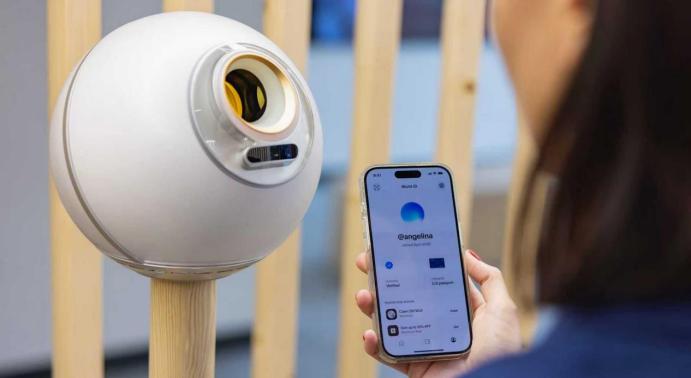
Caption: A user showing their World ID next to the Orb iris scanning device
As of July this year, nearly 18 million people have completed verification through Orb, with users across 160 countries. Dating app Tinder, video conference platform Zoom and electronic signature service provider DocuSign have all integrated or announced plans to integrate World ID. The World Foundation has also launched a charging mechanism for World ID: ordinary users can still use it for free, but enterprises that integrate this verification system need to pay fees.
World is not the only company targeting this business.
In 2025, Humanity Protocol, another identity verification company that provides "real-person proof" services, completed a $20 million financing round with a valuation of $1.1 billion. It solves the same problem as World, but confirms that there is a real human behind the account through palm print verification.
World has also designed a clear charging model for World ID. Ordinary users can use World ID for free, while enterprises and applications that integrate the verification system need to pay.
According to the currently announced plan, fees can be charged per single verification, or calculated based on the number of monthly