Moonshot AI's IPO, the "second stock" in the large model track, demands a new narrative.
Author | Liang Fan
Editor | Fan Zhang
Recently, news about Moonshot AI's planned Hong Kong IPO has resurfaced intensively.
On August 3, market sources claimed that Moonshot AI planned to submit its listing application to the Hong Kong Stock Exchange as early as that month, with a proposed fundraising of about 3 billion US dollars. The company later responded that the news was untrue. On August 8, another media report stated that Moonshot AI might submit its listing application before September 30.
This scenario is quite similar to the situation before Zhipu AI and MiniMax went public.
In 2025, Moonshot AI has long been in the first echelon of domestic large model companies, and is also one of the most watched large model startups besides DeepSeek. However, in terms of capitalization pace, Zhipu AI and MiniMax took the lead in completing their listings on the Hong Kong stock market.
At that time, Moonshot AI did not seem to be in a hurry. At the end of 2025, Yang Zhilin stated in an internal letter that the company held more than 100 billion RMB in cash after completing its Series C financing, and could still raise a large amount of capital from the primary market, so it was "not in a hurry to go public in the short term".
However, the experience of Zhipu AI and MiniMax after their listing demonstrates another value of the secondary market: IPO is not only a one-time financing, but also a channel for establishing continuous financing.
In July 2026, Zhipu AI raised about 31.4 billion Hong Kong dollars through the placing of new shares, only issuing new shares equivalent to about 4.25% of the enlarged total share capital; MiniMax subsequently completed the placing of 35.6 million new shares, and issued 6.5 billion Hong Kong dollars of convertible bonds at the same time.
Moonshot AI once fell into silence in market news, until the release of KIMI K3. In the comprehensive ranking of Artificial Analysis, KIMI K3's score is second only to the top-tier models of Anthropic and OpenAI.
Considering that Zhipu AI and MiniMax went public one after another in almost the same market environment, and the competitive landscape of large models is now different, Moonshot AI's this IPO is more like the real "second large model stock" in the Hong Kong market, and it also needs to present a capital market narrative that adapts to the new landscape.
K3 Opens the Valuation Window
The model ranking from Artificial Analysis provides a perspective to observe the preferences of the capital market.
In the "Comprehensive Performance - Single Task Cost" scatter plot, the higher the position, the stronger the model capability; the more left the position, the lower the usage cost. The former reflects technical competitiveness, while the latter affects large-scale application and potential profit space.
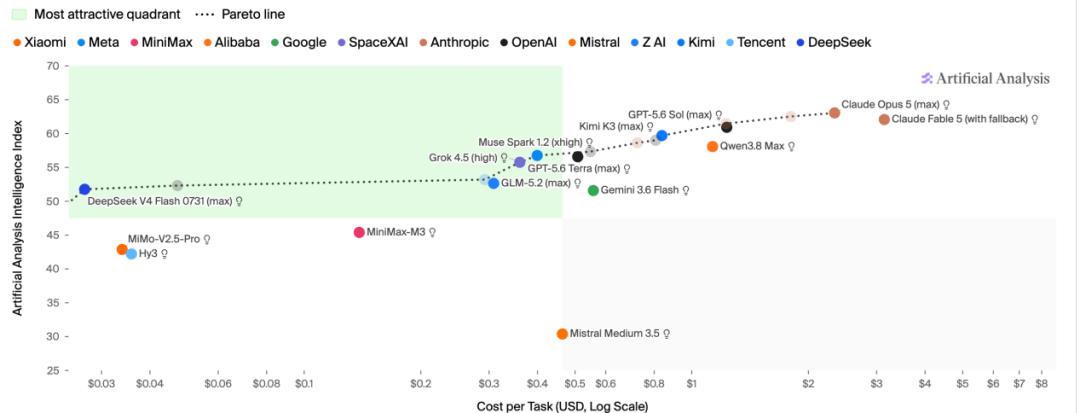
Figure: Performance and Cost Distribution of Some Mainstream Large Models Source: Artificial Analysis, 36Kr Collation
However, what the capital market focuses on is not the simple "cost-effectiveness", that is, the ratio of model performance score to cost, but prioritizes model performance, followed by cost.
The reason is not complicated: OpenAI and Anthropic have proved that a sufficiently powerful model can create high willingness to pay. In contrast, relying solely on low-price competition is not only difficult to build scarcity, but also has to face direct pressure from open-source models such as DeepSeek.
This is exactly where the significance of Kimi K3 lies. According to the comprehensive ranking released by Artificial Analysis, Kimi K3 ranks third, with a score very close to the two top-tier models of Anthropic and OpenAI, while its usage cost is even lower.
If it goes public at this time, Moonshot AI is expected to become a new target on the Hong Kong stock market that undertakes the investment demand for large models, and the technical momentum formed by Kimi K3 may also help the company obtain a higher issuance valuation and reduce subsequent financing costs. This may also be the reason why IPO movements of Moonshot AI have been frequently reported recently.
However, Moonshot AI's IPO still needs to race against time.
The vastly different stock price performance of Zhipu AI and MiniMax after their listing at least shows that the capital market is more willing to chase large model enterprises that are close to the industry frontier at a specific stage and are regarded by the market as the "strongest candidate".
However, the iteration speed of the large model industry is extremely fast, and almost no company can maintain absolute leadership for a long time. OpenAI's leading advantage is gradually challenged by Anthropic; after the outstanding performance in 2025, Google's relative advantage has also weakened in 2026.
New competitive pressures are still emerging. On the evening of August 12, the official version of DeepSeek-V4 Pro was released. According to the evaluation results of Artificial Analysis, although its comprehensive score is lower than that of Kimi K3, its cost advantage is very prominent: under the current pricing scheme, its single-task cost is less than 10% of Kimi K3's.
This means that the "frontier performance + cost advantage" narrative that Kimi K3 has just established may be impacted by new models at any time.
More importantly, the current globally leading large models are generally built on Transformer and its hybrid variants, and the main technical routes of the industry are gradually converging. Major companies continue to make progress around directions such as MoE sparsification, high-quality training data, long context, reinforcement learning, and Agent capabilities. The resulting outcome is that the competition of large models is more like a time-based race of continuous iteration, rather than a long-term, gap-leading advantage relying on a certain exclusive technology.
Once a certain capability is verified by leading manufacturers, latecomers can also replicate quite a part of the mature capabilities with lower costs by means of model distillation and other methods. Therefore, the general capabilities of various models will not be completely identical, but in specialized capabilities such as programming where market demand is most concentrated, they are likely to gradually reach a similar level of commercial availability.
This means that domestic and foreign large model manufacturers are still continuing to invest, the industry competition is far from over, and Kimi K3's current leading position cannot be guaranteed for a long time.
Therefore, promoting the IPO as soon as possible before the phased leading position is caught up by competitors is an effective way for Moonshot AI to obtain valuation premium, convert technical advantages into capital advantages, and reserve funds for the next stage of competition.
Computing Power Begins to Become a Constraint
In the latest Token consumption ranking of OpenRouter, although domestic models occupy 6 seats, Kimi K3 failed to enter the top ten.
It is worth noting that Kimi K2.5 and K2.6 both topped the OpenRouter consumption ranking shortly after their release earlier this year; after the release of K3, it also once entered the top ten in a short period of time. Why is the market's performance evaluation of Kimi K3 higher, but its ranking performance has not continued?
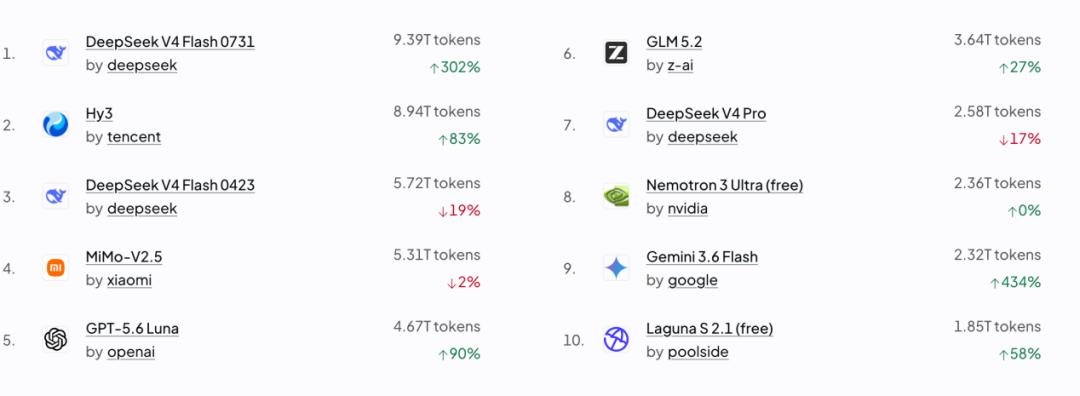
Figure: Weekly Token Consumption Ranking Source: OpenRouter, 36Kr Collation
This does not mean that the market does not recognize Kimi K3. The more likely reason is that users are currently unable to use this model on a large scale at low cost.
On July 19, shortly after the release of K3, Kimi released an announcement stating that the user request volume in the past 48 hours had far exceeded expectations, and was close to the carrying limit of the existing cluster. To ensure the usage experience of existing subscribed users, the company decided to suspend new C-end user subscriptions, and prioritize existing computing power to serve existing subscribed users.
At present, Kimi has resumed new C-end user subscriptions, but this temporary flow restriction still exposed a problem: in the early stage of K3's release, Moonshot AI's computing power supply failed to fully keep up with the growth of demand.
A similar situation also occurred to Zhipu AI before. In February 2026, after the release of GLM-5, user demand exceeded expectations, and some subscribed users also encountered flow restriction during peak hours. After that, Zhipu AI significantly accelerated its investment in capital and computing power. By the end of June, the company had used more than 93% of the net proceeds from its Hong Kong IPO, and the relevant funds were mainly invested in model R&D and computing power infrastructure construction.
This means that for any manufacturer trying to reach the frontier of large model performance, computing power has become an unavoidable constraint.
Capital, Becoming the Next Stage of Competition?
In terms of capital reserves, Moonshot AI is not short of money.
According to public statistics, from January to May 2026, Moonshot AI raised a total of about 30 billion US dollars through multiple rounds of financing. Coupled with its cash reserve of more than 100 billion RMB at the end of 2025, even excluding the 3.5 billion US dollars new round of financing completed in July as reported by Bloomberg, Moonshot AI's capital strength is significantly stronger than that of Zhipu AI in the early stage after its IPO.
Although the total parameter volume and activation parameter scale of K3 are higher than that of GLM-5.2, and the demand for computing power resources is also greater, the strong capital reserve in theory should endow Moonshot AI with stronger computing power procurement and scheduling capabilities.
However, K3 still quickly encountered a computing power bottleneck after its release, which shows that the company's early computing power investment may have been relatively cautious, and failed to timely match the rapidly growing demand after the model upgrade.
Zhipu AI once pointed out in its placing announcement that the more than 30 billion Hong Kong dollars of funds raised will be consumed before 2027. For Moonshot AI, if it continues to develop along the route of large-parameter models in the future, its computing power demand will also increase significantly.
In other words, if domestic large model enterprises have quickly caught up with overseas leading models in performance, one of the core shortcomings that need to be made up next may be the scale of computing power, and making up for this shortcoming requires huge capital investment.
According to the "AI Index Report 2026", in 2025 alone, OpenAI's expenditure on computing power services reached 16.3 billion US dollars. OpenAI's management also stated that it plans to invest about 500 billion US dollars in computing power procurement in 2026. In addition, OpenAI is also directly participating in data center construction through the Stargate project. By contrast, according to The Information, Anthropic's computing power service expenditure in 2026 is about 19 billion US dollars.
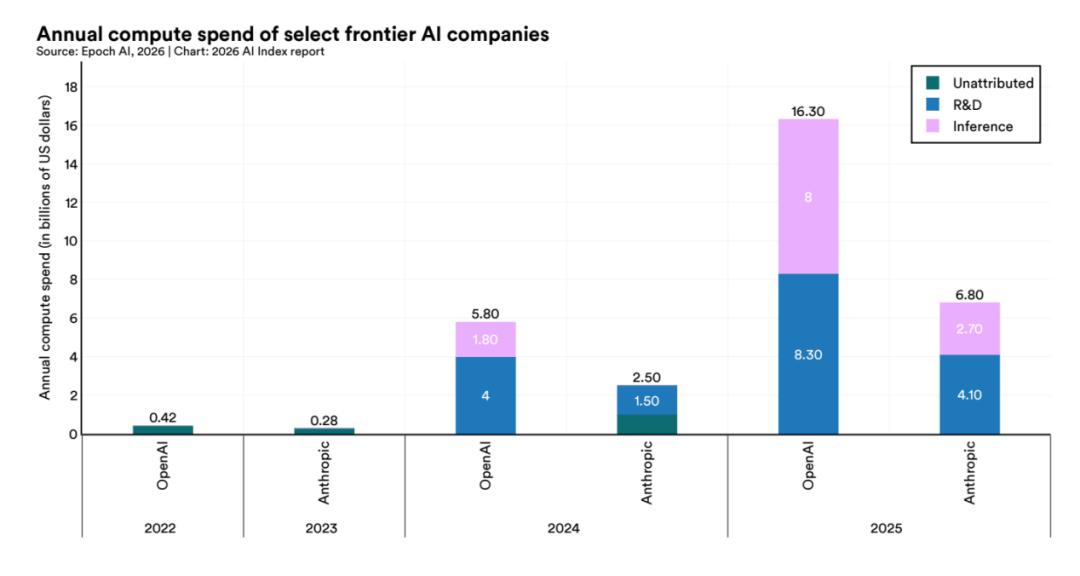
Figure: Computing Power Expenditure of OpenAI and Anthropic Source: "AI Index Report 2026", 36Kr Collation
This means that although domestic large model enterprises such as Moonshot AI and Zhipu AI are rapidly narrowing the performance gap with overseas models, and their valuations are also rising rapidly (for example, Zhipu AI's secondary market valuation was once close to one-sixth of OpenAI's), there is still a huge gap between the two sides in terms of capital volume and computing power expenditure.
When the performance of domestic and foreign models is close, what ultimately determines the outcome of market competition may be who can carry more users with lower cost and more stable services. In the final analysis, this still depends on the scale of computing power.
Therefore, after the model capabilities catch up rapidly, capital and computing power will become the key direction for domestic large model enterprises to catch up in the next stage, which is also why even DeepSeek rarely started external financing this year.
For Moonshot AI, establishing a low-cost and sustainable financing channel through the secondary market during the dividend period of valuation premium will be a cost-effective strategic choice in this computing power war.
*Disclaimer:
The content of this article only represents the views of the author.
The market is risky and investment needs to be cautious. Under no circumstances shall the information or opinions expressed in this article constitute investment advice to any person. Before deciding to invest, investors must consult professional advisors and make prudent decisions if necessary. We have no intention of providing underwriting services or any services that require specific qualifications or licenses to engage in to all trading parties.