From DeepSeek, Kimi to the "Jensen Huang Alliance": What exactly has been "opened" by the open-sourcing of AI models?
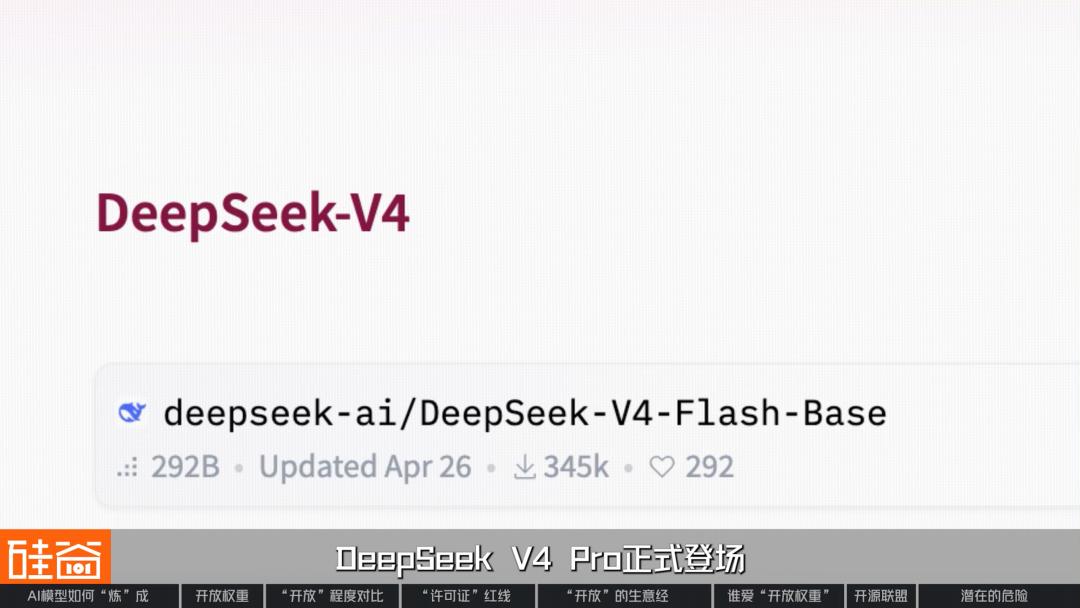
In the early morning of August 13, DeepSeek V4 Pro was officially launched, adding another strong boost to the open-source model ecosystem. From Kimi K3 to MiniMax H3, and then to DeepSeek V4 flash and DeepSeek V4 Pro, under the fierce offensive of China's open-source models, US AI companies are truly unable to sit still this time.
Jensen Huang personally posted his first ever tweet, calling on the entire industry to jointly promote the development of the US open-source ecosystem. At present, almost all major players in the US AI circle have joined this alliance except Anthropic, and heads of closed-source models such as Sam Altman and Sundar Pichai have also rarely posted to express their support.
Why did these companies, which usually compete the most fiercely, stand on the same front this time? And what is the reason why Anthropic insists on not joining?
To answer this question, we must first clarify a more fundamental matter: what exactly is the "open-source model" referred to in the current AI industry? And what does it mean for model vendors and the entire industry after the model is open-sourced?
01
What exactly does the open-source model open up?
Many people think that an AI model is a set of code, and the so-called "open source" is to release the code, but this is not the case. To understand what exactly the model opens up, we first need to sort out the complete process of a large model from training to final release.
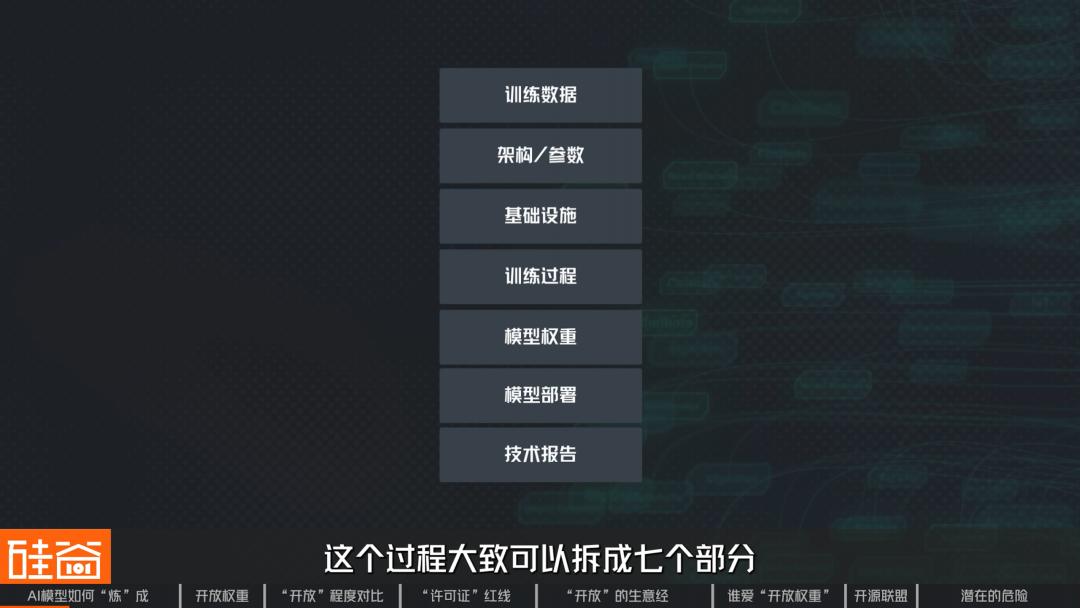
This process can be roughly divided into seven parts.
First, training data. The R&D team must first decide what data to use to train the model, such as web pages, books, code, and the proportion of different types of data, and then go through cleaning and filtering. This step determines whether the "foundation" of the model is good or not.
Second, model architecture and parameter scale. This stage mainly focuses on model planning and design, including what model architecture to adopt, how large the parameter scale is, and various training configurations. These designs determine the upper limit of the model's capability and training efficiency.
It should be noted that the parameter scale does not refer to the size of the training data. Training a model is essentially a continuous process of "adjustment", and the parameter scale refers to "how many places need to be adjusted in total this time". The larger the parameter scale, the more complex the details and rules that the model can capture and process.
Third, training infrastructure. After the model design is completed, huge computing power is required to complete the training, including GPU clusters, high-speed networks, storage systems, and various training frameworks. And how to efficiently organize these computing powers is exactly the most popular AI Infra (Artificial Intelligence Infrastructure) field today. DeepGEMM from DeepSeek, FlashKDA and MoonEP from Kimi K3 all belong to innovations at this layer.
After the data, architecture and infrastructure are prepared, the real training stage begins.
Fourth, training process and Checkpoint. At this stage, the model will undergo pre-training, fine-tuning and reinforcement learning. During the training process, it will continuously "save files" to facilitate continued training, testing or rollback.
Fifth, "model weights". After a long period of training, billions or even trillions of parameters inside the model will be gradually adjusted to appropriate values. The final set of these parameters is the "model weight", which is also the core achievement of the entire model, recording the knowledge and capabilities that the model has learned during the training process.
Sixth, model deployment. After the training is completed, the weights need to be deployed to the server, and truly provided to developers and enterprises through APIs or local deployment.
Finally, the "technical report". After these processes are completed, model vendors usually write a "technical report". It introduces the ideas of model architecture design, the general composition of data, the pitfalls encountered in training and the final evaluation results, so that the outside world can understand how the model is made. But the technical report is not a step-by-step operation manual that can be directly reproduced; it is more of a methodology.
After clarifying the training process, what exactly does "open source" refer to in terms of the open links? According to the openness of the model, it is mainly divided into three types: closed source, open weight and fully open source. Let's start with the two extremes.
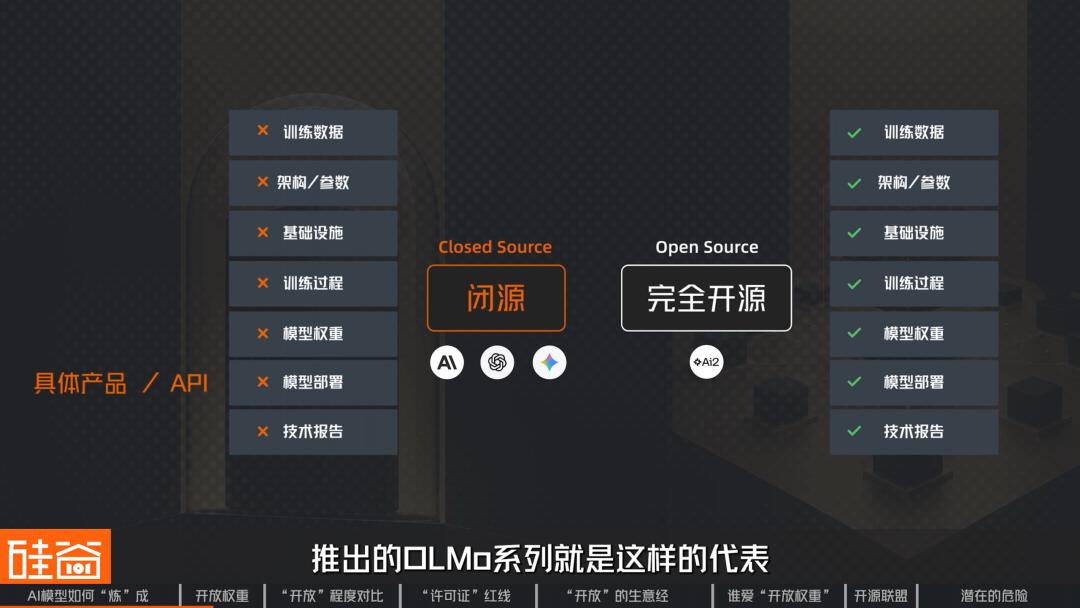
Closed-source models are easy to understand: all the above links are not open to the public, and customers can only use the model capabilities at the model deployment level through APIs or specific products. Most of the current models of Anthropic, OpenAI and Google are in this form.
A fully open-source model called Open Source means that everything from training data, training code to intermediate archives and technical reports is completely public. The OLMo series launched by Ai2 (Allen Institute for Artificial Intelligence) is a representative of this.
But most of the open-source models we are talking about now are not real Open Source, but Open Weight located in the middle ground between open source and closed source. It is equivalent to only giving out the final result of model training, and everyone can use it directly, and can also fine-tune and improve it on the basis of the result.
However, there are great differences in the degree of openness between different open weight models now, and we will use several representative models to explain it in detail.
First of all, strictly speaking, "model weight" is just a huge digital file, which cannot run directly by itself. If you directly download the weights of Kimi K3 from Hugging Face, you will get about 2.8 trillion floating-point numbers, which are neatly arranged in accordance with the order specified by the model architecture.
Therefore, in addition to the weights themselves, vendors usually also publish an inference code, which is specifically responsible for teaching users how to read the weight files, in what order to perform calculations, and finally how to turn the results into a sentence to reply to users.
The most basic "open weight" is to publish the model weights and this runnable and fine-tunable inference code, so that anyone can download the model to their own server to run. The most representative of these is Meta's Llama series.
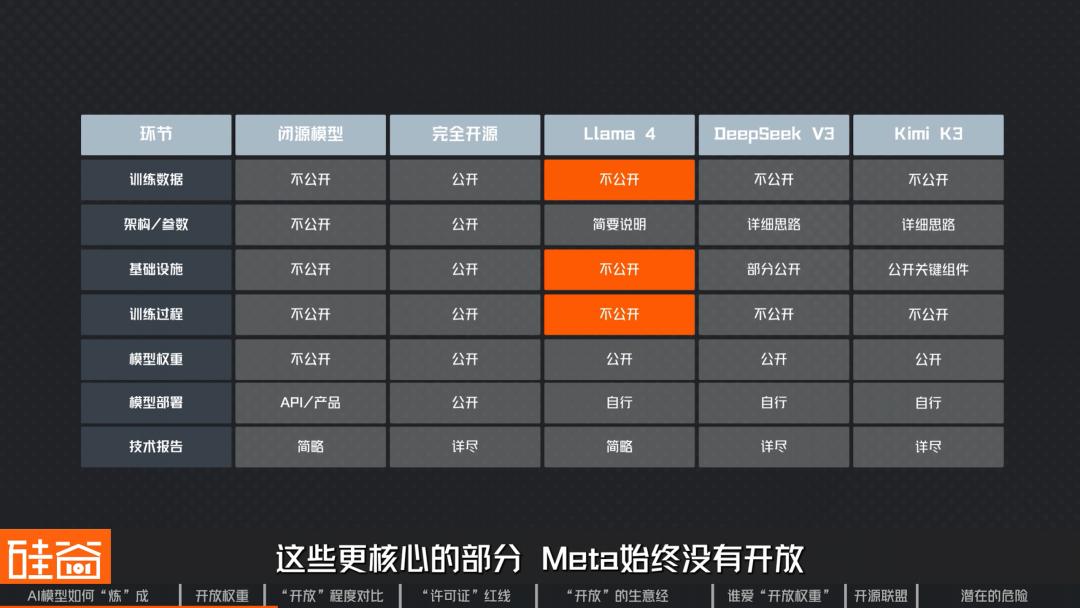
But Meta has never opened up the more core parts, such as the specific formula of training data, the strategy of continuous adjustment during the training process, and the internal toolchain that supports the entire model training.
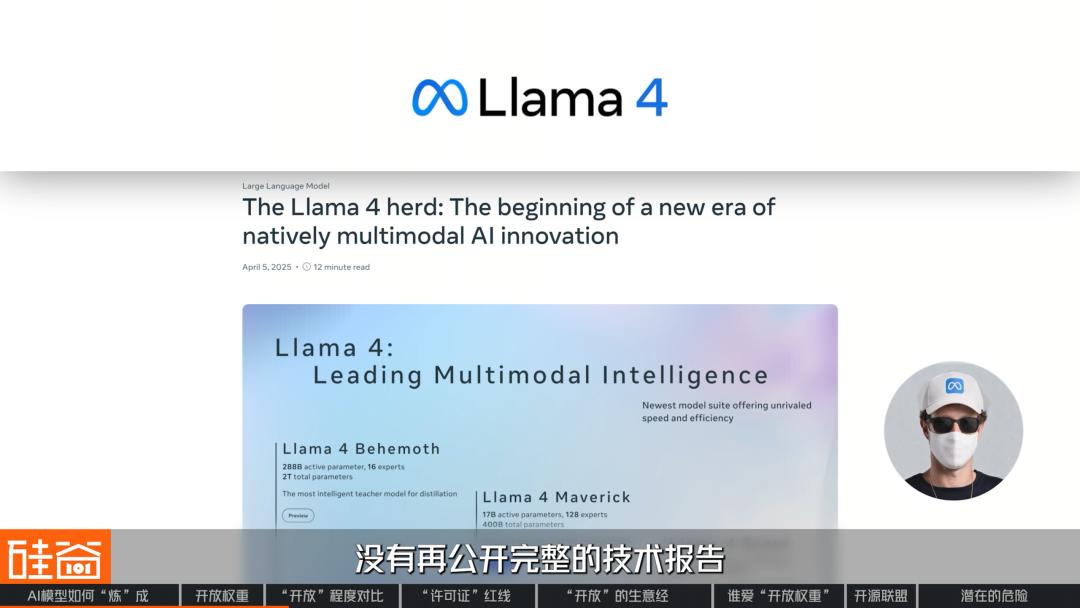
Previously, from Llama 1 to Llama 3, Meta would release more detailed technical reports to share model design and engineering experience. But for Llama 4 last year, Meta only published a short blog, no longer making the complete technical report public, and the degree of openness has become more conservative.
One of the important reasons why DeepSeek shocked the entire industry is that it not only explained the methods in detail, but even open-sourced the internal engineering toolchain itself, which can be said to be the Plus version of "Open Weights".
Before that, the technical reports of most model vendors were more like press releases, which usually told everyone how many parameters the model had and what results it achieved on which Benchmarks, but rarely explained how these results were achieved.
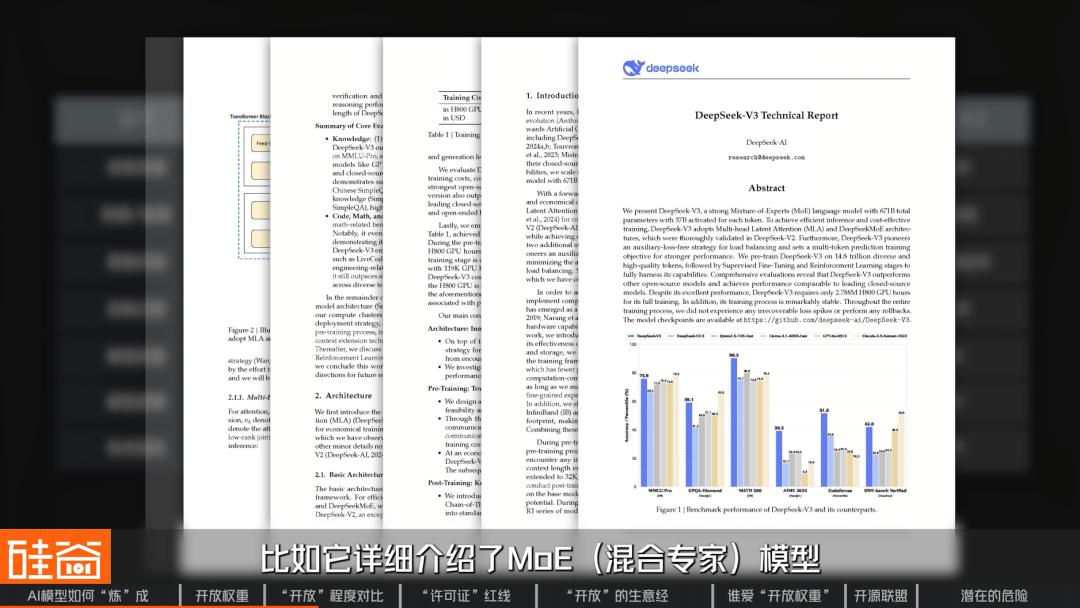
However, DeepSeek V3 and DeepSeek-R1 have written out some R&D details that were rarely made public in the past almost unreservedly. For example, it introduces in detail how the MoE (Mixture of Experts) model is designed, why Multi-head Latent Attention (MLA) is used to reduce the memory usage of KV Cache, how FP8 training is stably implemented, and why among different solutions, the current design is finally selected and other routes are abandoned.
In addition to technical reports, DeepSeek has also successively open-sourced training and inference infrastructure components such as DeepEP and FlashMLA, turning a lot of engineering experience that used to belong only to internal engineering teams into tools that the entire industry can use.
It can be said that DeepSeek has opened a new form of model openness, and this time Kimi K3 has also followed this practice.
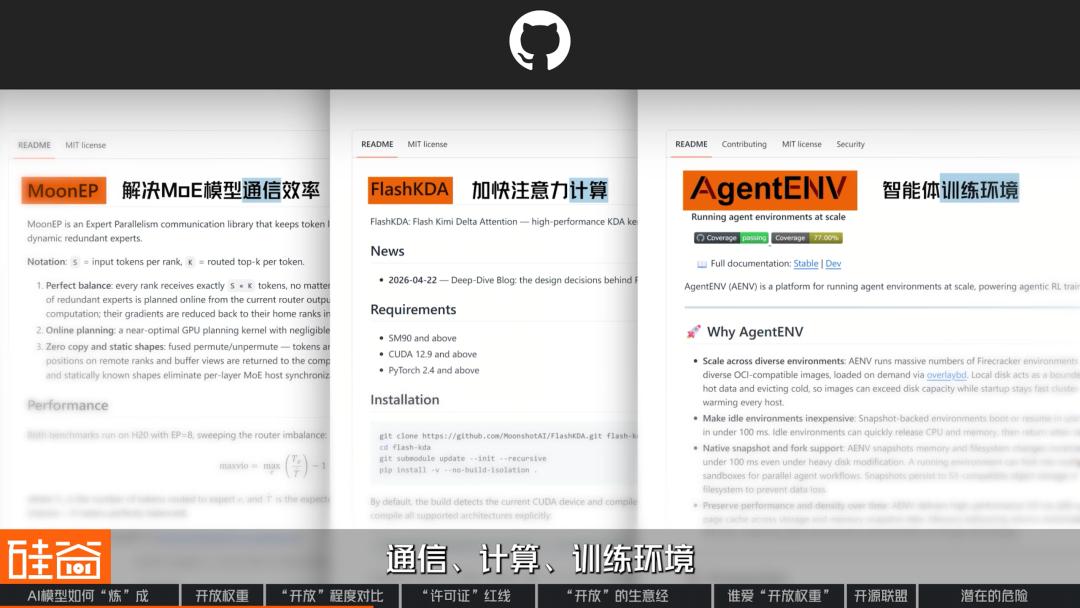
In addition to publishing a very detailed technical report introducing model architecture, training methods and a large number of engineering details, Kimi K3 also simultaneously opened three self-developed underlying infrastructures this time, including MoonEP that solves the communication efficiency between hundreds of "experts" in the MoE (Mixture of Experts) model, FlashKDA that accelerates attention calculation, and AgentEnv that builds a runnable environment for agent training.
These three correspond to three bottlenecks encountered when training large models: communication, calculation, and training environment, which also allow everyone to better understand how the Kimi team efficiently trained this model.
However, in the entire current training process, what most open weight models actually make public are only the model weights, inference code, as well as part of the technical reports and infrastructure tools. And the training data and complete training process are still the most core commercial secrets of each company.
Moreover, open weight does not mean no restrictions. It is the license attached to the model that truly determines whether developers can commercialize, modify and re-release the model.
02
How do open weight models make money?
In the past year, a very obvious trend is that the licenses of most Chinese model vendors are becoming more and more open.
For example, when DeepSeek first released its model, it adopted a self-developed agreement with some restrictions on usage scenarios. But for DeepSeek-V3 and R1, it has fully switched to the MIT License, which means that as long as the copyright notice is retained, developers can almost freely download, modify and commercialize the model with very few restrictions.
Alibaba's Qwen has followed a similar path. From initially adopting Alibaba's custom agreement to later switching to the widely used Apache 2.0 license in the world, the commercial usage threshold has also been greatly reduced. It is worth noting that the flagship Max series of Qwen has always been closed-source and can only be accessed through APIs, but earlier this month, Alibaba stated that it will open source the weights of its flagship model Qwen3.8-Max for the first time.
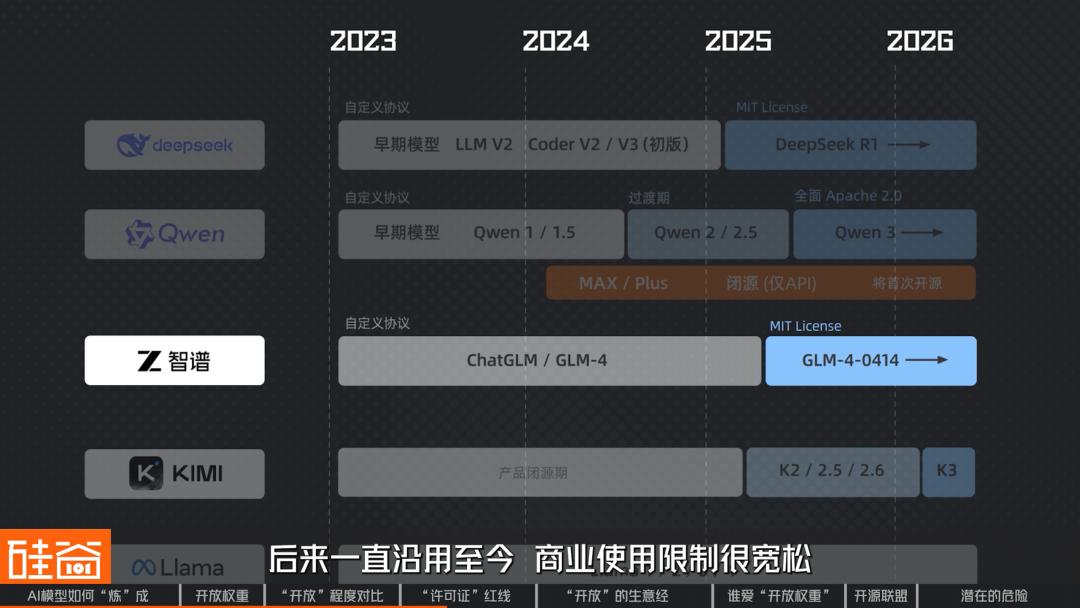
The same is true for Zhipu GLM. They have used the MIT License since GLM-4-0414 in 2025, and have continued to use it until now, with very loose commercial usage restrictions.
Of course, not all companies will choose to "fully open up". Kimi's previous K2 series used a license called Modified MIT. But this time K3 has enabled a brand new agreement called the Kimi K3 License, which no longer claims to be a modified version of MIT.
For the vast majority of developers and small and medium-sized enterprises, the actual usage experience is not much different from MIT, because they are all free to download, commercialize and modify. But it adds two thresholds: first, if the monthly active users of the product exceed 100 million or the monthly revenue exceeds 20 million US dollars, the "Kimi K3" logo needs to be prominently displayed on the interface; second, if you are in the model-as-a-service hosting business and the total revenue for 12 consecutive months exceeds 20 million US dollars, you must sign a separate commercial agreement with Moonshot AI before commercial use.
The one with the most restrictions is Meta's Llama. It does not adopt mainstream open-source licenses such as MIT and Apache, but has developed its own Llama Community License, which has many restrictions. For example, products with more than 700 million monthly active users need additional authorization, some versions were once restricted from use in the EU, and the agreement also clearly prohibits developers from using the output of Llama to train other large models, and so on.
However, Meta is also returning to the open route recently. Its newly released 30-billion-parameter open weight model Muse Glimmer adopts the Apache 2.0 license. In addition, Mark Zuckerberg also announced that Meta's current strongest foundation model Muse Spark 1.2 will soon open its weights.

Tiezhen Wang
Former Head of Asia Pacific Ecosystem at Hugging Face
After making these things clear, many vendors that specialize in model inference and cloud services are actually unable to take free ride. In the past, some open-source projects, including open-source databases, were most worried about the fact that cloud vendors did not contribute any work or effort, but could directly deploy the open-source projects on their own clouds to make money. Therefore, this kind of free riding has always been something the open-source community wants to avoid.
Of course, the license only draws a red line and cannot turn the model into revenue. So what do these open-source model companies rely on to make money?