Han Wang and Mo Wang failed the mid-term exam?
A B300 is priced at 10 million yuan, tripling its original price. The "high price with no available supply" of overseas GPU cards has pushed a large gap in computing power demand to domestic suppliers.
On the other side of the demand are Chinese large model companies that are expanding at a frantic pace.
DeepSeek has launched two consecutive rounds of financing to expand its computing power center; Kimi, which became well-known for its 3-trillion-parameter model K3, was forced to suspend new user registration because its "existing computing power is insufficient and approaching the limit"; in the same period, Zhipu AI announced the launch of 1GW of fully domestic computing power.
When finding sufficient computing power becomes the top priority for domestic large model developers, the market has begun to re-evaluate China's computing power sector — Cambricon's market cap breaking through 1 trillion yuan is a landmark event — and this revaluation is not only reflected in market value and stock prices, but also in the financial reports of the "water sellers" in the industry.
In the past week, Cambricon and Moore Threads, nicknamed "King Han" and "King Mo" respectively, have released their semi-annual reports one after another. Cambricon recorded a half-year revenue of 5.996 billion yuan, a year-on-year increase of 108.1%; Moore Threads achieved a half-year revenue of 1.736 billion yuan, a year-on-year increase of 147.4%. In terms of revenue alone, both companies have completed their full-year performance targets in just half a year.
With surging demand and growing performance, domestic computing power is constantly hitting the ceiling of the supply chain. In the past, most discussions focused on wafer production capacity, but now variables such as storage have been added to the equation. Therefore, when investors look at performance growth, they will inevitably raise the question: for domestic computing power players including "King Han" and "King Mo", what is the sustainability of their growth in the next six months and even longer?
01
"Contagious" High Growth
The high revenue growth of the two companies is beyond doubt, and this growth is definitely the common backdrop for all domestic computing power players in the past six months. It is reasonable to predict that the performance of MetaX, Biren, and Iluvatar will all achieve strong, rapid growth in the coming period.
If we have to coin a term to describe it, we can call it: "contagious" high growth.
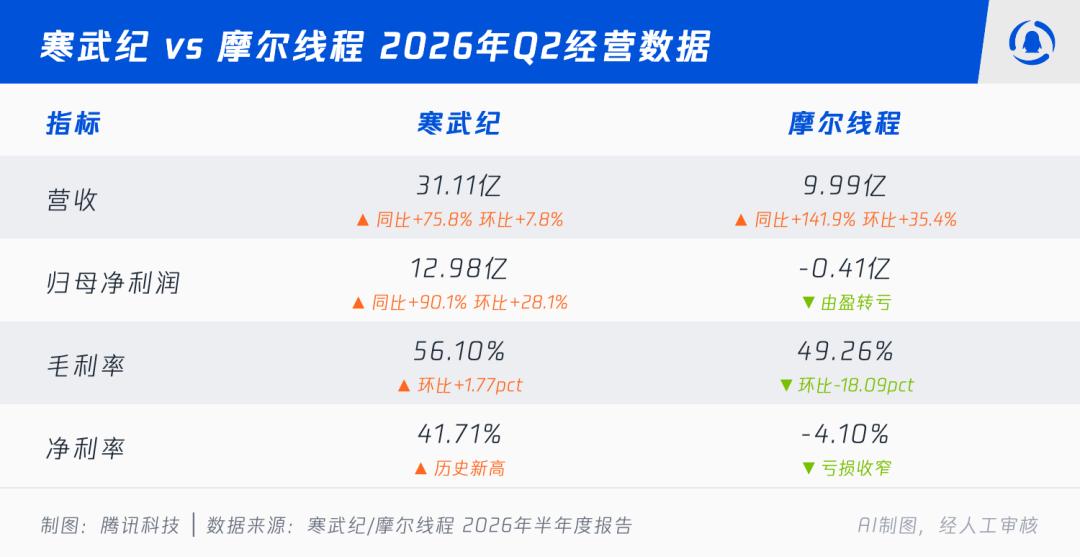
Cambricon recorded quarterly revenue of 3.111 billion yuan, and net profit attributable to shareholders of 1.298 billion yuan, representing a 28% quarter-on-quarter increase. Almost all core performance indicators have risen across the board. At the same time, accounts receivable at the end of the period decreased sharply by 67% year-on-year, which means customers have a very strong willingness to pay, and the delivered chips have been converted into real cash revenue.
However, on the first trading day after the earnings release, Cambricon's share price closed down more than 6%. Morgan Stanley explained the "divergence" between performance and stock price in its research report. Morgan Stanley stated that the revenue of 3.111 billion yuan was lower than expectations, even after those expectations had already been downgraded. In plain terms: "We have already loosened our forecast for you, but you still failed to meet expectations". Morgan Stanley emphasized that this situation reflects delayed delivery times and slower revenue recognition at Cambricon.
Despite the slower quarter-on-quarter revenue growth, the profitability strength of "King Han" remains solid. In the second quarter, its net profit margin reached 41.71%, hitting a new all-time high for a single quarter since its listing, which means Cambricon's profit curve is clear and predictable — the operating leverage brought by large-scale shipments of cloud AI chips continues to be released.
Compared with the steady revenue growth of Cambricon, Moore Threads, which has a relatively low revenue base, is expanding at a fierce pace: its half-year revenue of 1.736 billion yuan has already exceeded its full-year revenue of 1.506 billion yuan last year. Its H1 loss narrowed sharply from 274 million yuan in the same period last year to 12 million yuan, a narrowing range of 95.8%, leaving it just one step away from the break-even line.
While Moore Threads' revenue growth is "fierce", it also faces uneven growth rhythm. It achieved profitability in the first quarter, but returned to loss in the second quarter. The direct cause of this fluctuation is the decline in gross profit margin: the gross profit margin was 67.35% in Q1, but dropped to 49.26% in Q2, a 18.1 percentage point quarter-on-quarter decline. The overall gross profit margin in the first half of 2026 was 56.95%, down 12.19 percentage points from the same period last year.
The decline in gross profit margin mainly comes from two aspects. First, operating costs have skyrocketed, with a growth rate of 245.2%, exceeding the revenue growth rate of 147.4%. Revenue growth cannot keep up with cost growth, and the extremely high price of raw materials has directly diluted the gross profit margin. Second, Moore Threads delivered a large cluster order worth 660 million yuan in the second quarter. Cluster delivery is different from single-chip delivery: since it requires purchasing external hardware such as CPUs, storage, and switches, its gross profit margin is naturally lower than that of standard board products.
Cambricon also faces the problem of rising costs. Its operating cost growth rate in the second quarter was 111.3%, slightly exceeding its revenue growth rate of 108.1%. Price increases of upstream materials and components including memory have jointly put pressure on its gross profit margin.
On one hand, prices are rising, and on the other hand, companies have to increase inventory procurement to ensure supply. This change is directly reflected in the cash flow statements of the two companies.
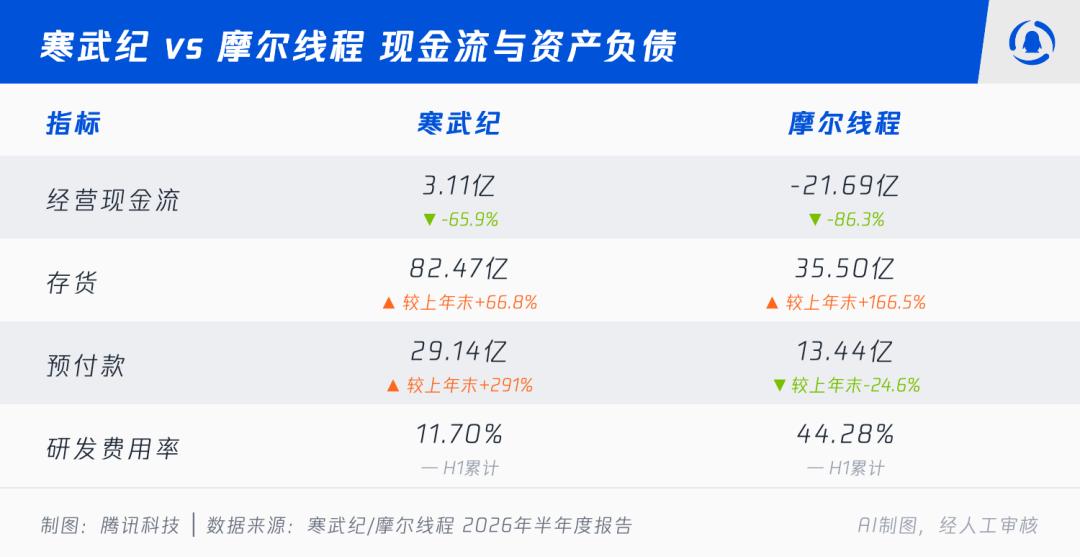
With a net profit of 2.311 billion yuan, Cambricon's operating cash flow in the first half of the year was 311 million yuan, a sharp drop of 65.9% year-on-year. A large amount of book profit has been converted into inventory products and production capacity deposits.
According to data disclosed by Cambricon: at the end of June, inventory reached 8.247 billion yuan, a year-on-year increase of 66.6%, accounting for 45.32% of total assets; prepayments reached 2.914 billion yuan, a year-on-year surge of 291%. These inventories and deposits will be converted into revenue again in the next two quarters.
Moore Threads' operating cash flow was -2.169 billion yuan, 86.3% larger than the same period last year, and its inventory is as high as 3.55 billion yuan, up 166.5% from the end of last year. Therefore, "King Mo" is burning cash to bet on the future at a pace no less intense than Cambricon.
One risk point is: if we spend a lot of money to stock up on goods today, what should we do if the assets are impaired for various reasons in the future?
If the upstream market is completely free of restrictions and is a highly competitive market, this assumption is reasonable. But the current situation is out of line with this assumption: the current situation is that supply restrictions are severe, while model demand only keeps increasing. In this case, increasing inventory levels is not negative news at all, but rather builds certainty for future operations.
However, from the perspective of listed companies, risk warnings are still issued as usual. At the performance briefing, Chen Tianshi, Chairman of Cambricon, said, "The company formulates procurement plans based on customer order demands and forecasts of future market demand. If the future market environment changes, it may increase the risk of inventory depreciation for the company, which will adversely affect the company's profitability."
02
The Examiner Pressing for Submission
At the WAIC conference in July this year, all well-known domestic computing power players including Huawei, KUNLUNXIN, Moore Threads, MetaX, and Iluvatar appeared on stage with their super nodes. "If you don't have a set of super nodes, you would be too embarrassed to set up a booth at WAIC," an industry practitioner wrote on his social media account earlier.
The competition intensity and iteration speed of Chinese large models are rising in a spiral manner, which indirectly stimulates domestic computing power players to accelerate their follow-up. June 30 is a landmark node.
On that day, Meituan and Huawei released open-source models on the same day, and Cambricon's intraday market value exceeded 1 trillion yuan. Meituan's new generation open-source model LongCat-2.0 has a total parameter of 1.6 trillion and is "trained entirely based on domestic computing power".
"Meituan started using Huawei's chips very early, and it is one of the few companies that actually use Ascend for training," a senior computing power practitioner told Tencent Technology.
In addition to Meituan, iFlytek is one of the first domestic model players to turn to domestic computing power. When iFlytek was developing its large model, the first batch of 910B servers arrived at iFlytek's data center, and Huawei even required the leaders of the iFlytek project to go to the site in person to participate in the equipment deployment.
The technical reports and papers of DeepSeek and Kimi have both released signals of embracing domestic computing power. Liang Wenfeng once said: "There is no problem with the hardware and ecosystem of domestic AI chips. The only problem is insufficient production capacity."
In the paper *Prefill-as-a-Service*, Kimi mentioned the concept of heterogeneous computing power, and also emphasized on its official account that "cross-data center + heterogeneous hardware unlocks the potential to significantly reduce the cost per token", implicitly indicating its embrace of domestic computing power.
Public information shows that DeepSeek is currently planning to build its own data center. In the job description for recruitment positions, the company states, "Every system, every parameter, and every decision you design may affect the operating efficiency and reliability of tens of thousands of GPUs and hundreds of thousands of servers in the future."
Zhipu AI also announced the launch of 1GW of fully domestic computing power. Converted based on the 100KW power consumption upper limit of a 64-card cabinet, without considering equipment such as switches, 1GW is equivalent to 640,000 NPU chips. Assuming the price of a single card is 100,000 yuan, the computing power part of the entire order will exceed 64 billion yuan.
The fact that Chinese model companies are burning money to build computing power infrastructure can also find references from overseas giants.
According to financial report data, the total capital expenditure of Google, Amazon and other companies this year has exceeded 850 billion US dollars, and it is expected to exceed 1 trillion US dollars by the end of the year. The total capital expenditure for 2027 is expected to reach 1.5 trillion US dollars. At the same time, OpenAI and Anthropic are also buying all available computing power from upstream computing power manufacturers through self-development, continuous financing and other methods.
Under the competition rhythm where models are updated on a daily basis, Chinese model companies and cloud vendors have no reason to slow down. From this perspective, Chinese model companies and cloud vendors are the "invigilators" urging domestic computing power players to hand in their exam papers.
03
The Supply Ceiling
Since the supply cut of H20 in April 2025, NVIDIA has been in a substantial vacuum in China's GPU computing power market. This can also be confirmed in the financial report recently released by Lenovo.
Lenovo stated that its revenue from selling international GPU servers in the Chinese market, and its AI server revenue recorded a triple-digit year-on-year growth in the international market. If there is revenue in the Chinese region, the year-on-year calculation can be done normally. But in fact, H200 cannot be sold in China this year, so no revenue is generated, and the year-on-year data will be distorted if not excluded.
Therefore, the past year and a half can be called the "golden age" of domestic computing power — model demand and computing power supply have been naturally matched together.
However, when demand shows no sign of reaching an end, supply has hit the ceiling first.
In the past, it was generally believed that wafer production capacity was the main problem for domestic computing power, but with the continuous expansion of production capacity, the impact of this problem is weakening. We do not need to pay attention to the specific production capacity of domestic chips. As long as we add up the revenue of all domestic chips, we can calculate the actual demand. Roughly calculated, 10 billion yuan of revenue does not even require 5,000 wafers.
Therefore, in the long run, wafer production capacity will no longer be a problem, which can also be confirmed by Liang Wenfeng's previous statement. "I don't believe that five years later, we will still be stuck in the production capacity problem. We are definitely stuck in the production capacity problem now, and I think this year, next year, and the year after will probably still be the case."
This problem can also be found in SMIC's second-quarter financial report and performance meeting.
The financial report shows that SMIC achieved total sales revenue of 3.006 billion US dollars in the second quarter, a 20% quarter-on-quarter increase, of which shipments increased by 14.4% quarter-on-quarter, and the average selling price of wafers increased by 5.7% quarter-on-quarter.
"The increase in shipments mainly comes from the surge in demand for supporting chips driven by artificial intelligence and customers pulling shipments. The company added 8,000 new 12-inch monthly wafers of production capacity, with a capacity utilization rate of 93.7%, a 0.6% quarter-on-quarter increase," said Zhao Haijun, Co-CEO of SMIC, at the performance meeting.
Compared with wafers, the supply of HBM is a more noteworthy issue at this stage, especially since it is also superimposed with the factor of price increases.
Morgan Stanley particularly emphasized in its research report that prepayments and inventory levels remain key indicators that need to be closely monitored. Locking sufficient HBM inventory in 2026 may become a key factor determining the stability of shipments in 2027.
Goldman Sachs stated in its research report on July 29 that "driven by the price increase of traditional DRAM, the price of HBM has the potential to double. We estimate that the average price of SK Hynix's HBM products next year will increase by 87% year-on-year, which is higher than the average 52% year-on-year increase expected by market sell-side institutions."
To hedge against the pressure of price increases, even NVIDIA has to adjust its SKUs, reducing the HBM configuration of specific Rubin Ultra models from 288GB HBM4E to 192GB.
Regarding HBM supply, the newly listed CXMT is a variable, but according to the information released in CXMT's financial report, most of its revenue still comes from consumer-grade DRAM customers, and no HBM-related information has been disclosed for the time being, which means this variable still has considerable uncertainty.
Domestic HBM may not necessarily adjust the performance and cost structure of domestic computing power, but as long as its production capacity is delivered, it can at least provide a bottom line for supply, which is somewhat similar to the situation of domestic foundries manufacturing Kirin chips in the past.
Therefore, it is precisely because of the tight upstream supply that "King Han", "King Mo" and other players are frantically stocking up on goods.
Back to the performance itself, in the first half of the year, Cambricon proved that domestic chips can make money with its profitability, and Moore Threads proved that domestic chips are in high demand with its growth rate. The "mid-term exam" results of the two companies are impressive enough. But in the second half of the year, the exam questions will no longer be purely about revenue, but also about "operational efficiency" — not only to deliver more chips, but also to achieve better profit margins, healthier cash