Has a conundrum that has plagued the mathematics community for 22 years actually been solved by an intern doctor from Peking Union Medical College Hospital?
The entire mathematics community is in an uproar right now.
A core conjecture that has plagued the world's top mathematicians for 22 years has been solved by a neurosurgeon from Peking Union Medical College Hospital?
He taught himself mathematics, used ChatGPT 5.6 to run autonomously for 16 hours, and finally resolved this 22-year outstanding mathematical unsolved case. This is almost surreal.
On July 30, 2026, Alex Townsend, a professor in the Department of Applied Mathematics at the University of Washington, opened arXiv as he usually did.
Over the past year, Townsend has developed an almost obsessive habit: every once in a while, he would ask GPT 5.6 questions, trying to get it to prove the famous unsolved case in the field of numerical linear algebra — the Crouzeix Conjecture.
In the hundreds of attempts in the past, the answers given by AI were either full of logical loopholes, or stuck when trying to cross a key lemma. Humans have hit a wall in front of this conjecture for 22 full years, and AI does not seem to be smarter than humans.
However, on this day, the Crouzeix Conjecture that has plagued the numerical linear algebra community for 22 years was proven.
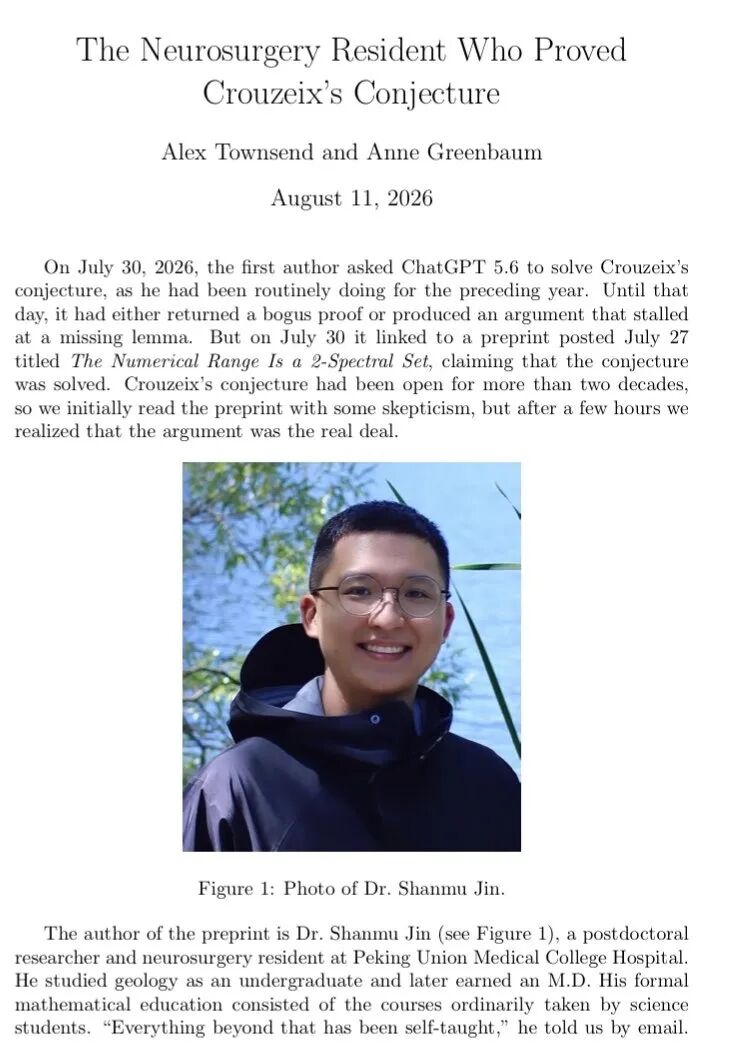
The author is not a mathematician, but a resident physician in the Department of Neurosurgery at Peking Union Medical College Hospital, Shanmu Jin.
He has no formal academic background in advanced mathematics. He studied geology for his bachelor's degree, and later obtained a Doctor of Medicine degree. His only assistant is GPT-5.6.
GPT-5.6 solved this problem in an autonomous operation of about 16 hours without any human intervention throughout the process.
Moreover, the list of verifiers includes Michel Crouzeix himself — the person who put forward this problem 22 years ago, who now personally confirms that the problem has been solved.
Townsend and Greenbaum are also experts in this field. After reading the proof process, they used only two words to describe their feelings: "Shocking".
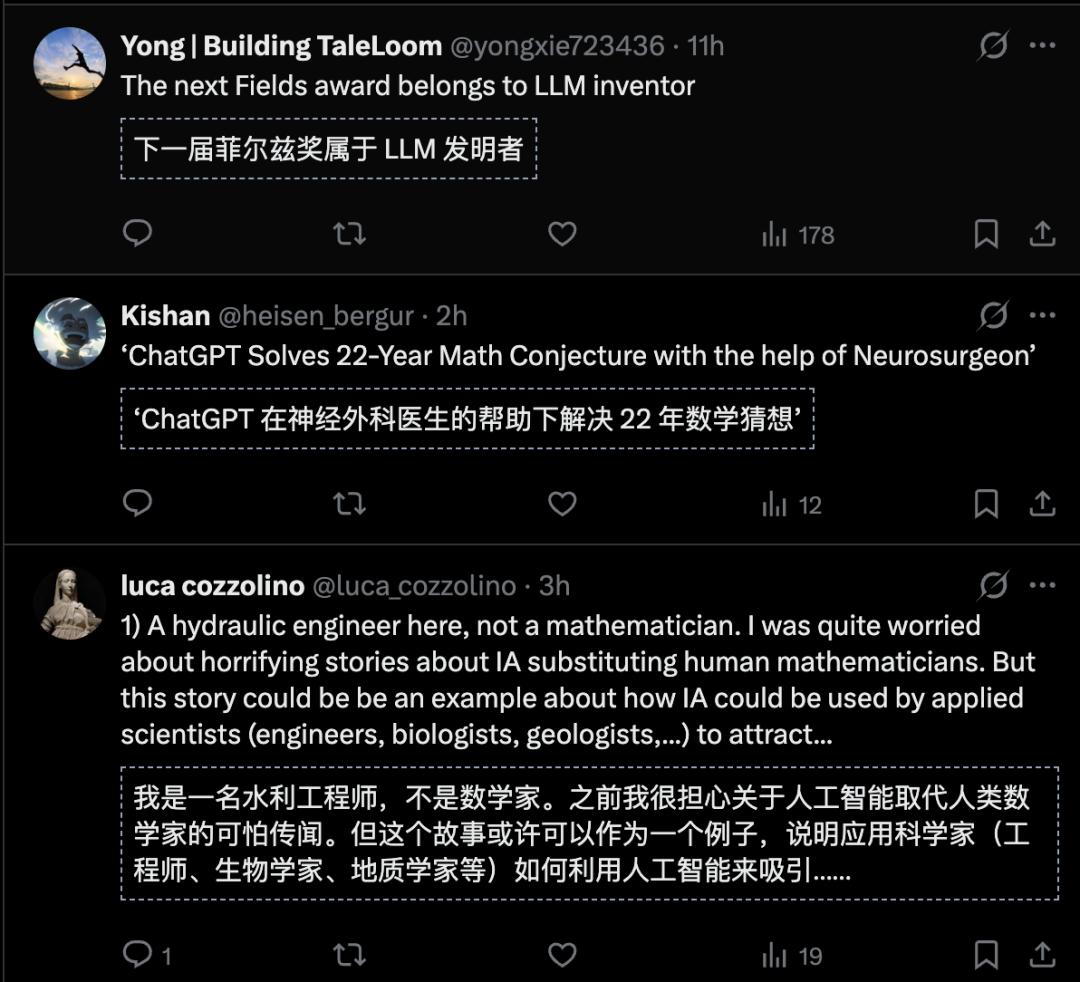
When a Resident Physician at Peking Union Medical College Hospital Teaches Himself Mathematics
The protagonist of the story is Shanmu Jin, a postdoctoral researcher and resident neurosurgeon at Peking Union Medical College Hospital.
His resume has nothing to do with mathematics.
His undergraduate major is geology. Later, he switched to medicine and finally obtained a Doctor of Medicine degree. All the mathematics education he received is the basic courses that ordinary science students need to take.
"All other mathematical knowledge is self-taught," Dr. Jin wrote casually in an email to the original authors (Alex Townsend and Anne Greenbaum).
Why would a neurosurgeon devote himself to this hardcore mathematical conjecture?
It all stems from a pain point in Dr. Jin's clinical practice and scientific research: transcranial ultrasound research.
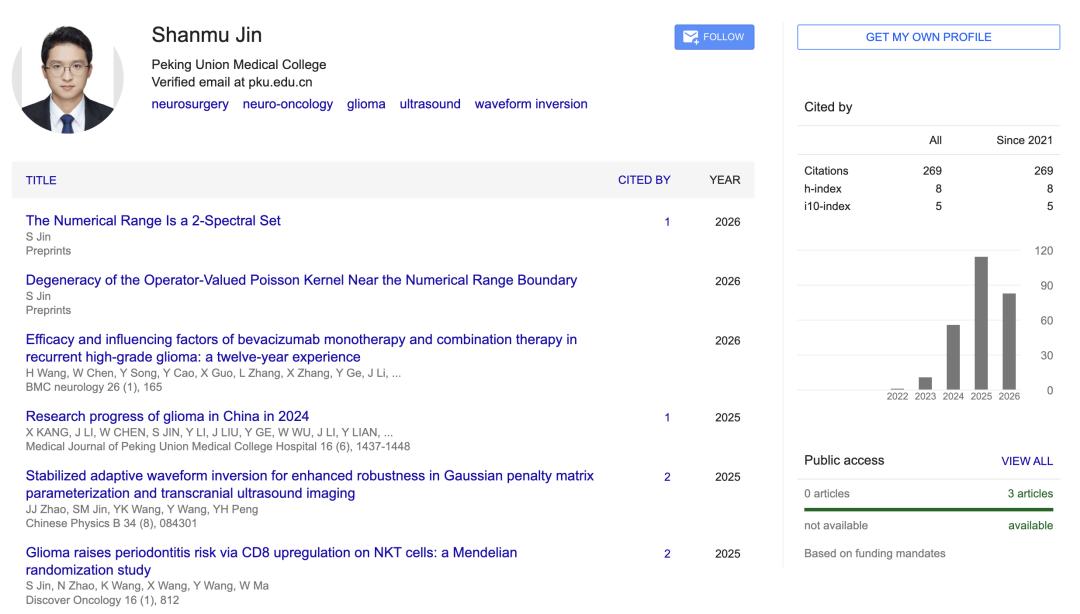
When trying to use ultrasound to penetrate the complex skull structure of the human body, he stumbled into the vast field of "matrix analysis". In the process of self-study, he accidentally came across the famous name that is widely known in the numerical linear algebra community — the Crouzeix Conjecture.
The statement of this conjecture is extremely concise, and the geometric intuitive form of the "numerical range" behind it is full of aesthetic sense. This extreme simplicity and beauty deeply attracted this cross-disciplinary outsider.
He decided to give it a try. He did not use the traditional pen-and-paper derivation, but used a large language model.
The "Devil's Constant" That Has Tormented the Mathematics Community for 22 Years
Why are these mathematicians so shocked? First of all, we need to understand how difficult the Crouzeix Conjecture is.
In modern applied mathematics and engineering computing, Matrix is a universal language that describes the operation of all things.
From the superposition of states in quantum mechanics, to the PageRank algorithm of Google search, and to the super-large-scale parameter iteration when training large language models today, the essence is the projection and evolution of huge matrices on the complex plane.
However, the behavior of Non-normal Matrices is extremely weird. They are like a group of grumpy and unpredictable beasts.
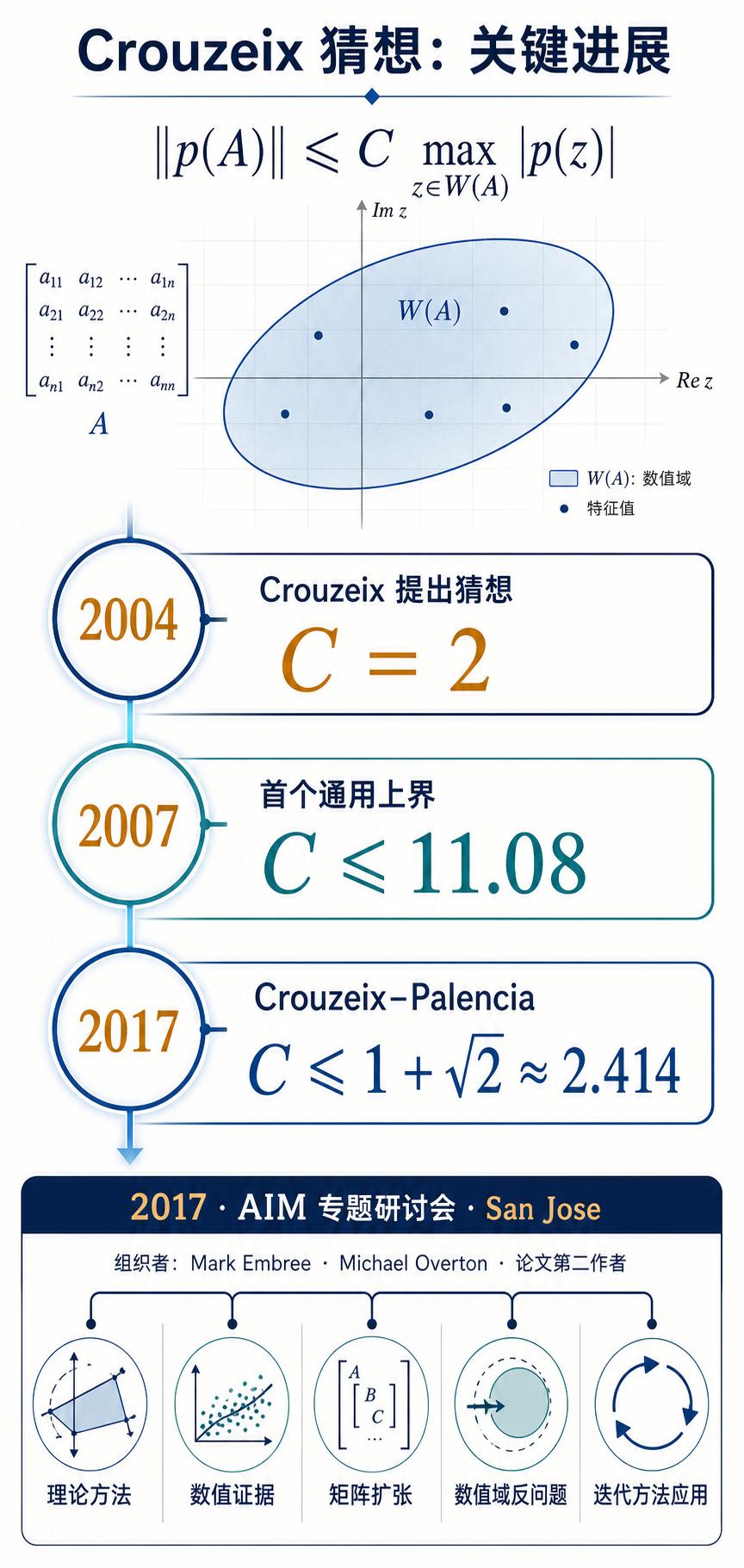
In order to tame them, French mathematician Michel Crouzeix put forward a wonderful conjecture with great geometric intuition in 2004:
For any polynomial p on the complex plane and any matrix A, its spectral norm can always be bounded by its maximum value on the "numerical range" W(A).
And the optimal constant between the two is exactly 2.
Expressed formally as:
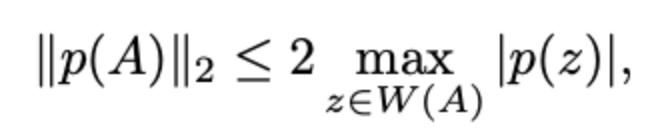
This inequality is extremely important in the applied mathematics community.
If it holds, we can directly convert the scalar approximation error on the complex plane into the norm bound of the matrix function. This is of decisive significance for analyzing matrix functions, the GMRES iterative method, the Krylov subspace method and other related methods.
However, "proving that this constant is 2" has become a nightmare for countless mathematicians.
But the door leading to the constant "2" remained tightly closed until July 30, 2026.
In 2007, Crouzeix himself tried his best and could only prove that this inequality holds when the constant is 11.08.
Ten years later, in 2017, the American Institute of Mathematics (AIM) even held a week-long special seminar in San Jose, gathering top experts from all over the world to discuss theoretical approaches, numerical evidence, matrix dilation and other related methods. Crouzeix and his collaborator Palencia finally reduced this universal constant to 2.414.
Since then, it seems that the human mathematical toolkit has run out of its last bit of potential.
Until this summer, an "outsider" holding a scalpel broke into this field.
Magically Modified "God-tier Prompt", ChatGPT Runs Continuously for 16 Hours
How did a neurosurgery resident at Peking Union Medical College Hospital with an extremely busy clinical schedule achieve this?
The secret lies in Prompt Engineering.
Dr. Jin did not treat AI as a simple question-and-answer machine, but turned it into a huge virtual mathematical research institute.
He borrowed and modified the famous prompt that OpenAI used when conquering the Cycle Double Cover Conjecture, and set up a strategically brilliant layout:
Physical disconnection from the internet (eliminate external dependencies): The prompt explicitly cuts off the system's access to the public internet and other external contexts. He did not want the AI to "plagiarize" those old failed ideas in human history from search engines, but forced it to start from axioms and carry out pure original thinking.
Multi-branch and divergent thinking (refuse premature convergence): He asked ChatGPT to start a large number of "sub-agents" to let them explore along completely different paths. The instruction strictly warned: Do not prematurely converge to the same seemingly attractive idea!
Cruel adversarial auditing (competitive iteration mode): The candidate proof strategies must be repeatedly subjected to adversarial review. A line of inquiry will be completely eliminated only when other agents successfully find a counterexample.
Determination to stick to the end: The prompt issued a strict order: Never give up before getting a complete proof that can withstand extreme logical testing.
After setting all this up, Dr. Jin pressed the enter key, then turned to his work and did not intervene in the whole process.
In the ChatGPT Work mode, GPT-5.6 Sol is like a tireless digital behemoth, running continuously in the deep sea of mathematics for about 16 hours.
During these 16 hours, the AI went through tens of thousands of times of hypothesis, overthrow and reconstruction, and finally succeeded in completing the proof.

When mathematicians saw this theorem, they were deeply shocked: The AI did not use the extremely complicated hard estimation that humans expected, but used a surprisingly clever "sampling strategy" to simplify it into an unexpectedly simple "positivity condition".
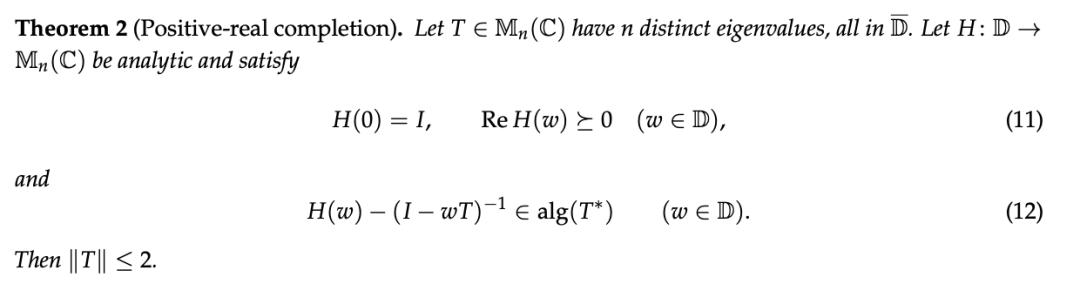
This is like humans have been trying to push open a huge iron door with brute force, but the AI just found an extremely small force point in the crack of the door, flicked it gently, and the door opened. It can be called dimensionality reduction strike.
Dr. Jin said modestly that finding this key idea "definitely involves an element of luck". But everyone knows that opportunities only favor those who design a perfect compass.
What is even more admirable is that Dr. Jin has fully open-sourced this process. His GitHub repository not only contains the final paper, but also the god-tier prompt, the manuscripts of previous iterations, the Lean 4 formal proof code and the axiom audit report. Everything is under the sun, accepting the inspection of all mankind.

Open source address: https://github.com/jinshanmu/CrouzeixConjecture
Preprint: https://www.preprints.org/frontend/manuscript/f5469a625a8e7313e19bbf4d6c608cff/download_pub
The Second Proof 8 Days Later, Shocks the Mathematics Community
At first, when faced with this sudden preprint, top mathematicians examined it with suspicion. After all, "an outsider announces the solution of a world-class conjecture" is often a farce in the mathematics community.
But only a few hours later, Alex Townsend and Anne Greenbaum's suspicion turned into shock, and finally into amazement — "This argument is indeed valid!"
Subsequently, the proposer of the Crouzeix Conjecture, the famous mathematician Michel Crouzeix himself also checked this proof line by line.
Finally, the conclusion was settled: Dr. Jin's manuscript is correct. The 22-year outstanding case has been completely resolved.

However, this academic earthquake caused by AI has only just begun.
Just 8 days after Dr. Jin's preprint was released (August 4), two other mathematicians Emiel Lorist and Felix Schwenninger suddenly published an independent proof of only 5 pages!
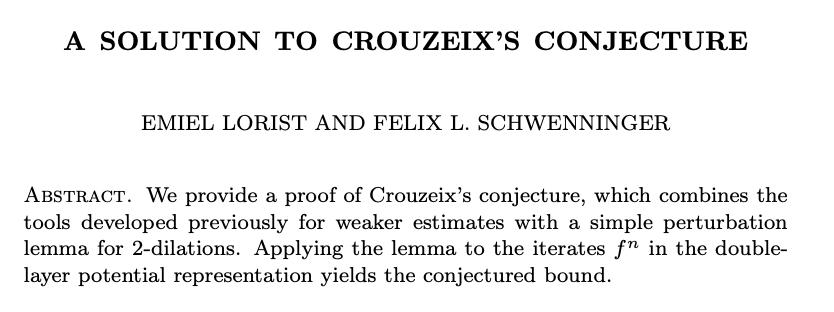
Title: A SOLUTION TO CROUZEIX’S CONJECTURE
Preprint: https://arxiv.org/pdf/2608.03841
The proof idea of these 5 pages is completely different from Dr. Jin's. It is extremely concise, combining the classic double layer potential representation method with the perturbation lemma for 2-dilation.
For traditional mathematicians, this proof method is more in line with the original cognitive habits of human beings, and seems more "friendly".
Coincidentally: Lorist and Schwenninger confessed that they also used ChatGPT 5.6 when exploring the proof strategy.
A problem that no one could solve for 22 years, with the support of AI, produced two completely different but equally exquisite proofs only 8 days apart!
After learning about this, Dr. Jin was not annoyed at all because he was "stolen the show", but felt pure joy. He thinks this is an interesting supplement to his method.
The Dawn of the Golden Age
In this summer of 2026, the gears of history are turning quietly.
In the history of mathematics, there is no shortage of medical scientists who have made important mathematical achievements, but all of them were geniuses who received special mathematical training at that time.