A historic moment: Tencent and Mindray have joined hands. What do they intend to do?
The first is the leading player in China's medical device industry, with a market value exceeding 100 billion yuan, and its products have been deployed in more than 190 countries and regions around the world.
The other is a top giant in China's internet sector, boasting cloud computing, large language models, and a massive technology ecosystem.
Now, the two have joined forces.
Recently , Mindray Medical, in collaboration with Tencent Cloud's Intelligent Agent Development Platform ADP, launched the world's first large model for medical technology services.

Interface of Mindray's "Ruizhifu" mini-program
At first glance, this seems to be another typical "tech giant + AI + healthcare" partnership.
But a closer look reveals that the story is far more complex than it appears.
The core reason is that the scenario they have implemented enables AI to first "understand" medical devices, rather than the doctor assistant model that has long been the mainstream in the industry.
It is well known that in the past, when a ventilator, monitor or testing device suddenly triggered an alarm, hospital engineers and medical staff often had to check the instruction manual, refer to maintenance documents, contact the equipment department, and even wait for senior engineers to make judgments remotely.
Now, Mindray is trying to compress this entire process to just a few seconds.
When a device malfunctions, users can ask questions in natural language about what the problem is, where to start troubleshooting, and what to do next, and the system will immediately provide corresponding troubleshooting steps and precautions.
On the surface, this only makes the after-sales service of medical devices a little smarter.
However, if we put together Mindray's moves in device interconnection, large models, automation, closed-loop anesthesia and surgical robots over the past few years, and look at why Tencent chose to participate in this partnership, the whole picture becomes far more intriguing.
Next, we will conduct a detailed in-depth analysis.
01
The New Super Entry Point:
AI Learns to "Diagnose" Machines First
The most industry-focused question about this collaboration between Mindray and Tencent is: why take medical device services as the first entry point for AI implementation?
The core reason is that this sector has long been highly dependent on human labor, and the scarcest resource is precisely professionals who can quickly retrieve, judge and apply professional knowledge.
When an abnormality occurs in a device, users first need to identify the model, software version and alarm information, and then search for answers from instruction manuals, maintenance documents, training materials, and even the personal experience of engineers.
A seemingly simple alarm code may correspond to different devices, different versions, different scenarios, and completely different handling methods.
The large medical technology service model launched by Mindray this time, the first thing it does is to reorganize these scattered knowledge, and move the entry point for retrieval and judgment to AI.
It is reported that this model is built with a massive amount of key clinical knowledge and device corpus training data, covering core business areas including life information and support, in vitro diagnosis, and medical imaging.
In professional test evaluations, the accuracy rate of answers to key questions reaches 99%, which can support second-level responses to millions of service consultations per year.
As a result, the first level of change takes place in the service chain itself.
That is, AI is placed at the forefront of the service chain, and a large number of standardized problems are initially judged by the model, while complex situations are then transferred to engineers.
The second level of change occurs in the role of engineers.
Human employees are not excluded from the workflow, but shifted from repetitive question answering to more complex long-tail problems.
The situation of repeatedly answering a large number of similar questions has dropped sharply, and with the help of AI, engineers can devote more time to long-tail faults, on-site handling, and scenarios that truly require experience-based judgment.
At the same time, the way experience is transmitted is also changing.
In the past, new employees had to learn slowly by following senior engineers; now, part of the experience is being structured and deposited into the system.
This means that in the medical industry, in addition to "assisting doctors in diagnosing diseases", the earliest scenario where AI can demonstrate value may be helping engineers process a large number of repetitive and standardized knowledge tasks.
Behind this lies the law of industrial AI implementation: scenarios with large knowledge volume, high repeatability, clear feedback, and sufficiently high labor costs are the most likely to be transformed by AI first.
Medical device services almost fully meet these criteria, so it is easier to calculate a clear economic account for them.
As Mindray mentioned in its 2026 first-quarter report: "Medical institutions are generally facing the pressure of operation and the tightening of procurement budgets."
If we convert this into an operating account, its value will be more intuitive. Especially under the background of hospitals "tightening their belts", both equipment manufacturers and medical institutions are recalculating service efficiency.
Mindray's total sales expenses in 2025 reached 5.145 billion yuan, of which employee salaries and benefits exceeded 3.2 billion yuan, and travel expenses were nearly 600 million yuan.
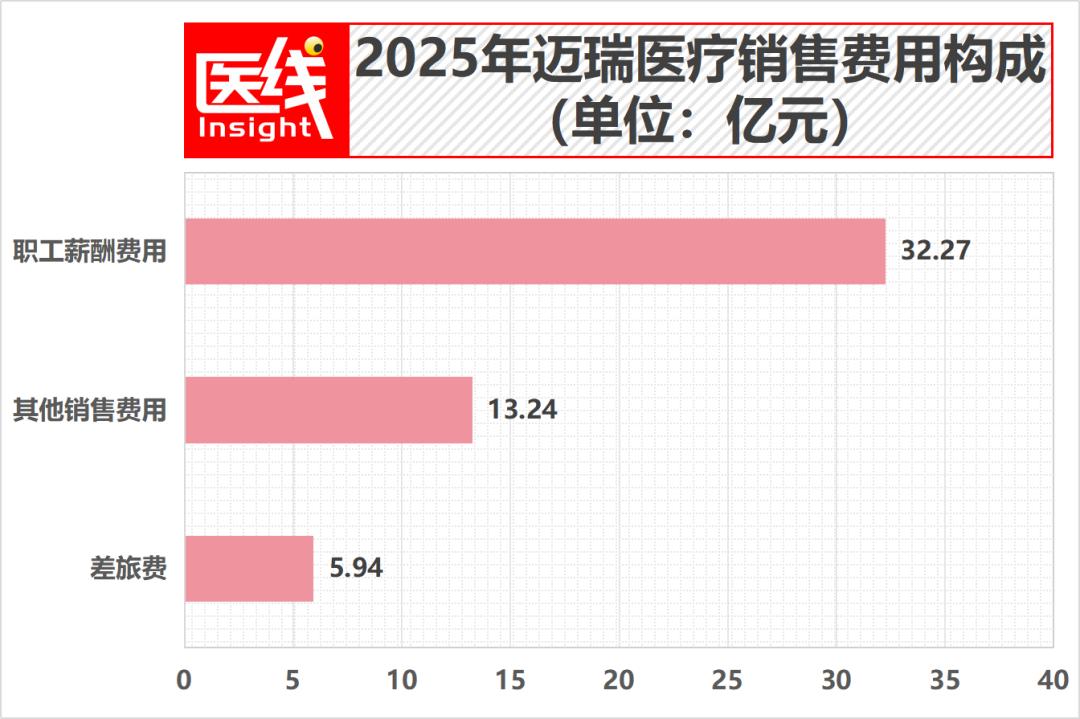
Data source: Mindray Medical 2025 Annual Report
To maintain a huge device network, the traditional service model relying on "human sea tactics" has very high costs.
How much the device downtime can be shortened, how many devices one engineer can cover, how many repeated consultations do not need to wait for manual response, and whether primary hospitals and night scenarios can obtain nearly consistent service quality — these indicators are not only related to the operation and maintenance costs of manufacturers, but also directly meet the rigid demand of medical institutions for high device utilization.
However, if we only interpret this move as cost reduction and efficiency improvement, we still underestimate the potential of this business.
The truly critical next step is whether service data can become a new infrastructure.
Mindray proposes that the more important value of the large medical technology service model is to form a data base for global device services.
The confidence for this vision first comes from Mindray's increasingly large global business footprint.
The 2026 first-quarter report shows that Mindray's international business revenue reached 4.449 billion yuan, a year-on-year increase of 15.70% against the general market trend, accounting for 53% of the group's total revenue.
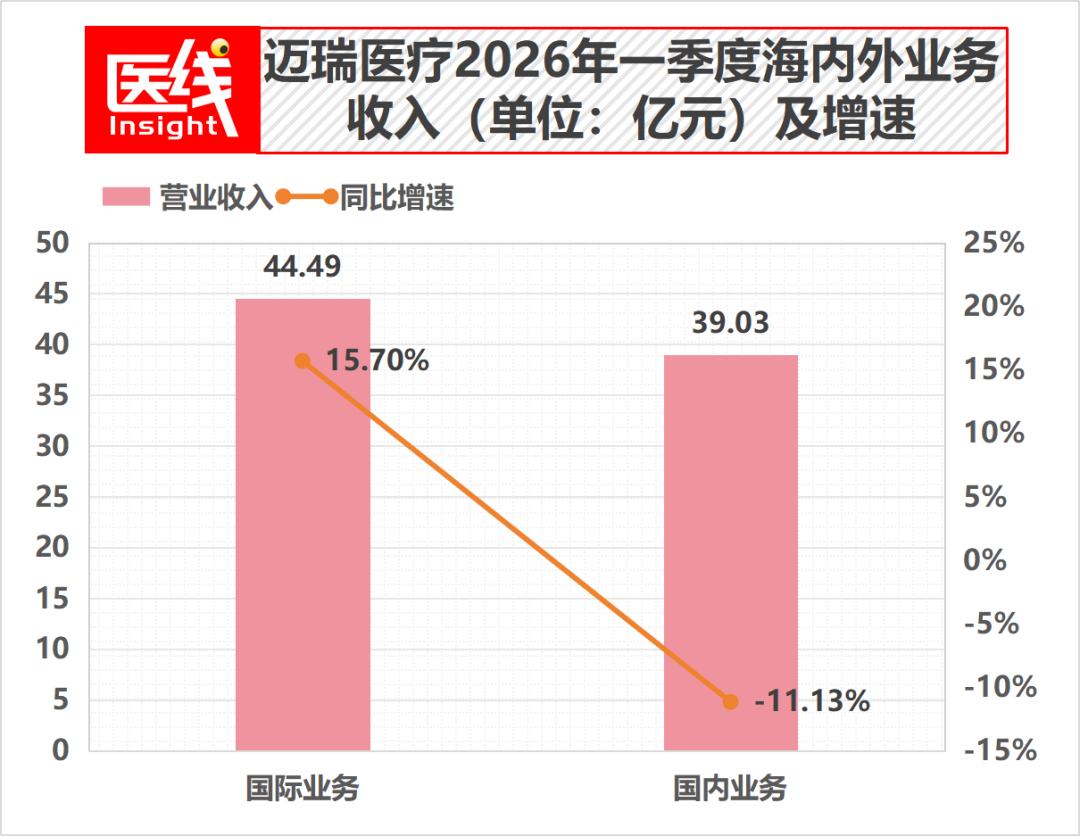
Data source: Mindray Medical 2026 Q1 Financial Report
When more than half of the revenue comes from overseas markets across time zones and languages, coupled with the high labor costs in developed countries, an AI data base that can provide 7×24-hour second-level response is not only an after-sales tool, but also a key infrastructure to support the global service network.
More importantly, with the continuous accumulation of service data, AI can further understand the law of device failures, the distribution of user needs and the changes of service scenarios, and extend to scenarios such as predictive maintenance, remote services, VR training, and management decision support.
Shifting from "how to troubleshoot after a failure occurs" to "how to predict before a failure occurs", the value chain of medical device services will be re-extended.
Looking back at Mindray's moves in the past few years at this point, we will find that the large technical service model is not an isolated after-sales innovation, but an entry point in a larger intelligent development roadmap.
02
Years of Ambition Come to Fruition:
Mindray Wants to Give Machines a "Brain"
If you only focus on this new release, it seems that Mindray has only built a smarter after-sales system.
But if you look at a longer time span, the whole picture is completely different: after-sales is only the entry point, and what Mindray really wants to promote is the continuous expansion of the capability boundary of medical devices.
In the strategic signals released in Mindray's 2025 annual report, the company has sorted out a five-level progressive digital and intelligent evolution roadmap.
The first level: breakthroughs in underlying technologies for single-point products;
The second level: integrated innovation of multiple devices;
The third level: building an IT ecosystem for device interconnection;
The fourth level: building the "Qiyuan" ecosystem of vertical large models for medical use;
The fifth level: pointing to embodied intelligence.
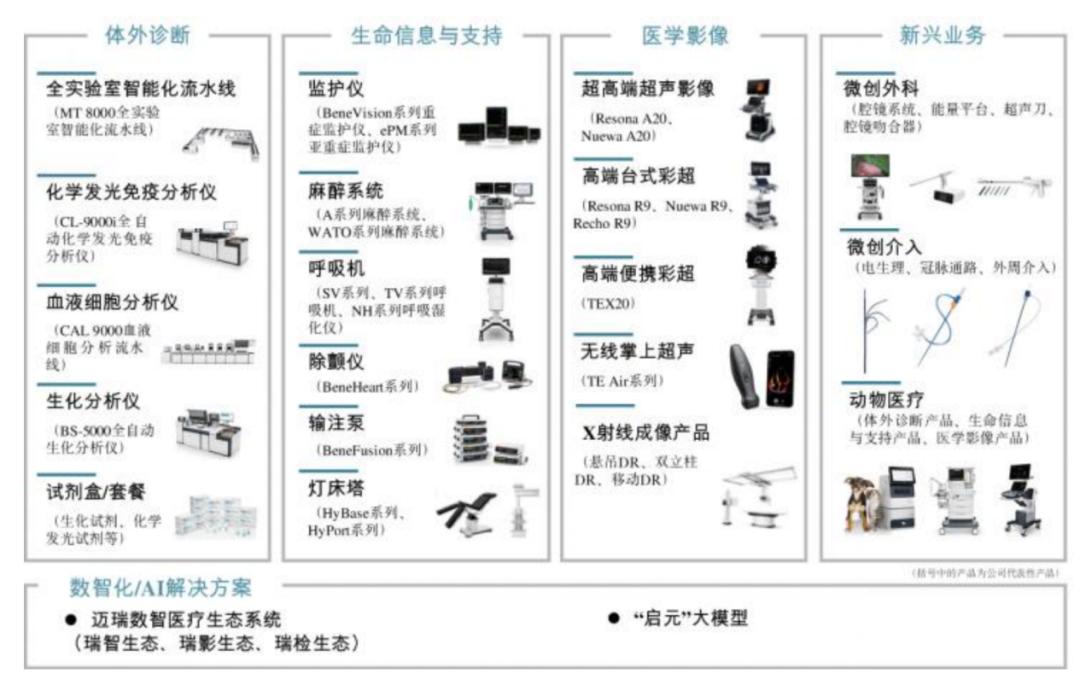
Product portfolio of Mindray Medical's main business lines Image source: Mindray Medical 2025 Annual Report
These five levels are not five independent businesses, but an evolution chain from "standalone intelligence" to "system intelligence", and then to "physical execution".
Initially, a machine only needs to perform its own functions well.
After devices are interconnected, they can exchange data with each other; when data is gathered together, large models have the opportunity to identify patterns, extract information and assist in decision-making from the data.
Going one step further, if the judgments given by the model can directly act on the devices, drive device adjustment and execution, a closed loop of "perception - decision - execution" will gradually take shape.
This is exactly the underlying logic of Mindray's bet on embodied intelligence, first connect the devices, then let the model make judgments, and finally enable the judgments to act on the real world.
Therefore, the large model in this system is more like a hub connecting data, devices and processes.
What Mindray wants to do has also evolved from "making a single device smarter" to "enabling a group of devices to connect, judge and collaborate".
From the current implementation status, this roadmap can be divided into two stages.
The first step is for AI to help people understand and process information; the second step is for AI to gradually enter the device execution link.
In the ICU, Mindray has launched the "Qiyuan Critical Care Large Model".
This model has been first deployed in 30 hospitals including the First Affiliated Hospital of Zhejiang University School of Medicine, Renji Hospital Shanghai Jiao Tong University School of Medicine, and Peking University Shenzhen Hospital.
It can sort out the patient's condition over the past 24 hours and generate a dynamic digital portrait within 5 seconds, generate medical records within 1 minute, assist in completing 70% of medical record writing, and reduce the manual entry time of medical staff by more than 50%.
In the clinical laboratory, the "Qiyuan Laboratory Large Model" has been implemented.
It starts to link sample quality, instrument status, patients' historical test results and medication information, and forms four types of agents for review, interpretation, management and audit preparation.
At Shenzhen Hospital of Southern Medical University, after the introduction of this model, the average sample review efficiency of the department has increased by about 30 times, and the report review accuracy rate exceeds 90%.
This technological evolution that empowers clinical practice with AI and automation is not only reflected in efficiency improvement, but also begins to translate into real market competitiveness.
According to the 2026 first-quarter report, against the background of general pressure on the whole industry, the average market share of Mindray's core domestic in vitro diagnosis business (immunoassay, biochemistry and coagulation) has steadily increased, rising from 12% at the end of 2025 to 13% in the first quarter of 2026.
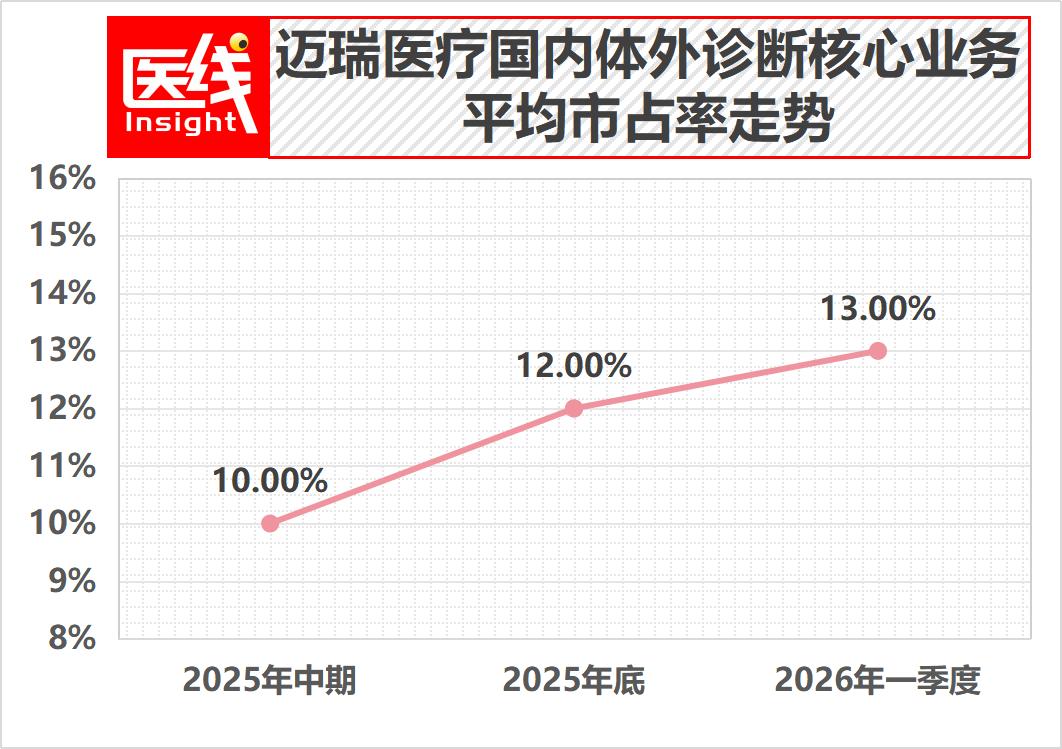
Data source: Mindray Medical 2026 Q1 Financial Report
In other words, AI intelligence is not only a technical label, but also becoming a tool to compete for market share in the stock game.
The radiology department continues to follow the same logic.
That is, first let AI process complex information, and then free doctors from repetitive labor.
Mindray combines the Qiyuan Obstetrics and Gynecology Large Model and the Breast Large Model with ultrasound equipment to realize historical positive feature extraction, key section recognition, automatic lesion measurement and structured report generation.
Relevant clinical data shows that this system reduces the repetitive workload of doctors by 50% and that of assistants by 80%.
At this point, AI is mainly helping people understand information and form judgments, and the final execution right still remains with humans.
Mindray's next move will cross this line: allowing AI to gradually enter the physical world from "assisted judgment".
The first form is to approach the "lights-out laboratory" in the in vitro diagnosis field.
The MT8000C intelligent coagulation production line launched in 2025 tries to further reduce manual intervention.
Its intelligent quality control module can automatically complete the reconstitution and testing of dry powder quality control bottles; the "Eagle Eye Check" system combines image recognition and AI technology to monitor sample quality.
The relevant AI technology can also capture high-definition serum images in 1.2 seconds, independently judge serum quality, with a recognition accuracy rate of over 97%.
The second form goes a step further, as closed-loop anesthesia begins to allow the model's judgments to directly drive device actions.
The 2025 annual report shows that Mindray is developing a self-regulating closed-loop anesthesia system integrated with anesthesia machines, monitors and other devices.
In such a system, the monitor undertakes the perception function to monitor the changes of the patient's vital signs in real time; the data enters the IT hub and the large model, and after the model completes reasoning, it sends instructions to infusion pumps, anesthesia machines and other devices to adjust the dosage of medication and gas concentration.
At this point, the closed loop of "machine - data - model - machine" is formed, with one machine responsible for perception, the model responsible for judgment, and another machine responsible for execution.
The third form is surgical robots.
It extends the "perception - decision -