Tencent spent no more than half a day's profit to bring "Lin Junyang from Alibaba" into its fold.
Hunting for the "leading wolf" in new tracks is a standard operation for all types of capital.
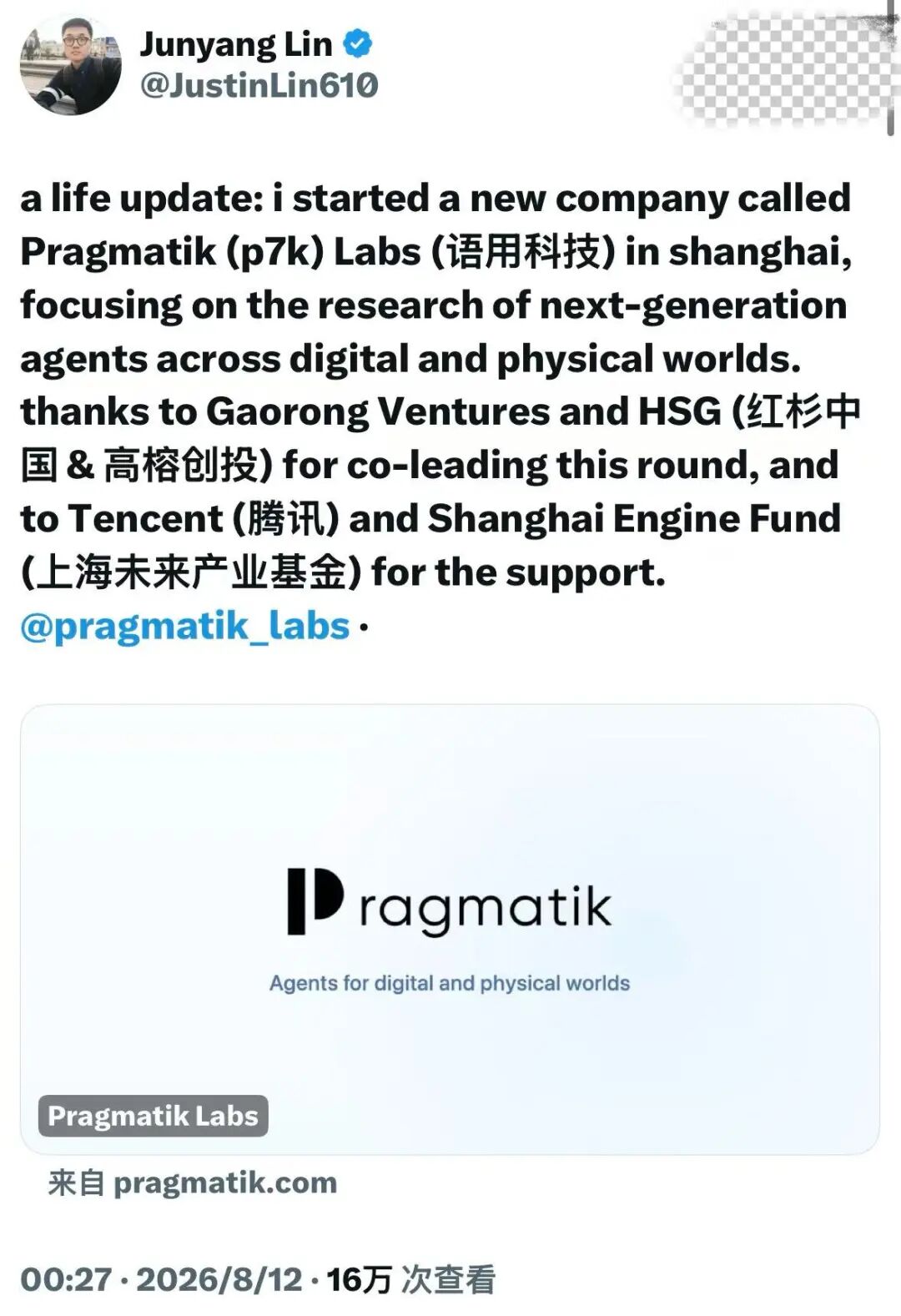
In the early morning of August 12, Lin Junyang announced on social platforms that he founded an AI company named Pragmatik Labs in Shanghai, whose research direction is "next-generation agents spanning the digital world and the physical world".
It also announced the investors: co-led by Gaorong Ventures and HSG, with participation from Tencent and Shanghai Future Industry Fund.
This is most likely the angel round financing of Pragmatik Labs. Citing sources familiar with the matter, media reported that Pragmatik Labs raised about 220 million U.S. dollars in financing -- Gaorong and HSG each invested about 100 million U.S. dollars, and Tencent followed with about 20 million U.S. dollars. The post-money valuation is as high as 2 billion U.S. dollars, equivalent to about 13.5 billion yuan.
Tencent's attributable net profit for the full year of 2025 was 224.842 billion yuan, with an average daily amount of about 616 million yuan. The 20 million U.S. dollars invested this time, equivalent to about 135.76 million yuan, is roughly equal to Tencent's net profit of more than 5 hours.
With the money Tencent earned in less than half a day, it invested in a former core technical member of Alibaba Qwen -- behind this is not just a financial investment, but more like a "layout for risk hedging".
The Shocking Incident in March
On March 4, shortly after the end of this year's Spring Festival, Lin Junyang posted a sentence on social media: "me stepping down. bye my beloved qwen."
This tweet with less than ten words quickly caused a huge stir.
Chen Cheng, a contributor to the Qwen project, said: "I'm really sad. I know leaving is not your choice. Just last night, we released the small Qwen3.5 model side by side. To be honest, I can't imagine what Qwen would look like without you."
Lin Junyang was not the only one who "left". On the same day, Yu Bowen, the head of Qwen post-training, also officially announced his resignation, while Hui Bin, the head of Qwen Code, had left earlier in January to join Meta. All three were fresh graduates trained by Alibaba, and were witnesses to Qwen's growth from 0 to 1.
On March 5, Alibaba CEO Wu Yongming sent an internal email, officially confirming and approving Lin Junyang's resignation. The email also announced the establishment of a "Foundation Model Support Group" led by Wu Yongming himself, Zhou Jingren, CTO of Alibaba Cloud, and Fan Yu, CTO of Alibaba, to directly coordinate group resources to support foundation model construction.
Lin Junyang's departure once sparked a lot of speculation. At that time, a widely spread view was that Lin Junyang fell on the eve of the commercialization of Alibaba Qwen. During the Spring Festival, Qwen widely distributed coupons for users to order milk tea and buy groceries on the platform, which was a test for commercialization.
After that, an insider of Alibaba revealed the real reason to the media: "As Qwen was upgraded to the overall strategic level of the group, the company believes that it needs to recruit more technical experts to increase the talent density of the foundation model team. This process involves the adjustment of Lin Junyang's authority scope, and Lin Junyang refused to accept it and submitted his resignation."
Implicitly, Alibaba probably wanted to adjust Lin Junyang's scope of responsibilities to make room for introducing more top technical talents. But this caused dissatisfaction of Lin Junyang, who had grown up in the team from scratch.
Now it seems that Alibaba's practice has actually become a standard operation in the industry. All major manufacturers spare no expense to compete for talents.
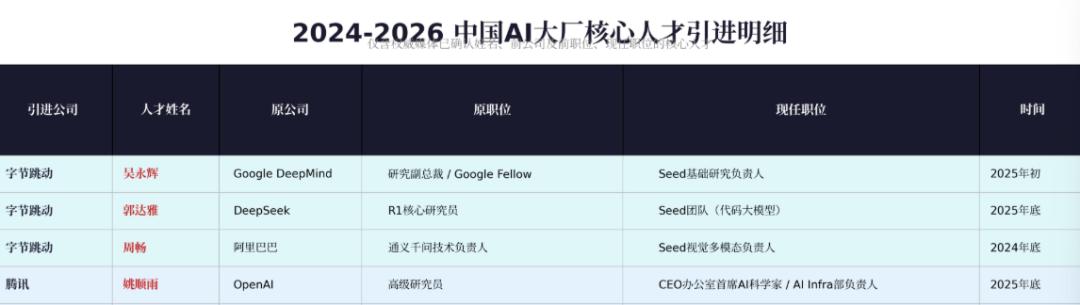

Figure | Sorted out based on public information, zoom in to view
Lin Junyang's resignation once also aroused the concern of Alibaba's core management. Ma Yun said bluntly that AI iteration is calculated in "weeks", "None of us is fully prepared, but we must move forward at full speed".
After Lin Junyang left, Alibaba quickly completed the management adjustment. Zhou Jingren, CTO of Alibaba Cloud, took over the top position of the Qwen model, and Liu Da Yiheng, the former core head of pre-training, expanded his authority to take over the post-training and Coding teams.
At the same time, Alibaba introduced Zhou Hao, a former senior principal researcher at Google DeepMind from outside. He participated in the core R&D work from Gemini 1.5 to Gemini 3 Pro. After joining Alibaba low-key in early 2026, Zhou Hao took over the post-training work left by Yu Bowen after his resignation, and reports directly to Zhou Jingren.
This also confirms the simple truth that no one is irreplaceable in the workplace. Although 33-year-old Lin Junyang, the youngest P10 in the history of Alibaba, has pushed China's open-source models to the global first echelon with his own efforts, his departure is undoubtedly a loss for Alibaba. But as a large manufacturer, Alibaba can always find someone from the reserve force to take over the position.
The "Risk Hedging" Logic of Tencent
Lin Junyang "stumbled" at Alibaba, and Tencent immediately extended an olive branch to him.
For Tencent, which has abundant capital, the 20 million U.S. dollars invested in Lin Junyang accounts for less than 0.07% of its annual profit, which is equivalent to the profit of more than 5 hours, and it is just a trivial sum for Tencent. But we cannot ignore the great things that this small amount of money can accomplish.
Tencent actually faces many challenges in the AI track. Before the launch of WorkBuddy, Tencent's Yuanbao and Hunyuan large model did not have many outstanding highlights in the market. Fortunately, this AI office software came in time to "save the situation".
What makes Tencent feel more competitive pressure is that the input and output of the AI track is like a bottomless pit.
In the first quarter of 2026, Tencent's capital expenditure in a single quarter reached 31.936 billion yuan, a month-on-month increase of nearly 63%. The top leader of Tencent once confessed at the general meeting of shareholders: "A year ago we thought we had boarded the ship, but later found that the ship was leaking. Now we feel we are standing on it, but we cannot sit down yet."
Large models have derived many application sub-tracks, from coding to vibe working, each track requires heavy capital investment. Although Tencent has abundant capital, it has "limited energy" and cannot cover every aspect. Therefore, it also gives full play to its "capital advantage" to carry out a dual layout of "defense and offense" by widely spreading investments.
In the past two years, Tencent has invested in general large model companies such as Moonshot AI, MiniMax, Zhipu AI, and DeepSeek is also one of its investment targets.
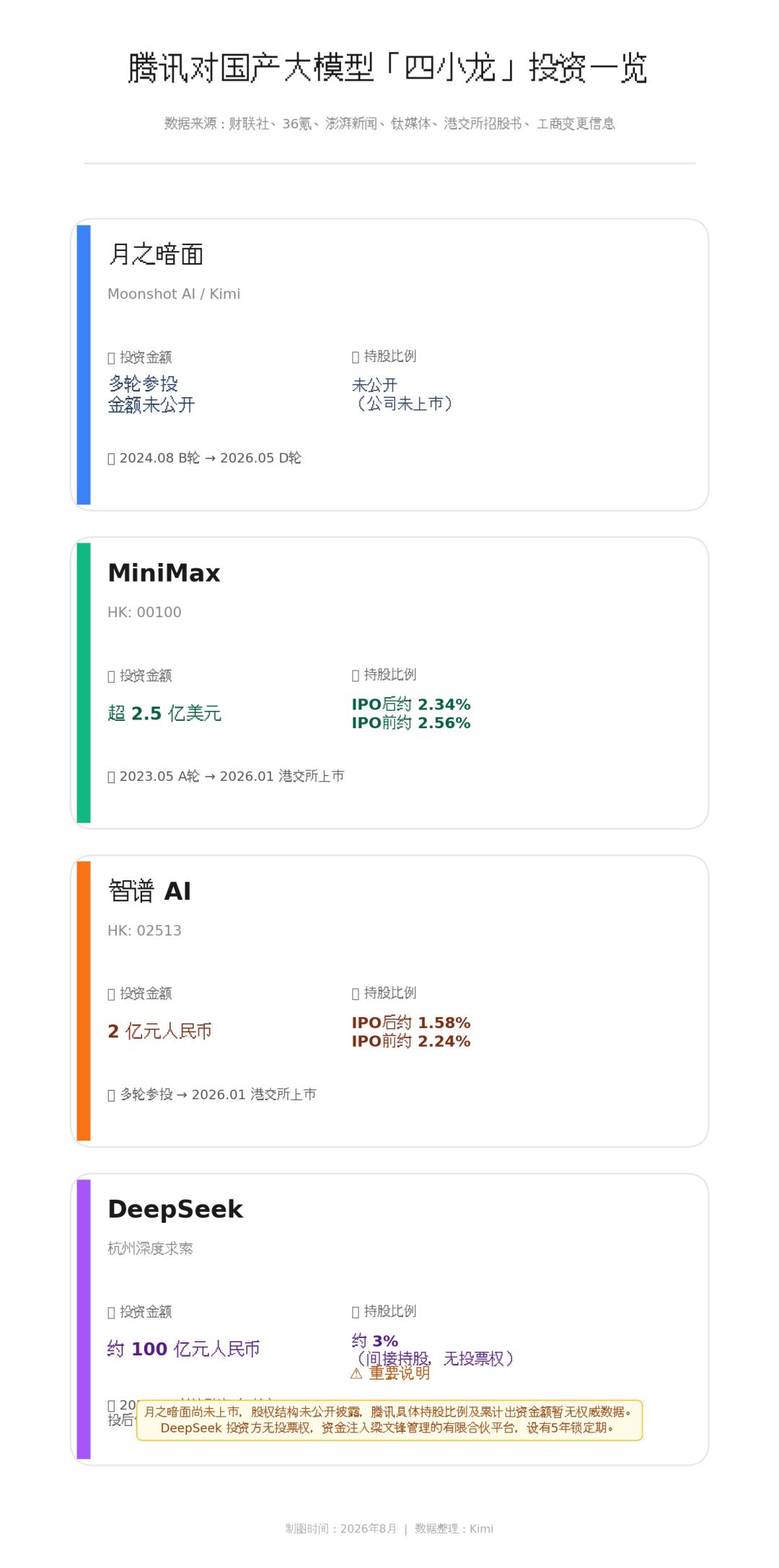
Figure | Sorted out based on public information, zoom in to view
However, the vision of all these companies' products is to "make AI an agent that assists humans in thinking and working". In terms of technical R&D, they all need to overcome the difficulty of "making the model itself have stronger reasoning ability".
At this time, the value of the entrepreneurial direction chosen by Lin Junyang is highlighted. He believes that in the next stage of AI, the core problem is no longer "whether the model can think long enough", but "whether the model can think in a way that supports effective actions".
If this route succeeds, Tencent's 20 million U.S. dollars for an admission ticket is not expensive by any calculation.
Of course, there is also a view that Tencent's investment in Lin Junyang is a common "defensive investment" for large manufacturers. Lin Junyang graduated from Alibaba and will have an impact on Alibaba's large model business. Tencent's investment in him is also to lock in talents, which is equivalent to "position locking".
According to Tianyancha information, Pragmatik Labs was established on May 13, 2026, with a registered capital of 1.25 million yuan. Lin Junyang holds a total of 88% of the company's shares through himself and related entities, and external investors hold a total of 12% of the shares -- among which Tencent holds 1% of the shares through Shanghai Qishan Investment Co., Ltd.
With 1% of the shares, what Tencent wants is not control, but a good position that allows it to attack and retreat. Tencent has its place in the track of world models and future embodied intelligence.
The Next Stop of the AI Competition
Lin Junyang's company official website divides its business into two major sectors: Digital Agents and Physical Agents.
Digital Agents: General agents for digital world tasks such as knowledge work and business operation.
Physical Agents: Embodied intelligence systems that can adapt to the environment, take actions, and complete long-term tasks in the real world.
Why did Lin Junyang choose these two "practical-oriented" and "technology down-to-earth" directions? It seems not a random decision for now.
In October 2025, when Lin Junyang was still at Alibaba, he publicly disclosed on social media that he had built a robotics and embodied intelligence research team from scratch inside Qwen, and wrote that "multimodal foundation models should move from the virtual world to the real world".
After leaving his job in March this year, he published a long article titled "From 'Reasoning' Thinking to 'Agentic' Thinking", whose core judgment is: The previous stage of AI competition made models better at thinking, and the next stage will make models think for action.
In fact, this is not the direction chosen by Lin Junyang alone. In 2024, Zhou Chang, the former head of Tongyi Qwen, switched to ByteDance, and now his jurisdiction covers multimodal large models, world models, visual generation and embodied intelligence. And Kong Tao, the head of ByteDance's robotics technology, joined Xiaomi last year, preparing to use the automobile manufacturing scenario to make large models, robots and agents collaborate to play a real role in the front line.
It can be said that Lin Junyang's startup project cleverly avoids the foundation large language model track which is already crowded with top players, and chooses a new track with fewer competitors and remaining development space.
This is also what Tencent wants. What Tencent wants to invest in the next stage of AI is to make agents really work in the physical world.
With this 20 million U.S. dollars investment, Tencent can kill three birds with one stone. It has "locked in" three magic weapons at one go: an option for a technical direction, a position lock for a top team, and a hedge for the competition pattern.
At present, Lin Junyang's new company has not announced any products. The official website only has the names and direction descriptions of the two sectors, and the official launch of products may take several months or even years.
But he has already occupied a place in China's AI talent map. His particularity lies in that he is a liberal arts student with a linguistics background, started from NLP (Natural Language Processing), pushed China's open-source models to the global first echelon with his own efforts, and now bets on a new direction at the inflection point of the AI competition.
This article is from the WeChat official account "Muhe Business and Finance", author: Gong Zheng, editor: Yang Jing, 36Kr is released with authorization.