Three routes, one match point — who will have the last laugh in the trillion-dollar game of AI video?
In the first half of 2026, Sora was shut down due to commercialization difficulties, while China's AI video track ushered in a historic inflection point.
From the launch of PixVerse R1, the world's first 1080P real-time world model by Aishi Technology in January, to ByteDance's Seedance 2.5 refreshing the standards of industrial-grade video generation in July, in just half a year, the entire industry has collectively broken through the three core pain points of long-sequence generation, subject consistency and real-time editing, and officially entered a new stage of industrial availability.
If we say that in the past two years, the industry was still groping for technical possibilities in the dark, and AI video players were still struggling and worrying about generating a non-distorted human face, then now, the first ray of dawn has pierced through the clouds, and there has been a collective industry-wide answer to technological breakthroughs.

This is far more than a technical carnival. More critically, capital with a keen sense of smell has already taken action, and the financing pace of leading enterprises has accelerated significantly.
Behind this, the rules of the capital game have changed quietly. They no longer pay for technical stories, but start to price for clear scenario closed loops and predictable growth curves.
Beneath the bustling surface, profound route divergence is taking place in the industry. Three completely different technical routes, namely industrialized tools, real-time interactive world models, and open-source inclusive technologies, correspond to three judgments on the final form of AI video, and also push players to march into completely different commercial battlefields.
The technological watershed has been crossed, capital ammunition is ready, and the real competition has only just begun.
1
AI video crosses the technological watershed,
Players bet on three routes
In the past two years, behind the concept of "AI video", there is not only a key scenario for the implementation of large models, but also countless embarrassing situations that make creators torn between laughter and tears.
The generated characters deform while walking, and the clothes they wear change color in the next second; the generated video starts to "stream of consciousness" distortion once its length exceeds 5 seconds; it is even a fantasy to modify a detail in real time...
In the first half of 2026, the industry narrative has changed — players have collectively crossed the threshold of AI video availability, and started to sprint towards different end states. In the past, industry problems such as long sequence, consistency and controllability are being broken through one by one by this collective technological leap across the whole industry.
Technological breakthroughs do not mark the end, but a fork in the road. When the competition of AI video shifts from "whether it can be done" to "how well it can be done", players have their own paths and considerations.
Large manufacturers take the route of industrialized production. They develop technologies based on their own ecological scenarios, take AI video as a tool to improve the efficiency of their parent businesses, and believe that the ultimate identity of AI video is a digital production tool.
Seedance 2.5 released by ByteDance in July is a representative of this route. Its core breakthroughs are not only the native 30-second continuous generation capability, 50-channel multi-modal reference input and timestamp-level local editing, but also that it brings the capability of AI video beyond the screen for the first time.

Source: Jimeng AI WeChat Official Account
AI video is no longer limited to online content creation such as advertising and short dramas, but deeply embedded in the production links of the real industry, becoming a basic production tool in fields such as industrial manufacturing, embodied intelligence and autonomous driving.
In the industrial manufacturing scenario, Seedance 2.5 can directly read CAD drawings, real photos of production lines and process SOP texts, and generate standardized operation demonstration and safety training videos with one click; in the field of embodied intelligence, it can generate complex interactive data that conforms to physical laws, providing low-cost training samples for robots and solving the industry pain points of high physical collection cost and difficulty in reproducing extreme scenarios; in the autonomous driving track, it can generate a large number of simulation videos of extreme working conditions such as heavy rain and fog as well as marginal accident cases, making up for the shortage of real data.
From content creation on the screen to industrial production off the screen, the boundary of AI video has been completely opened.
Alibaba's HappyHorse takes a radically architected industrialization path, using a single-stream Transformer architecture to realize one-time inference generation of audio and video, fundamentally solving the problem of audio-video asynchrony. Combined with distillation technology, it improves the inference efficiency several times, and finally outputs standardized APIs through Alibaba Cloud, binding to Alibaba's ecological scenarios such as e-commerce and marketing.
Kuaishou's Keling in the same track focuses more on the industrialized efficiency improvement of the content industry, featuring long-sequence subject consistency and fine-grained controllability, supporting continuous video generation up to the minute level. It internally serves the material production of Kuaishou short dramas and Magnet Engine; externally opens APIs and SaaS tools, becoming the standard production tool for a large number of MCNs and brands.
If the industrialization route is to improve the efficiency of existing industries and optimize within the existing video production framework, then the world model route taken by most startup players is to directly reconstruct the essence of video. This route is more ambitious, believing that AI video will become the core entry point for the next generation of human-computer interaction.
Aishi Technology is a firm explorer in this direction. The core selling point of the PixVerse R1 real-time world model in January this year lies in its real-time performance and interactivity. Users can watch the picture while issuing text instructions to adjust the lens, light and shadow, and plot direction in real time, realizing dynamic interactive creation.
Imagine that you are watching a short drama, you don't like the ending, input a sentence, and the plot turns in real time. This is no longer a linearly played video stream, but a dynamically calculated parallel universe.
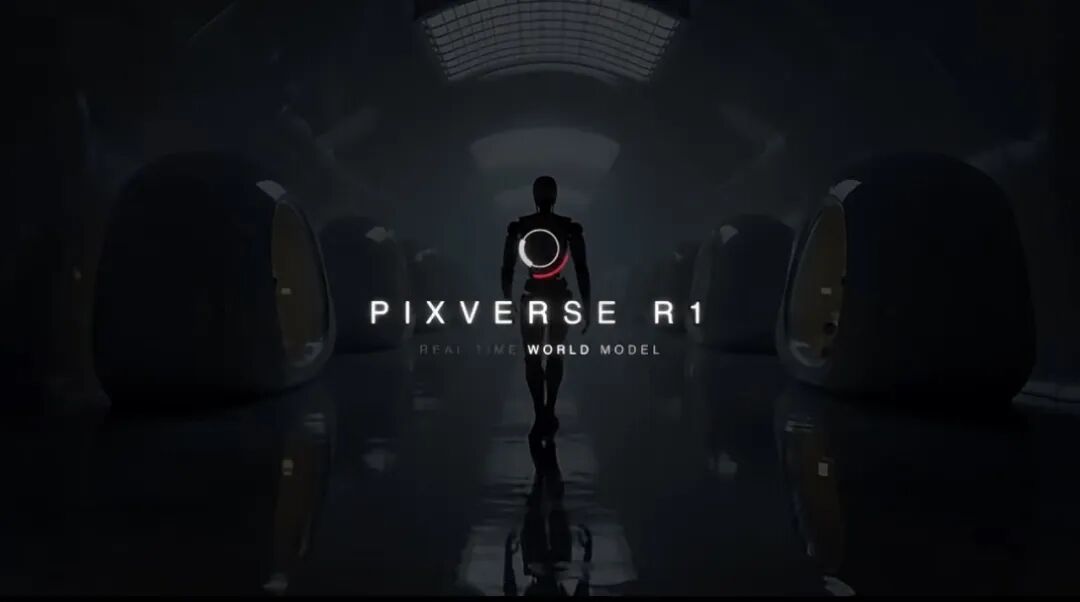
Source: Aishi Technology WeChat Channel
Since the release of this model, PixVerse has had more than 150 million global users, and ranks among the top in the world in the Artificial Analysis video generation model list.
Kunlun Wanwei focuses on simulation and game fields. Its DiT architecture trained based on the Unreal Engine dataset can not only achieve minute-level scenario logic consistency, but also realize real-time rendering on a single GPU, and later extend to scenarios such as robot control and industrial simulation.
This route has the greatest imagination space, but also higher commercialization difficulty. What it wants to create is a brand-new product category, rather than optimizing the existing production process, and market education still takes time.
Production tools and world models are essentially exploring value upwards, while the open-source inclusive route is rooted in the ecosystem downwards, making AI a utility accessible to everyone through open source or cost-effective APIs. In this route, whoever can minimize the generation cost and build a developer ecosystem can define the industry standard.
The open source of MiniMax H3 is one of the most impactful events in the industry in the first half of the year. In addition to the upgrade of full-modal generation capabilities, its real killer feature is pricing: 2K resolution is only 0.8 yuan per second, less than one-third of the mainstream price in the industry. After open sourcing, enterprises can deploy locally and fine-tune freely, which directly breaks the pricing system of closed-source API vendors. Shengshu Technology is deeply bound to vertical scenarios, deeply aligning model capabilities with the short drama production process, and seizing large-scale call volume by relying on scenario-based advantages.
The three seemingly distinct routes are not completely separated parallel tracks. Instead, more and more cross-integration has emerged in technical capabilities and implementation scenarios.
Seedance 2.5, which takes the industrialization route, breaks through the boundary of content production and deploys in the fields of embodied intelligence and autonomous driving simulation, which essentially touches the core of the world model; PixVerse R1, which focuses on real-time interaction, also opens APIs to serve industrial content scenarios such as advertising and short dramas; open-source players such as MiniMax are also continuously iterating the capabilities of long-sequence generation and subject consistency, gradually catching up with the effect upper limit of closed-source industrial models.
They have different emphases on the judgment of the final state and different choices in technical paths, but at the bottom they are all promoting the same thing, turning AI video from a skill-showcase Demo into a implementable, scalable and reusable general capability. The dividend period of pure technical parameters is over. The next competition is no longer an either-or dispute over routes, but who can first run out of a mature commercial closed loop on their main track.
2
Highly sought after by capital,
Valuation logic shifts from technical stories to scenario implementation
The divergence of technical routes is also mirrored at the capital level.
When the whole industry crosses the unified threshold of technology, capital's betting logic shifts from technical narrative to commercial realization. Different judgments of the final state correspond to different business models, and naturally lead to different financing paths.
The financing boom that broke out intensively in July this year is a landmark node of this logic shift. In just 20 days, five companies including Keling AI, Shengshu Technology and Aishi Technology successively announced large-scale financing, with a total amount of nearly 300 billion RMB.

This is not a bubble blindly chasing the trend, but a collective entry of capital. When technical capabilities cross the industrialization threshold and the commercialization path becomes clear, funds are not distributed evenly. Players with different backgrounds have taken completely different financing paths, and also bear different growth expectations.
The most "low-key" type is the large manufacturer ecological closed-loop model. Such as ByteDance's Seedance and Alibaba's HappyHorse. They hardly raise financing externally, but never lack computing power, scenarios and customers, because they are inherently embedded in the parent company's commercial closed loop.
Take ByteDance as an example, Volcano Engine provides the computing power base, Doubao large model provides the technical base, Douyin, Jianying and Hongguo Short Drama provide implementation scenarios, and Ocean Engine provides paying customers. Technology iteration and commercial realization can be completed simultaneously. According to LatePost, Seedance-related businesses have an annualized revenue of 2 billion US dollars, which can basically offset the computing power cost of Doubao.
Alibaba adopts a dual-track model of self-research + investment. On the one hand, it polishes HappyHorse internally, and on the other hand, it has invested in almost all mainstream players such as Aishi, Shengshu and Keling.
However, the cost of this model cannot be ignored. Internal incubation projects often face the game of group resource allocation, and the innovation rhythm may be restricted by the overall strategic cycle of the parent company. More importantly, AI video consumes real money. At present, in the parent company's financial statements, investment often outweighs return.
While large manufacturers are self-sufficient through their parent ecosystem, Kuaishou has taken a more aggressive independent model of splitting from the parent. In July this year, Keling AI set a single financing record for global video large models with a valuation of 3 billion US dollars, up to 18 billion US dollars at maximum, and attracted BAT to invest together.
The essence of the Keling model is to split the cost center that originally belonged to Kuaishou internally into an independent market-oriented entity, using equity in exchange for funds, resources and incentive mechanisms.
The other side of the coin is the urgency of IPO. The market generally expects that there is a 5-year IPO gambling clause, which means that Keling cannot take its time like the internal business of large manufacturers, and must produce high-growth revenue data in a limited time to support its valuation with performance.
In contrast, independent startups without the backing of large manufacturers take a completely head-on market-oriented financing route.
As of October 2025, Aishi Technology has won more than 100 million global users, 16 million monthly active users, and more than 40 million US dollars in annualized subscription revenue, and has received multiple rounds of investment from Alibaba so far. Relying on the explosive demand in the short drama track, Shengshu Technology has completed three rounds of financing in five months, totaling more than 5 billion yuan, and is rapidly promoting shareholding reform to impact IPO; Zhixiang Future's contracted revenue in the first quarter of 2026 exceeded 400 million yuan, surpassing the total of 2025; Yanyu Technology was reported in August to be considering a Hong Kong IPO, with a new round of financing valuation reaching 3 billion US dollars.
The advantages of independent companies are flexible strategy, efficient decision-making, and no constraints of internal business, but they also face the greatest pressure. Without native scenario traffic, customers need to be expanded one by one; without the advantage of large-scale computing power, cost control is more difficult; with the dimensionality reduction attack from large manufacturers above and the impact of open-source models below, the living space has to be fought for by themselves.
In other words, these startups must prove their self-sustaining ability earlier. For this reason, they generally adopt a two-wheel drive model of global C-end subscription and domestic B-end customization, using overseas subscription cash flow as the foundation, and using domestic B-end business to drive growth.
MiniMax is in a unique position. As the only listed independent player in the AI video track, MiniMax's brand endorsement and financing convenience are beyond doubt, but the capital market's patience is limited. The commercialization path of the open-source model has not been fully verified. Although H3's pricing strategy has brought large-scale call volume, whether it can support the profit ceiling is a question that needs to be answered in every quarterly financial report.

Source: MiniMax official website
A more profound change than the financing amount is the switch of valuation logic. Two years ago, investors looked at the team, parameters and ranking, and talked about the technical story of "China's Sora". Today, investors calculate ARR, growth rate, renewal rate and gross profit margin, focusing on the real commercial realization ability.
Capital no longer pays for possibilities, but prices for certainty. This also confirms the industry consensus that AI video will not repeat the old path of burning money for scale in the large model track. There are mature payers in scenarios such as advertising, short dramas and e-commerce, with clear and calculable ROI, and commercialization is only a matter of time.
3
Commercial realization becomes the core competition point,
The second half of the year is a critical period for pattern formation
Technical routes define the competition boundary