A "contagion" phenomenon has emerged that former CapCut employees are quitting their jobs to launch their own startups.
On July 14, LibTV launched its Agent feature and immediately rolled out large-scale promotion campaigns.
A day later, Flova, another video Agent product, also began intensive public outreach. A core point in its external communication is that Flova pioneered the Agent-generated AI video paradigm, while all other competing products are just following the trend.
Flova did not name which "other products" it referred to, but given the two products were promoted in close succession with highly similar functions, the public naturally put the two side by side for comparison.
What the two sides are competing for is far more than just users.
The AI application market is highly narrative-dependent. Claims about who first identified the market direction, who defined the product form, and who is merely a follower — statements that are difficult to verify precisely — will directly affect a company's financing, valuation and industry position. The last player that reaped the biggest dividends from this set of narratives was Manus, and since then, all companies developing Agent products have learned one lesson: seize the right to define the category first.
Indeed, LibTV and Flova share a great number of similarities. Apart from overlapping product designs and operational strategies, a more subtle connection has been increasingly mentioned: both founders are labeled as "CapCut alumni" entrepreneurs.
Chen Mian, founder of LibTV, previously served as Head of Global Commercialization for Jianying and CapCut. Guo Lie, founder of Flova, is the founder of Mengmeng. The Mengmeng team was acquired by ByteDance in 2018, and a number of its product and technical staff later became the core founding team of Jianying in its early stage.
When Guo Lie left ByteDance in October 2019, Jianying had been online for only four months, while Chen Mian did not transfer to the Jianying team from the Guagualong education business until the contraction of ByteDance's education division at the end of 2021.
But years later, both of them entered the AI application entrepreneurship circle with the "CapCut alumni" label. They have gained market attention from this label, and also launched more direct competition.
In today's AI entrepreneurship boom, the "CapCut alumni" group is one of the largest sources of new entrepreneurs. A "viral spread" phenomenon has emerged where Jianying employees leave to start their own businesses. They have also become a key entry point to observe and understand this round of AI application entrepreneurship boom.
1
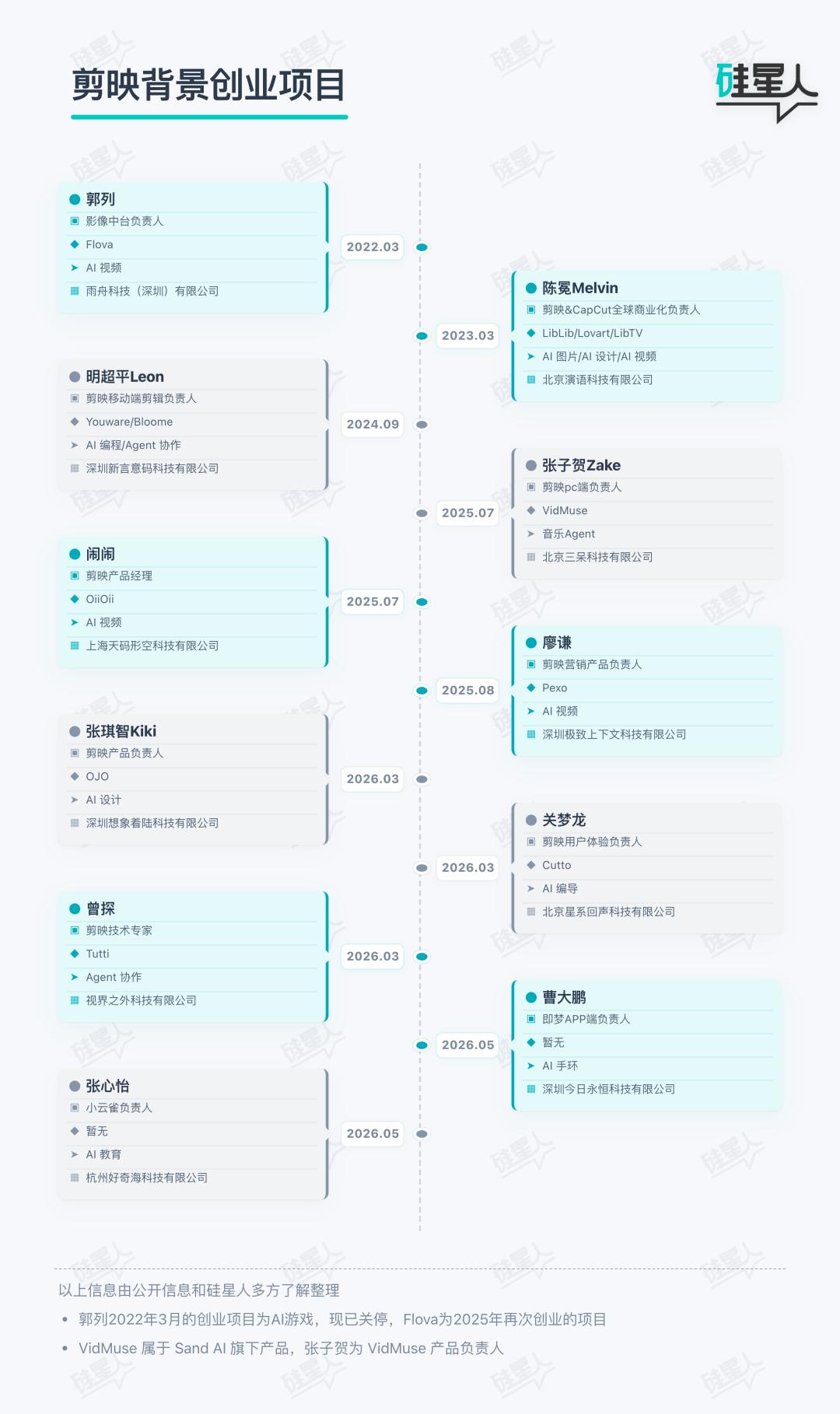
According to public information and our own research, at least 10 "CapCut alumni" entrepreneurs have founded AI application companies in the past two years, with a particularly concentrated wave of departures in the first half of this year. At the same time, Jianying's talent network is also spilling outward, as a number of former Jianying employees have successively joined the startup teams of their ex-colleagues.
In March, Zeng Tan, a technical expert at Jianying, left the company. He was a founding team member and technical lead of Tencent Docs. At Jianying, he was responsible for the R&D of the CapCut/Jianying web version, the engineering technology of Dreamina, and Jianying's internal AI Coding tools.
After leaving, Zeng Tan started his entrepreneurship focused on multi-Agent collaboration. For a newly established team whose product has not been made public, the title of former Jianying technical expert plus a group of talents following him is enough to get the project its first round of attention in the primary market. He has now secured seed round financing from HSG, and his product is about to be officially announced.
In April, Zhang Qizhi, Head of Product at Jianying, left to start her AI Design-focused business. She was an early member of the Mengmeng team, and worked at ByteDance for about eight years after the team was acquired. At Jianying, she was the team lead for many later departing entrepreneurs, including Ming Chaoping. Her new product OJO is positioned as an Agent team workspace for design scenarios, and has already launched internal beta testing.
In May, Cao Dapeng, Head of the Dreamina App division, left. He took over the Dreamina mobile division in February 2025. Before joining Jianying, he was responsible for PopAI, a productivity tool developed by 01 Wannengwu for overseas markets, and Wanzhi, its domestic counterpart, and previously worked at Feishu. After leaving Dreamina, he co-founded Eternal Tech in Shenzhen with Cui Yuyan, a former product staff member of Thunderbird Technology. According to recruitment information, the team is developing proactive Agent hardware for the European and American markets, which may take the form of an AI bracelet — a rare hardware project among Jianying-background entrepreneurs.
Zhang Xinyi, Head of the Xiaoyunque division, also left in the same month to focus on AI education, and has not yet announced the specific product details.
After Chen Mian left ByteDance, it was Zhang Xinyi who took over Jianying's commercialization team.
According to insiders, the commercialization team had about 20 people when Chen Mian was in charge, and expanded to around 60 after Jianying prioritized commercialization — the growth and commercialization of Dreamina, Xiaoyunque and Pippit were actually fully operational under the management line of Zhang Xinyi and Wu Xiaodan. Zhang Xinyi was at a lower rank than Wu Xiaodan in the internal hierarchy.
Before this year's wave of concentrated departures to start businesses, people who left Jianying earlier have already built the first batch of companies recognized by the market.
Chen Mian's team has successively launched the AI model and creator community LibLib, the design Agent Lovart, and the video Agent LibTV. Yanyu Tech announced in June this year that it had completed nearly $300 million in Series B+ financing, with a post-money valuation of $2 billion, making it the highest-valued startup founded by a Jianying alumni to date.
Ming Chaoping, former Head of Jianying Mobile, joined Moonshot AI after leaving Jianying, where he was responsible for the overseas music video product Noisee and the Kimi browser extension. In 2024, Moonshot AI scaled back its overseas strategy, and more than 10 employees including Ming Chaoping left the company. This collective departure later became the starting point for another batch of AI startups.
Ming Chaoping pivoted to AI Coding, launched YouWare, a creation community for Vibe Coder, and later released Bloome, an instant messaging product for human-Agent collaboration. His company Xinyan Yima has completed three rounds of financing, with its latest valuation reaching hundreds of millions of dollars.
Zhang Zihe, former PC-side product manager of Jianying, shares overlapping experiences with Ming Chaoping: both worked on imaging products at OnePlus before joining Jianying.
Ming Chaoping later led the Jianying mobile tool division, while Zhang Zihe oversaw the zero-to-one product strategy and user experience of Jianying's PC version.
In April 2025, after seeing Sand AI release Magi-1, a regression-based foundational video model, Zhang Zihe proactively reached out to and joined the Sand AI team, and is now in charge of its music Agent product VidMuse.
Identifying what kind of product a new model capability can be integrated into as soon as it emerges, and then moving quickly to execute — this is the specialty of "CapCut alumni" entrepreneurs.
These tracks seem quite scattered: video, design, programming, education, expression tools, and hardware. But the most crowded segment is still AI video — at least four entrepreneurs with Jianying experience have launched video Agent products: Chen Mian's LibTV, Guo Lie's Flova, Nao Nao (real name Zhang Ting)'s OiiOii, and Liao Qian's Pexo.
Nao Nao (Zhang Ting) previously worked on Douyin special effects and Jianying products. She left Jianying in 2022, later led the animation content division at Bilibili, and was in charge of the two-dimensional community product Lipu at Stepfun. After starting her business in July 2025, she focused on animated video creation, and released OiiOii a few months later.
Liao Qian initially worked at Volcano Engine, and later transferred to Jianying, where he led Pippit, an AI content creation and distribution platform for overseas merchants that was the predecessor of Xiaoyunque. After leaving Jianying, he joined Shengshu Tech as Head of Video Generation Product Vidu, left again in August 2025, and subsequently launched Pexo.
Liao Qian's career has covered almost all key positions along the AI video value chain: cloud services, in-house merchant content tools at Jianying, video model companies, and finally developing his own video Agent product.
The four have different career backgrounds, but their products are highly similar.
They all believe that video generation will not stay in the stage of entering prompts to get raw materials for long. A truly usable product needs to understand user intent, split creation tasks, organize materials and shots, call different models, and finally complete editing and delivery.
For people from Jianying, this judgment was formed through long-term accumulation in Jianying, one of the few successful tool product teams under the ByteDance ecosystem.
2
The public tends to refer to all these entrepreneurs collectively as the "CapCut alumni" group, which easily leads to the assumption that they are like those well-known cliques in the early internet industry, with stable personal connections who look out for each other and start businesses in groups after leaving the company.
But the real situation may be far more complex.
Jianying spans multiple product lines including Jianying, CapCut, Dreamina, Xingtu, Xiaoyunque and Kesong, and has gone through multiple rounds of organizational restructuring and staff turnover. It has never been a small, long-term fixed founding team.
Many entrepreneurs later labeled as Jianying background did not have direct reporting lines or close collaboration relationships in the company, and did not even work together closely.
Take Chen Mian and Ming Chaoping as an example. Chen Mian was responsible for the global commercialization of Jianying and CapCut, while Ming Chaoping was part of Zhang Qizhi's product team, working on advanced editing features in the early stage and later becoming the head of the mobile editing tool division. The two had very limited business overlaps during their time at Jianying.
It was only after they both became entrepreneurs that they built closer connections.
In June this year, after Yanyu Tech secured large-scale financing, the market began to discuss its valuation, business model, advertising investment scale and capital efficiency. Companies that do not develop models and only focus on applications are heavily dependent on model vendors, and most of their costs go to model procurement. When the company was at the center of public debate, Ming Chaoping spoke up for Chen Mian on social platforms, stating that many people might have misunderstandings about Lib (Yanyu Tech).
He said that it is a very rare capability for a founder to clearly figure out the business model and know how to run ad campaigns and spend money properly. He also mentioned that he had encountered many problems in his own entrepreneurial journey, and Chen Mian had once given him help.
This was a very supportive gesture. As a fellow entrepreneur, publicly explaining the spending logic of another founder who was facing criticism meant that Ming Chaoping was staking part of his own reputation for him.
However, when Chen Mian was interviewed by LatePost and asked about this incident later, he first thanked Ming Chaoping, then added that they actually did very little ad investment. Ming Chaoping vouched for Chen Mian's growth and commercialization capabilities, but Chen Mian himself did not fully follow that narrative.
This kind of interaction is closer to their real dynamic than a simple "mutual help" relationship.
According to Elsewhere's reports, around 2023, the primary market's preference for AI application founders did not favor Chen Mian. At that time, investors preferred founders who were senior product managers from large tech companies, and Ming Chaoping was one of the most frequently cited figures in this group; while founders with commercialization backgrounds like Chen Mian, whose resumes are full of experience in ad investment and growth, were considered to have a heavy operational path with limited imagination.
The valuation of LibLib in its first round of financing was only $18 million. By the second round, the subsidy war had almost burned through its cash, and the product was once removed from app stores, with some investors directly suggesting that they shut down the company. But Chen Mian eventually pulled through. Now, their valuations have reversed, and many investors are re-evaluating and comparing their projects with new reflections.
This kind of comparison and linkage is everywhere, not only among investors, but also between entrepreneurs.
After rumors about OJO's entrepreneurship appeared on social media accounts that gossip about large tech companies, the official account of Cutto left comments under multiple posts to "dispel rumors" for OJO, stating that the founders of the two companies are friends, and adding that since the founders left Jianying to start businesses, they are naturally bound by non-compete agreements, so it is impossible for them to develop AI video projects.
Of course, the official Cutto account making these comments also took advantage of the discussion heat to showcase its own new company and product to the public.
Apart from showing off friendships at appropriate times, there are also entrepreneurs who know the "real situation" of the original organization better, and "debunk" each other after starting their own businesses.
Many people in the venture capital circle have encountered such a scenario: a "CapCut alumni" entrepreneur will talk about another founder's publicly displayed past resume and title. Their shared experience in the same organization allows them to clearly expose how inflated those titles are, without holding back at all.
If "mutual disdain among peers" is a necessary action in competition, then continuing to "dig into" the original organization's resources is also a common choice for many CapCut alumni entrepreneurs when accumulating resources and building teams.
For example, after Guo Lie left ByteDance, he has kept in touch with some members of the original Mengmeng team, and many Jianying-background employees have joined his company.
According to media reports, Wang Xuezhi, former technical lead of Jianying, may have joined Guo Lie's team after leaving at the end of 2024. Wang Xuezhi is also an alumnus of the Mengmeng team, and joined ByteDance after the team was acquired. In the context of the Mengmeng relationship, this is a reunion of people who started a business together 10 years ago.
Yanyu Tech is the same: the industry perceives its recruitment style as heavily favoring senior ByteDance employees. It is the company that tells the "CapCut alumni" story the best, and also the most aggressive one in poaching talents from ByteDance.
The talent, experience and capital network formed around the "CapCut alumni" group have all become resources that these entrepreneurs can continue to leverage.
After interacting with many CapCut alumni entrepreneurs, you will also notice an interesting way of thinking. Whether it is the mutual comparison, private criticism of each other, or poaching talents from the familiar former organization, they all like to use ByteDance's internal rank system as the judgment standard, and keen to discuss whether a person is at the 3-2 level or 4-1 level, even long after leaving the company.
Many entrepreneurs and employees who left ByteDance to join startups mentioned that only the people in charge of full business lines are real leaders, and others cannot be considered real heads.
"You can only say you are in charge of one module, or just a product manager. At ByteDance, whether you manage a few people or hundreds of people, you can be called 'Head of X', because everyone is required to be responsible for a certain business or function."
3
It is not just the departed employees who are obsessed with ByteDance internal titles. Investors are also very keen on them.
In the early stage when models are evolving rapidly and the AI application entrepreneurship boom is taking off, CapCut alumni entrepreneurs are the most sought-after group by investors.
Founders' past experiences are often easier for investors to identify than the products themselves. A person familiar with Jianying told us that this group of people attracts attention first because of the completeness of the businesses they were responsible for in the past — many of them have led large-scale products, teams or global businesses at a very young age.
Titles like Head of Jianying, Head of Global Commercialization for CapCut, and Core Product Manager of Jianying mean that they have experience building large-scale consumer products, serving global users, and implementing generative AI in real products.
The concentrated exodus of this group of people is also directly related to the internal changes at Jianying in the past two years.
In February 2024, Zhang Nan stepped down as CEO of Douyin to take charge of Jianying. A person close to ByteDance told us that this adjustment is equivalent to "gathering all core leaders to the front line".
He said that in the early stage, Jianying did not rank high in the group's product portfolio. Although it had a large user base and certain influence, as a tool product