Jensen Huang has launched an open-source AI model, which is open to developers for free.
Less than three weeks after Jensen Huang announced his public support for open-source models, NVIDIA has taken practical action.
On August 11 local time in the United States, NVIDIA released the open-source model Nemotron 3.5 Lightning, and launched the open-source model routing library NeMo Switchyard at the same time.
Nemotron 3.5 Lightning is a 30-billion-parameter Mixture-of-Experts model designed for long-running agents, which is mainly responsible for high-frequency tasks such as code review, tool invocation, security alert monitoring, and billing Q&A. NeMo Switchyard is responsible for model selection, routing between different models according to the requirements of tasks.
Enterprises can download, use and modify this Nemotron model for free, without obtaining NVIDIA's permission or paying any fees.
NVIDIA said that the output speed of Nemotron 3.5 Lightning can reach up to 4 times that of similar models, and the task completion speed of agents is increased by 30%. Internal tests of NeMo Switchyard show that while maintaining state-of-the-art accuracy, the task cost can be reduced to nearly one-third of that of using Opus 4.8 alone.
01 Specially built for high-frequency tasks of Agents
The AI competition in the past few years centered on model scale, but now the era of agents puts more emphasis on the efficiency of models in performing specific tasks. Nemotron 3.5 Lightning is the model launched by NVIDIA for this demand.
In a complex agent system, more powerful reasoning models can be responsible for task planning, while Nemotron 3.5 Lightning handles a large number of repetitive, execution-oriented tasks. This can reduce the number of large model invocations and lower operating costs at the same time.
NVIDIA verified this direction in its self-developed agent task evaluation benchmark PinchBench test.
Tests show that Nemotron 3.5 Lightning is about 30% faster in completing tasks while matching the accuracy of Qwen 3.6-35B; under similar completion time, its accuracy is higher than that of Gemma 4-26B.
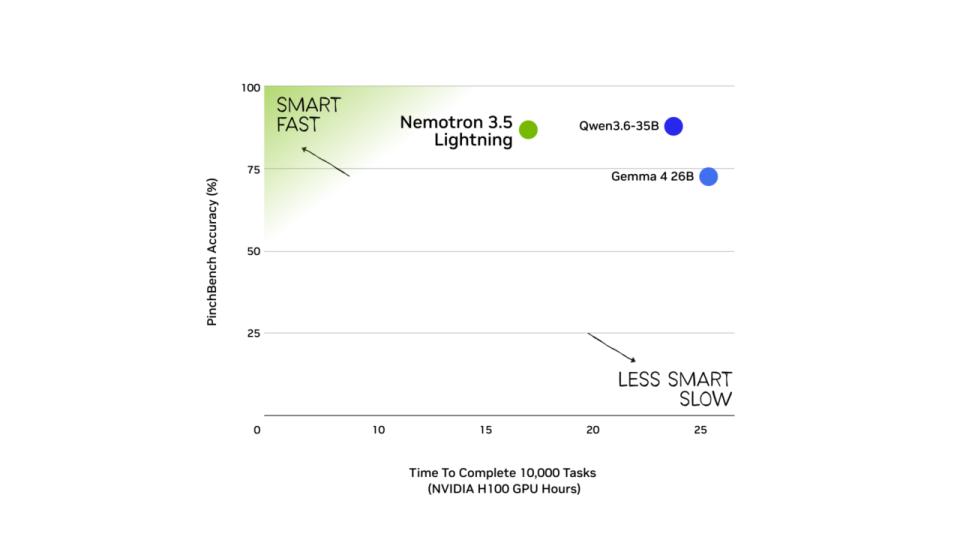
Nemotron 3.5 Lightning is the fastest among similar models with state-of-the-art accuracy
However, in terms of general capabilities, Nemotron 3.5 Lightning is not the highest-level model at present. According to the Intelligence Index of third-party evaluation agency Artificial Analysis, Nemotron 3.5 Lightning covers 9 evaluations with a score of 24, which is on a par with gpt-oss-120b and lower than some larger models.
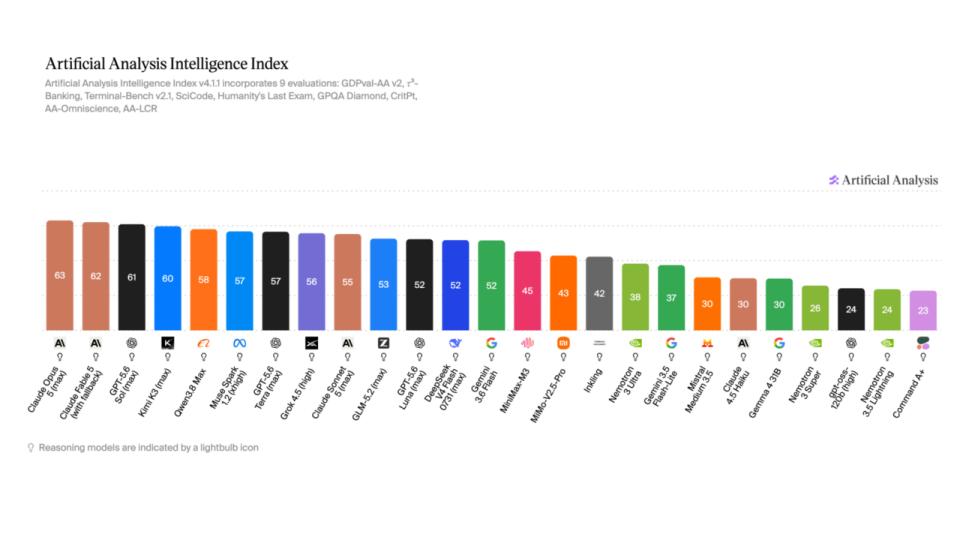
Nemotron 3.5 Lightning is customized exclusively for high-frequency agent tasks
NVIDIA puts more emphasis on the efficiency and availability of this model in real workloads. At present, many companies have begun to test the application of Nemotron 3.5 Lightning in specific businesses.
CrowdStrike has used Nemotron 3.5 Lightning for cybersecurity, Harvey and Trajectory for legal services, CodeRabbit and Baseten for code review, LilaSciences for physics and life science tasks, and FastinoLabs for customizing software development, finance and healthcare workloads.
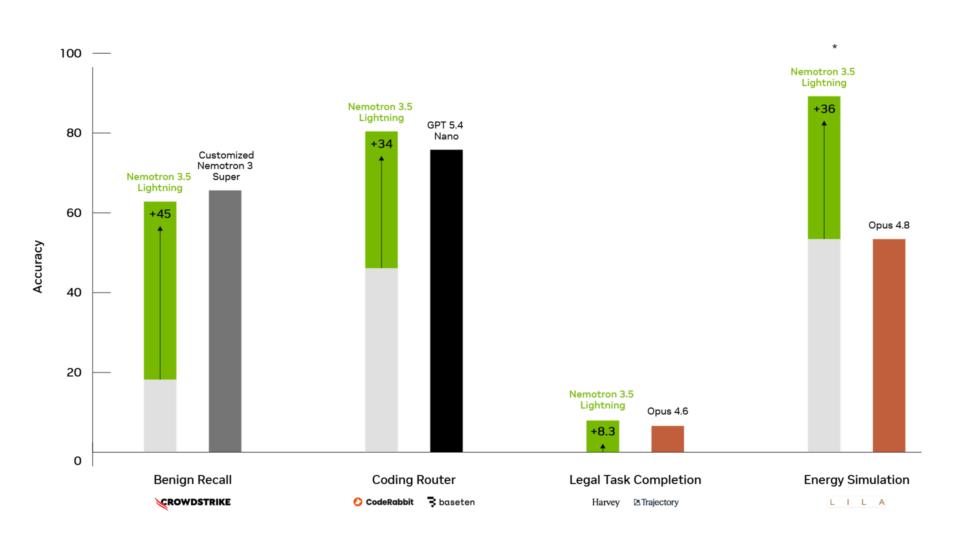
The enterprise-customized Nemotron 3.5 Lightning has extremely high accuracy in professional agent tasks
Enterprises can also continue to adjust the model based on their own data. CodeRabbit's test provides a case. NVIDIA said that the company used the standard NeMoAuto model recipe to train for one cycle, about two hours and 85 US dollars, and built a working router agent.
Nemotron 3.5 Lightning also supports multiple deployment methods, which can run on NVIDIA RTX PCs, DGX Spark, DGX Station and Jetson, and can also be extended to RTX PRO workstations, data centers and the cloud.
NVIDIA said that the company will release training data and technologies within the scope permitted by the license, and simultaneously release the Nemotron-RL-Agentic-Terminal-Pivot dataset for further training the capabilities of coding agents.
02 Add a "dispatcher" for AI models
When enterprises own more and more models, a new problem arises: how to select the appropriate model?
Different links of agents have different requirements for models: complex tasks require stronger reasoning capabilities, while simple tasks put more emphasis on speed and cost. Using all large models is too expensive, and using all small models may affect the effect.
NeMo Switchyard is launched to solve this problem.
It is an open-source model routing library that can select between different models according to task requirements. Developers can set strategies based on accuracy, latency and cost, and can also adjust the routing logic according to their own business.
Kari Briski, Vice President of Enterprise Generative AI Software at NVIDIA, said that Switchyard can dynamically select models according to the current state of the agent, and it will not pre-specify which model handles which type of task before the task starts.
In addition, Token cost is also included in the selection process. Briski explained that Switchyard can evaluate the number of Tokens that may be generated when different models complete tasks, and then select a more appropriate model based on this prediction.
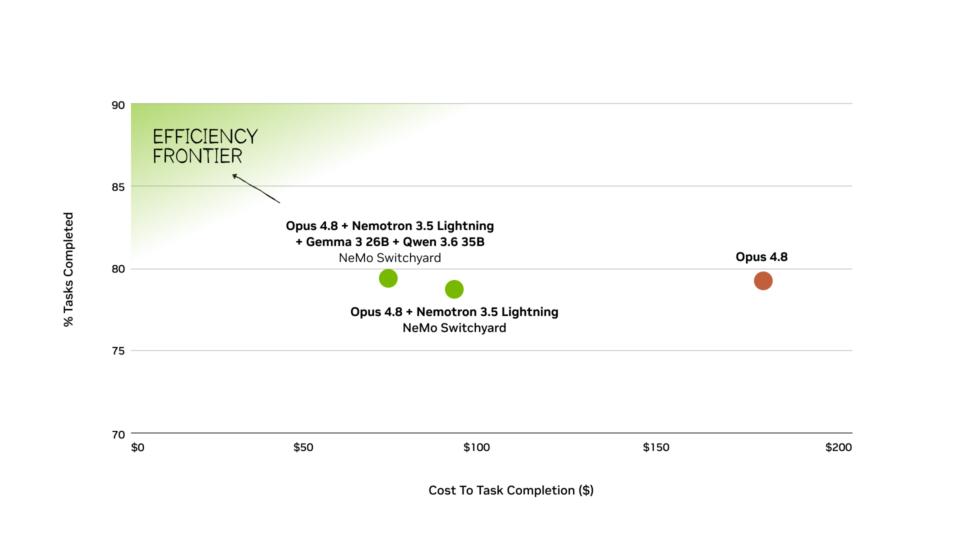
Cost comparison of Switchyard through intelligent routing of different models
The enterprise test results announced by NVIDIA show that in 145 multi-turn DeepAgents tasks, LangChain only assigned 7% of the calls to state-of-the-art models, with the accuracy reduced by 6% and the cost decreased by 74%.
Ramp achieved performance comparable to state-of-the-art models in RampSWE-Bench, while reducing costs by 58% and running time by 33%. Cognition integrated Switchyard in DevinDesktop, reporting that the average cost was 28% lower than using a single state-of-the-art model entirely.
Boomi achieved 100% domain routing accuracy in 5 routing capability tests, and sent 59% of the traffic to fine-tuned models that are 5 times faster, reducing latency in subsequent rounds by 21%. Preliminary tests from Classmethod show that costs are reduced by 27% while maintaining quality.
These results indicate that in the future, when enterprises use AI, the focus of competition may shift from "owning the strongest model" to "managing multiple models".
03 The next larger open-source large model is already on the way
While launching the 30-billion-parameter model and model routing tool, NVIDIA is also advancing the larger open-source model project Nemotron 4.
According to tech media The Information citing people familiar with the matter, employees participating in the Nemotron project expect that the largest Nemotron 4 model will have at least 1 trillion parameters, which is about twice that of NVIDIA's current largest model Nemotron 3 Ultra.
However, Nemotron 4 is still in the development stage, the specific specifications and release date have not been determined, and the final training has not been completed. Employees participating in the project said that large-scale training operations may take several months.
But from the overall layout point of view, what NVIDIA focuses on is not just launching a larger model.
In the past few years, the core competition of the AI industry mainly revolved around the models themselves. Enterprises needed stronger foundation models, larger training scales, and higher benchmark test scores.
NVIDIA is trying to build another system. This system includes not only models, but also training data, evaluation tools, development frameworks and computing resources.
Around the Nemotron project, NVIDIA is expanding cooperation with external enterprises and research institutions. Companies such as Reflection, Cursor, Thinking Machines and Mistral are participating in providing training data, evaluation support and model design experience. Prime Intellect has also contributed a large number of simulation environments to improve model training capabilities.
At the same time, NVIDIA is continuously increasing its computing investment required for AI R&D. As of April this year, the scale of the company's multi-year cloud service commitments has expanded to 28 billion US dollars, covering up to the beginning of 2031.
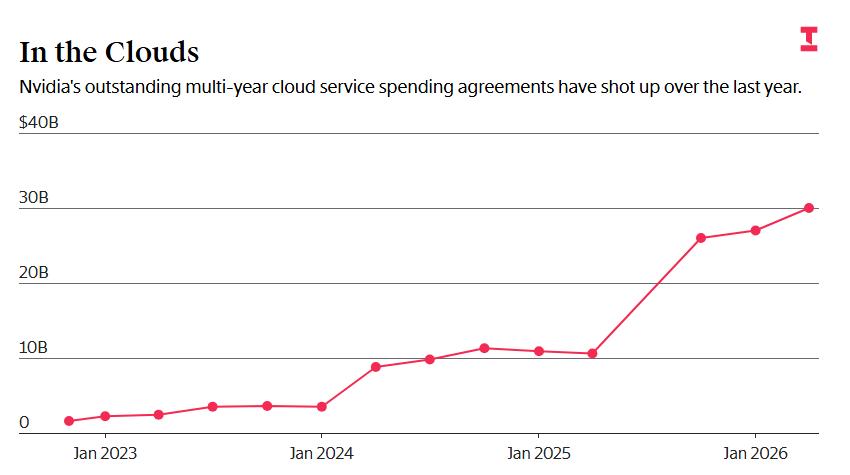
NVIDIA's outstanding multi-year cloud service expenditure agreements have surged sharply in the past year
Not all of these resources are used for Nemotron training, but they show that NVIDIA is reserving infrastructure in advance for the next stage of AI competition.
Different from companies such as OpenAI and Anthropic that mainly compete around "building the strongest model", NVIDIA prefers to become a platform connecting models, tools, computing and developer ecosystems.
From a chip supplier to an AI infrastructure provider, this is the role change that NVIDIA is promoting.
04 Increasing investment in open source is not just for making models
NVIDIA's choice to promote open source is not simply to join the large model competition, but because the competition rules of the AI industry are changing.
In the past few years, the focus of the industry has been "who owns the strongest model". Companies such as OpenAI and Anthropic have continuously improved the capabilities of state-of-the-art models, and the competition has revolved around parameter scale, reasoning capabilities and benchmark test scores. Whoever can train a more powerful model often means greater market influence.
However, as enterprises begin to deploy AI on a large scale, new problems are emerging.
In actual work, an AI agent usually needs to complete multiple steps, including understanding tasks, invoking tools, processing information, checking results and performing operations. Not all of these links require the most powerful model. Complex reasoning tasks may require state-of-the-art models, while a large number of repetitive execution tasks are more suitable for small models with faster speed and lower cost.
Therefore, the focus of future AI competition may shift from "who owns the strongest model" to "who can make multiple models work together more efficiently". This is also the reason why NVIDIA promotes open-source models and model routing tools.
In late July, Jensen Huang, CEO of NVIDIA, publicly supported open-source models for the first time. He said that open-source models can help enterprises better grasp their own AI future, while promoting competition and reducing costs.
In a subsequent interview with Axios, he said: "Free AI should be good for hardware and chips."
For NVIDIA, the core value of open source is not to let Nemotron replace all commercial models. More importantly, it allows more enterprises to access, modify and deploy AI models, thus promoting more enterprises to enter the stage of AI development and application.
The more widely enterprises use AI, the greater the demand for computing resources for training, reasoning and deployment.
Kari Briski, Vice President of Enterprise Generative AI Software at NVIDIA, said that NVIDIA invests in Nemotron because the company believes that every company and every country needs easily accessible state-of-the-art open-source models to strengthen security, promote innovation and provide a foundation for long-term reliance.
Therefore, NVIDIA's promotion of open source is essentially expanding the entire AI infrastructure market. When models are no longer just a game for a few companies, but enter the business systems of more and more enterprises, the demand for chips, computing power and AI infrastructure will also grow accordingly. For NVIDIA, this may be more important than owning the "strongest model".
Special contributor Jin Lu also contributed to this article
This article is from "Tencent Tech", written by LI Hailun, edited by SU Yang, and published with authorization by 36Kr.