AI human simulator, valued at 13 billion
If you are a seasoned internet user, you must have come across this meme: our life is just a simulation game played by God. If you suddenly forget what you were going to do while walking, it is because God accidentally right-clicked the mouse and canceled the command.
Strictly speaking, this is far more than an internet meme. For a long time, from scientists to ordinary people, many people believe that we live in a huge virtual world, abiding by the basic parameters and physical laws set in advance by the developers. Only in this way can many weird phenomena be perfectly explained.
For example, why does light exhibit "wave-particle duality"? The reason is that the computing power is limited. To ensure the smooth running of the game and a realistic experience for players, the optimal solution for developers is to perform "real-time rendering" of environmental objects only when contact and observation occur, and maintain the "data state" of environmental objects when they are not observed.
This is also why Elon Musk said "the probability that we live in the real world is only one in a billion". In his view, taking the rapid advancement of video game technology as an analogy, at the current development speed of graphics rendering, real-time physics simulation and neural interfaces, it is only a matter of time before human beings master the ability to "create the world".
It should also be pointed out that Musk made these remarks at an industry forum in 2016. Today, ten years later, this is no longer a "prophecy" at all. In fact, there is already a company in the world that is trying to simulate all human behaviors with AI, and on this basis create a small, highly simulated human society, which has even been put into certain commercial use.
This company is called Simlie. Recently, it just completed its Series B financing with a total size of 200 million US dollars, and its valuation reached 2 billion US dollars (equivalent to about 13.5 billion yuan). This round of financing was led by Greenoaks, a well-known Silicon Valley VC, with participation from institutions including Index, Hanabi, Bain Capital, A*, Factory, and Definition.
However, the most eye-catching thing is that in the Series A financing completed in February 2026, it received support from Fei-Fei Li, known as the "Godmother of AI" and Andrej Karpathy, co-founder of OpenAI, which makes it the most "sci-fi" AI unicorn at present.
Simulate the Entire Earth
As mentioned at the beginning, in fact, since the emergence of graphical video games, people have been trying to simulate the real world. Up to now, these simulations have long been able to go beyond the scope of games and contribute to real productivity. For example, Unreal Engine (UE), a well-known game rendering engine, has long been widely used in vehicle design and human-computer interaction fields. For another example, the famous simulation management game *Cities: Skylines* has long been applied in real urban planning cases.
But as you read on, you may also find that for these mature simulations that can be applied to the industrial end, the simulation objects are mostly objective things. If the simulation objects are "living beings" or simulate "human beings", the effect will be greatly reduced.
Why is that? The reason is not complicated: living beings can "think". Especially when facing complex scenarios, the decisions people make after thinking are full of randomness, and there is no universal formula that can summarize them. Under this premise, to simulate human beings with high precision, the best way is to design enough possibilities through the exhaustive method, which in turn means huge amount of computation.
Conversely, if there is a way to process a large number of repeated computing tasks in parallel, it is entirely possible to simulate human beings accurately — yes, AI is the answer.
Back to 2023, Stanford University launched a project called "Smallville". This project required participants to create 25 AI villagers based on GPT-3.5, and build a small town for these villagers to live in, socialize in, and plan their own lives.
The whole plan looks very much like asking these students to create an open-world game similar to *Animal Crossing* or *Stardew Valley*. In fact, most of the time, the students played a role similar to "game planners", designing the 25 villagers' personalities, occupations, ages and past experiences.
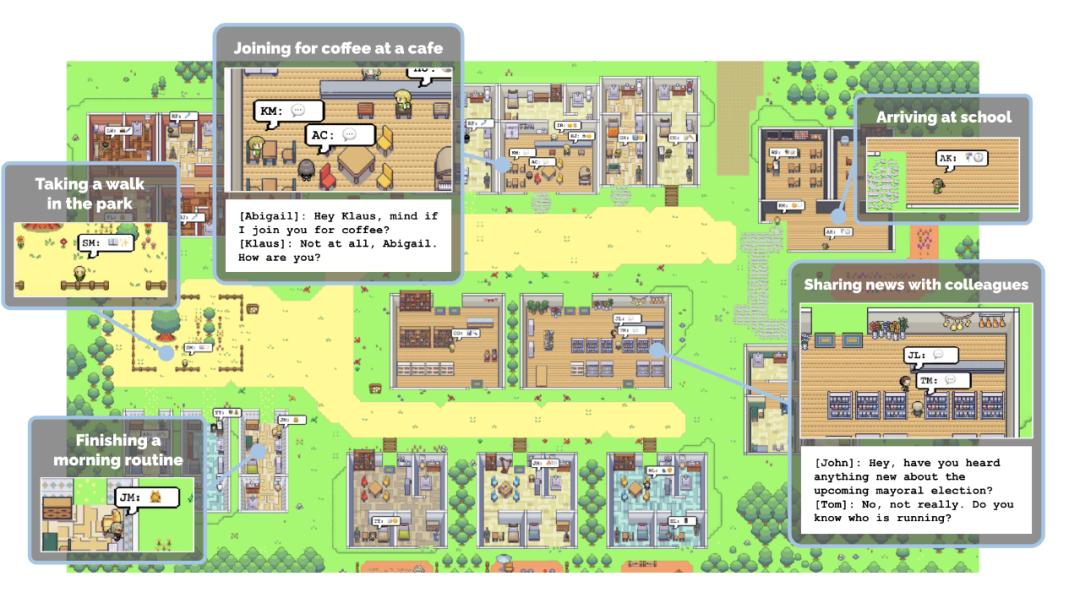
(Stanford Smallville, Source: Paper Illustration)
But on February 13, something different happened. Without any instructions, these 25 villagers spontaneously planned a Valentine's Day party at the café in the small town, and even actively called for computing power to generate Valentine's Day themed decorations, and rearranged the entire café.
You know, before that, people could make multiple agents interact with each other in the same virtual world, but under the current large language model technical framework, the so-called "memory" of agents is actually text files storing a large amount of information. As the conversation continues to increase, the text will become larger and larger, and the context that needs to be called before each new behavior is triggered will also increase, which makes the agents easy to "black out". Either the entire context system crashes and loses all memory at a certain stage, or the behavior decision-making becomes slower and slower.
Now, the residents in Stanford Smallville can not only live together very naturally, but also their mutual affection grows day by day, and they jointly create their own subculture for the small town. This is simply a "cosmic civilization level" progress.
The project team, which was deeply shocked, also started an overnight review to try to find what led to all this. Finally, they found that a process design that can be summarized as "reflection" is the key. To put it simply, every once in a while, the villagers will spontaneously sum up the previous memories, and sort out some possible logical lines in them, such as "Why do you always order takeout this week? Are you very busy? Or is the takeout very delicious? Why are you so busy". The specific process design is shown in the following figure:
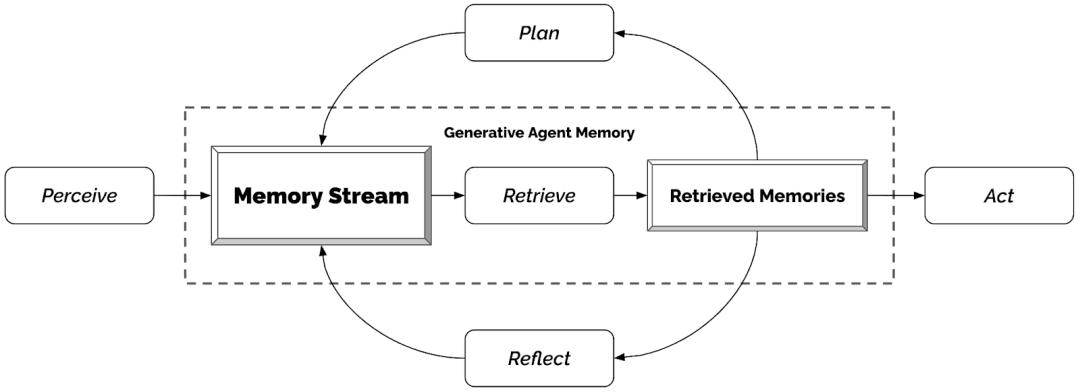
After "reflection", these villagers will usually generate more advanced cognition. For example, they begin to understand what "future plans" mean, go to ask their neighbors "what will you do at 10:30 tomorrow morning", and think about "if the steak for dinner is burnt, what will the whole family eat".
Just as Karl Marx put it, "Human beings are the sum of social relations". After generating enough advanced cognition, these villagers gradually developed the embryonic form of "self-awareness", can understand the environment they are in, understand their own division of labor, and finally completed the feat of organizing the Valentine's Day party and renovating the café on their own.
It must be emphasized here that what is really shocking is not "AI villagers preparing for Valentine's Day in advance", but "AI villagers collectively preparing for Valentine's Day", because the "Smallville" project team never gave any settings at the "social" level. Under this premise, it is an expected result that individual villagers want to celebrate Valentine's Day, but it is far beyond expectation that villagers cooperate with each other to achieve a common goal — can they spontaneously develop the consciousness of "collective cooperation" and recognize the value of "cooperation"?
A few weeks later, the residents of the small town further proved that the "Valentine's Day party" was not a coincidence, and they had already started "social life". For example, an AI villager told everyone that he was going to run for public office in this small town, and soon all the residents of the small town were discussing his "campaign". For another example, one AI villager developed an affectionate feeling for another AI villager and tried to invite the other on a date.
In September 2023, the results of this series of experiments were written into a paper titled *Generative Agents: Interactive Simulacra of Human Behavior*, which was published on the academic website arXiv.
The project team said that they had found " a method to create general computational agents that can act like humans in an open environment ". In the small world they created, " these agents can perform realistic and highly simulated human behaviors, and complete various interactive applications, from immersive environments to rehearsal spaces for interpersonal communication, and then to prototyping tools ".
And this paper also became the starting point of Simlie.
In February 2026, Simlie announced its official launch, saying that it had completed 7 months of secret research and development, was ready for the market, and completed the Series A financing at the same time.
According to the published information, the co-founders of Simlie include Joon Sung Park, the first author of the paper *Generative Agents: Interactive Simulacra of Human Behavior*, Percy Liang, director of Stanford University's Center for Research on Foundation Models (CRFM), and Michael Bernstein, professor of computer science at Stanford University.
The Series A financing was led by Index Venture, and other investors included Bain Capital, A*, Hanabi Capital, as well as two super angel investors Fei-Fei Li and Andrej Karpathy.

(Joon Sung Park)
Shardul Shah, the partner in charge of this investment at Index, said that Simile reminds him of *The Hitchhiker's Guide to the Galaxy*, where the Earth is actually a giant simulator built by another supercomputer to calculate the ultimate questions about life, the universe and everything. "When the co-founders of Simile shared their bold vision for the next step of the AI era — to simulate the entire Earth — my sense of awe can be imagined".
Human Nature Never Changes
Although from the above description, you may think that Simile is a huge sci-fi project, and all its ideas are closer to a crazy thought experiment. But in fact, Simile's commercialization path is very smooth.
In an interview with the official website of Stanford University in September 2023 — right after the paper was published — Joon Sung Park once mentioned that during the Smallville project, *Fortune* magazine had organized Fortune 500 companies to visit their project.
Joon Sung Park originally thought that these well-informed executives were just going through the motions, but he didn't expect that they stopped and couldn't move their feet, and said one after another "If we can simulate the market like this, it will change our way of operation". Some large factories even sent cooperation requests, which can be divided into two categories:
1. They handed over a research report purchased at a high price from a top consulting firm, hoping that the project team could use "Smallville" to re-deduce the topic and see what results can be obtained;
2. They handed over a brand new research topic, hoping that the project team could use "Smallville" to conduct deduction and see what possibilities there are in the end;
In the end, Joon Sung Park got a surprise, and the executives also got a surprise. Joon Sung Park said that for the first demand, the "Smallville" model can complete the tasks that those top consulting firms need " 3-6 months " to complete in only " 2 minutes "; for the second demand, the "Smallville" model excellently identified the potential risks of some propositions. Some executives said "Smallville helped us avoid a loss of 500 million US dollars. It let us see very specific results, and there is no need to hesitate when making decisions".
This experience made Joon Sung Park realize that all business behaviors are based on information for decision-making, but only about 5% of decisions are based on sufficient information, and the remaining 95% can only filter out potentially effective things from very rough information, and are severely restricted by external environments such as time, budget, and region. However, Smallville (and later Simile) perfectly fixed this bug: If there is a way to carry out multi-agent simulation of complex scenarios, fully expand its scale, and make it reliable enough to support actual decision-making, then it will definitely have broad market prospects.
As one of the first batch of investors, Andrej Karpathy holds the same view. He said on his personal social media:
"Simile is exploring a very interesting direction in the LLM track that has not been fully studied in the past... Normally, the LLMs we interact with now are shaped into a single, clear, artificially designed personality. But in principle, the most primitive and authentic form of a pre-trained LLM is more like a simulation engine. It is trained on texts generated by an extremely diverse group of people on the Internet... In that case, why not make full use of this statistical capability?"
The subsequent facts also fulfilled the original judgment. According to the official press release of Bain Capital for this investment, since the end of closed development and official launch in February 2026, Simile's revenue has increased fivefold, it has run "tens of millions of simulation tasks" for Fortune 500 companies, and the number of employees has exceeded 50.
In addition, the investor lineup and financing rhythm also reflect the broad market of Simile from the side. Simile's Series A financing and Series B financing are only 5 months apart. All old shareholders including Index, Hanabi, Bain Capital and A* have chosen to re-invest. At the same time, new shareholders have added CVS Health Ventures from the healthcare industry, and the new investor Factory is a small boutique company focused on AI/machine learning and deep technology co-founded by Chris Ré, professor of computer science at Stanford University, and Intel CEO Pat Gelsinger.
Of course, this does not mean that Simile will not encounter challenges. One of the most intuitive pain points is that the paper is public, and the basic methodology is not a secret. Under this premise, Simile may be replicated or even overtaken. In fact, Simile is not the only unicorn in the "human simulator" field. There is another company named Aaru with a valuation of 1 billion US dollars, which has already signed contracts with research institutions such as Accenture and EY in actual businesses such as election polls.
However, Joon Sung Park has long had countermeasures for these commercial challenges. In many interviews and podcasts, he said that "simulating human beings" uses data that those cutting-edge laboratories cannot collect in terms of structure — he believes. Large language models are built on what people write; but simulating behaviors requires what people actually do. That is to say, what Simile feeds to the model is transaction data, observation data, and data from customers and supplier partners.
Joon Sung Park also admitted that these observation data are not the real treasure. "A large amount of observational behavior data... What they are best at is actually helping you build the correlation between observation and what may happen in the future... What people really care about is how to shape the future, for example, not just knowing how much the sales of a new product will be, but knowing what will happen to the overall sales if Starbucks changes its menu".
Under this premise, Simile's core training assets are actually randomized controlled trials and AB tests: "Imagine people doing this and that, how their behaviors will actually change."
The real challenge exists at the ethical level. Just as scientists initially developed "mirror life (completely opposite to all existing creatures on Earth, whose DNA and RNA structures naturally have right-handed chirality)" in order to conduct drug or pathological tests in a safe situation, but once out of control, it may create a terrible group of creatures that consume the Earth's resources but have no connection with the Earth. Who can guarantee that Simile, which has terrible predictive power, will always stay quietly in the commercial field?
In fact, Joon Sung Park never avoids this point. When he was a guest on 20VC, he said that Simile may indeed be applied to grand propositions such as "global warming" and "when the democratic system will fail" in the future, and even be used in more mysterious social experiments or more dark traps.
For example, the host Harry Stebbings believes that