Behind the scramble for AI talents with multi-million annual salary offers, what do top engineers really value?
The competition for AI talents with high salaries is intensifying, but it is difficult to continuously attract technical practitioners only by relying on salary and grand visions. Compared with distant blueprints, AI talents attach more importance to the actual progress of projects and partners with complementary advantages. Building credibility first and then offering flexible solutions is a more pragmatic path to compete for AI talents.

The recruitment market in the technology industry is undergoing drastic changes. On the one hand, companies like Meta are conducting large-scale layoffs, which makes many people worry that AI will cause a large number of technical positions to disappear. At the same time, many global large technology giants are setting off a fierce battle for AI talents.
Despite the recent wave of layoffs, Meta is still investing heavily in recruiting AI researchers and engineers, with reports stating that the compensation packages for some talents are as high as millions of dollars; Elon Musk is forming an "elite team" directly under his own control, poaching top AI engineers everywhere; Amazon recently announced plans to recruit thousands of engineering employees and interns in 2026, some of whom may be employees who were just laid off by Meta. As a head of an AI enterprise department said: "If I plan to invest one billion dollars to build a model, spending ten million dollars to hire an engineer is actually not a high cost."
However, the headline news of eight-figure salaries easily hides a more realistic truth: The battle for talents is not only aimed at well-known AI researchers, but also covers a wider range of technical engineers, developers and talents for technology implementation. A large number of these practitioners are indispensable to transform AI models into products.
The current industry environment raises a tricky but unavoidable question: Faced with the unbeatable salaries and signing bonuses offered by Silicon Valley giants, how can other enterprises compete for high-quality AI talents? What methods can be used to attract AI talents to join?
The talent matching platform CoffeeSpace has more than 25,000 global users, and the platform data can provide us with answers. The research team is composed of one founder of CoffeeSpace and researchers from Arizona State University. After analyzing relevant data, the team summarized three major conclusions to help enterprises maintain competitiveness when recruiting AI talents. The platform mainly targets start-ups with financing of at least 10 million US dollars, but the research conclusions are universal and can be referenced by enterprises of different scales and development stages.

The Attraction Conditions That AI Talents Really Care About
CoffeeSpace platform users include founders who are starting businesses, as well as job seekers who intend to join start-ups as co-founders or employees. The users have diverse backgrounds, including both technical practitioners and non-technical position personnel, but the platform gathers a large number of high-level AI talents, which makes it convenient for us to compare and observe the decision-making differences between them and other job seekers.
Platform users can send connection invitations to others, and the receiver has the right to choose to accept or reject. Once the invitation is approved, both parties can start communication. Although accepting a chat invitation does not mean accepting a job offer, more than one million interaction records on the platform constitute a unique real-time behavior data set, which intuitively shows how AI talents evaluate potential job opportunities.
We compared the interaction data of users with AI-related backgrounds (machine learning engineers, data scientists, AI researchers, etc.) with other users, and analyzed the different preferences of the two groups for various traits of founders.
We carried out multi-dimensional comparisons around the data: Do AI talents value equity more? Compared with industry experience, do they care more about geographical location? Or are they attracted by other completely different signals? By analyzing the characteristics of the objects that AI talents actively initiate communication and match with, we can clearly see what significant differences exist in the selection logic between AI talents and other job seekers in the start-up ecosystem.
The research shows a clear pattern: Regardless of seniority, AI practitioners are more likely to be impressed by a type of founder trait - these traits represent that the project has implementation momentum, the founder has excellent capabilities, and the work attitude is pragmatic. In particular, AI talents tend to follow founders who have already invested full-time in entrepreneurial projects and achieved phased progress. These intuitively verifiable signals constitute an effective AI talent attraction framework, which is based on practical actions rather than empty vision preaching.
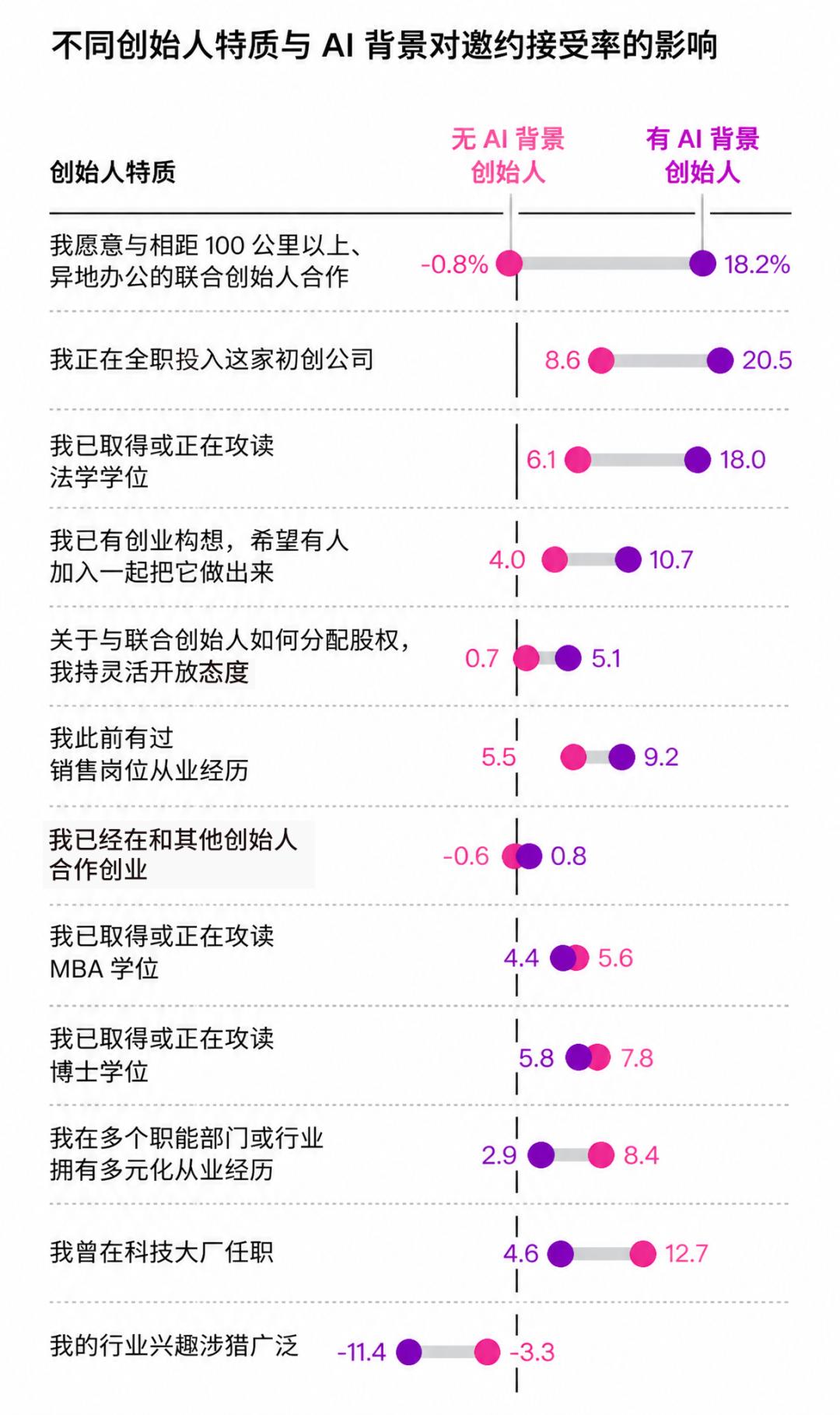
Many entrepreneurs may be surprised by this. Many of them still firmly believe that vision is the key to winning, and recruiting technical talents can still replicate the classic story of Steve Jobs and Wozniak: relying on a charismatic founder and bold ideas to impress top engineers. But this narrative may no longer reflect the current job selection logic of technical talents.
There are also some factors that are difficult to attract AI talents, such as whether the founder has a doctorate or MBA degree, whether he has extensive working experience in multi-functional fields, or whether he has worked at FAANG (Facebook, Amazon, Apple, Netflix, Google).
Managers who are struggling to compete for AI talents can implement the following three measures to improve their competitiveness.
1. Demonstrate project progress as early as possible
The most stable and powerful signal in the data is: AI practitioners want to join projects that are already in progress. All the models we built show that founders who hold clear plans and advance the project full-time are at least 20% more likely to have their invitations accepted by AI practitioners than founders who are still in the conceptual exploration stage. High-quality AI technical talents often have multiple offers. For them, what impresses them to join a start-up is not a higher equity ratio, nor an exciting vision, but tangible and visible project progress.
Managers can regard project advancement momentum as a new hard currency to attract AI talents. The key is that "momentum" does not require a mature and perfect product, but only needs to prove that the project has started to operate. An early prototype product, a small number of seed users, or the founder's full dedication can strongly prove that the idea has moved beyond the purely theoretical stage.
This conclusion also applies to large mature enterprises. Managers who want to recruit AI experts do not need to repeatedly publicize lengthy strategic documents, but empower small teams to launch AI functions quickly, continuously try and error, and display phased results externally, so as to convey the signal that the project is advancing steadily.
2. Demonstrate complementary core capabilities
The second remarkable rule: AI talents particularly favor founders with specific non-technical advantages. Founders with a legal background (such as Juris Doctor) are 18% more likely to have their invitations accepted by AI practitioners than founders without a legal background; founders with sales experience have an acceptance probability about 10% higher. In the model, these two are the core non-technical indicators for predicting attractiveness.
Why are these capabilities so important? In the process of building products relying on AI, legal literacy means that the founder understands data governance, compliance requirements, contract negotiation and risk responsibility. When AI models are implemented for real users or enter highly regulated industries, the above are all practical problems that need to be solved urgently with extremely high risks. Founders with legal background can reduce the perceived tail risk of talents: they can independently build cooperation frameworks, draw up legally effective agreements, handle privacy and intellectual property disputes, and do not have to rely entirely on external lawyers.
Sales experience plays another equally critical role: it represents that the enterprise has a clear path to reach early customers and achieve revenue. AI engineers hope that the technologies they develop can be put into use. Founders who are good at sales are more likely to land pilot projects, reach cooperation, get feedback from real scenarios, and promote prototype products to commercialization.
Therefore, managers do not have to mistakenly think that if they want to recruit AI talents, they must be proficient in AI technology. The best way to attract technical partners may be to show that they are good at solving the fields that these technical talents are unwilling to spend energy on. This logic also applies to large enterprises: give full play to the role of non-technical managers who can transform AI capabilities into commercial value, as they are often the people that AI talents are most willing to work with.
3. Offer flexible solutions after building credibility
The third rule reveals another important logic: When managers show flexible space on the core conditions of start-ups, they are more likely to get positive responses from AI talents. Specifically, if the founder states that the compensation plan has sufficient room for negotiation, AI practitioners are more willing to communicate in depth. At the same time, compared with other job seekers, AI talents are less sensitive to geographical location, and generally more receptive to remote and distributed collaboration modes.
There are reasons behind this combination of preferences: to a certain extent, it stems from the stronger bargaining power of high-quality AI talents at present. If the project idea is attractive enough and the project momentum is truly visible, talents will want to participate in the negotiation of the compensation plan or choose to work remotely from any location. However, the establishment of this selection logic has a premise: there must be a negotiable foundation. Flexible conditions in terms of salary and office location cannot make up for the shortcomings of lack of project progress; only after project progress and team capabilities are recognized can flexible policies remove cooperation obstacles.
For managers, this means that when promoting talents, do not emphasize negotiable salary and support for remote work as soon as possible. They should first show the results that have been implemented, and explain the core problems to be solved. When AI talents see the real advancement momentum, the flexible policies you offer will become an important plus point to facilitate cooperation.
Entrepreneurs and corporate executives who want to recruit top AI talents cannot simply describe grand visions. The more critical thing is to show clear progress - whether it is an available product prototype, early user feedback, or the founder's determination to devote all efforts to solving problems.
Top engineers will not simply wait to be impressed by the vision. What they are looking for is project advancement momentum, actionable implementation evidence, and founders who can complement their advantages and move forward side by side.
Fauzan Reza Maulana, Travis Howell, Hazim Mohamad, Carin Gan | Article
Fauzan Reza Maulana is the founder of CoffeeSpace, a start-up AI talent matching platform. Travis Howell is an Assistant Professor of Management and Entrepreneurship at the W.P. Carey School of Business, Arizona State University. Hazim Mohamad is the co-founder and current CEO of CoffeeSpace. Carin Gan is the co-founder of CoffeeSpace and was selected to the 2026 Forbes 30 Under 30 Asia list.
This article is from the WeChat official account "Harvard Business Review" (ID: hbrchinese), author: HBR-China, published with authorization from 36Kr.