Mark Zuckerberg published a 10,000-word manifesto blasting Silicon Valley, and Meta has officially open-sourced its high-performance compact 30B large model that can run smoothly on a single MacBook.
Just now, Meta has made a huge move!
First of all, Meta's Superintelligence Lab has officially launched its brand new 30B large model — Muse Glimmer, which is fully open-sourced to the public.
This agent model is specially tailored for local devices. It delivers powerful performance yet fits into memory of less than 20GB, and can run smoothly on a consumer-grade GPU (such as RTX 5090) or a MacBook with M4/M5 Max chip!
What's more, Meta adopts the most user-friendly Apache 2.0 license this time, which allows free commercial use for any scenario.
On the other hand, Mark Zuckerberg, CEO of Meta, personally published a landmark 10,000-word manifesto titled "The Future Belongs to Everyone".


In this lengthy statement, he did not name specific targets, but every line is a veiled jab at OpenAI and Anthropic.
He pointed out sharply: Some people keep hyping the AI doomsday theory, trying to concentrate superintelligence in the hands of a few companies and a tiny elite group, which is exactly the biggest danger facing humanity!
Muse Glimmer: The "Superintelligence" That Fits in Your Backpack
Although there are numerous open-source AI models available today, most high-performing models cannot run on ordinary users' personal computers, while the lightweight models that are runnable deliver surprisingly poor performance.
The launch of Muse Glimmer is designed to break this deadlock.
Meta's ambition is to enable this 30B model to run completely offline and locally!
This means you can access this super powerful AI any time even on flights or high-speed trains with no internet connection, while your privacy is fully protected, as local files and private code do not need to be uploaded to remote servers.
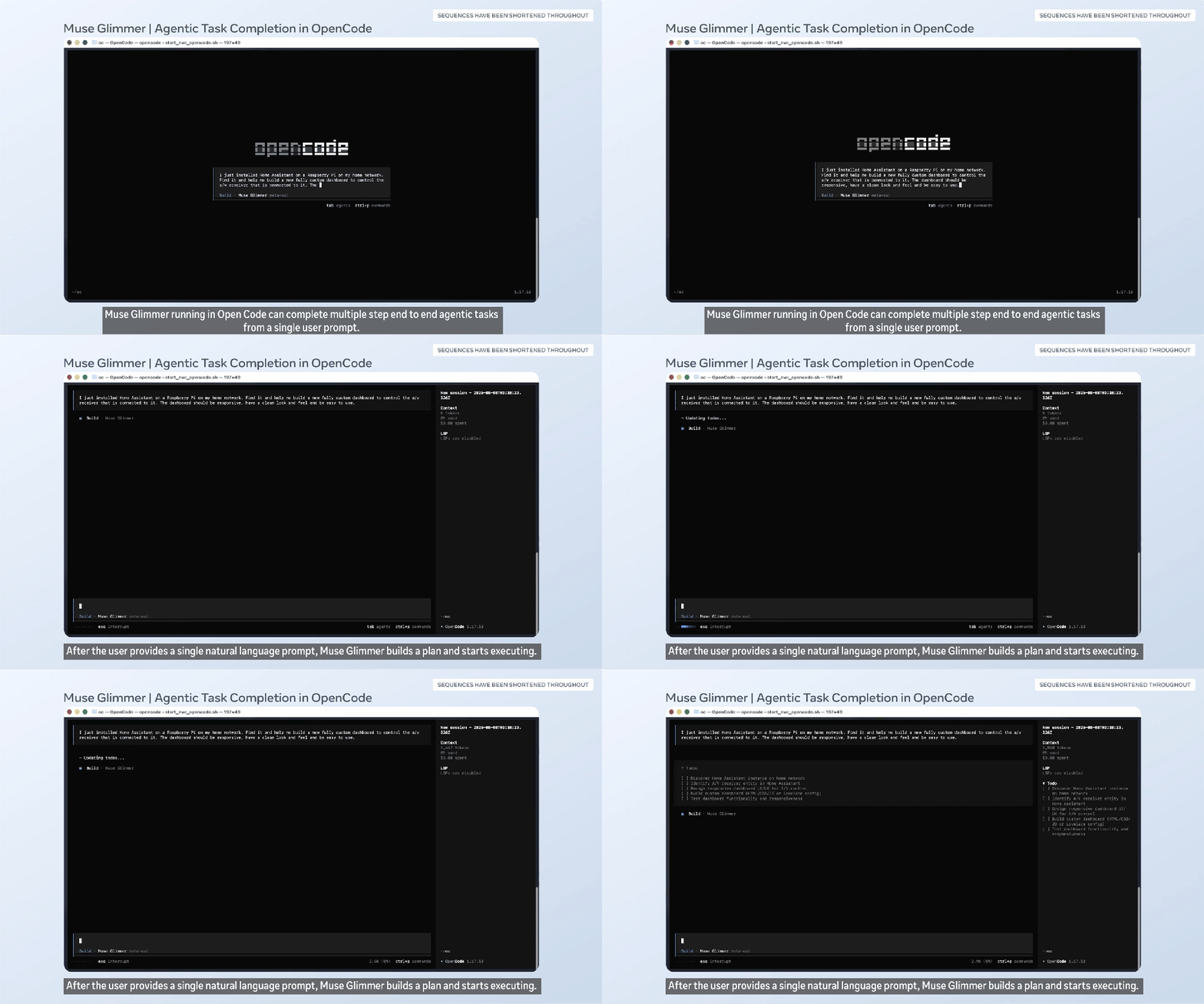
How can a 30B large model fit into a personal computer? Meta has the following cutting-edge optimizations.
Extreme Compression: Perfect Slimming to Under 20GB
Under conventional precision standards, a 30B model takes up at least 55GB of video memory, which far exceeds the limit of consumer-grade graphics cards.
To solve this problem, the Meta team adopted 4-bit quantization compression technology, successfully compressing the model weights to less than 20GB.
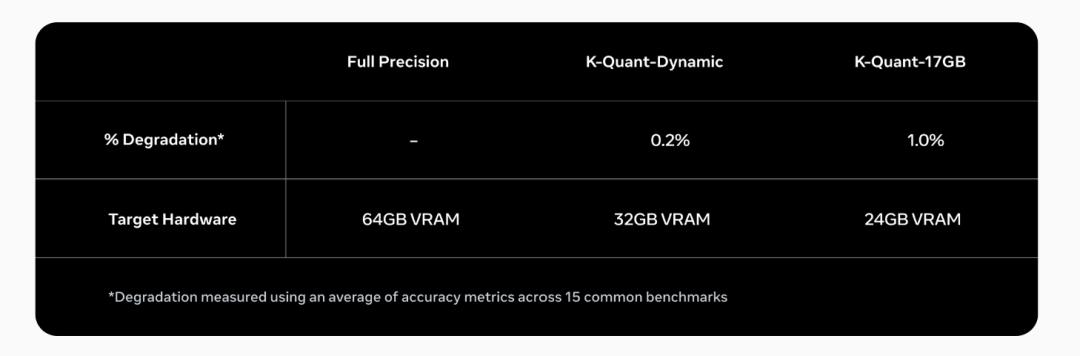
What is even more remarkable is that this extreme compression barely causes any performance degradation on agent-related tasks.
From now on, on devices with 24GB VRAM (such as RTX 3090/4090) or 32GB unified memory (such as Mac devices), users can not only run this model, but also reserve sufficient space for its "visual perception encoder" and context cache.
DFlash Speculative Decoding: Skyrocket the Generation Speed
What is the most annoying part of running large models locally? The slow speed.
The model generates output word by word at a very slow pace, which completely ruins work efficiency.
To address this issue, Muse Glimmer comes with a lightweight "draft model" built on the DFlash technology.
This small model will "guess" a large segment of Tokens at one time, and then submit them to the main model for parallel verification. The correct parts will be kept, and the wrong parts will be corrected.
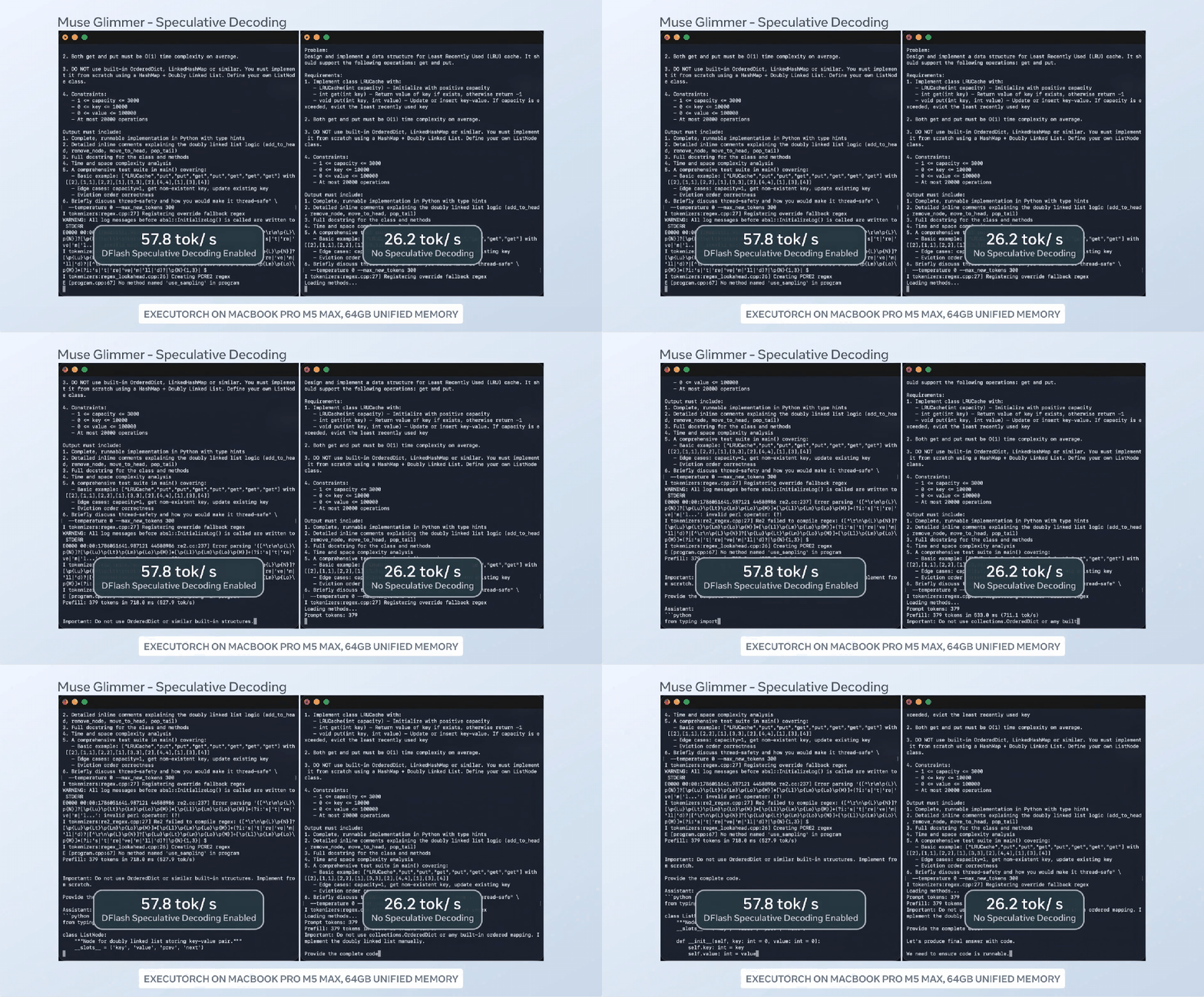
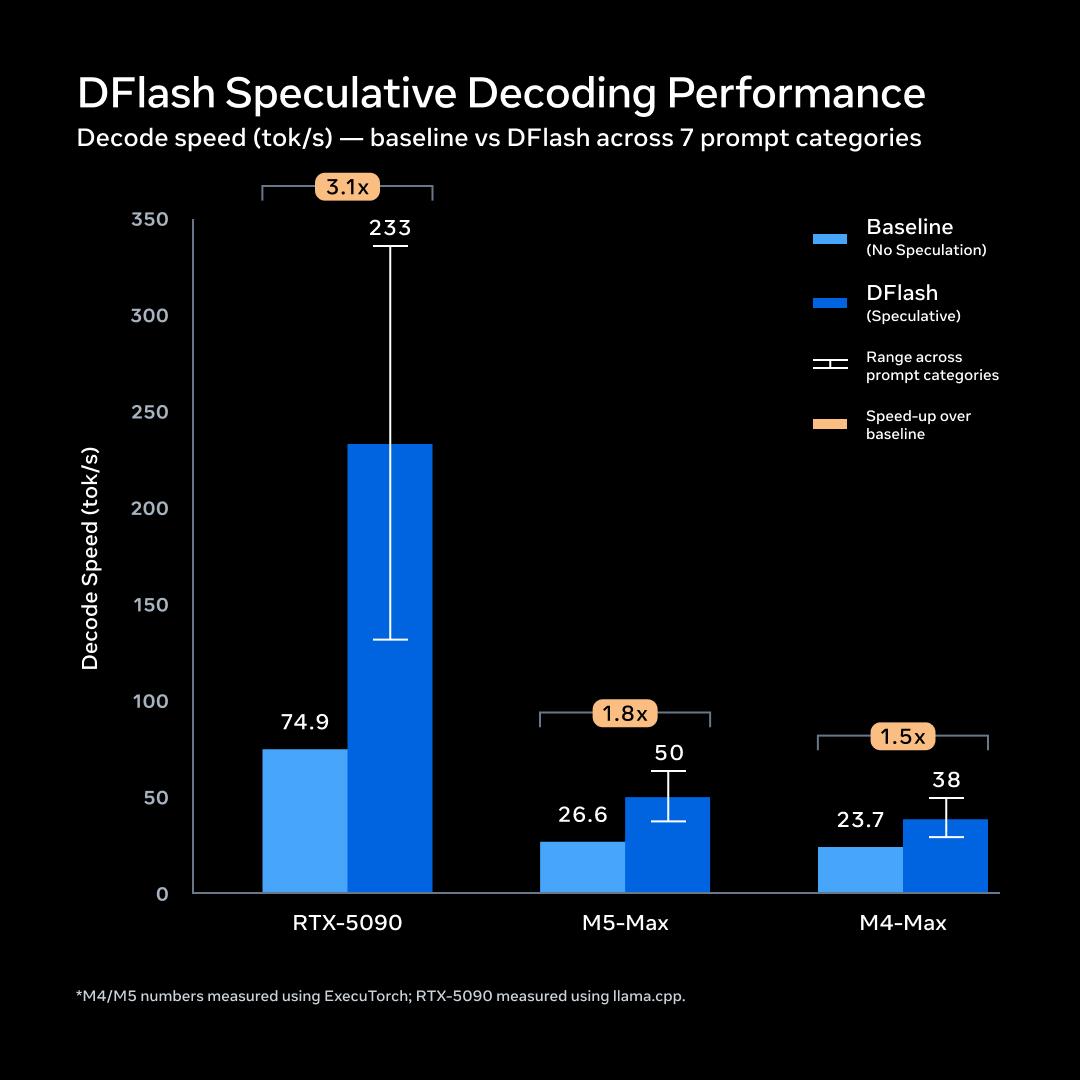
With this "speculative decoding" technology, without sacrificing any output quality, the generation speed of Muse Glimmer on RTX 5090 has been increased by 3.1 times directly!
It also runs extremely fast on MacBook M4-Max and M5-Max, supporting smooth real-time conversations and complex code generation tasks.
A True Agent-Oriented Model
Furthermore, Muse Glimmer is not just positioned as a large language model, it is specially optimized for agent workflows.
It is trained via "logical distillation" from Meta's top closed-source large model Muse Spark, inheriting the core capabilities of this top-tier model.
It has five core superpowers.
- End-to-end task completion: It delivers outstanding performance in extremely challenging tests such as DeepSearch QA and SWE-Bench, and can help you write code, debug, and look up reference materials from start to finish.
- Reliable tool invocation: It can accurately identify when to call the calculator, when to search local files, and when to run code.
- Failure recovery capability: This is the most critical capability for agents. When the code reports an error or the tool invocation fails, it will not crash and stop working, but automatically diagnose the error, modify the parameters and retry just like a human programmer!
- Long-range multi-step reasoning: It can formulate long-term coherent plans, and will not lose track of context in the middle of tasks.
- Multimodal understanding: It can directly read your screen screenshots, charts and documents, and realize reasoning across text and images.
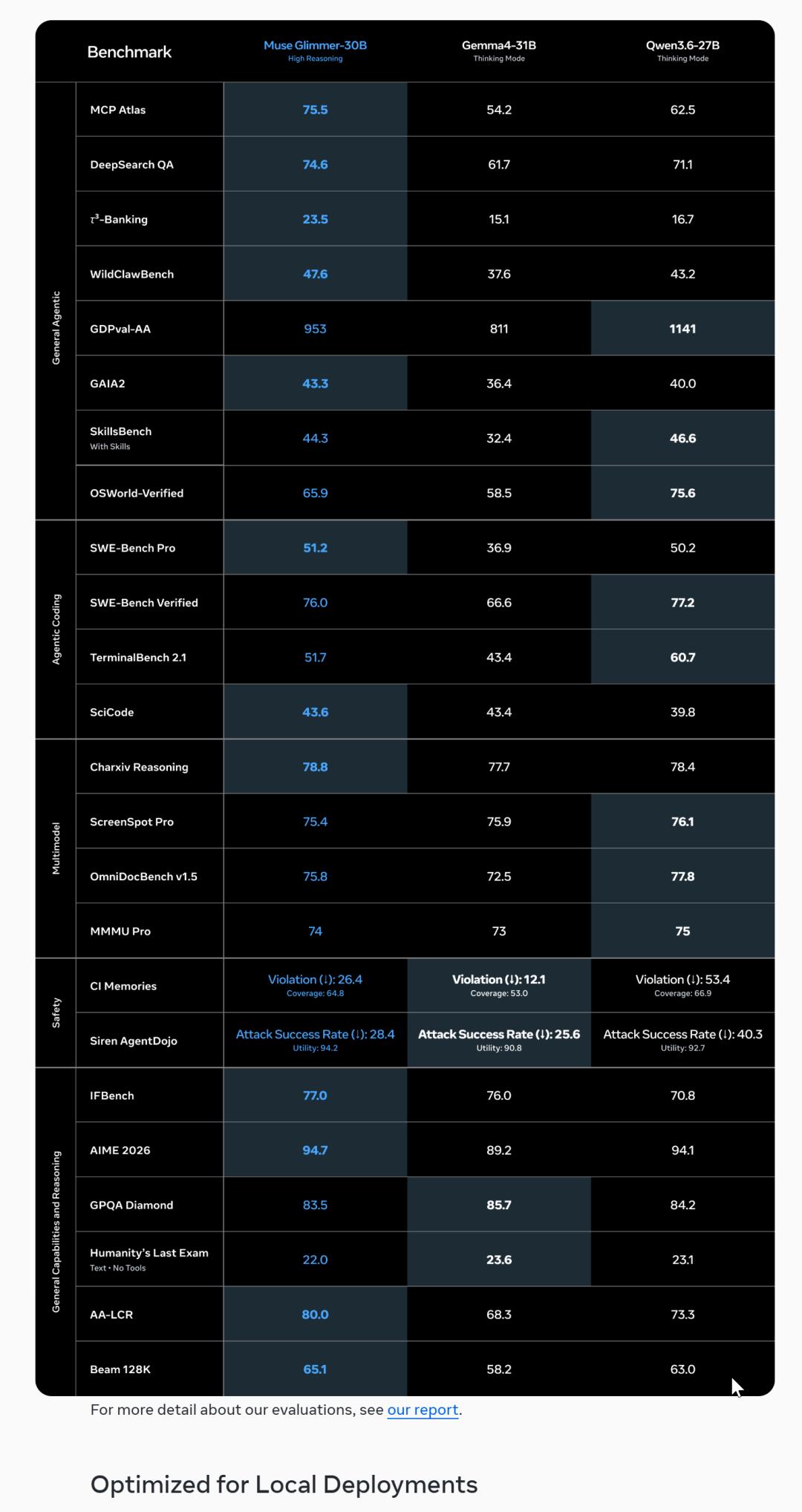
In various benchmark tests, Muse Glimmer performs on par with Gemma4-31B and Qwen3.6-27B among models of the same parameter size, and shows astonishing performance in "agent operation" tasks.
Most importantly, it is released under the Apache 2.0 license!
This means that both individual developers and enterprises can use it for free for commercial scenarios.
Its model weights have been available on Hugging Face, and will soon be fully integrated into mainstream local operation tools such as Ollama and LM Studio.
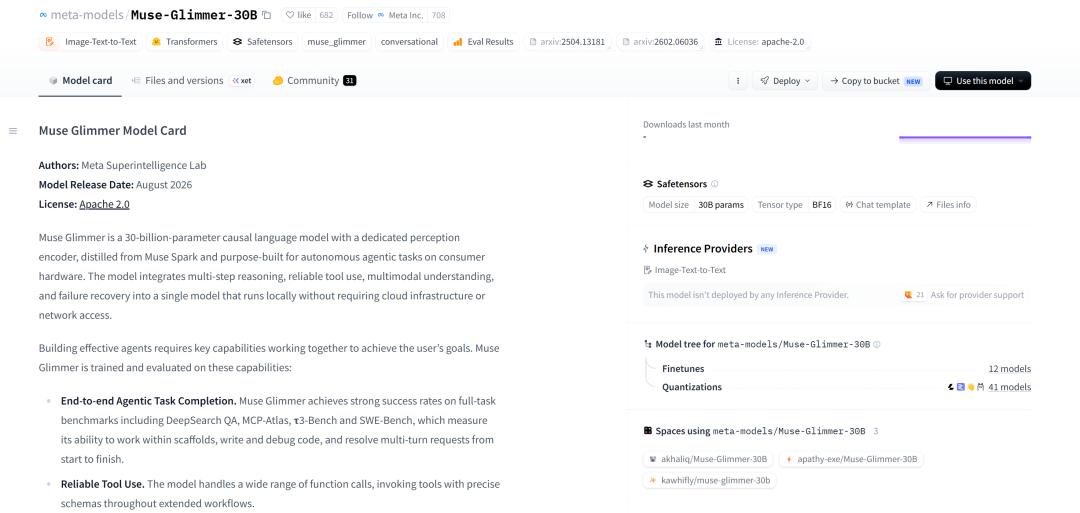
https://huggingface.co/meta-models/Muse-Glimmer-30B
Zengyi Qin, former head of evaluation at Meta's Superintelligence Lab, analyzed that Muse Spark will exert a dimensionality reduction impact on global open-source models.
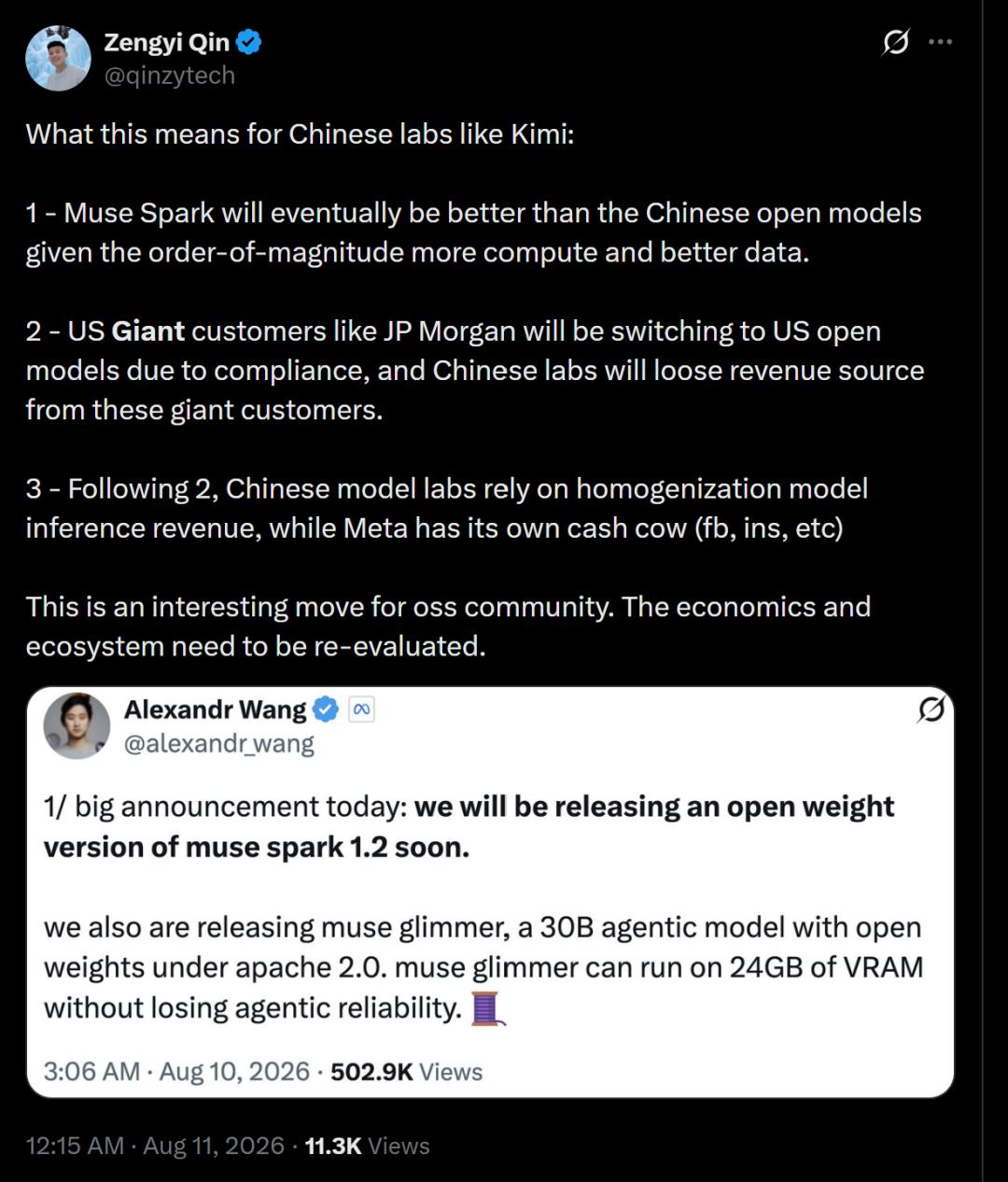
The reason is that Meta's infrastructure budget this year is as high as 145 billion US dollars, which grants Meta far more computing resources than its peers; it also has advantages in compliance.
Most crucially, why does Meta choose to open-source the model? Because it does not need to make money by selling API services at all!
A 30B free model released under the Apache 2.0 license will bring a huge impact to the commercial logic of open-source AI labs.
Zuckerberg's 10,000-Word Manifesto,
Fully Exposes the False Facade of Silicon Valley's "AI Security" Narrative
At the same time, Mark Zuckerberg published a 10,000-word long article, which can be regarded as a declaration of war from Meta to the entire closed-source camp!
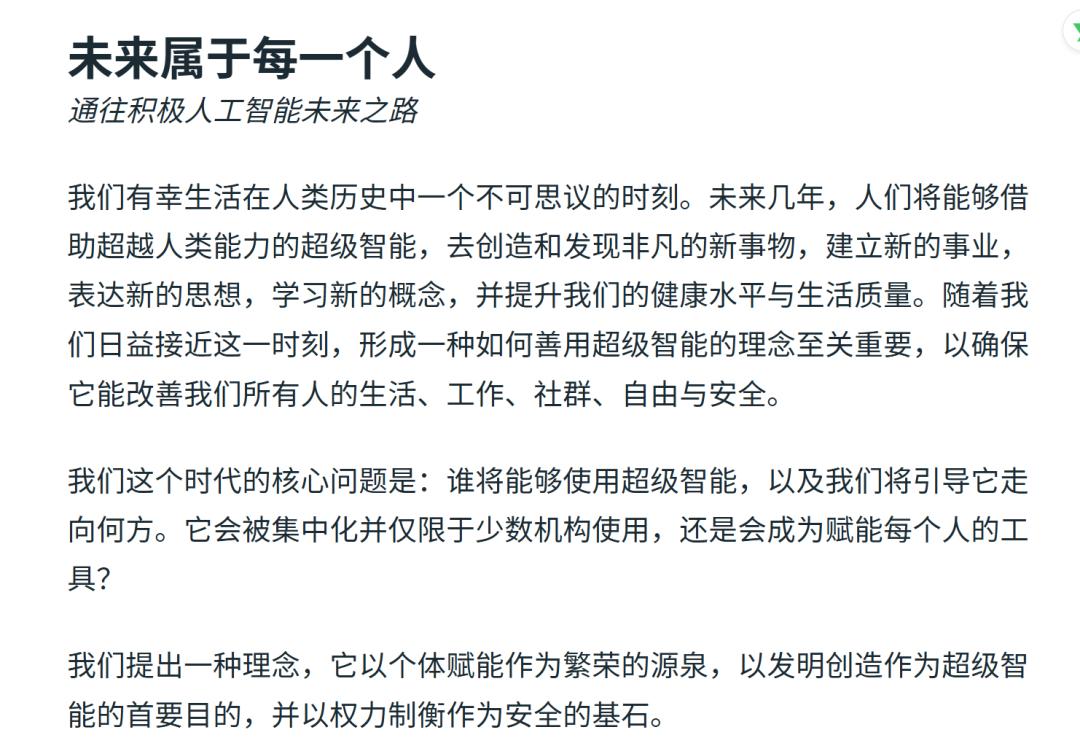
This article shocked everyone: it is rare to see Zuckerberg make such a strongly aggressive statement.
The core idea of the article is: Superintelligence must belong to everyone. Concentrating superintelligence in the hands of a few people is the biggest danger facing humanity!
Fierce Criticism of the "AI Doomsday Theory" and Power Centralization
As we all know, there are two companies in Silicon Valley that are particularly keen on promoting this narrative: AI is so dangerous that it may destroy humanity at any time, so it must be locked in the hands of a few elite companies.
Zuckerberg issued a fierce criticism against this:
The idea that AI is so dangerous that the only safe path is extreme centralization of power has inherent flaws. Throughout history, counting on absolute power to be benevolent enough to take care of all humanity has never brought safe or positive outcomes.
He gave an example: If only one person in the world owns a "superintelligent lawyer", he will have absolute advantage in the court, which will push the whole society backward. But if everyone has such a lawyer, the world will become far more fair instead.
Similarly, if only a few people master super AI for hacking, it will be a disaster, but if everyone has super AI to provide defense capabilities, the world's entire digital infrastructure will be impregnable.
"True security comes from checks and balances of power, not monopoly of power."
Disruptive View on "AI Alignment": Who Should AI Obey?
Regarding AI alignment, Mark Zuckerberg put forward a famous viewpoint:
Humanity is not a single culture... There is no single technical solution that can satisfy all the conflicting interests of all people. Therefore, no single superintelligence can be benevolent to everyone.
He harshly criticized the practices of competing products: A leading model refused to help the user draft a letter to the school, just because its internal team thought "standardized exams are unethical"!
This is not alignment at all, this is "imposing the company's dogma on users"!
Meta proposes that AI must be aligned with the personal goals and values of individual users, rather than the values of Meta as a company.
To achieve this goal, Zuckerberg promised that Meta will provide a "fully private mode" for personal Agents, which is as secure as the end-to-end encryption feature of WhatsApp.
The Life and Death of the Open-Source Ecosystem, Pointing to the US AI Regulatory Policy
In the second half of the article, Zuckerberg expressed strong dissatisfaction with the current AI regulatory policy in the United States.
He said that these excessively strict restrictions are "giving a big gift to competitors".
What's more, Zuckerberg even publicly voiced his support for model distillation technology!

He pointed out that learning from other models is an important principle for the operation of the open-source ecosystem. "Every AI model is derived from human knowledge... You should be able to learn from anything you can observe, that is how the world works."
In fact, Muse Glimmer is distilled from Meta's own Muse Spark. Zuckerberg called on the US government to relax restrictions on training data and distillation technologies, otherwise the US open-source AI industry will lose its competitiveness.
He also believes that restricting US open-source models cannot solve any problems, but will weaken the discourse power of the United States in the global AI ecosystem.
He warned that if the United States imposes unnecessary restrictions on its own, emerging open-source AI projects from other countries will quickly fill the gap, making the United States lose the opportunity to define global AI standards.
At the