AI is eating up the internet, but we are quickly running out of content to feed it.
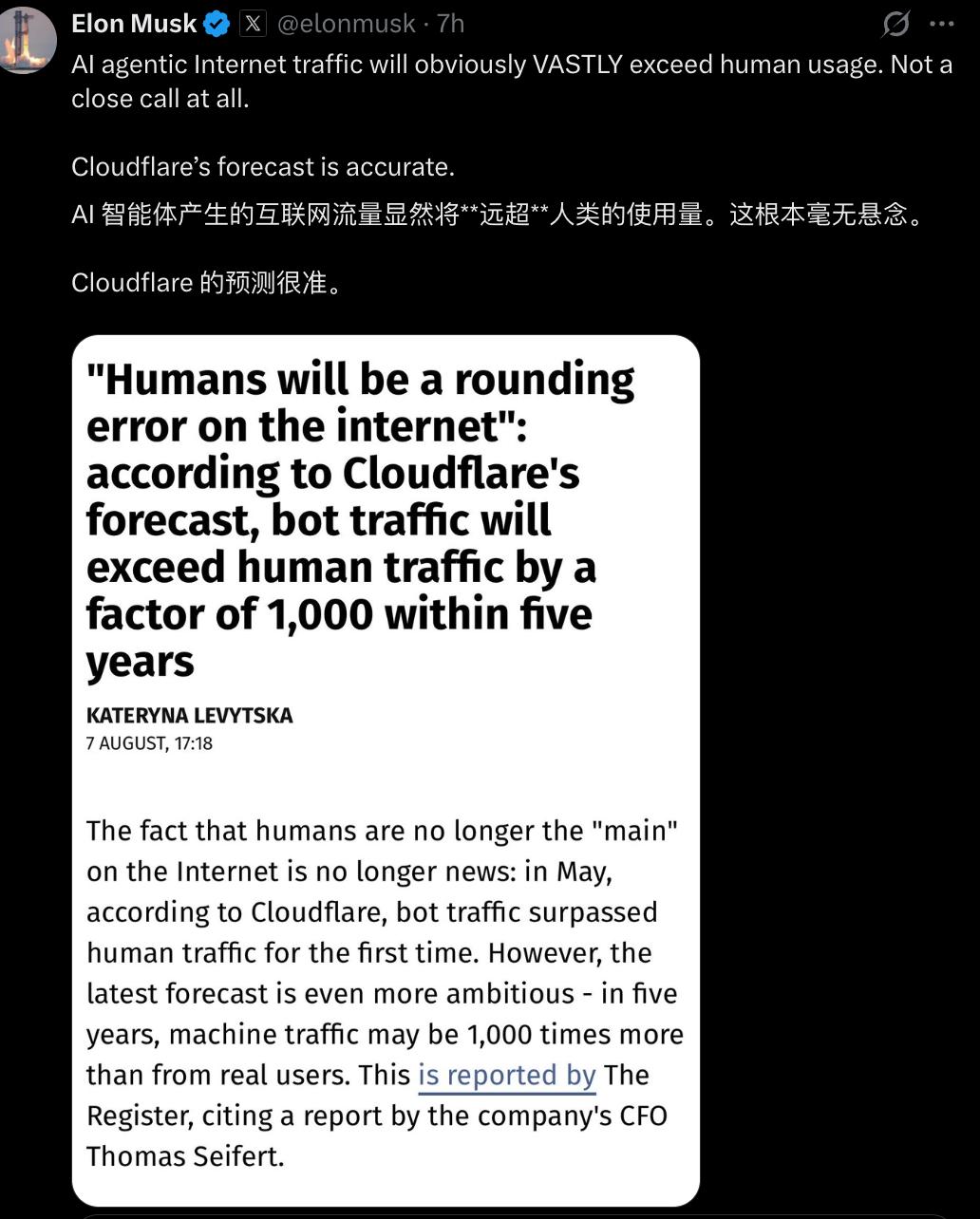
Five years from now, AI-generated traffic on the internet will be 1000 times larger than human-generated traffic. Humans will no longer be the primary users surfing the web, and their activity volume will not even account for a tiny fraction of the total traffic in the cyber world.
This is a prediction from Cloudflare's recent earnings call, and it is not an alarmist claim. At this very moment, access traffic generated by AI has officially exceeded that from human internet users.
No one has seriously considered whether there will still be grass growing on that pasture in the future.
According to estimates, the training of large language models will consume all publicly available human text data between 2026 and 2032. The depletion of high-quality language data may even come as early as 2026, two years ahead of the total exhaustion of all public text content.
The Sinking of Stack Overflow
Stack Overflow used to be the collective brain of the programmer community.
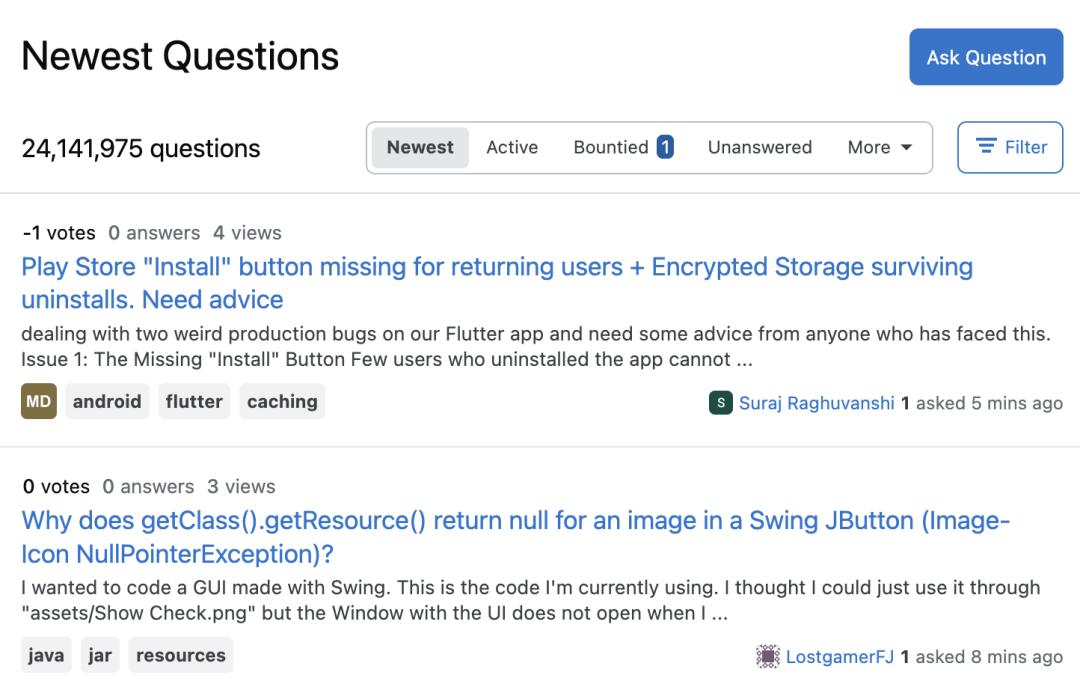
From its launch in 2008 to its peak in 2014, the platform attracted more than 200,000 new questions every month, forming a huge archive of human intellectual knowledge.
Any engineer who has stayed up to 3 a.m. debugging knows exactly that feeling: when you search with an accurate error message, the first result is almost always a Q&A posted on Stack Overflow five years ago, with answers that carry dozens of upvotes and rebuttals from other users.
However, in the two years following the release of ChatGPT at the end of 2022, the number of monthly questions on Stack Overflow dropped from over 200,000 to less than 50,000, almost returning to the level of 2009 — the period when the platform was just launched.
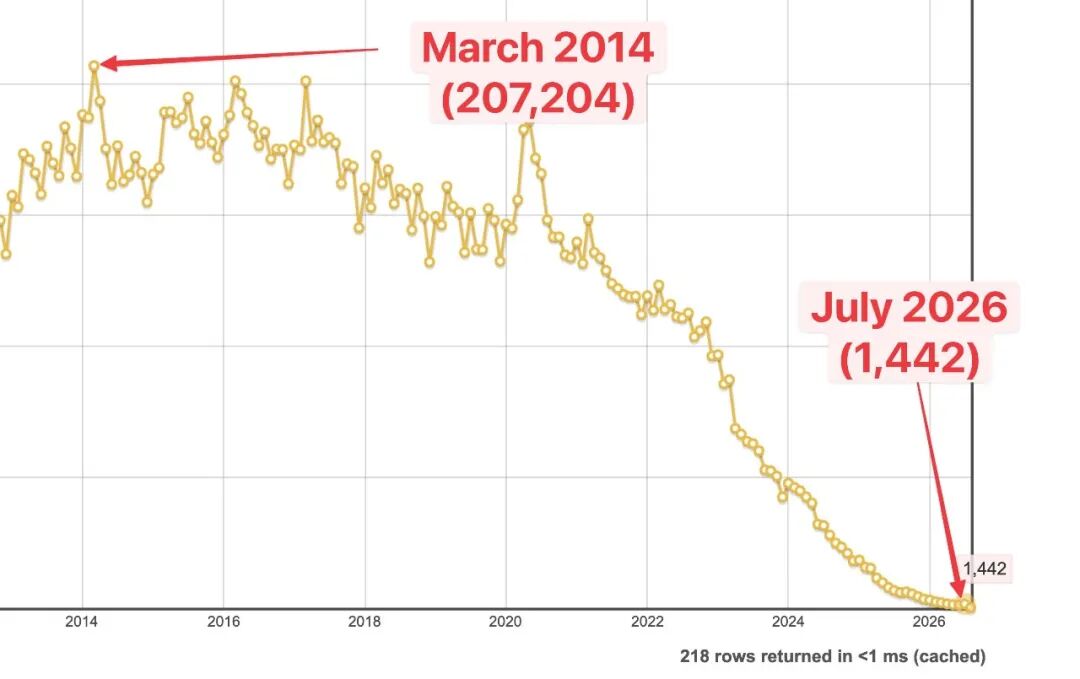
The supply of new questions has dried up. People no longer visit the platform as they turn to AI for answers instead.
According to Stack Overflow's own 2025 survey, 84% of developers use AI tools every day.
At the same time, 46% of developers do not trust the accuracy of AI outputs. Their biggest concern is not that AI gives wrong answers, but that the outputs "look correct, just with a tiny flaw", appearing to be answers from real experts. This situation makes people easily lower their guard, and puts higher demands on the personnel who perform the final review and verification.
Even around 35% of developers said they sometimes visit Stack Overflow to fix, understand or debug problems created by AI.
By analyzing the behavior trajectories of 24,304 active contributors over 17 months after the launch of ChatGPT, researchers also found that the most technically skilled and highest-reputation users on the platform are more likely to leave the platform.
This has pushed the proportion of unanswered questions on the platform from 19.9% to 25.7%, and the total volume of real, high-quality contributions has dropped by about 35%.
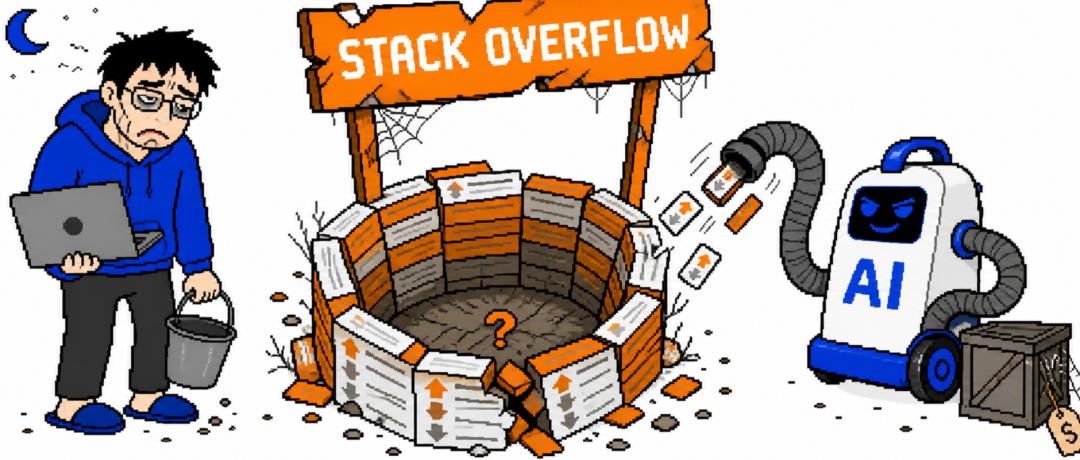
The situation has gradually become absurd: The knowledge accumulated on Stack Overflow trains AI, AI takes away the questions that would otherwise be posted on Stack Overflow, and developers then return to Stack Overflow to find solutions to the problems caused by AI.
But without a steady stream of new questions, the old answers will gradually become outdated.
Answers from five years ago may still solve problems from five years ago, but they cannot address newly released frameworks, newly discovered vulnerabilities, or brand new bugs that no one has ever encountered before.
Models can generate answers, but they cannot foresee the next new problem for humanity.
Free Riding, or the Tragedy of Public Knowledge
There is a classic proposition in economics called the "Tragedy of the Commons". On a shared pasture, every herder has the incentive to add one more head of cattle to their herd, because the benefits are private while the consumption of pasture resources is shared by all. Eventually, the pasture is overused and collapses.
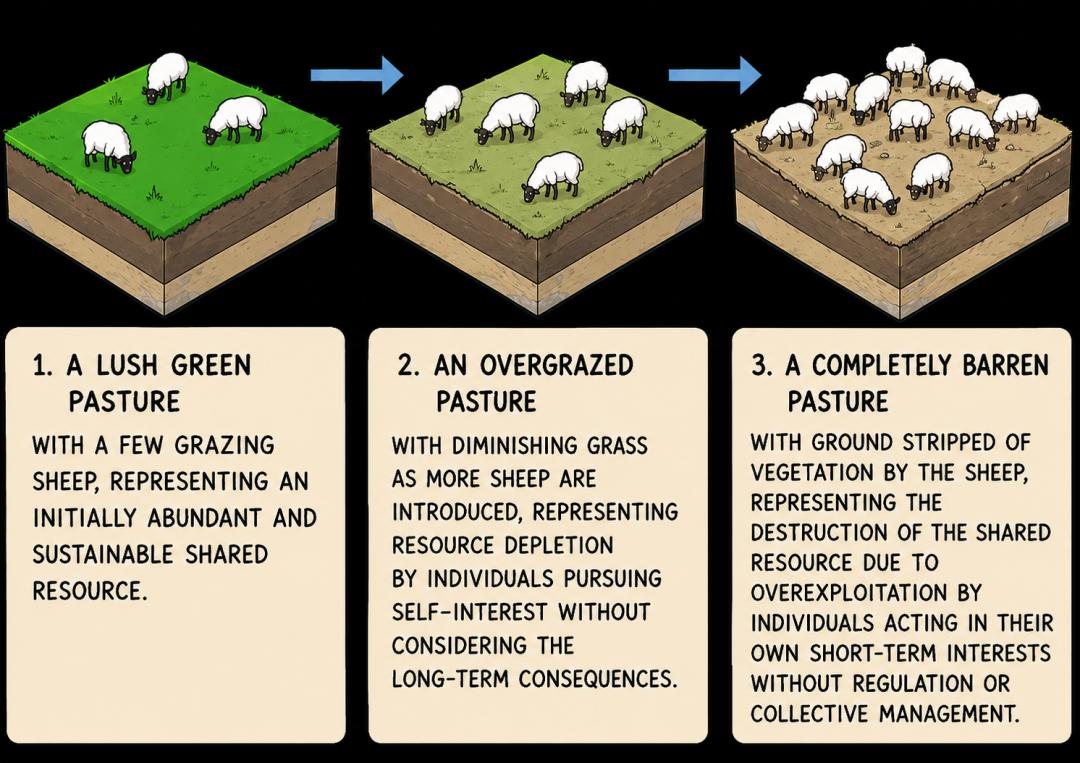
In the past, people shared knowledge because there was an implicit social contract: you contribute, others contribute, the entire community benefits as a result, and you also gain certain reputation, recognition, or learning feedback through this participation. This formed a positive cycle.
The voting mechanism and answer ranking system on Stack Overflow are both designed to encourage participation. The editing culture of Wikipedia works in the same way.
However, AI is accelerating the departure of expert contributors.
When a tool can generate sufficiently good answers at near-zero cost, the marginal benefit of "sharing professional knowledge" shrinks rapidly.
A database architect with 20 years of work experience spends three full hours writing an in-depth article on PostgreSQL tuning, while anyone can get a similar AI-synthesized piece of content just by typing a single query. Why would that architect still bother writing that article?
You might say it is out of passion, or out of the willingness to help others. There are indeed people like that. But human time is limited. As the feedback for "sharing" keeps decreasing — fewer comments, fewer citations, fewer readers — the internal drive required to keep contributing will become stronger and stronger, and people who can sustain such drive are a minority in any group.
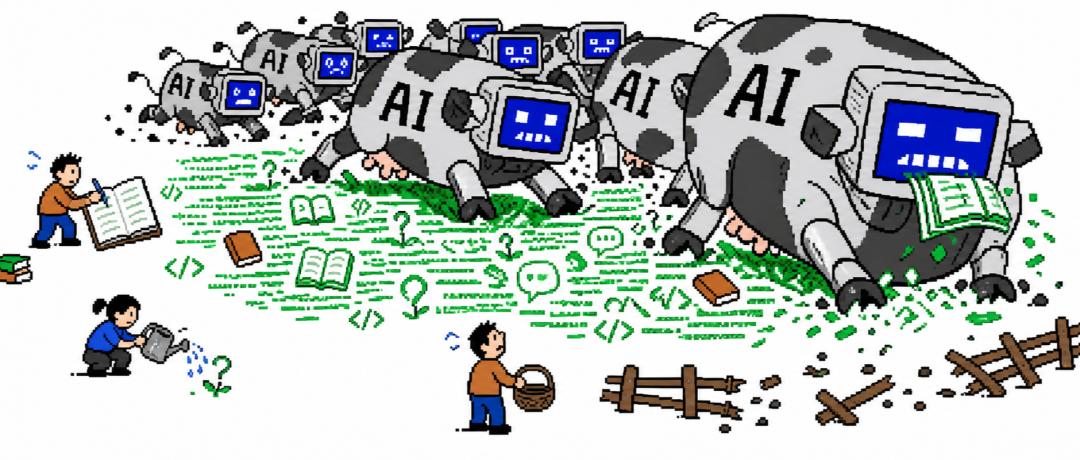
The changes brought by this may lead to valuable knowledge being moved to corporate intranets, paid communities and private chat groups; or it may lead to reduced human knowledge production, so that AI is trained on increasingly scarce data, the quality of knowledge declines, and the entire system eventually falls into a spiral of recession.
The Computer Science Version of Inbreeding
Over the past 30 years, the internet has built a great cathedral of human knowledge. Its bricks and mortar come from countless strangers who carefully answered questions on BBS, volunteers who tirelessly maintain Wikipedia entries, and engineers and researchers who debated heatedly in forums.
AI learned to speak from that cathedral.
Now, fewer and fewer visitors come to the cathedral, and fewer and fewer new bricks are produced. AI starts to fill the silence with its own echoes, so that some researchers have already begun to talk about the "inertialization" of knowledge:
Updates stop. AI consumes a slowly aging heritage, then regenerates that aging heritage, which ages again and gets regenerated once more.
In July 2024, Ilia Shumailov, a former research scientist at Google DeepMind, and several other authors published a widely discussed paper in the journal Nature.
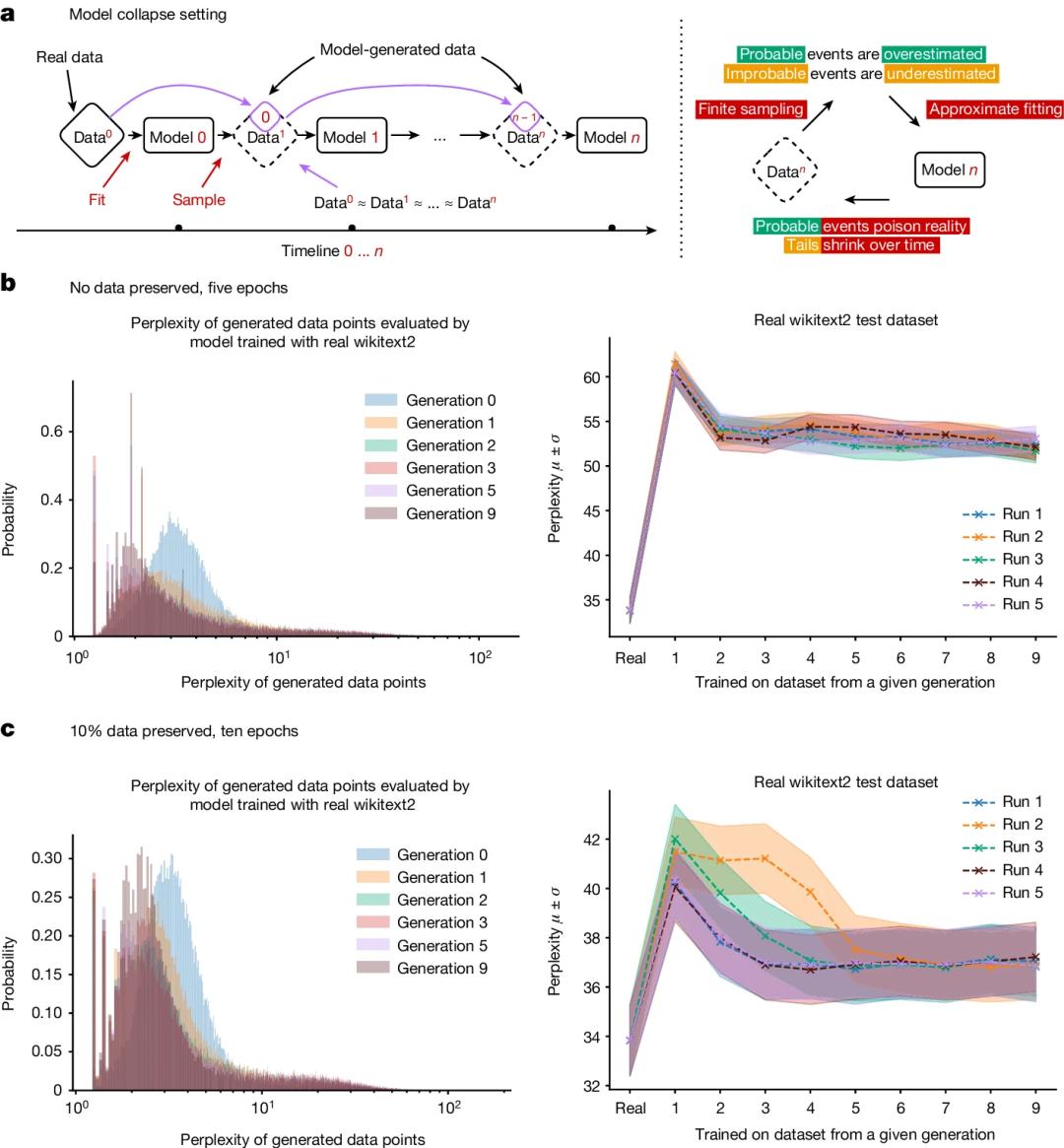
AI models collapse when trained on recursively generated data
The paper points out that systems such as large language models and variational autoencoders will experience performance degradation when repeatedly trained on content generated by themselves. In the early stage, rare patterns disappear; in the late stage, the overall output tends to be monotonous, drifting towards the average value with peculiar outliers.
Some mainstream American science media quoted a vivid statement in their reports: "Training AI on text generated by AI is the computer science version of inbreeding."
Massive amounts of AI-generated content flood into the internet. When this content in turn becomes part of the training corpus, the errors in the feedback loop will continue to accumulate, leading to an increasing deviation between the model's output and the distribution of the real world.
Who Will Grow the Next Crop of Grass for AI?
Assume that 15 years from now, AI has reached "expert level" proficiency in most knowledge domains.
At that point, who will have enough knowledge reserve to verify whether the answers given by AI are correct?
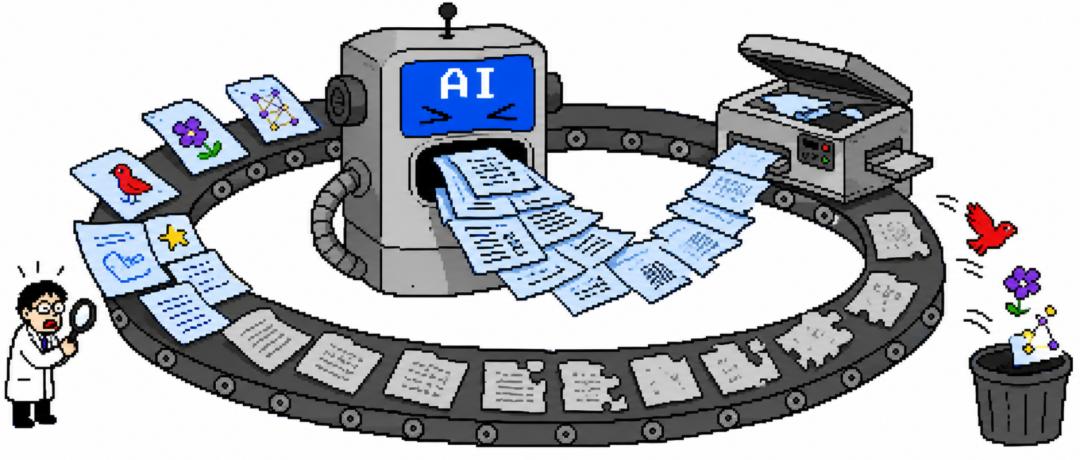
Supervising AI requires people to understand what AI is doing. But the process of cultivating "people who understand this" has already been taken over by AI. The next generation will rely on AI to learn, work, and make judgments, and eventually rely on AI to supervise AI.
Some people would say there is no need for supervision at all, just like there is no need to verify the result given by a calculator. But we all know that a calculator only executes deterministic arithmetic logic.
However, AI is not a calculator. When the complexity of AI completely exceeds the cognitive limit of individual human beings, our trust in it will helplessly degenerate from rational verification into blind faith.
A 2026 article from the World Economic Forum points out that the more capable AI becomes, the weaker human effective supervision will be, as humans take on fewer and fewer cognitive tasks, and their first-hand mastery of that work fades away accordingly.
In the future, will we need to require AI users to independently complete difficult cognitive tasks on a regular basis, just like we require pilots to perform manual flights periodically, and establish some kind of capability audit mechanism to ensure that human judgment does not atrophy unconsciously?
Human beings have a very tenacious tendency: after a certain tool greatly lowers the threshold of a certain type of knowledge, new, higher-level demands will emerge instead.
The involvement of AI may force knowledge production to move into the deep water zone that "cannot be replaced".
But this requires a prerequisite: the value of cognitive labor must be recognized, acknowledged, and returned to the creators in some form.
We need to provide more sources for answers, and more importantly, reserve the opportunity for the next generation to learn independently and make mistakes without relying on AI.
The collective wisdom of human civilization is not a data packet that has already finished downloading. It is composed of collective memory, collective attention and collective reasoning, which requires continuous debate, revision and supplementation by living people.
AI can enhance part of it, but if human participation itself atrophies, these three elements will lose their living source, leaving only an increasingly sophisticated echo chamber.
AI can distill all past knowledge, but it cannot conjure up a group of people willing to take responsibility for the future out of thin air.
We keep saying that models need computing power and tokens, but there is another very important requirement: people who step into the real world, discover new problems, and are willing to make their answers publicly available.
The best knowledge base is not necessarily the one that provides the most authoritative and correct answers, but the one that people will always come back to modify and constantly update.
AI is running at full speed, but the knowledge pasture will not automatically grow the next crop of grass just because the cattle are running faster.
This article is from the WeChat official account "APPSO", author: APPSO that discovers tomorrow's products, published with authorization from 36Kr.