Qwen is bustling with high-profile activities in the public spotlight, while ERNIE stays quiet and low-key at the underlying technical level.
On the afternoon of August 8, Apple China quietly posted a document on its official website, titled "Use Qwen with Apple Intelligence on Mac". This marks the first time Apple has officially confirmed in the form of official documentation that Qwen is integrated into Apple Intelligence for Chinese mainland versions of devices. The document details how users can use Qwen on Mac for writing, text comprehension, information query, and even comes with operation screenshots. Many tech bloggers took screenshots and reposted them immediately, and tutorial posts quickly emerged on social platforms, with some users starting to follow the steps in the document to try to call the Qwen function. Less than a day later, the document was removed, the link became invalid directly, and those newly posted tutorials turned into 404 references.
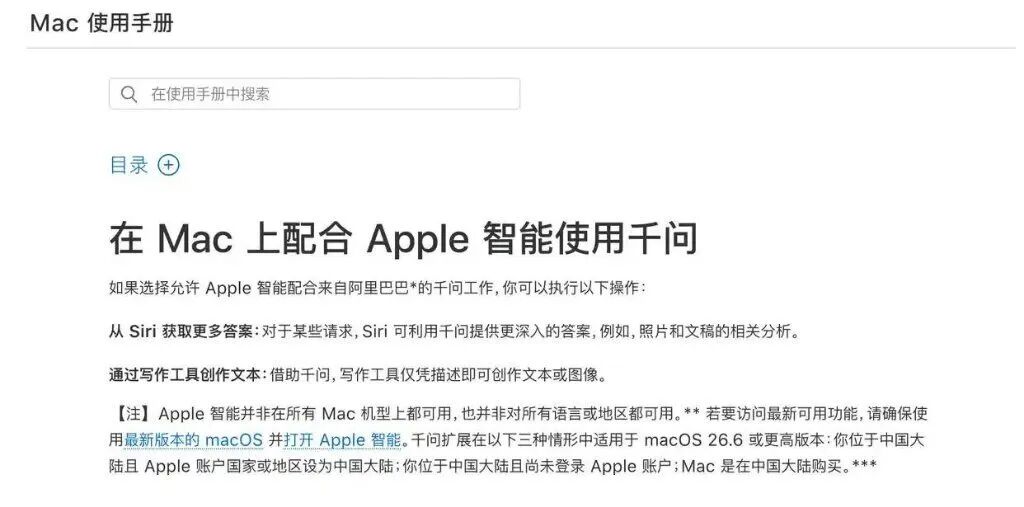
Apple's own statements were not aligned. Its customer service told some platforms that the approval is still in progress, while told other platforms that no relevant intelligent functions are under application for the time being. At the official level, it told the media that it was just a regular content update, and the framework of cooperation with all parties remains unchanged. For the same incident, there are three different statements, none of which match. And the other supplier, Baidu, has not made any statement from start to finish.
Apple's AI for Chinese mainland devices adopts a dual-supplier architecture. On July 8 this year, Apple Technology Development (Shanghai) Co., Ltd. completed the filing of generative AI services, which was publicized by the Cyberspace Administration of China on July 15. The architecture was then clarified: Alibaba's Qwen is responsible for the core generative AI, while Baidu is responsible for search and visual retrieval. After the filing, the two parties embarked on completely different paths.
Front Stage and Behind the Scenes
Qwen has been making non-stop moves. As soon as the filing was publicized in July, Alibaba officially confirmed that Qwen is system-level integrated into Apple Intelligence for Chinese mainland devices, covering all iOS and macOS platforms. Although the document posted on August 8 was removed in less than a day, the market reaction spoke for itself. According to market data, Alibaba's Hong Kong stock rose nearly 3% intraday that day, and the market generally linked this trend to the launch of the Qwen document. Two days later, the Qwen Open Platform was released, covering more than ten livelihood fields such as house rental and express delivery, supporting access from three types of terminals: mobile phones, PCs and AI glasses. Developers can directly call Qwen's capabilities on the platform and integrate them into their own applications.
Qwen's presence in the Apple ecosystem is genuinely built up by users and the media together. After the document was launched, users spread it through screenshots, and its sudden removal triggered media inquiries. When the open platform was released, developers gathered to check the interfaces. This kind of fluctuation itself became a hot topic. Even after the document was removed, the discussion did not stop, instead, more people learned that Qwen is about to be integrated into Apple's system.
Baidu's situation is completely different. Over the past month, there have been almost no public actions related to Wenxin Yiyan in the Apple ecosystem. On August 9, some media quoted Apple's statement that Baidu's model is being adapted and has entered a small-scale internal test. Apart from that, no relevant documents can be found on the official website, there is no movement on the open platform, no official announcement has been released, and the stock price has remained completely stable. It did not even get the chance of having its content removed, because the relevant content was never launched in the first place.
The boundary between the front stage and behind the scenes has been drawn since the day of the filing.
From Being Polished by Apple to Taking a Supporting Role
Baidu's silence is not without reason. Looking back to December 2024, according to reports from multiple tech media outlets, Apple was then cooperating with Baidu to debug the Wenxin large model to adapt it to iPhone. That was the closest Baidu had ever been to the core position of Apple's AI for Chinese mainland devices. Apple personally polished Baidu's model, trying to make it the main AI engine on devices sold in Chinese mainland.
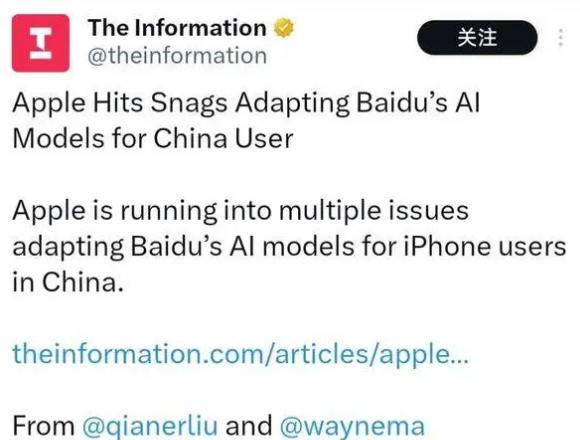
However, the same report pointed out that the model had problems in understanding prompts and making accurate responses to common scenarios, and the two sides also had differences in data privacy rules. This node is very critical. In the C-end generative interaction track, Baidu failed to get Apple's core admission ticket.
By 2025, the caliber of public reports changed. Some media reported that Apple's AI for Chinese mainland devices shifted to a dual-track parallel model of Alibaba and Baidu. It changed from Apple focusing on polishing Baidu's model alone to the two suppliers working in parallel. In June this year, the identifiers of SearchPartnerInferenceProvider and Baidu Visual Search appeared in the iOS 20 Beta 2 firmware code, further clarifying Baidu's role. It has no share in the generative AI core brain, and is only responsible for search and visual plugins.
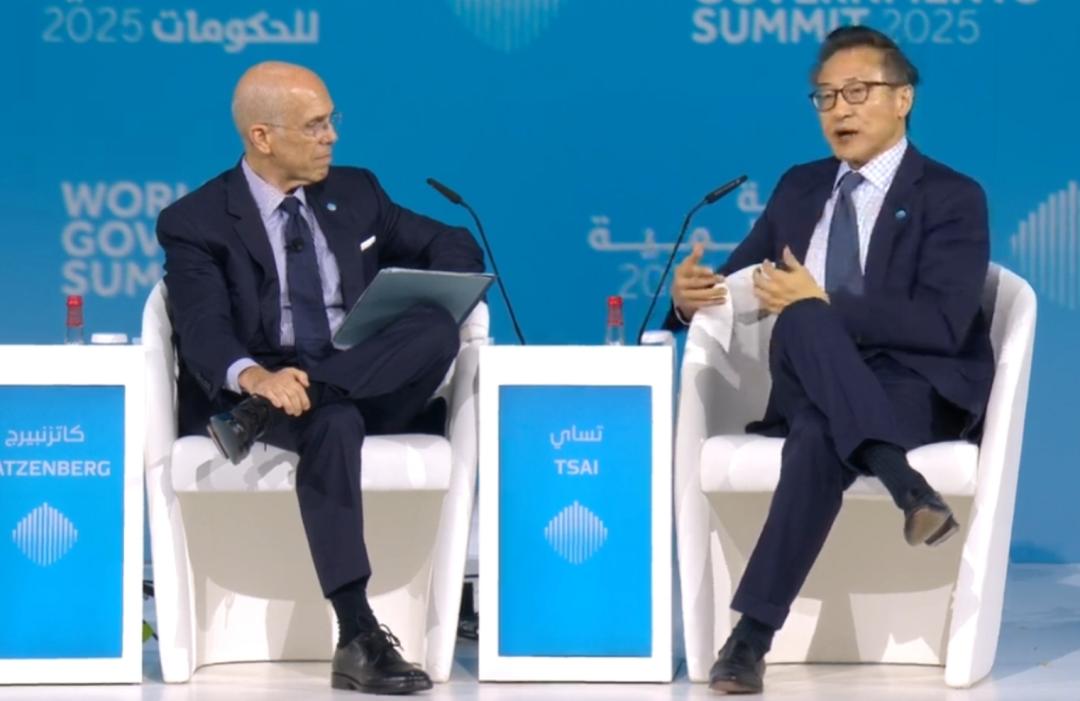
After the filing was finalized in July, Joseph Tsai publicly confirmed that Qwen is the core AI capability provider, and Baidu's role was clearly defined as search and visual support. This timeline points to one thing: Baidu fell behind in the core generative AI track first, and then was adjusted to its current supporting position. Alibaba did not take its position, it just failed to catch the admission ticket to the core field. Neither Apple nor Baidu has stated at which specific node it fell behind, or who is responsible for it.
Qwen is responsible for writing, comprehension and generation, which can be directly perceived by users, so it has to be high-profile. Baidu is responsible for search and visual retrieval, hidden under the underlying layer of Siri and the system. Users will most likely not know that they are using Baidu even if they use its functions. Baidu has no choice, it is placed in a position invisible to users.
Conclusion
According to Tim Cook, the first batch of functions has been approved, and Apple has officially announced that they will be launched in batches. The market expects that they will be rolled out as soon as the fall system update. At that time, when users turn on their iPhones, Qwen will be responsible for writing, generation and understanding complex instructions. Baidu's search and visual functions are hidden in Siri. It does exist, but users will not pay an extra penny for it, nor will they know that they are using Baidu's services.
Apple's pluggable multi-supplier architecture adopts ChatGPT plus Gemini overseas, and Qwen plus Baidu in Chinese mainland. In essence, it treats partners as components in the system, not equal brand partners. Whoever can enter the dialogue layer of Siri can hold the user cognition. Qwen has obtained the entry to the dialogue layer, and users know that Qwen is working every time they use it; what Baidu gets is the underlying system retrieval call, and users can't even perceive its existence.
Qwen has been making frequent moves because generative AI must be seen by users. Wenxin Yiyan keeps a low profile because it is arranged in the invisible layer. Baidu has obtained an entry in the Apple ecosystem, but this entry does not generate direct user cognition for it, nor does it bring any willingness to pay from users.
This article is from the WeChat official account "AI Contrarian", written by Li Xiaowen, and authorized for release by 36Kr.