Behind the nearly 4 billion yuan financing: Why is capital bullish on Pacini?
Over the past two years, large models have improved robots' capabilities in understanding tasks, deconstructing instructions and planning movements, and vision models have also made machines better at recognizing objects and judging spatial positions. However, once a robot actually extends its manipulator to make contact, the problem will quickly shift from "what is seen" to "what happens after contact". When a robotic arm inserts a wire harness into the interface, even if the vision system has confirmed the position is correct, the action may still fail: the insertion force suddenly increases, the part deflects, or the material starts to slip. For humans, these judgments are completed instinctively through fingertips; for robots, they rely on tactile perception and closed-loop control.
This is also the reason why tactile sensing has stepped into the "spotlight" at the current stage of the embodied intelligence industry.
At the node when the industry is shifting from prototype competition to delivery competition, Pacini has completed a new round of 10 billion yuan in financing, with total accumulated financing approaching 40 billion yuan; at the same time, the company has relocated its headquarters to Beijing and completed the shareholding system reform. Putting the three events together, it is more like a signal of track stage transition: embodied perception is no longer only about verifying technical feasibility, and leading enterprises have begun to leverage their capital, organizational and ecological capabilities to amplify the already formed technical and commercial advantages.
According to public information disclosure, this round is jointly led by global consumer electronics and semiconductor industry giants (combined with the investor profile, the leading investor of this round may refer to Samsung), BOC International Investment, Kunpeng Fund, and Hexin Fangce, with joint investment from CDH Wealth, Chengdu Jiaozi AI Fund, JM Capital, Jinrong Guosheng, and continued additional investment from old shareholders including Zhilai Capital. The investor lineup covers industrial capital, national financial forces, regional AI funds and market-oriented institutions, which not only provides the company with funds, but also supports supply chain, industrial implementation, governance and global scenario connection.
Tactile Sensing Evolving from an "Optional Item" to a Core Control Link
Tactile sensing used to be frequently evaluated within the map of robot components, with focuses concentrated on dimension, range and resolution. When entering real tasks, its value is closer to a part of the control system: robots must read the contact result, judge whether the action deviates, and make timely corrections.
Traditional automated equipment completes tasks relying on structured environments, fixed workstations and preset programs, and perception only needs to confirm whether the object exists and whether the position is correct. Embodied intelligence faces continuous changes: the same cup requires different gripping strategies when it is empty, half full and full; when the angle, friction and material state of the same wire harness change, the insertion resistance will also differ. If a robot can only perform pre-planned actions, it remains a more flexible automated device, rather than an intelligent agent that can adapt to the physical world.
Therefore, the way tactile sensing creates real value is to enter the physical closed loop: the sensor obtains contact information, the acquisition system synchronizes the information with tasks and movements, and the execution end adjusts the control according to feedback. If any link is missing, tactile sensing may remain at the stage of parameter display, and it will be difficult to translate it into task success rate.
Full-link Layout Native to Embodied Intelligence
If Pacini is only summarized as a tactile sensor company, the most critical formation logic of its technical system will be missed. Pacini's goal since its inception has been to accelerate the implementation of embodied intelligence. Centering on this goal, the company has simultaneously deployed three major technical directions: tactile sensors, embodied data acquisition, and tactile integrated terminal execution. The three are not a time sequence of "making sensors first and then extending to upstream and downstream", nor are they a product platter after business expansion, but a set of parallel systems that define the technical map in reverse from the real tasks of robots.
Tactile sensors are responsible for converting physical contact into computable signals. Based on the HAPTA heterogeneous multi-core array architecture, Pacini's current products can provide up to 717 channels of tactile signals, while taking into account high-frequency output, micro-force recognition, IP68 protection and a measurement lifespan of more than 10 million times. This means that its products not only have high accuracy, but also possess the reliability and consistency required for large-scale installation.
The full-modal acquisition system deployed synchronously with perception technology aligns tactile sensing with vision, joint status and motion trajectory, forming data that can be used for model training; dexterous hands and robot bodies test the model and control effects in real tasks. The execution results flow back continuously to iteratively optimize sensors, data and algorithms. The three technical lines thus form a closed loop, pushing the competition dimension from single device parameters to the task success rate and large-scale delivery capacity of robots.
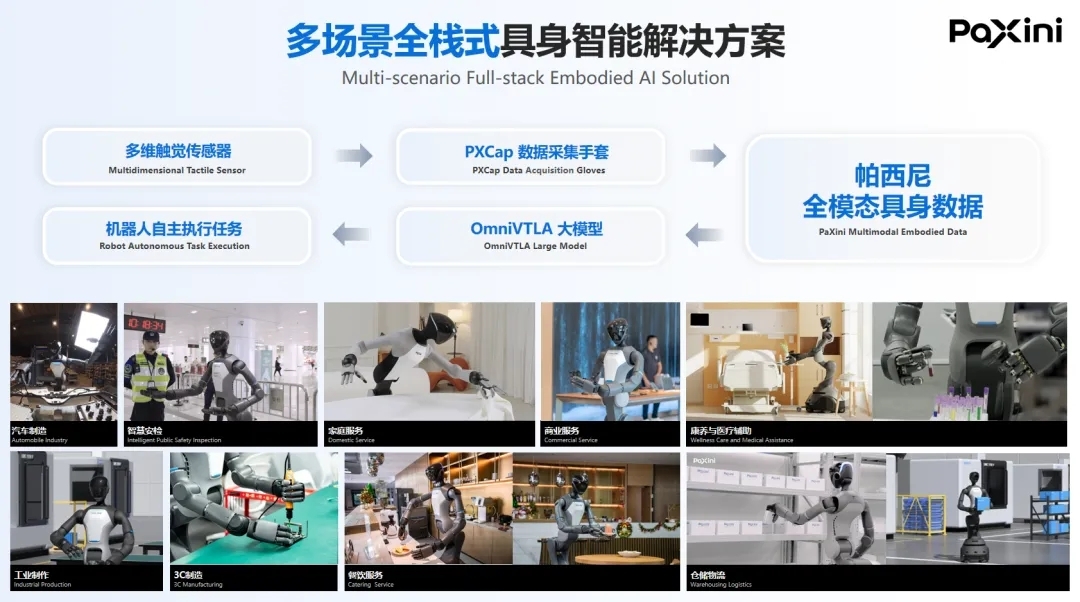
This closed loop is not self-verified internally, but has been double verified by large-scale application and external adoption. In the past year, the consumption of Pacini's self-developed tactile chips has approached 1 million units, and its full-modal data has been adopted by many leading embodied intelligence foundation model enterprises and large Internet technology companies. The company has also participated in the formulation of relevant national and international standards. The three progresses respectively reflect the hardware large-scale capacity, the external application value of data, and the company's discourse power in the construction of industry standards.
The Capital Logic Has Changed: From Buying Possibility to Buying Compound Interest
Back to the continuously "hot" capital sector. In a truly blank track, it is a reasonable strategy for capital to sow widely. When the technical direction has not yet converged, multi-project coverage can purchase options. However, when leading enterprises have crossed the thresholds of productization, data closed loop, commercial delivery and organizational scaling, the investment logic must change. When capital examines new embodied perception projects, it needs to ask: what irreplaceable increment does the latecomer bring exactly?
Does it bring new perception modalities that cannot be covered by existing solutions? Can it achieve order-of-magnitude improvements in cost, lifespan, volume, power consumption or consistency? Can it solve new scenario problems? Can the technical advantages recur in real tasks? Even if the product is feasible, what is the time and capital cost to catch up with leading enterprises?
If there are no answers to these questions, and only a similar map of "sensor + dexterous hand + data + model" is rebuilt, what capital buys is not innovation, but repeated uncertainty. The most common misjudgment in the hard technology industry is to confuse "technology being proven" with "company being proven". Tactile sensors are particularly easy to be beautified by demonstration videos: many routes can present intuitive effects with a single gentle press, drag or grab; after entering the real production environment, engineering problems begin to emerge in clusters. After all, there is a long engineering process between "similar roadmaps" and "identical industrial capabilities".
Pacini's investors cover industrial directions including automotive, logistics, consumer electronics, artificial intelligence and precision manufacturing. For embodied intelligence enterprises, such a shareholder structure means more than just the scale of funds. What tactile technology often lacks is real tasks that are specific enough, repetitive enough and allow continuous iteration.
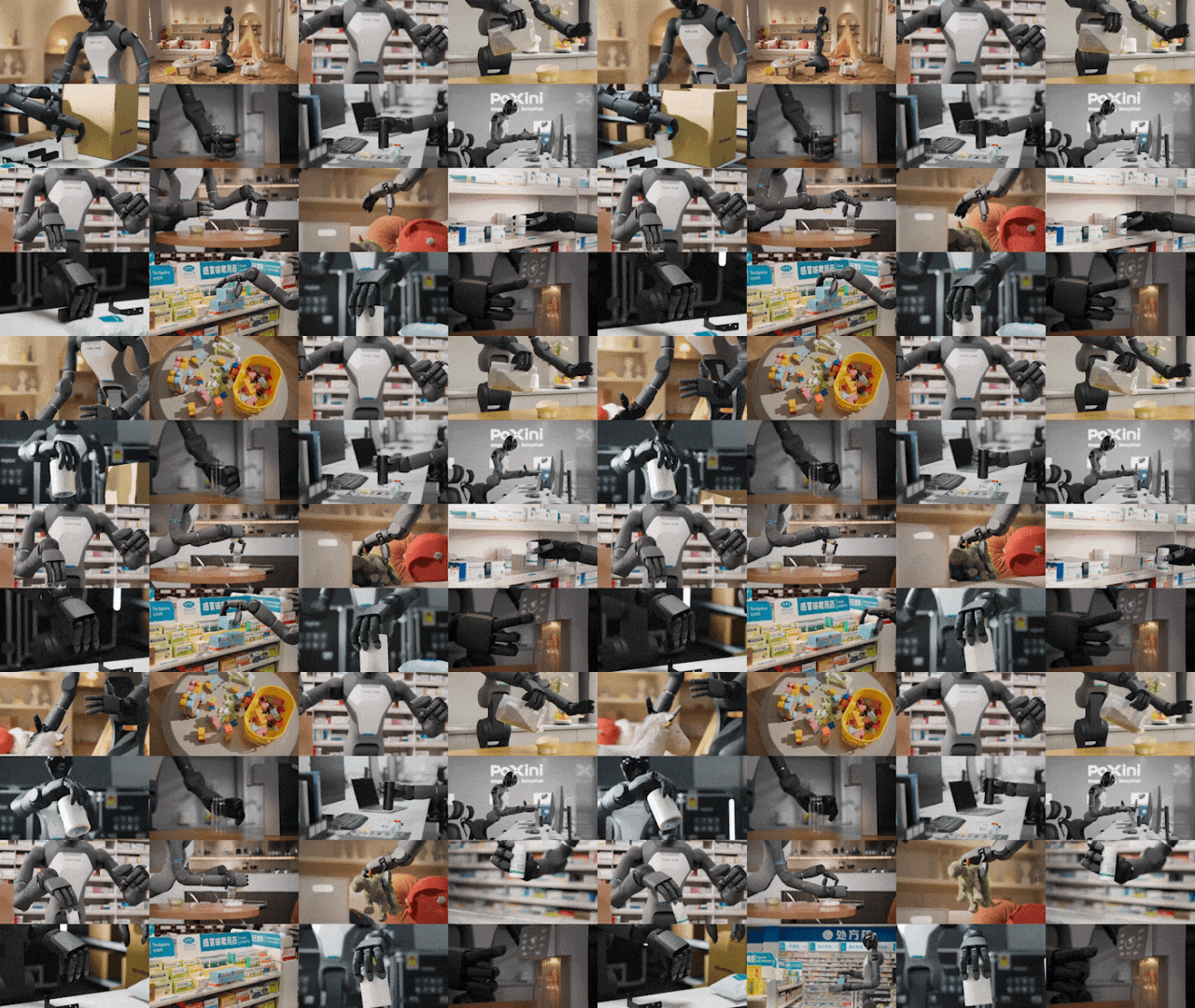
Automobile production lines, 3C assembly and logistics sorting put forward completely different requirements: different materials, different rhythms, and different fault tolerance boundaries. Industrial capital can bring scenarios, supply chains and testing standards; the failure data obtained by enterprises in these scenarios will in turn promote the improvement of sensor structures, control strategies and data acquisition methods.
This is also the reason why Pacini is more noteworthy than a single tactile startup project. Latecomers can start from the latest papers and may quickly take the lead in a certain indicator, but technical barriers will not form naturally just because the technical paths in financing roadshow PPTs converge. They must be built through continuous high-intensity R&D investment and continuous accumulation of mass manufacturing and delivery experience. The more deliveries an enterprise makes, the more data it masters; the richer its customers are, the more experience it has in cross-body and cross-task adaptation; the higher the output, the stronger its yield and cost control capabilities; the more real data it has, the harder it is to catch up with the closed loop between hardware, control and models.
In the globalization process, Pacini's core patents have covered major markets, and the local operation and delivery systems in North America, Japan, South Korea and Europe are under construction. The addition of industrial capital in this round will further translate into supply chain coordination and overseas customer verification, and Pacini's leading edge may extend from domestic engineering accumulation to cross-regional standardized delivery capabilities.
Leading Position Is Not a Conclusion, But Continuous Verification
Making a positive judgment on Pacini does not mean avoiding the pressure it will face next. Whether large orders can be converted into revenue on schedule, whether the adaptation across robot bodies is efficient enough, whether the data scale can match real quality, and whether the hardware business and model business can cooperate at the organizational level are all questions that the company must answer when moving towards a larger scale.
However, a clearer industry judgment has been formed: embodied perception is no longer a blank paper waiting for capital to fill, and Pacini can hardly be evaluated in the coordinate system of ordinary tactile sensor enterprises. With the goal of accelerating the implementation of embodied intelligence, it has simultaneously built tactile sensors, embodied data acquisition and tactile integrated terminal execution, and taken the lead in advancing this system to the stage of commercial and organizational verification.
This is also the deep meaning behind the occurrence of financing, relocation to Beijing and shareholding system reform in the same period. The focus of enterprise competition has shifted from finding feasible routes to expanding the already formed system advantages; the focus of capital competition has shifted from completing the track map to identifying incremental innovation and leading compound interest.
The next stage of embodied intelligence will not only belong to companies that "can make robots", nor will it only belong to companies that "can make sensors". What is truly scarce is an industrial system that can convert contact into data, data into control, and control into stable delivery.
And this is exactly the key watershed for embodied perception to move from conceptual boom to industrial infrastructure.