Just now, Doug, the largest pre-trained model of OpenAI, was unveiled.
On August 9, ChrisGPT, an X user who has long been tracking the developments of OpenAI's models, revealed that OpenAI is advancing a new round of large pre-trained models codenamed Doug.
Per his statement, Doug will be the largest pre-training project ever launched by OpenAI to date, and it is not the same model as GPT-6.
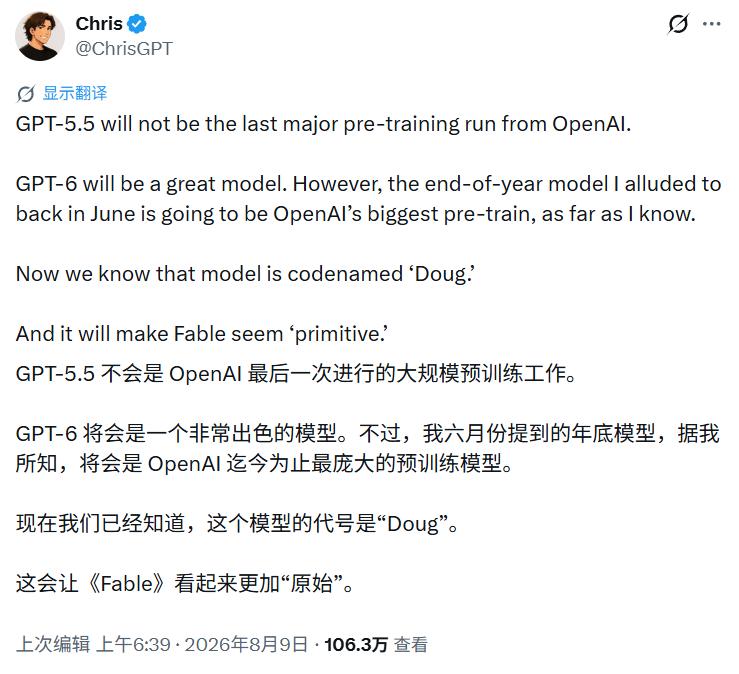
In subsequent replies, ChrisGPT further stated that GPT-6 is very likely to be Astra, OpenAI's most powerful model that the company urgently suspended the release of yesterday due to security issues.
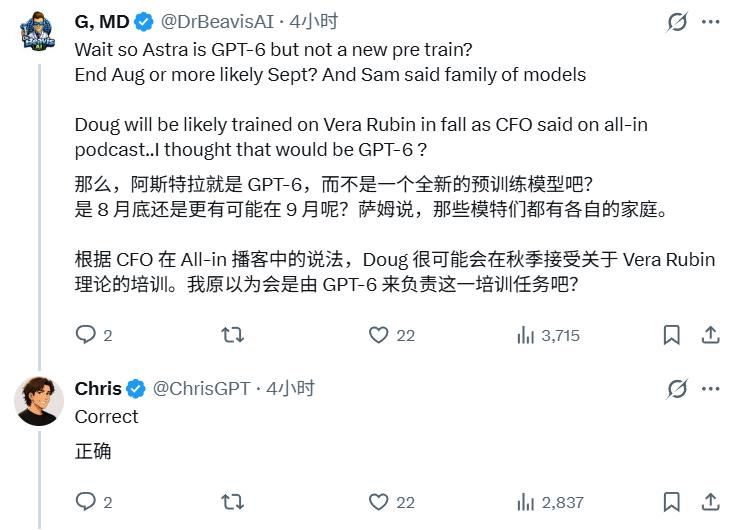
As for Doug, he expects it to be launched no later than November.

ChrisGPT is not the first source to publicly mention Doug.
On August 7, SemiAnalysis, a semiconductor and AI industry research institution, published a research memo previously sent to its institutional clients in an article discussing Gemini and Google Cloud. The memo is dated July 9.
Article link: https://newsletter.semianalysis.com/p/gemini-is-cooked-but-gcp-is-cooking
There is a key line in it: OpenAI has overcome pre-training challenges, and a much larger model codenamed Doug is being actively advanced.
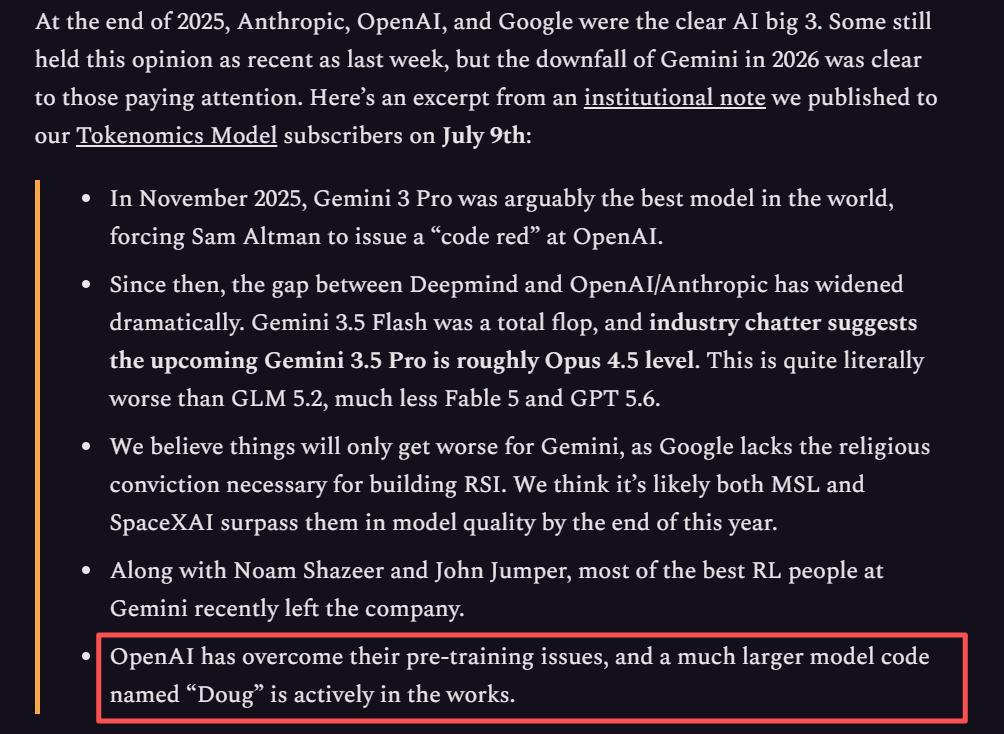
If the relevant information is accurate, Doug may mean that after nearly two years of relying mainly on post-training, reinforcement learning and inference-time compute to drive capability growth, OpenAI is restarting a large-scale foundational model iteration.
The story starts with GPT-4o.
OpenAI has shifted more capability growth to RL
On May 13, 2024, OpenAI released GPT-4o and positioned it as its new flagship model.
In the nearly two years that followed, although OpenAI trained and released new pre-trained models such as GPT-4.5, it never completed a full-scale pre-training round that could be widely deployed as the next-generation main frontier model.
At the same time, the capability growth of OpenAI's models has increasingly come from another path.
On September 12, 2024, OpenAI released o1-preview.
Compared with the past approach of driving capability growth through larger-scale pre-training, o1 demonstrated another scaling method : through large-scale reinforcement learning, the model learns to devote more computing resources to reasoning. Since then, post-training, RL and inference-time compute have become increasingly important in OpenAI's model system.
In April 2025, o3 was officially released. OpenAI emphasized again that the reasoning capabilities of the o series come from large-scale reinforcement learning.
In August 2025, GPT-5 was released. It is no longer just a single model, but a unified architecture consisting of fast models, deep reasoning models and routing systems.
SemiAnalysis believes that behind the o1, o3 and even the GPT-5 series, there is no new base model generational leap comparable to GPT-4o. The relevant models are actually still built on the foundational model system of the GPT-4o era.
OpenAI has never confirmed this training lineage, but if SemiAnalysis's information holds true, the roadmap of the past two years is easy to understand: The base model has not undergone a generational leap of the same level, and capability growth is mainly driven by increasingly powerful post-training and RL.
Model scaling has also gradually expanded from relying mainly on pre-training in the past to three dimensions: pre-training, RL and inference-time compute.
The problem is that if the foundational model does not undergo a generational upgrade of the same level for a long time, and only relies on post-training and inference compute to continue scaling, it will sooner or later face the problem of diminishing marginal returns.
The emergence of Gemini 3 quickly turned this potential training roadmap issue into actual competitive pressure.
Garlic: Pre-training has restarted operation
On November 18, 2025, Google released Gemini 3.
Ten days later, SemiAnalysis put forward a widely discussed judgment in its TPUv7 analysis: Since GPT-4o, OpenAI has not completed a successful full-scale pre-training round that can be widely deployed as a new frontier model.
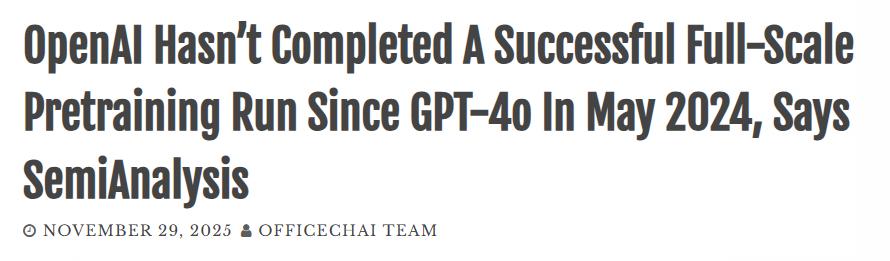
After Google launched Gemini 3, this difference evolved from a training roadmap issue to direct competitive pressure.
On December 1, multiple media outlets reported that Sam Altman announced "Code Red" internally at OpenAI, requiring the team to prioritize improving ChatGPT and reallocating some resources.
A day later, more critical training information came to light.
On December 2, 2025, The Information reported that OpenAI is developing a new pre-trained model codenamed Garlic. Citing internal sources, the report stated that Garlic performs well in coding and reasoning evaluations, and also uses a series of bug fixes discovered by OpenAI during previous training processes.
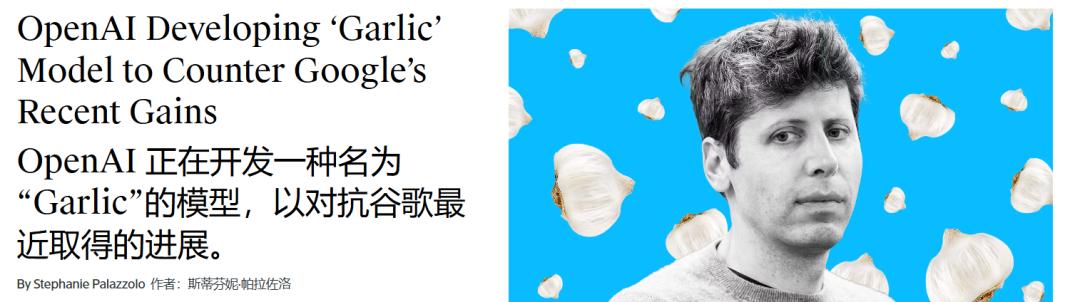
More critically, Mark Chen, Chief Research Officer of OpenAI, reportedly told the team that the company has resolved some key issues in previous pre-training. The report also mentioned that these training improvements allow smaller models to hold knowledge that previously required much larger models to acquire.
In the same report, there is another line that later proved to be particularly important: OpenAI has started developing an "even bigger and better model" based on the experience learned from Garlic.
The story of Doug actually started right here.
On January 6, 2026, SemiAnalysis once again talked about OpenAI's model roadmap. This time, they wrote directly: OpenAI has resolved the pre-training issues.
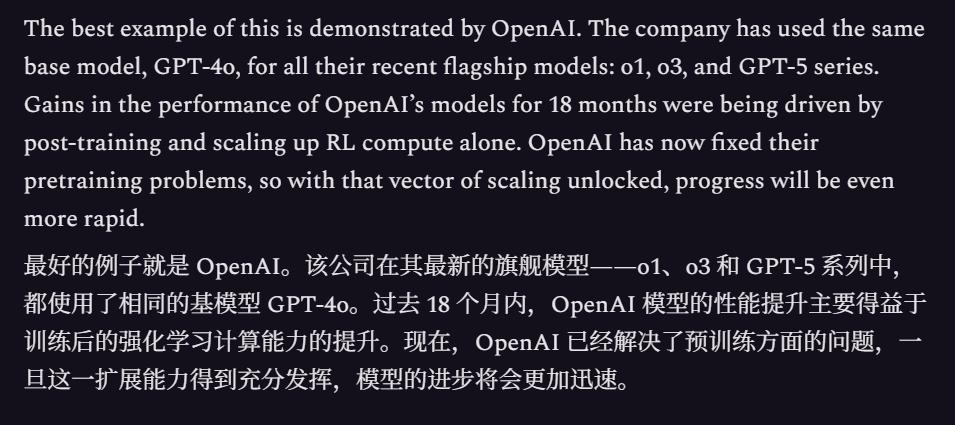
In other words, according to the information held by SemiAnalysis, the problems that previously plagued OpenAI's full-scale pre-training have been resolved.
Garlic most likely took on the role of verifying the effectiveness of these fixes, while Doug is the result of these training methods being truly scaled up to a much larger scale.
OpenAI may be preparing to restart base model scaling
If the above information is accurate, OpenAI may be continuously advancing at least two important model projects: Astra, which has entered the advanced evaluation stage, and Doug, which is reportedly even larger in scale.
And Doug points to another thing: restarting the scaling of the base model itself.
Over the past two years, OpenAI has proven that the old base model can still be continuously improved through RL, reasoning and inference-time compute.
Doug is meant to answer another question: After the base model itself completes a major leap again, how far can this post-training system, which has been pushed to its limits, take the model's capabilities.
This may be the real starting point for OpenAI's next round of model competition.
Reference links:
https://x.com/ChrisGPT/status/2086220662264250764
https://newsletter.semianalysis.com/p/gemini-is-cooked-but-gcp-is-cooking
https://newsletter.semianalysis.com/p/rl-environments-and-rl-for-science
https://www.theinformation.com/newsletters/ai-agenda/openai-developing-garlic-model-counter-googles-recent-gains
This article is from the WeChat official account "Ji Qi Zhi Xin" (ID: almosthuman2014), the author is a member of Ji Qi Zhi Xin focusing on LLM, and it is published with authorization from 36Kr.