100 billion yuan, a new rising powerhouse from Jiangxi has emerged.
The A-share market sees another miraculous wealth creation story.
This week, Shenzhen Jialichuang Technology Group Co., Ltd. (abbreviated as Jialichuang) was officially listed on the main board of the Shenzhen Stock Exchange. Its share price surged sharply at the close on Friday, with its market capitalization remaining above 100 billion yuan.
In this way, three college graduates behind the company have reaped staggering wealth: brothers Ding Hui and Ding Huixiang from Xuzhou, Jiangsu hold shares with a net worth of about 60 billion yuan, while Yuan Jiangtao from Jiujiang, Jiangxi holds the largest number of individual shares, with a book net worth of 40 billion yuan.
Looking back, the starting point of the 100-billion-yuan Jialichuang was exactly the one-meter counter Yuan Jiangtao rented in Huaqiang North, Shenzhen 20 years ago. This native of Jiangxi has inadvertently added a new chapter to the "Jiangxi Moment" of China's technology industry.
From Jiangxi to Shenzhen
Jointly Building a 100-Billion-Yuan IPO
The story began in Huaqiang North, Shenzhen.
In 2006, 27-year-old Yuan Jiangtao came to this place with 100,000 yuan in savings and rented a one-meter counter. He was born into an ordinary family in Duchang County, Jiujiang, Jiangxi Province. He graduated from Nanchang University with a junior college degree in mechatronics. In 2000, he went south to Shenzhen and worked as an electronic design engineer in an industrial drone company for five years.
Working with circuit boards every day, he noticed a fragmented but widespread pain point in the industry: traditional PCB manufacturers only accepted large-batch orders, with the startup fee for proofing starting at 800 yuan, and the delivery cycle often lasted for several weeks. The small-batch sample trial demands of R&D personnel were ignored. The high cost and slow delivery of proofing became the first threshold for hardware innovation.
Yuan Jiangtao decided to fill this gap on his own. In November 2006, he registered the predecessor company of Jialichuang, rented a shared counter less than one meter wide that he shared with others in Huaqiang North, Shenzhen, and officially entered the PCB proofing business. With a background in hardware R&D, Yuan Jiangtao knew better than anyone what engineers needed. He started with the small orders that his peers looked down on, took the trial-and-error demands of engineers as his core base, and gradually gained a firm foothold.
In 2012, in order to solve the difficulty in purchasing electronic components, he launched the spot trading website "Lichuang Mall", where customers from upstream and downstream of the electronics industry can complete the whole process of component selection, bill matching and payment.
At almost the same time, on the other side of Shenzhen, brothers Ding Hui and Ding Huixiang from Xuzhou, Jiangsu were also engaged in the PCB industry, focusing on mass production and having mature production lines. The two brothers also have junior college degrees, and they also went south to start their businesses from grassroots. Their industrial concepts are highly consistent with Yuan Jiangtao. Since 2012, the two entrepreneurial lines have begun to converge. Yuan Jiangtao took the lead in integrating resources and reached cooperation with the Ding brothers, who were responsible for circuit board manufacturing, supply chain operation and overall group operation respectively.
Until 2021, Jialichuang, Lichuang Mall and Citic Hua completed the restructuring, and the three officially joined forces to build a super PCB platform with an annual revenue of more than 10 billion yuan. Among them, Ding Hui served as chairman, holding 26.25% of the shares; Yuan Jiangtao served as general manager, holding 35% of the shares; Ding Huixiang served as deputy general manager, holding 26.25% of the shares, the three are the actual controllers of the company.
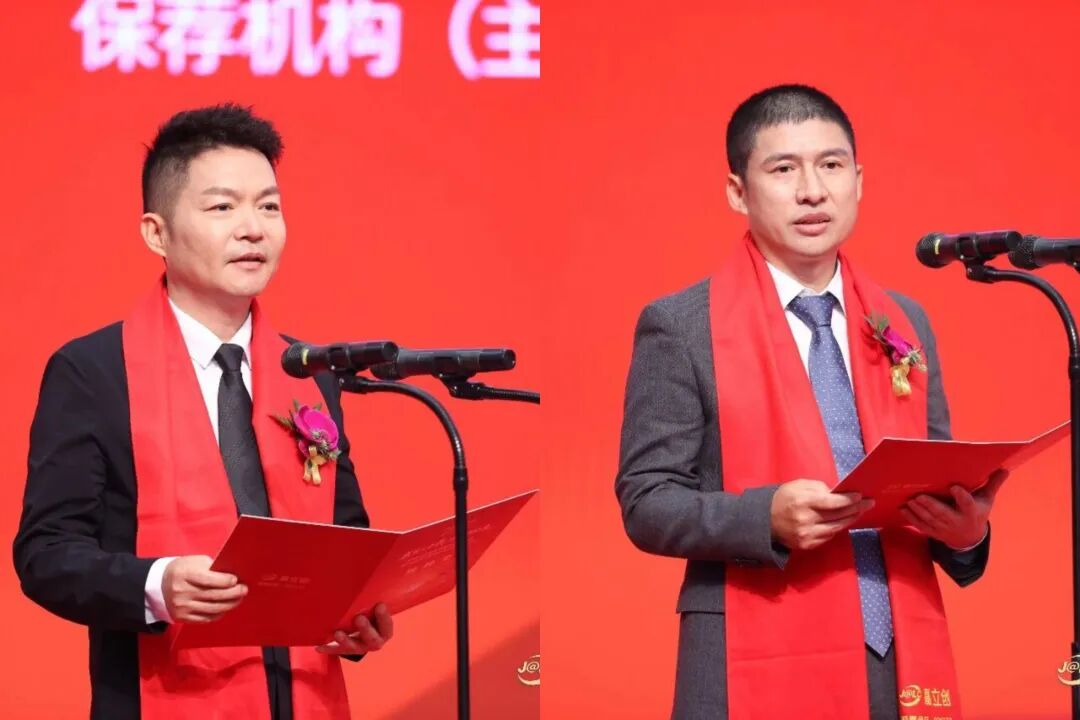
Helmsmen of Jialichuang (from left): Ding Hui, Yuan Jiangtao
The three have worked together for more than ten years, and finally stood on the IPO bell ringing stage together, creating Jialichuang with a market value of 100 billion yuan. Yuan Jiangtao, who walked out of the rural areas of Jiangxi back then, has a net worth of about 40 billion yuan, becoming a new wealthy person in Jiangxi.
Employee Wealth Creation Boom
Employees of Jialichuang also shared the joy of IPO.
According to the prospectus, the company has six employee shareholding platforms — Dingchuang Tiancheng, Dingchuang Xingyuan, Dingchuang Haoying, Dingchuang Jiahe, Dingchuang Jiatong, and Dingchuang Jiahua. The first three directly hold 0.86% of the company's shares respectively, and the last three hold shares indirectly by holding shares of the aforementioned platforms. This means that a number of senior management personnel, middle-level backbones, core technical personnel and key post employees will obtain considerable wealth incentives from it.
In another corner, a group of employees have also seen their wealth double. For this listing, more than 300 senior management personnel and core employees participated in the IPO strategic placement through 3 special asset management plans. Among them, Jialichuang No. 2 Asset Management Plan was allocated about 750,000 shares, and the participants included core employees such as business managers, factory supervisors, and R&D supervisors.
Take a factory supervisor named Liu Diyuan disclosed in the prospectus as an example. He paid 800,000 yuan in actual payment this time, holding about 1% of the shares of the asset management plan. With Jialichuang's IPO hitting a market value of 100 billion yuan, Liu Diyuan's floating profit has more than doubled.
"Engineer Liu of Jialichuang, seeing you live a happy life, I feel relieved." On the social platform, an old customer posted a message with emotion. This "Engineer Liu" is exactly Liu Diyuan — he used to be the receiver of bulk materials at Jialichuang's Zhuhai factory. If users can't buy non-mainstream components on Lichuang Mall, they need to send them to the factory by themselves, and he will receive and handle them. The poster has sent materials to Liu Diyuan more than a dozen times, and a subtle connection and affection has taken root.
In Jialichuang, there are two to three hundred such "Engineer Liu". For ordinary employees, this is undoubtedly a profound gift — not by speculation, not by luck, but by working in a company for a long time and growing up with it, reaping the dividends that belong to ordinary people.
Jialichuang's IPO has also aroused a more enthusiastic response in another circle.
Among electronic engineers and university circles, Jialichuang has a special title — "Cyber Bodhisattva". "My hardware entry path started with the Lichuang development board, which allows us students with little budget to dare to practice boldly, instead of just talking on paper against textbooks." A college student majoring in electronics spoke out the aspirations of many people.
Lichuang Mall has solved the long-standing problems of difficult component procurement and many counterfeit products. More importantly, Jialichuang has also self-developed the EDA software "Lichuang EDA", with core functions permanently free of charge. Drawing, proofing and purchasing components can be completed in one-stop.
Students with no budget can make low-cost trial and error, and entrepreneurs who do not understand the supply chain can complete proofing and procurement in one stop at Jialichuang. It has long been the "hardware enlightenment teacher" of countless electronic engineers, greatly lowering the threshold of hardware innovation.
Jiangxi, a Cradle of New Tech Tycoons
Sorting out this round of China's technological wave, a group of people from Jiangxi have emerged unexpectedly.
Let's start with the "Cold King". In 1985, Chen Tianshi was born in Nanchang, Jiangxi. He was admitted to the Junior Class of University of Science and Technology of China at the age of 16, and later completed his master's and doctoral studies at USTC. In 2016, he and his brother Chen Yunqi founded Cambricon, focusing on AI chips. After being listed on the Sci-Tech Innovation Board in 2020, Cambricon fell into a two-year trough due to losses. It was not until 2024 that it began to surge, and its market value once exceeded 900 billion yuan. With a net worth of more than 230 billion yuan, Chen Tianshi has retained the title of the richest man of Jiangxi origin.
Going down the AI industrial chain, more entrepreneurs of Jiangxi origin have surfaced.
The helm of the storage giant Longsys is a pair of twin siblings from Jiujiang, Jiangxi — Cai Huabo and Cai Lijiang. In the 1990s, Cai Huabo came to Shenzhen alone from his hometown to make a living, starting as an electronic component salesman in Huaqiang North, and then pulling his sister Cai Lijiang to found Longsys. Starting from the trade of storage chips, it has grown all the way to become a leading player in the industry. In the second half of 2025, with the outbreak of AI storage demand, the company's market value soared from less than 300 billion yuan to more than 300 billion yuan, and the market value of the shares held by the siblings once exceeded 100 billion yuan.
The market value of TFC Optical Communication once exceeded 400 billion yuan, and behind it is also a native of Jiangxi — Zhou Zhinong. Coming from Yichun, Jiangxi, he found that the ceramic sleeve, the core component of optical fiber connection, in the network cabling business was monopolized by Japan, with high price and slow delivery, so he went to Suzhou to start a business. After being listed on the ChiNext in 2015, with the outbreak of AI computing power, its share price skyrocketed, and the net worth of Zhou Zhinong and his wife once exceeded 900 billion yuan.
There are also a number of new tech upstarts: Zhihuijun from Agibot, Luo Yuhao from miHoYo, the core founders are all from Jiangxi. In addition, well-known entrepreneurs such as Zhu Mingming from Lingban Technology, Liang Rubo, co-founder of ByteDance, Cheng Wei from Didi, Yu Kai from Horizon, Duan Yongping, founder of BBK, all have the same native place — Jiangxi.
To a certain extent, a group of people from Jiangxi are changing China's technological landscape.
"Jiangxi may not be rich in unicorns, but it is rich in unicorn founders", as the outside world teases, a large number of founders of 100-billion-level tech giants have emerged from Jiangxi, but most of them are based in Shenzhen, Suzhou, Beijing and Shanghai, and few of them take root in their hometown.
The reason is not difficult to understand. Jiangxi is located at the crossroads of industrial migration in southeast China, bordering Hubei and Anhui in the north, Guangdong and Fujian in the south, Zhejiang and Shanghai in the east, and Hunan in the west. Although Jiangxi has no 985 universities, it has always attached great importance to education. Due to the fierce competition in the college entrance examination, a large number of talents in mathematics, science and engineering have emerged in Jiangxi. Generations of students from Jiangxi have left their hometowns, accumulated resources in the fertile coastal industrial land, and started businesses accordingly.
However, most of these people retain their hometown complex. TFC Optical Communication has formed a dual-base mass production cluster in Gao'an, Jiangxi, Jialichuang has its own production base in Ji'an, Jiangxi, and part of Longsys' assembly production capacity has been settled in Jiangxi — Industrial feedback and production capacity return have become the mainstream mode of giving back to the hometown, driving local employment and tax revenue.
And Jiangxi itself is also catching up with all its strength. In the proposal of the 15th Five-Year Plan, Jiangxi clearly proposed to "vigorously develop emerging industries and future industries". Just like the electronic information industry in Nanchang, new energy and rare earth new materials in Ganzhou, and equipment manufacturing in Jiujiang, all regions are making differentiated layouts and accelerating growth.
Going out is for a better return. When more and more entrepreneurs of Jiangxi origin move their production capacity back to their hometown, when more and more Jiangxi people working outside begin to look back at this land — maybe next time, the first stop for them to start a business no longer needs to be Huaqiang North.
This article is from the WeChat official account "PEDAILY" (ID: pedaily2012), author: Zhou Jiali, published with authorization from 36Kr.