Precious Interview: Jeff Dean Talks About the Next Paradigm Upgrade of AI
I highly recommend an interview with Jeff Dean, which is full of valuable insights and provides forward-looking guidance for the development of AI in the coming years.
Who is Jeff Dean? He is the technical founder of Google. The well-known TPU, TensorFlow, MapReduce and Gemini are all his creations.
Just yesterday, Jeff Dean decided to leave Google where he had worked for 27 years, and founded the AI startup Discovery Loop.

Figure: A recent photo of a friend with Jeff Dean
The name of this company is the biggest spoiler: The next core paradigm of AI is recursion and automation.
(1) Any problem that can be clearly measured will soon make great progress
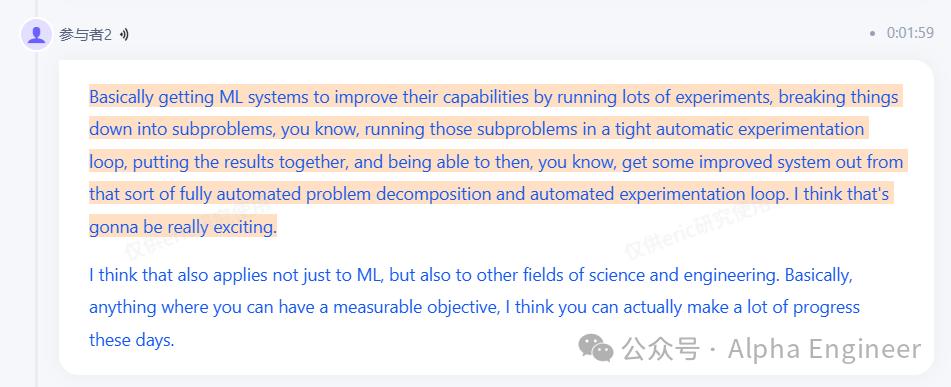
I believe that by 2027, you will see that ML systems themselves will be largely automated.
We can let the system continuously improve its capabilities by running a large number of experiments.
AI will automatically split the problem into sub-problems, put each sub-problem into a fast automatic experiment loop, then combine the results, and finally produce an improved system. The whole process does not require in-depth human intervention.
This paradigm is not only applicable to ML, but also to other scientific and engineering fields.
Basically, as long as the goal of a task is measurable, it will make great progress in the next two years.
Comment: This view is consistent with Jason Wei's "Asymmetry of Verification" point of view: Anything that can be measured can be conquered.
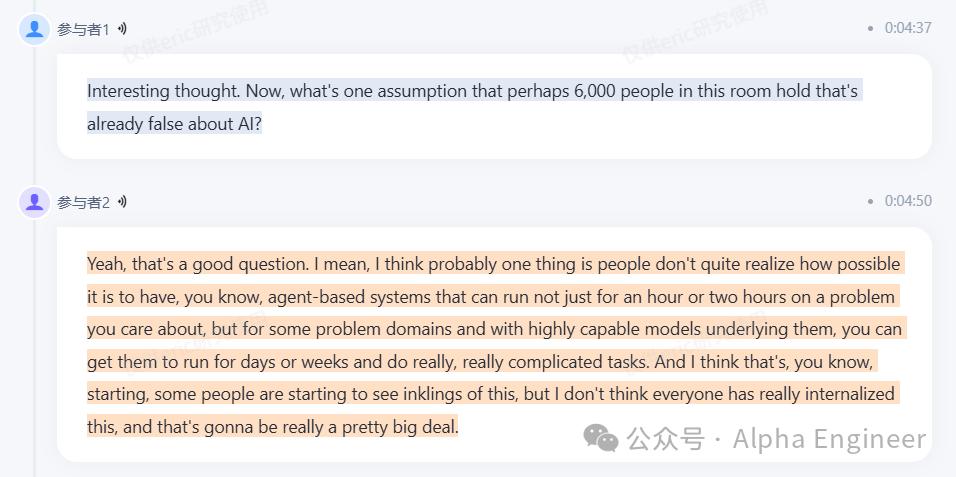
(2) What is the biggest unconsensus in the current AI field?
The biggest unconsensus is that people have not realized how long Agents can run autonomously.
It's not just one or two hours. In certain problem domains where the underlying model is sufficiently powerful, they can run for days or even weeks to complete very complex tasks.
A small number of people are beginning to see the clues, but the vast majority have not really internalized it, and this will be a big deal.
Comment: The market underestimates the upper limit of AI applications. Token consumption should not be calculated by Session, but imagine a future where "the reasoning speed is 100 times that of now & AI runs autonomously and persistently".
(3) High-performance and low-energy consumption inference hardware will emerge
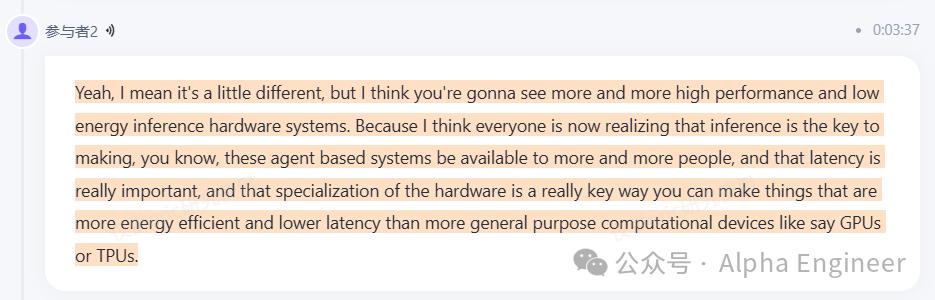
In the future, more and more high-performance, low-energy consumption inference hardware will emerge.
Because people now realize that with the development and popularization of Agents, the latency of inference is becoming more and more important.
Customizing hardware is the key to improving energy efficiency & reducing latency.
Imagine what form AI applications will take if the inference latency of large models is reduced by 50 times.
Looking at this problem from the first principle, one multiplication operation consumes about 1 picojoule, while moving data consumes a thousand times more.
This thousand-fold gap shapes the underlying logic of many things we do in machine learning.
It is precisely because of this energy gap that you have to gather a large number of samples or tokens at one time to spread the cost of data movement, which is called batching.
On the contrary, if you want to reduce latency, batching is quite bad.
To reduce inference latency, you have to make trade-offs at the hardware performance level.
For example, you don't need to support many calculation precisions. If you already have a clear answer about what precision is needed, harden it into the hardware and do nothing else.
Comment: Training pursues throughput while inference pursues latency. The two have opposite demands for batching, which is the simple logic behind high-performance inference hardware.
(4) How to make Agents conduct long-horizon reasoning without derailment?
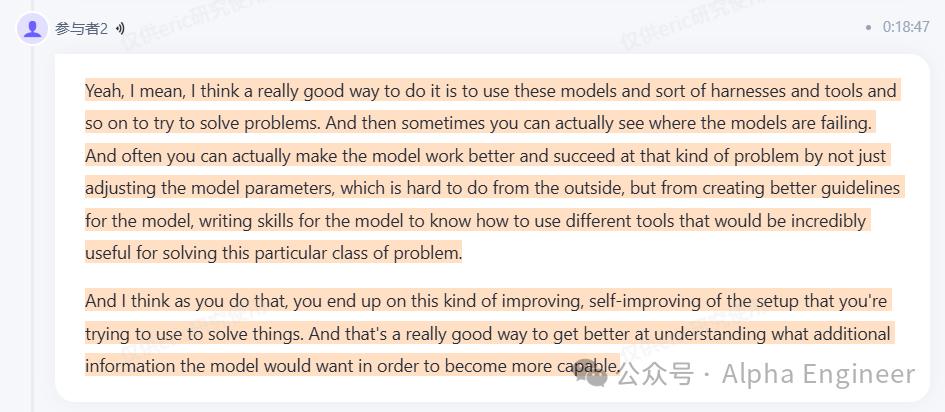
The common reason why Agents derail in long-horizon reasoning is that the model is doing things it has little experience with.
Once it deviates slightly from the distribution it is familiar with, the performance will begin to degrade like all ML models, and the further it deviates, the worse the performance will be.
There are two types of solutions:
One is to use Skills and prompts to pull it back to that "well-lit path".
The other is to build a multi-agent system, let multiple agents try different paths, and then use another agent to evaluate which path is promising, keep the promising ones and discard the derailed ones.
This uses computing power during reasoning to search in the solution space, which can significantly improve the performance and reliability of long processes.
Comment: Assuming that the model performance remains unchanged, there are two ways to build a loop: either narrow the distribution through skills, or perform spatial search through multiple agents.
(5) For large companies with full-stack layout, what entrepreneurial opportunities do super individuals have?
First, pick things that really excite you and that you think are useful to the world.
Second, test how the current general-purpose model performs on this problem. You have to judge whether what you are doing is durable or will be swallowed by the large model within 6 to 12 months.
Based on the above principles, Jeff Dean gave two specific paths to build the unique advantages of the entrepreneurial team:
One is to make your product able to obtain data that general-purpose models cannot get.
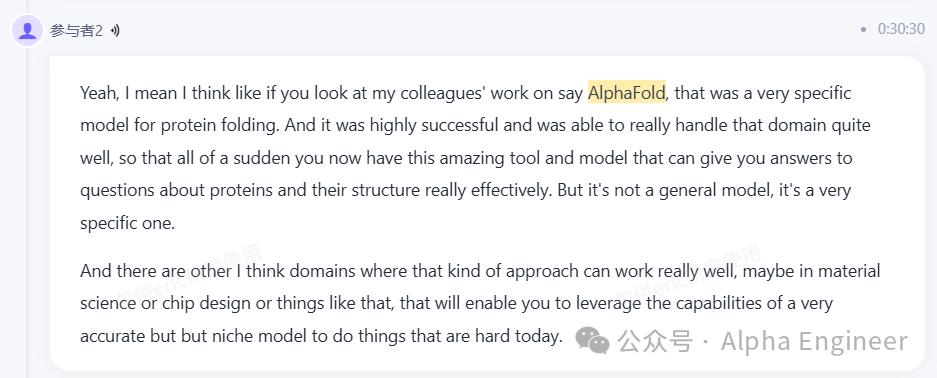
The other is to use the right training data to train a dedicated model like AlphaFold, which may not require much computing power but is extremely accurate.
Fields such as materials science and chip design may all apply.
Comment: The core essence of AI entrepreneurs is to make the capabilities of large models a booster for their own strategy. How to capture the beta is a profound knowledge, and the value of "following the trend" is still increasing.
(6) After everyone can command hundreds of Agents, what is the scarce skill in the AI era?
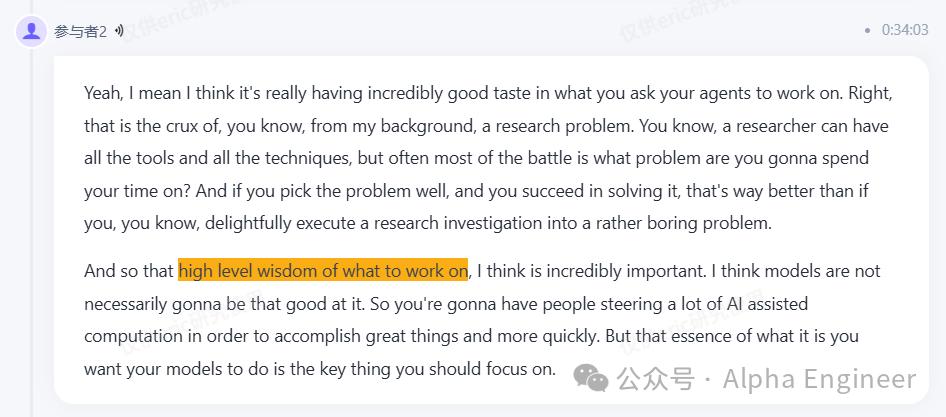
What is truly scarce is always Taste.
The essence of taste is the high-level wisdom of what to work on.
Choosing the right problem and solving it is far better than elegantly completing a rather boring research.
I don't think models will be particularly good at this kind of high-level wisdom, so humans will be in control of a large amount of AI-aided computing.
Comment: Raising the right question is always more important than being busy solving the problem.
(7) How to cultivate this kind of taste?
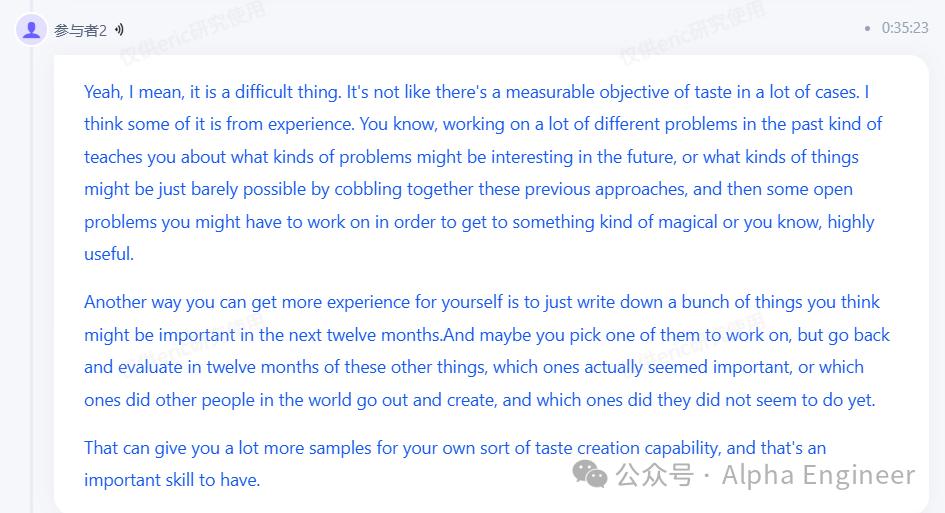
An effective method is to write down a list of things you think are important in the next twelve months. You may only do one of them, but after twelve months, look back and evaluate: Which ones are really important? Which ones have been made by others? Which ones have not been done yet?
This can accumulate a lot of samples for your own taste building.
Another trick is to do crazy thought experiments.
For sixty years, the chip industry has assumed that every chip of the same design should be exactly the same, and bits should not flip.
But at the macro scale, we don't make that assumption. For example, we build reliable large-scale distributed systems with unreliable hardware.
So what happens if you try to rebuild the entire modern IT industry with transistors that make 20 errors a day instead of one error every million years?
This will bring a whole new way of thinking about problems, for example, signals may need to take multiple redundant paths.
Occasionally questioning assumptions is very valuable, and this kind of crazy thought experiment is an excellent way to cultivate taste.
Comment: For gaining insight, napkin math is much more useful than excel modeling, or in other words, "vague correctness" >> "precise error".
(8) The implementation path of AI creating AI: orchestration framework + automatic experiment loop
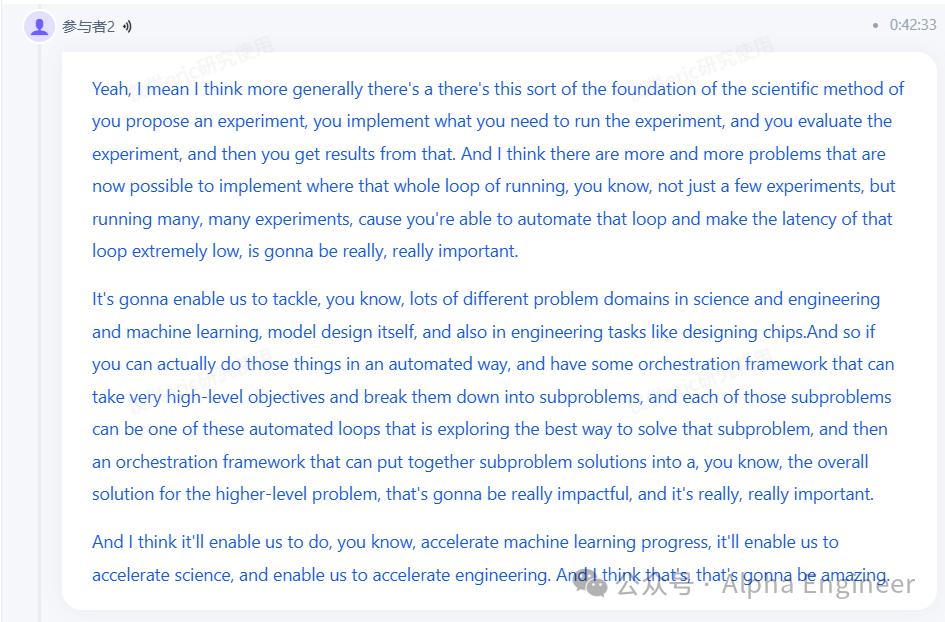
The foundation of scientific research is: you propose an experiment, run the experiment, evaluate the experiment, and then get the results.
Now more and more problems can not only run a few experiments, but run a very large number of experiments at the same time, because you can automate this loop and press the latency of the loop to an extremely low level.
This will allow us to conquer a large number of problem domains in science, engineering, machine learning and even model design itself, including engineering tasks such as chip design.
Furthermore, if you have an orchestration framework that can accept very high-level goals, split them into sub-problems, each sub-problem is an automatic loop that explores the best way to solve the sub-problem, and then the orchestration framework assembles the sub-solutions into the overall solution of the upper-level problem, that will be very influential.
It will greatly accelerate breakthroughs in machine learning and all scientific and engineering problems.
Comment: Jeff's thinking here is very core, which is the concretization of the RSI (Recursive Self-Improvement) concept. I think we should not only regard AI as a tool. AI is more like a new species or a new country, and humans are outsourcing more and more work to them. With the improvement of AI capabilities, this new species will gradually start to iterate its own technology tree, and in the next ten years or so, we will most likely usher in an era of big technological explosion.
(9) The efficiency bottleneck of Loop Engineering: Evaluator Acceleration
In order to speed up the iteration efficiency of Agents, your evaluator needs to be greatly accelerated.
Ten years ago, when my colleagues were working on quantum chemistry, running a density functional theory simulator to judge the properties of a molecule took a whole night of calculation.
They used a large number of simulation input configurations and outputs to train a neural network model, and created a verification device that is 300,000 times faster with almost no loss of accuracy.
This has completely changed the way of doing science. Assuming you have ten million candidates to screen, you can finish running them by lunchtime now, instead of a six-month project.
Comment: Jeff Dean's entire interview, from beginning to end, actually has only one line: automate the cycle of "hypothesizing -> implementing -> verifying" and press the latency to an extremely low level, any field with measurable goals will be rewritten.