With nearly 8 billion U.S. dollars in single-quarter revenue and 100 billion U.S. dollars in cash on hand, SpaceX's first financial report is more wild than you might expect.
Starlink's cash generation, Starship's high-stakes bet, massive Capex pouring into AI: a full breakdown of SpaceX's commercial flywheel.
In the early hours of August 5, 2026, Beijing time, SpaceX officially released its first quarterly report after going public (Q2 2026, ending June 30).
Several key figures:
Total Q2 revenue reached 7.814 billion US dollars, up 92% year on year;
Net loss narrowed from 1.008 billion US dollars to 541 million US dollars.
After the IPO net proceeds of 85.7 billion US dollars and the issuance of 25 billion US dollars in bonds, cash reserves stood at 100 billion US dollars, with unfulfilled orders of 47.5 billion US dollars.
This financial report once again shows that SpaceX's business profile has completely changed, and it is no longer a rocket company.
From Rocket Company to Infrastructure Giant
SpaceX divides its business into three segments: Space, Connectivity, and Artificial Intelligence (AI).
The three segments have vastly different financial profiles. Only by looking at them together can we understand what the company is actually making money from now and where it is pouring capital.
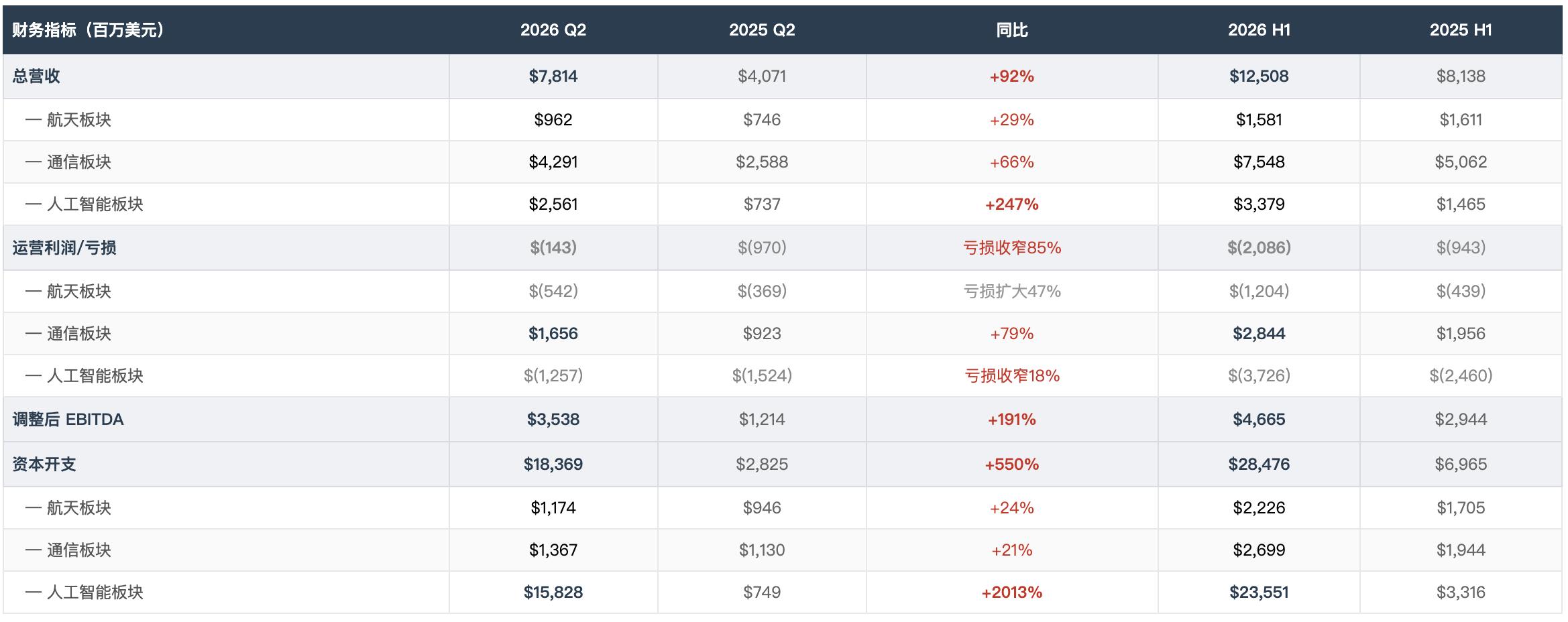
Summary of core financial data for the second quarter and first half of 2026
This table has three easily overlooked points.
First, the revenue structure has been completely reversed.
In Q2, the connectivity segment contributed 55% of revenue, AI contributed 33%, and the space segment accounted for only 12%.
If we go back two or three years, space launch was still SpaceX's signature business. Now it is the last segment among the three largest revenue sources.
From a profit perspective, the picture is even more extreme: the connectivity segment recorded an operating profit of 1.656 billion US dollars in the single quarter, while the space and AI segments posted a combined loss of 1.8 billion US dollars. The connectivity segment alone supports the other two segments.
Second, the inflection point of narrowing losses appeared in Q2, and the H1 data is not that impressive.
Operating loss in Q2 was only 143 million US dollars, but the combined loss for the first half of the year reached 2.086 billion US dollars, 2.2 times that of the same period last year.
This means Q1 still saw heavy cash burn, and the Q2 improvement came from the dual effects of profit release in the connectivity segment and narrowed losses in the AI segment.
The single-quarter data looks good, but whether the momentum can continue for the full year depends on whether the connectivity segment can maintain its growth rate in Q3 and whether the AI segment can continue to narrow its losses.
Third, the structure of capital expenditure reveals the strategic focus.
Total capital expenditure in Q2 was 18.369 billion US dollars, of which the AI segment alone accounted for 15.828 billion US dollars, taking up 86% of the total.
The year-on-year growth of capital expenditure for the space and connectivity segments was just over 20%, while the AI segment saw a 2013% year-on-year increase. This fund is mainly used for the construction of the Colossus II computing power center and server procurement.
SpaceX is using the cash generated from launch and connectivity businesses to subsidize an unprecedented scale of AI infrastructure investment.
The capital base supporting this investment comes from two historic financings in Q2:
Equity Financing: On June 15, the company went public, issuing 639 million Class A common shares, with net proceeds of approximately 85.7 billion US dollars.
Debt Financing: On June 26, the issuance of 25 billion US dollars in investment-grade bonds was completed, with 5 tranches (maturing between 2031 and 2056) and a weighted average interest rate of 5.855%.
The two tranches of funds expanded the total assets from 92.079 billion US dollars at the end of 2025 to 192.77 billion US dollars.
100 billion US dollars in cash reserves means that even if the AI segment maintains its current loss rate, the capital is sufficient to support operations for several years. This is the fault tolerance space the market grants to SpaceX.
Three Segments, Three Logics
Space is the technology bet, connectivity is the cash engine, and AI is the capital bet. The three segments correspond to three completely different business logics.
1. Space Segment: Losses from Starship R&D, Betting on 99% Cost Reduction
The space segment generated revenue of 962 million US dollars in Q2 (up 29% year on year), but posted an operating loss of 542 million US dollars, with losses expanding by 47% year on year.
The expansion of losses is driven by R&D investment, with single-quarter R&D expenditure reaching 1.076 billion US dollars, up 55% year on year. This fund is mainly invested in Starship V3.
Quarterly Operating Data of the Space Segment
Number of Launches: A total of 38 launches were carried out in Q2 (10 customer launches, 28 internal Starlink deployments), with a cumulative 78 launches in the first half of the year
Mass to Orbit: 485 tons were sent to orbit in Q2 (87 tons for customers, 398 tons for internal use), with a cumulative 1041 tons in the first half of the year. R&D investment reached 1.076 billion US dollars in the single quarter, up 55% year on year
There is a key detail here: 28 out of the 38 launches are internal Starlink deployments.
SpaceX is its own largest launch customer. This means that a large proportion of the "launch service revenue" of the space segment is internal settlement, and the real external revenue is only 648 million US dollars brought by 10 customer launches.
The two test flights of Starship V3 were the technical focus of this quarter.
In May, Flight 12 achieved precise landing of the upper stage spacecraft and deployed V2 Starlink satellites; in July, Flight 13 deployed 20 mass-produced V3 satellites, completed the reignition of the Raptor vacuum engine in space, achieved the smoothest soft splashdown in history, and recovered the heat shield intact.
The financial report clarifies that the goal of full and rapid reuse of Starship is to reduce the cost of mass per unit to orbit by more than 99% compared with the historical level.
The commercial implication of this goal is that if Starship V3 achieves high-frequency reuse, SpaceX's launch cost will drop to a level that competitors cannot follow, while supporting larger-scale Starlink constellation deployment and space-based deployment of AI computing power infrastructure. The current loss of the space segment is the cost of the investment period, and the bet is on the cost gap after Starship V3 is fully delivered.
2. Connectivity Segment: The Only Profitable Segment, and the Lifeblood of the Entire Company
The connectivity segment (Starlink and derivative businesses) generated revenue of 4.291 billion US dollars in Q2 (up 66% year on year), with an operating profit of 1.656 billion US dollars (up 79% year on year) and an operating profit margin of 38.6%.
This profit margin is at the top level in the telecommunications industry. For reference, the traditional GEO satellite operator Viasat recorded an operating profit margin of about 10%~15% in its latest quarter.
The revenue structure of the connectivity segment is shifting from the consumer tier to the enterprise and government tiers, which is a more important signal than the growth of total users:
User Scale: 12 million global subscribers (doubled year on year), with a net increase of 1.7 million in the single quarter, covering 167 countries, 10,200 satellites in orbit, and an ARPU of 66 US dollars per month
Enterprise and Government Business: Up 108% year on year to 1.806 billion US dollars — accounting for 42% of the connectivity segment's revenue
Starshield: Secured a multi-year contract worth over 6 billion US dollars from the U.S. government, focusing on the U.S. Space Force's low-orbit communication and sensing constellation
Aviation Penetration: Newly signed American Airlines, and activated Southwest Airlines, Virgin Atlantic, Iberia, and Aer Lingus
Airborne Broadband Direct-to-Device: Reached operator cooperation with SoftBank, NTT Docomo, and Spark NZ
Spectrum: Obtained FCC approval for the transfer of EchoStar's licenses, adding 65MHz of MSS spectrum in the U.S. territory and globally
The 42% proportion of enterprise and government business represents a structural change.
The ARPU (66 US dollars per month) of consumer-tier Starlink has limited room for growth, but the unit customer price and renewal rate of enterprise and government contracts are much higher.
The existence of the 6 billion US dollar Starshield contract means that the revenue base of the connectivity segment has been locked by government budgets, and the stability of this part of revenue is far higher than that of consumer subscriptions.
The profits from the connectivity segment flow directly to the two loss-making segments. This is an internal cross-subsidy model: the scale effect of Starlink generates cash flow, the space segment uses this money to bet on Starship V3, and the AI segment uses this money to build computing power infrastructure. The three segments are not in a parallel relationship, but form a flywheel relationship.
3. AI Segment: Burning 15.8 Billion US Dollars in a Single Quarter, What Is the Bet On?
The AI segment is the part of this financial report that most needs to be dissected.
The AI segment generated revenue of 2.561 billion US dollars in Q2 (up 247% year on year), of which 2.194 billion US dollars came from newly signed cloud service agreements, namely AI solutions and infrastructure revenue. It posted an operating loss of 1.257 billion US dollars.
Key Metrics of the AI Segment
Computing Power Scale: Reached 1.4 GW (0.4 GW in the same period of 2025)
Computing Power Capital Expenditure: AI Capex in Q2 reached 15.828 billion US dollars, mainly used for Colossus II computing power centers and servers
EBITDA Turning Positive: The AI segment's EBITDA reached 1.146 billion US dollars, turning positive for the first time
Acquisition of Cursor: Plans to acquire AI code tool developer Cursor for 60 billion US dollars, with the transaction expected to close in Q3
Model Release: Grok 4.5 was released in July, a 1.5-trillion-parameter V9 base model, co-trained with Cursor
The logic of this investment needs to be viewed in the context of SpaceX's overall strategy.
15.828 billion US dollars in AI capital expenditure is equivalent to twice the total Q2 revenue, but this capital density is not uncommon in the construction of ultra-large-scale computing power. Microsoft and Google's single-quarter investment in AI infrastructure has also reached the level of tens of billions of US dollars.
SpaceX's differentiation lies in its own space-based communication network (10,200 satellites) and launch capabilities, which allow it to build a closed loop of "space-based data collection — ground/space-based computing power processing — global real-time communication distribution", a physical layer asset that traditional cloud vendors do not have.
The planned 60 billion US dollar acquisition of Cursor is another point worthy of attention. Cursor is an AI code tool developer. If this transaction is completed, it means that SpaceX is not only selling computing power infrastructure in the AI field, but also entering the application layer.
The arrangement of co-training Grok 4.5 with Cursor shows that SpaceX hopes to bind Cursor's developer ecosystem with its own computing power and model capabilities.
This is not a conventional move for an aerospace company. It is directly competing with the Microsoft+OpenAI and Google+DeepMind alliances.
Industrial Chain Impact
SpaceX's degree of vertical integration has no precedent in aerospace history.
From Raptor engines, Starship fuselage, Starlink satellites, Starshield defense systems to computing chips and operating systems, almost every layer is self-developed and self-produced. The industrial chain impact of this model is transmitted along three directions:
1. Launch and Satellite Manufacturing: Vertical Integration Squeezes Out Traditional Suppliers
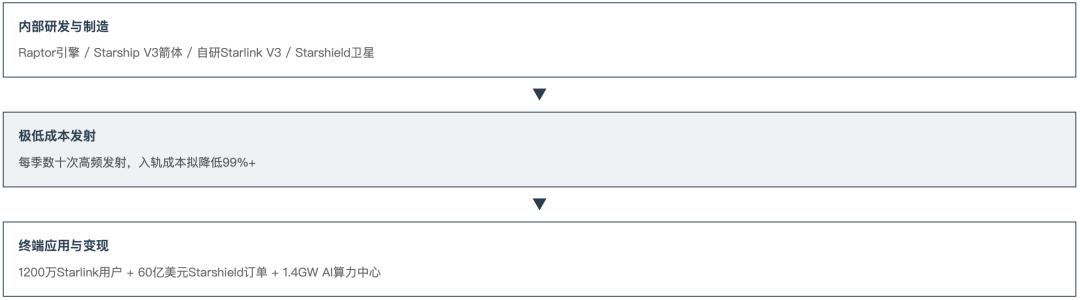
(Schematic Diagram of SpaceX's Vertical Integration Closed Loop)
For traditional component suppliers, SpaceX's high proportion of self-development means that Tier-2/Tier-3 suppliers hardly have access to its supply chain.
Among the 38 launches in Q2, 28 were internal deployments, and only 10 were external customer launches. SpaceX has effectively monopolized every link of its own supply chain, and the parts that external suppliers can participate in depend on how much SpaceX is willing to outsource, a willingness that is extremely low.
For traditional commercial launch service providers (ULA, Arianespace, Blue Origin), the competitive pressure comes from the cost structure.
SpaceX amortizes fixed costs through frequent internal launches, allowing it to accept extremely low quotes when undertaking external commercial launches.
The 648 million US dollars in external launch revenue in Q2 corresponds to 10 launches, at about 64.8 million US dollars per launch. This price leaves almost no profit margin for traditional launch service providers that need to cover full costs.
2. Satellite Communication and Defense: Structural Shift Where LEO Suppresses GEO
Starlink's penetration in the aviation sector (signing American Airlines, activating Southwest Airlines, etc.) directly impacts the IFEC (in-flight entertainment and connectivity) market of traditional GEO operators Intelsat, Viasat, and SES.
The latency and coverage flexibility of GEO satellites cannot compete with LEO constellations, which is a generational gap at the physical level.
The 6 billion US dollar Starshield contract has a deeper impact on the defense industry. It indicates that the U.S. military is shifting from "purchasing