FDE is not enough again
Following the Forward Deployed Engineer (FDE), a new role that integrates technical, management and organizational promotion capabilities has emerged: the Forward Deployed Executive (FDX).
Rick Manelius, startup mentor at ATechstars and Ph.D. in Materials Science from the Massachusetts Institute of Technology, pointed out that while FDEs can bridge technical gaps, they are often too far removed from the core decision-makers who hold sway over budgets, organizational structures and corporate culture. To put it another way, if FDEs are likened to the "external CTO" of AI projects, FDXs are the "external CEO".
1 "Forward Deployment" Becomes the Next Battlefield for Cloud Vendors and Model Companies
In June this year, AWS announced an investment of 1 billion US dollars to form the Forward Deployed Engineering team, planning to station thousands of engineers directly in customer teams to jointly develop and deploy agent systems.
AWS explicitly stated that enterprise AI has "moved beyond the consulting and roadmap phase", and what customers really need is personnel who can push systems directly to production under the constraints of real data, real governance and real business. Its goal is not to make customers rely on external teams for a long time, but to enable them to operate independently after the project is completed.
OpenAI has also built FDE into a large independent organization. Its recruitment page currently shows dozens of related positions covering multiple regions and industries including San Francisco, New York, London, Dublin, Tokyo, Munich, the United Arab Emirates and government business.
OpenAI defines FDEs not as ordinary pre-sales or solution consultants, but as personnel who work with strategic customers to jointly take charge of demand discovery, technical scope definition, system design, development and production launch, with actual adoption rate, workflow impact and measurable results as assessment criteria. The FDE position in San Francisco requires up to 50% travel time, with an annual salary ranging from 162,000 to 280,000 US dollars plus equity.
Although Anthropic rarely uses the term FDE directly, it is actually building the same delivery model.
In May 2026, Anthropic partnered with Blackstone, Hellman & Friedman and Goldman Sachs to establish a new enterprise AI service company, where Anthropic's Applied AI engineers work with customer teams to identify Claude's most valuable application scenarios, develop customized systems and provide long-term support. Anthropic stated directly in the announcement that embedding Claude into core enterprise businesses requires on-site engineering capabilities and in-depth understanding of the specific operation mode of each enterprise.
The cooperation between Anthropic and UST also shows that this model is expanding through consulting and system integration companies. UST plans to train 20,000 employees to use Claude, including forward deployed engineers who work directly in customer teams, and set up a dedicated Claude deployment team.
It can be seen that cutting-edge model vendors are also expanding from "selling APIs and Tokens" to building larger and more specific on-site delivery scenarios. After models are gradually commoditized, the ability to enter enterprises, transform workflows and deliver measurable results is becoming the focus of competition in the next stage.
Domestic FDE positions have also been very common.
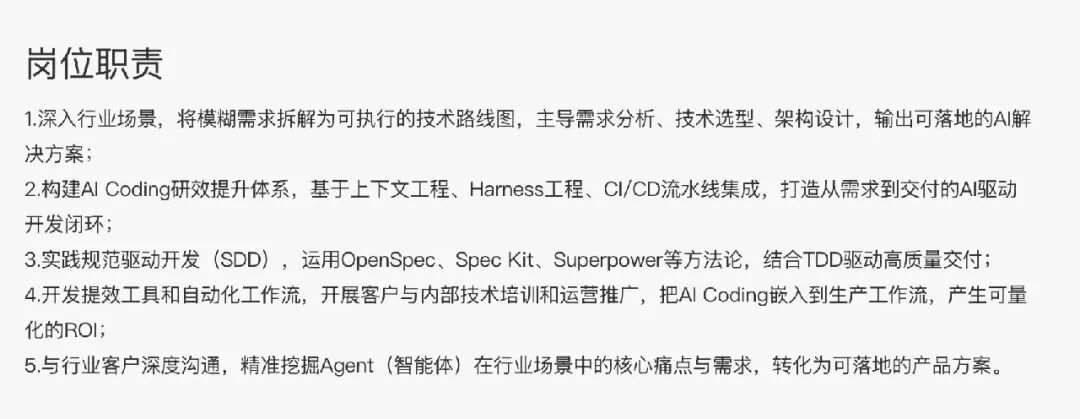
For example, Tencent's positioning of "AI Forward Deployed Engineer FDE" is not only "connecting large models to customer systems", but also helping enterprises redesign R&D processes and AI Coding systems. It actually integrates the responsibilities of full-stack engineers, solution architects, R&D effectiveness consultants and customer delivery leads.
MiniMax also has the position of "Head of Solution / Forward Deployed Engineer FDE". The recruitment information emphasizes that FDEs need to enter industry scenarios such as education, healthcare, finance and manufacturing, identify real obstacles in AI implementation, complete end-to-end solution design, and make data generated from industry scenarios flow back to model training to drive algorithm iteration in reverse. MiniMax specifically notes that this position is not purely pre-sales, but requires maintaining direct connection with the model and algorithm teams.
This is very close to the core closed loop of Palantir-style FDE: engineers should not only complete individual customer projects, but also bring problems, data and demands arising at the customer site back to the product and model team, so that a customized delivery can eventually precipitate into platform capabilities.
But now, FDE alone seems no longer able to meet the needs of enterprises.
2 Forward Deployed Engineers Can Only Solve Technical Problems
Palantir is one of the first enterprises to recognize the implementation gap between enterprises and new technologies.
Its customers are often government agencies, the military, manufacturing, energy and large financial institutions. The data, permissions and processes of these organizations are highly complex, making it impossible to complete deployment with only a set of standardized SaaS products. Palantir's approach is to station outstanding engineers involved in technology development directly in customer teams to work with customers. These FDEs are not only responsible for completing deployment, but also continuously discover new application opportunities and promote customers to expand the scope of use.
Although this approach is similar to technical service or personnel augmentation in form, its mindset is different. It is relatively easy for enterprises to procure technology, but the real difficulty lies in completing data migration, tool integration, code refactoring, personnel recruitment and training, resource management, internal and external communication, cross-departmental coordination, executive support, board game playing and budget arrangement, so as to finally achieve the initially set goals and return on investment.
After the rise of generative AI, this model has been re-adopted by companies such as OpenAI and AWS.
Manelius pointed out that the software procurement cycle of large enterprises usually lasts 18 to 24 months, and only one or two new tools are often introduced in each cycle. The external environment changes rapidly on a quarterly, monthly or even weekly basis. Multiple factors together lead to the fact that more than 90% of enterprise AI projects fail to achieve the expected return.
He believes that FDE is an important first step to solve this problem. By directly entering the customer team, FDEs can see the real workflow instead of the sorted version in the bidding documents; they can deliver operable results within weeks, days or even hours, reducing the situation where projects stay in the pilot stage for a long time; their work measurement standard is not signing orders or increasing usage rate, but whether customers have truly achieved results.
However, FDEs mainly solve technical problems and are often far away from the core managers who decide budgets, organizational structures and corporate culture. To truly build an AI foundation, enterprises also need top management to become AI promoters.
"The bottleneck at this stage is not the cost of models, products, agents or Tokens, but how fast humans can successfully absorb AI practices, products and methods into enterprises," said Manelius. For this reason, some executives suffer from severe anxiety for fear of falling behind.
"What they really need is not another article listing a few suggestions, but a trusted consultant with both technical and leadership experience to help them sort out challenges and push for practical changes."
In addition to technical and process issues, AI transformation is also accompanied by obvious psychological pressure. AI is changing fast, and the risk of wrong decisions is very high, which generates a lot of fear, uncertainty and doubt. Therefore, even if managers get an ideal answer, they may not adopt it unless they trust the person who provides the answer.
3 Enterprises Also Need "Forward Deployed Executives"
Dan Shipper from Every once said that an important indicator to judge whether an enterprise can effectively adopt AI is whether the CEO himself uses AI frequently and actively shares results with the team. A PwC survey also shows that enterprises that have built a strong AI foundation have 3 times higher probability of their CEO reporting significant financial returns than other enterprises.
Based on this, Manelius proposed that since enterprises cannot replace the entire management team in a short period of time, external FDXs are needed to help executives improve their AI capabilities. FDXs should not only tell managers what technology to adopt, but also help them identify problems, set priorities, and cross the psychological and emotional thresholds that hinder action.
It is also worth noting that in its 2026 product demonstration, Palantir also proposed that "forward deployed engineering is no longer done exclusively by humans". Its AI FDE can write AIP Logic functions, create evaluations, debug systems, and push preliminary solutions to production-grade systems in a continuous loop. Palantir also demonstrated the process of "agents building agents". This shows that FDE itself may be partially automated by AI.
But the more AI can complete the technical work in deployment, the more enterprises need someone to undertake the organizational judgment work that cannot be replaced by code, and FDX is the one that takes on this decision-making role.
In fact, in January this year, investor Rishi Taparia shared that one of his portfolio companies signed a six-figure contract, but what the customer purchased was not software, but required the founder to enter the enterprise as an external executive for several months, participate in the formulation of AI and data strategies, and directly engage in real decision-making scenarios.
Taparia pointed out that the "E" in FDE can also stand for Executive. Later, this title has begun to enter the recruitment market. Provectus, an AI consulting and engineering firm, recruited "Senior Product Owner/Forward Deployed Executive—AI Delivery" in July, combining product ownership, customer delivery and high-level business promotion capabilities into one position.
Companies such as Anthropic once predicted that by around 2030, AI may start to replace 50% of white-collar jobs. But Manelius believes that at least for now, this change has not occurred on a large scale.
Manelius draws an analogy between FDX and the "solution architect" that was sought after by the market ten years ago.
An excellent solution architect usually needs to have three types of capabilities at the same time: technical capability to understand system architecture and best practices; management capability to handle cost, time and team configuration; entrepreneurial capability to understand business demands, return on investment and market opportunities.
In the AI era, FDXs also need to have stronger adaptability, be able to respond quickly to changes, and maintain a high tolerance for uncertainty; they need to put AI first, and consider what work AI can undertake first when analyzing problems; at the same time, they should have the capabilities of hands-on execution, collaborative teaching and task delegation, being able to complete work on their own and help the team master methods.
Manelius said that in the past year or more of AI capability improvement work, many executives hope to have someone to test, experiment and optimize AI tools with them, and provide support during the transformation process. What they need is not a pure technical person, but someone who can not only understand the language and demands of managers, but also solve practical technical obstacles.
4 Similar FDX Positions Also Exist in China
There are positions similar to FDX in China, but they are often not a complete independent role.
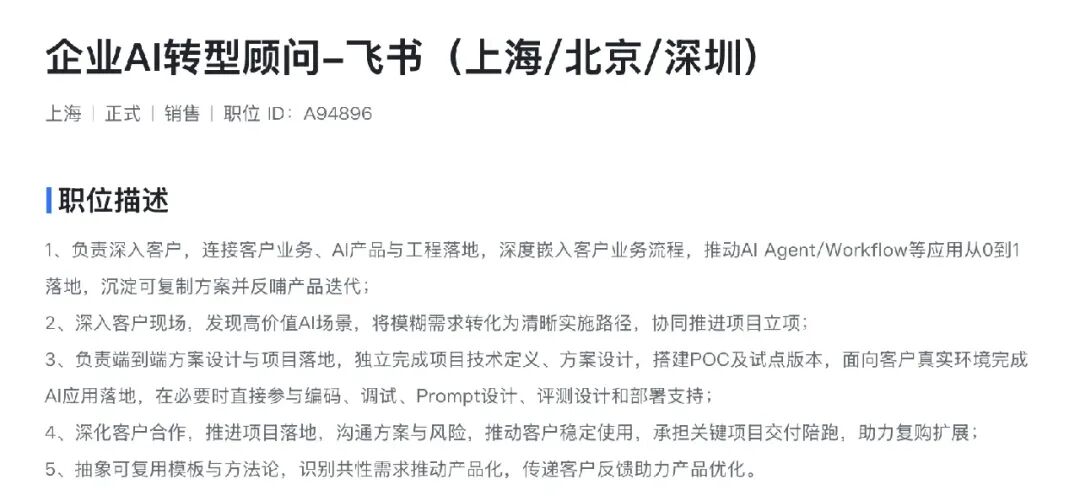
The "Enterprise AI Transformation Consultant" recruited by ByteDance's Feishu is not only responsible for pre-sales explanation or software implementation, but also enters the customer's business site, takes charge of the whole process from product launch, business pain point identification, AI scenario design to effect tracking, and solves the problems of enterprises such as "being unable to find scenarios, failing to land, and having difficulty quantifying value". The position also requires capabilities in high-level customer communication, business consulting, technical solution design and complex project promotion. Its work content is already very close to FDX: standing between management, business and technology, to promote enterprises to complete AI transformation.
Some positions at Baidu Intelligent Cloud also have obvious FDX characteristics. For example, its Smart Industry Solution Architect not only needs to design AI and Agent solutions, but also needs to understand the customer's business strategy and AI transformation goals, communicate with customer CXOs, quickly write PoC, calculate Token costs, coordinate sales, product, R&D, marketing and ecological partners, and promote customers to move from experimentation to large-scale use.
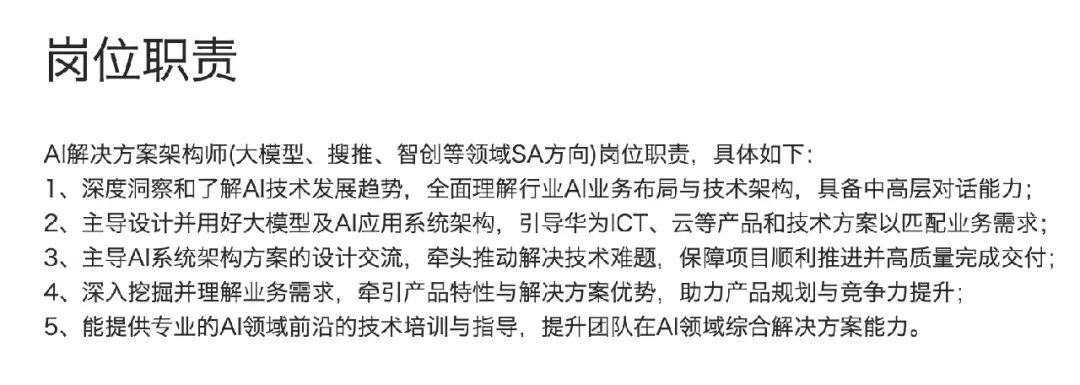
Huawei's AI Solution Architect also requires the ability to communicate with mid-to-senior customer management, help customers design large model and AI application architectures, solve project problems, ensure delivery, feedback frontline demands to product planning, and train customers and internal teams. Both this position and FDX need to influence customer decisions and coordinate technology and business. The difference is that the main body of the position is still a technical architect, and organizational change and business results are usually not its sole responsibility.
It can be seen that although the titles are different, both domestic and foreign markets are actually looking for the same type of person: someone who can not only understand the boss's problems, but also go to the business site, and truly deliver AI projects.
5 "You May Not Know You Need FDX"
Manelius's judgment also comes from two AI transformation practice cases.
In the first case, Ben, an entrepreneur with a non-technical background, planned to develop a feature: call an API once and export the results as an HTML table. He hired a developer with an hourly salary of about 30 US dollars, and the delivery cycle was two weeks.
In May, about half a year after Opus 4.5 changed the AI programming industry, Manelius launched Claude Code via screen sharing and dictated an instruction: create a simulation database for a certain industry, and then make an HTML page that calls the database and converts the results into an HTML table. After about 2 to 10 minutes, the demo page ran successfully.
This experience became a turning point for Ben's company to adjust its operation mode. Within a few days, the company recruited an AI-first developer to help the team improve their capabilities; a few weeks later, a customer demo project that was almost impossible to complete on schedule became deliverable. Manelius believes that what helped Ben cross the threshold of cognition and action was not just an engineer, but an FDX who could identify problems and push managers to make changes.
Another practice came from Tyler, an entrepreneur with a non-technical background.
In the weeks to months before that, Manelius had been sharing AI industry updates with him. On January 25, Tyler asked the author what he thought of Clawdbot, later known as OpenClaw. Manelius said he had already bought a Mac mini and was preparing to fully adopt the product, believing that its importance might be comparable to Opus 4.5, and the market would realize this in less than a month.
After that, Tyler deployed two OpenClaw instances in the company within a week, one of which took on the role of CTO. By the second week, its product delivery speed had increased to 3-5 times the original, and the team size was cut in half.
"Similar to Ben's situation, Tyler's initial bottleneck was not the lack of FDEs, but the need for someone familiar with AI to push him to take action. Subsequently, Tyler's understanding and use of related technologies quickly surpassed the people who initially gave him advice," Manelius said.
Manelius regards FDX as a market opportunity worth billions of dollars or even more. More importantly, it may also create a new career path for enterprise managers who are worried about being replaced by AI. At least in 2026, there are still a large number of technical, business and organizational gaps within enterprises, and companies are looking for people who can help them bridge these gaps.
He believes that what is truly scarce in the AI era is not people who only understand models or only understand management, but people who can understand technology, business and organization at the same time, and personally push enterprises to turn AI into practical results.
Reference Links:
https://www.rickmanelius.com/p/forward-deployed-executives-the-next
https://taps.substack.com/p/fde?utm_source=chatgpt.com