Alibaba, ByteDance and Tencent are going all out for AI office.
BAT collectively steps in to seize your next workstation.
Reported by Zhidx on August 3, within just two weeks, three internet giants ByteDance, Alibaba and Tencent have successively launched heavyweight moves in the AI office sector.
On July 30, Liang Rubo, CEO of ByteDance, issued an internal email that merged the Feishu product team into Doubao, and placed the sales line under Volcano Engine. The original product and commercial system of Feishu was split up.
On the same day, Tencent WorkBuddy launched the "Human-AI Dual Writing" collaborative editing capability. On August 3, Alibaba's Qianwen Office officially opened public beta testing, and three Agent products including QoderWork, Wukong and MuleRun were integrated into a unified product system.
The three companies adopted different integration approaches, but point to the same direction: transform AI from an independent function into the underlying capability of office applications.
The "Report on AI Development Trends and Implementation in the Collaborative Office Sector" jointly released by IDC, an international market data tracking institution, and Tencent Cloud points out that the future collaborative office will no longer be a simple "AI embedded in traditional tools", but a native architecture system designed for deep collaboration between AI and humans.
IDC predicts that by 2030, 95% of job roles will be redefined, and employees will shift from executors of repetitive tasks to "task architects" for creative work.
Liang Rubo also put forward his judgment: The form of office software in the AI era will be restructured, and eventually evolve into a new type of work platform with agents as the core, rather than traditional document or collaboration tools.
Under the tweet about WorkBuddy's function update, some netizens sighed at the fast iteration speed of functions: AI skills that needed to be encapsulated a few days ago can now be completed in one second.

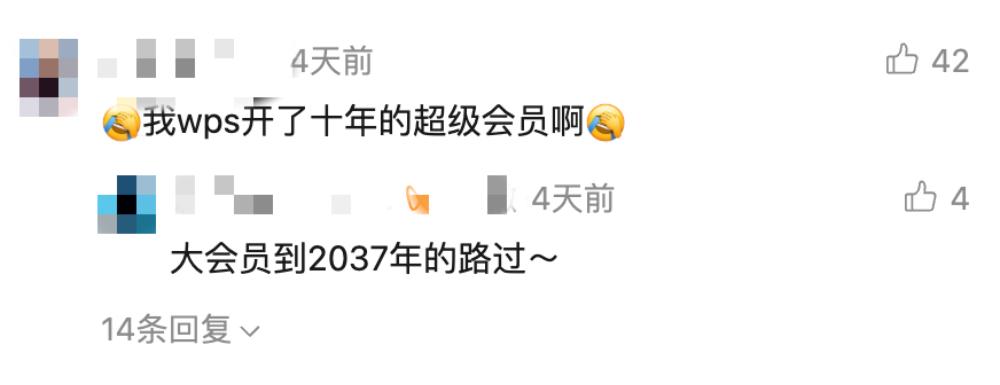
Some other netizens joked that they had been a super member of a certain office software for 10 years, and never expected AI functions to develop so fast.
01. ByteDance: Split Feishu to Empower Doubao
The internal email issued by Liang Rubo, CEO of ByteDance on July 30, announced two integration lines:
Product line: The Feishu product team and the Doubao product team are integrated to form a new "Doubao Product Team", which is under the unified responsibility of Zhao Qi, the head of Doubao, and Xie Xin, the former head of Feishu, reports to Zhao Qi.
Sales line: The Feishu GTM (marketing, sales, customer service) team is integrated with Volcano Engine to form a new ToB GTM organization "Creativity Service Platform", which is in the charge of Tan Dai, the head of Volcano Engine. Lin Chan, the head of Feishu sales, and Shi Zhijun, the head of Feishu strategy and marketing, report to Tan Dai.
In short, Feishu's originally relatively complete product and commercial system has been split up, with the product part under Doubao and the sales part under Volcano Engine. Among them, the enterprise version of Doubao has started internal testing among some Feishu customers.
Why is Feishu the one being split? Liang Rubo gave the answer in the internal letter:
According to ByteDance's disclosure, calculated based on the average consumption caliber in July 2026, the annualized revenue run rate (ARR) of its large model business has exceeded 4 billion US dollars, surpassing the sum of all other domestic model companies. The monthly active users of Doubao have reached 382 million, taking a leading position far ahead of others.
These two indicators mean that Doubao's B-end commercial capability is already in a leading position among domestic large model companies.
At the same time, among the newly signed enterprise customers of Feishu recently, the proportion of customers who purchase Feishu AI function modules (such as AI assistant, intelligent meeting minutes) at the same time has exceeded 90%.
This set of data shows that market demand is forcing Feishu to accelerate its AI transformation. Instead of letting the two teams act on their own and make repeated investments, it is better to merge Feishu's product team into Doubao, so that Doubao's AI capabilities can be directly embedded into the enterprise scenarios accumulated by Feishu, eliminating intermediate links.
02. Alibaba: Three-in-One, Focus on Promoting Qianwen Office
Alibaba has also taken drastic measures in the AI office sector.
In terms of products, on July 30, DingTalk launched DingTalk WorkSpace CLI (DWS) in version 8.3.45, which encapsulates DingTalk's product capabilities into command line tools, providing 18 business modules, more than 160 commands and 32 automation scripts for developers and AI agents.
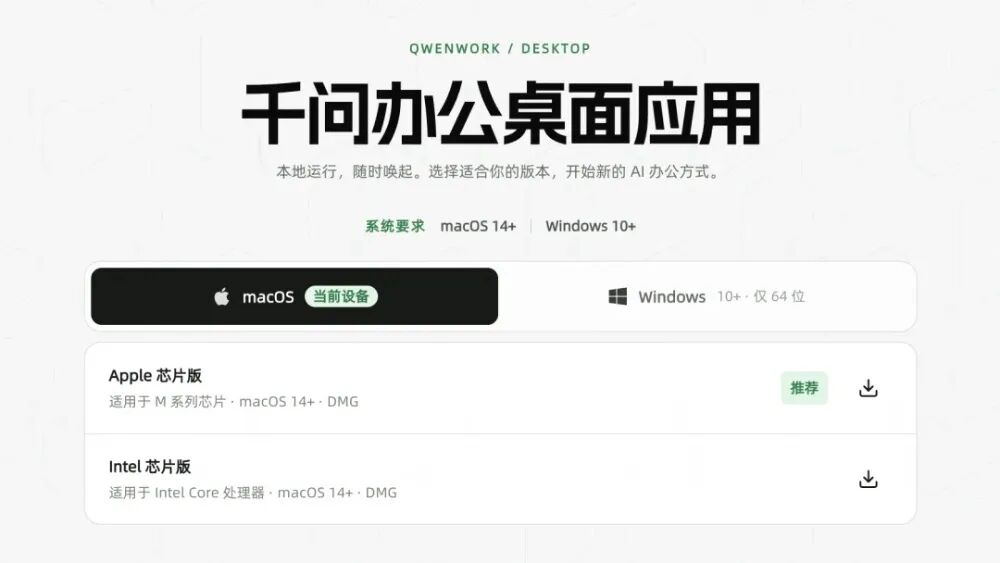
Today, Alibaba's new AI Agent product Qianwen Office officially opened public beta testing. This product integrates three Agents under Alibaba: desktop-side agent QoderWork, web-side agent MuleRun, and enterprise-level agent Wukong. Qianwen Office started small-scale testing on July 27, and the local desktop client has been launched so far.
According to the latest report from Huxiu, Alibaba has internally regarded "AI Office" as one of the company's AI strategic directions, with a clear positioning from the decision-making level: to build an AI productivity platform for enterprise organizations, rather than a C-end personal office tool.
In terms of organizational structure, the former Wukong Business Unit of Alibaba ATH Business Group has been upgraded to "Qianwen Office Business Unit", which is led by Chen Yusen, integrating the three products QoderWork, Wukong and MuleRun. The three products will no longer exist independently after integration, and all relevant personnel will be incorporated into the unified Qianwen Office system. Senior group executives including Wu Yongming personally participate in key meetings of Qianwen Office.
In terms of organizational structure, the specific changes to the architecture system of Alibaba ATH (Alibaba Token Hub) Business Group are as follows:
- Token Foundry Business Unit:
Led by Wu Yongming, it includes the Tongyi Large Model team and the Future Life Laboratory (Happy Horse, Happy Oyster and other projects);
- Qianwen Business Unit:
Led by Wu Jia, Vice President of the group, it is responsible for C-end applications such as the Qianwen APP;
- Qianwen Office Business Unit:
Led by Chen Yusen, it is responsible for the two core businesses of Qianwen Office and DingTalk;
- MaaS Business Line:
A model service platform and technical system that links upstream and downstream and opens up the Token link;
- Innovation Business Unit:
It consists of multiple super unit teams, responsible for incubating innovative applications and new projects.
03. Tencent: WorkBuddy Launches Independently, Increasing Investment in "Human-AI Dual Writing"
Tencent completed two key product upgrades in July.
On July 18, WorkBuddy, Tencent's AI office agent product, launched its independent App on iOS, Android and Hongmeng platforms, becoming the first desktop office agent on the Hongmeng platform.
On July 30, WorkBuddy launched the "Human-AI Dual Writing" collaborative editing capability. Users, colleagues and AI can jointly edit the same document, covering Tencent Docs and local Word, Excel, PPT, Markdown files. After selecting text, tables, images or PPT elements, users can use natural language instructions to let AI modify the original file directly, and the modification results are synchronized in real time.
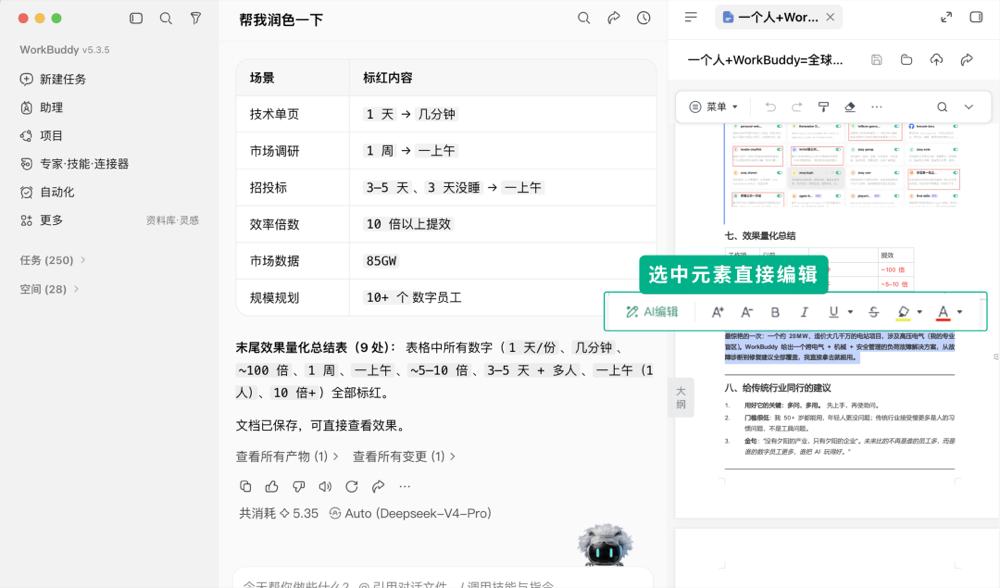
All three core office tasks are covered by AI capabilities: the document scenario supports generating summaries, batch format adjustment, typo checking and polishing; the table scenario supports making pivot tables, formula completion, data cleaning, chart generation and outlier marking; the PPT scenario supports unified layout, image and chart generation, page splitting and speech note writing.
Before the launch of the "Human-AI Dual Writing" capability, the monthly visits of WorkBuddy had shown a significant upward trend. According to the "2026 Q2 China Office Agent Platform Market Insight Report" released by Analysys on July 20, 2026, the monthly visits of WorkBuddy increased from 8.85 million at the time of its release in March to 20.97 million in June, with an increase of over 100%.
04. The Time is Ripe: BAT Has Three Consensus on Integrating AI Office in the Same Month
The three giants took concentrated actions in the same window period for three reasons behind it:
First, the office scenario is one of the rigid demand scenarios with the largest token consumption scale.
According to the analysis of LatePost, the surge in ByteDance's large model revenue is mainly due to the deep embedding of Doubao in programming assistance and agent scenarios, which drives high-frequency token calls in real work flows.
The office scenario has the triple attributes of high frequency, high stickiness and high willingness to pay, and has become the export with the highest token realization efficiency of large models.
Second, Agent capabilities have crossed the availability threshold.
Yin Qi, Chairman of StepStar, previously put forward a judgment: in 2026, model capabilities are crossing a key critical point, and AI has evolved from being only able to perform tasks for several seconds continuously to being able to work independently for dozens of hours.
The office scenario is exactly the scenario with the densest "long-horizon tasks". For the first time, the maturity of Agent technology is sufficient to support real work flows, rather than staying at the tool layer such as information retrieval and minutes generation.
Third, the window period for entrance competition is narrowing.
OpenAI has launched ChatGPT Work integrating Codex, and Microsoft confirmed that the Copilot "super application" will be launched within the year.
Overseas giants are simultaneously promoting layouts in the same direction. If the three domestic companies cannot complete internal integration and unify product entrances first, they will lose the first-mover advantage in the competition for the next-generation office entrance.
05. Conclusion: The "Entrance War" of AI Office is Accelerating
The three companies have the same logic for integration in the same month: the value of single-point tools is diluting, and a unified entrance and full-process coverage are the new barriers.
The competition in the AI office track has passed the stage of "comparing functions". Whoever can truly integrate AI into the enterprise's production process will get the ticket to the next-generation office entrance.
There is not much time left for players who have not yet completed integration.
This article is from the WeChat public account "Zhidx" (ID: zhidxc om), written by Wang Han, edited by Yunpeng, and published with authorization from 36Kr.