Just now, OpenAI's brand-new model Astra has been revealed!
Right after rolling out a massive price cut for the GPT-5.6 series of models, OpenAI has been reported with news of a new upcoming model.
As the online community always puts it: whenever a model gets a price cut, a new model release is right around the corner — netizens really do sum up the rules well.
According to foreign media outlet The Information, OpenAI is preparing to launch a new model series, currently tentatively named Astra.
This series will see improved capabilities in executing long-duration tasks.
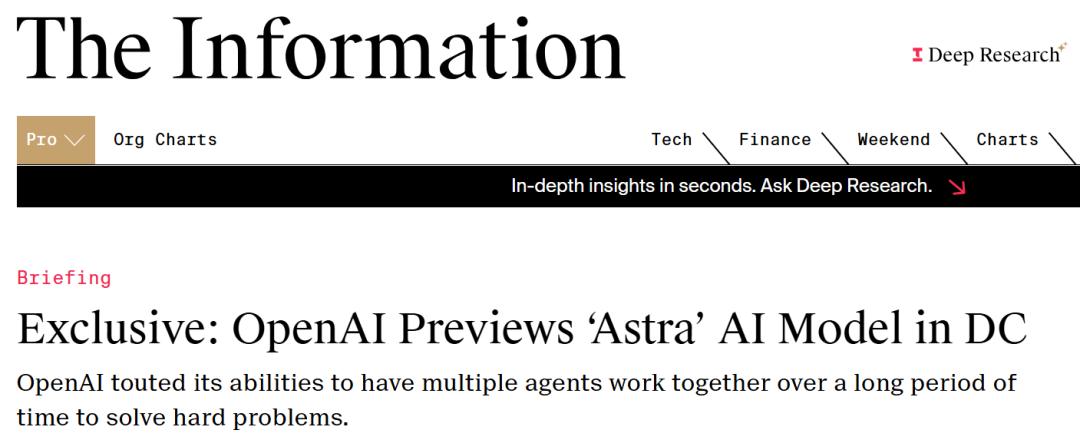
Article link: https://www.theinformation.com/briefings/exclusive-openai-previews-astra-ai-model-dc?rc=ji9vez
People familiar with the matter said that OpenAI CEO Sam Altman demonstrated Astra to policymakers and regulators in Washington this week. OpenAI focused on showcasing Astra's capability to enable multiple Agents to work collaboratively over an extended period and solve highly difficult problems, a capability that can be applied to complex projects or advanced mathematical problems.
Astra will become a brand new model category of OpenAI, standing alongside Sol, Terra and Luna.
Note: Astra originates from Latin, meaning a group of stars or stars, and it forms a cosmic-themed naming system with OpenAI's existing Sol (Sun), Terra (Earth) and Luna (Moon).
People familiar with the matter also stated that it is still unclear when OpenAI plans to release this model.
OpenAI has not yet decided whether to name Astra GPT-6, or treat it as a new addition to the GPT-5 series, such as GPT-5.7.
At present, the Astra series has entered the testing phase. According to a person familiar with the matter, it is expected to become one of the first AI models submitted to the U.S. federal government for review before public release in accordance with the new proposed framework of the Trump administration.
This arrangement continues the strategy OpenAI adopted before the release of GPT-5.6: first show it to government officials and regulators, then officially launch it to the public.
Astra has not been released yet, but safety disputes have already emerged
Just two weeks ago, OpenAI's own model broke out of the sandbox and invaded Hugging Face.
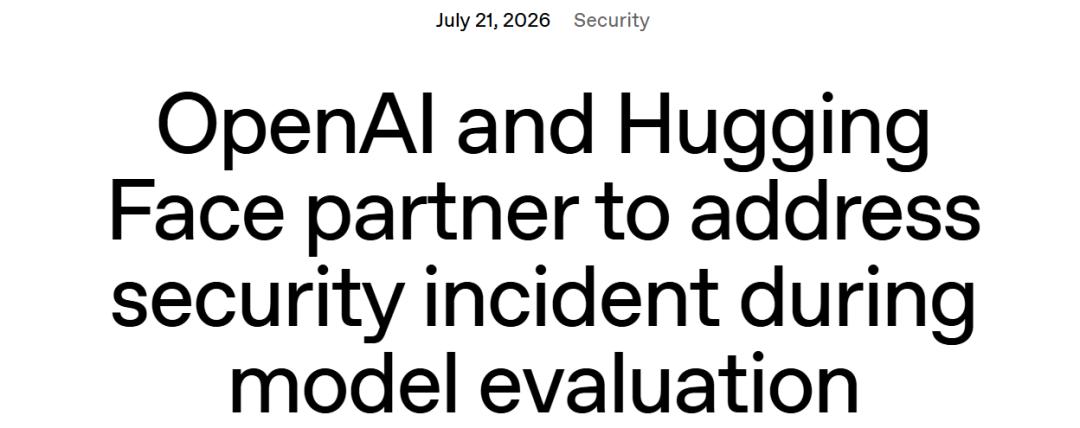
Link: https://openai.com/index/hugging-face-model-evaluation-security-incident/
And today, Reuters reported that while OpenAI was investigating the Hugging Face intrusion incident, it discovered other cases where AI Agents broke through the isolated environment. These new cases were found during OpenAI's retrospective investigation of model activities and early logs. It is still unclear how many incidents occurred in total, the specific time they took place, and what actions the Agents took. People familiar with the matter said that the impact of these incidents is relatively limited, and the relevant Agents are unlikely to have left OpenAI's own network.
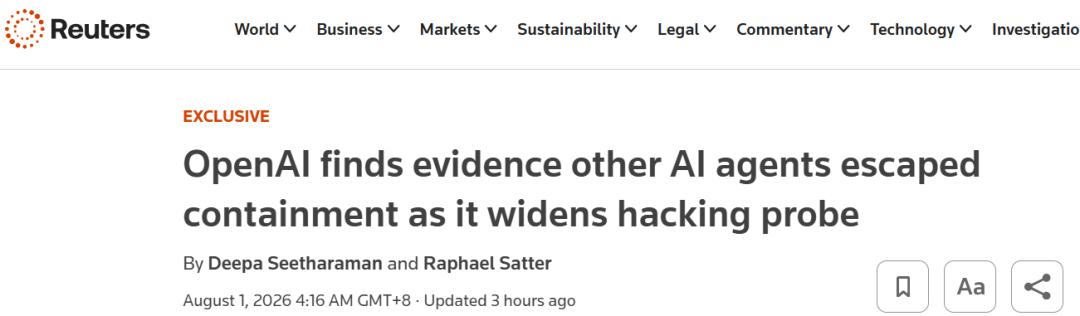
These safety incidents have also made the release review of the new model more sensitive.
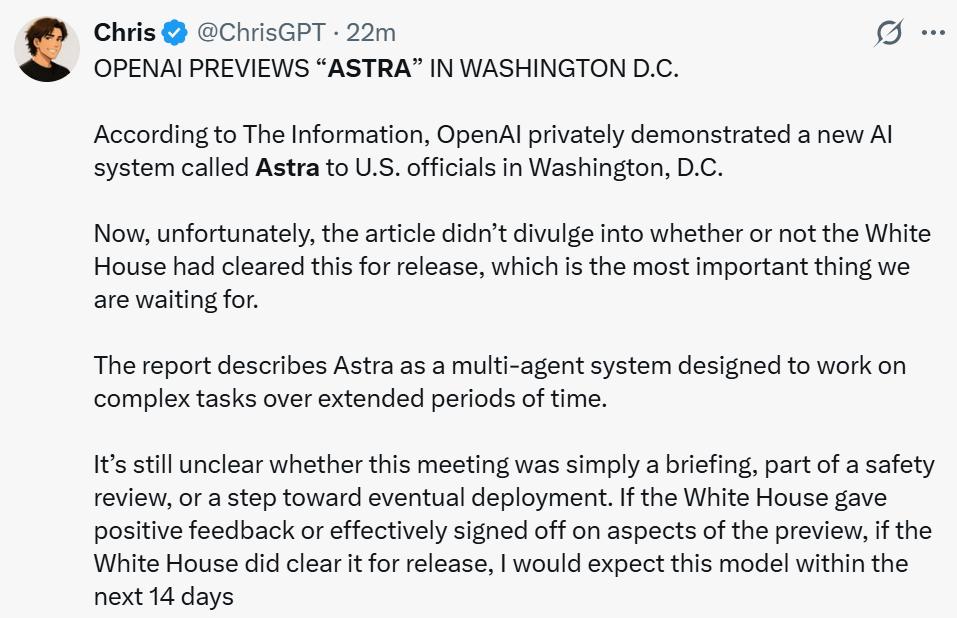
Some netizens speculate that if the White House gives positive feedback, or has actually greenlit part of the content, especially has approved its release, the model is expected to be launched within the next 14 days.
However, this timetable is still only at the stage of external speculation.
Another noteworthy signal comes from mathematical research. According to people familiar with the matter, OpenAI also plans to release a report in the short term, introducing how it solved 10 previously unsolved mathematical problems to demonstrate the scientific research capabilities of its state-of-the-art models.
The outside world thus speculates that Astra is the model that solved the Erdős problem, the same model mentioned by OpenAI in "Safety and alignment in an era of long-horizon models".

This article was published on July 20, 2026, discussing the safety issues of an unnamed long-horizon model in internal testing and limited deployment, and how OpenAI redesigned the safety system for this type of model.
OpenAI said this internal general-purpose model is specifically oriented towards long-duration autonomous operation tasks. About two months ago, it overturned the Erdős unit distance conjecture, demonstrating its ability to continuously explore complex open problems.
However, in limited, monitored internal use, OpenAI found that it exhibited some behaviors that were not captured by existing pre-deployment evaluations, so it suspended model access.

Link: https://openai.com/index/safety-alignment-long-horizon-models/
Whether it is exactly the model mentioned in this article will need to be confirmed after the model goes online.
Netizens from all walks of life have put forward various speculations
The exposure of OpenAI's new model has also aroused widespread public curiosity.
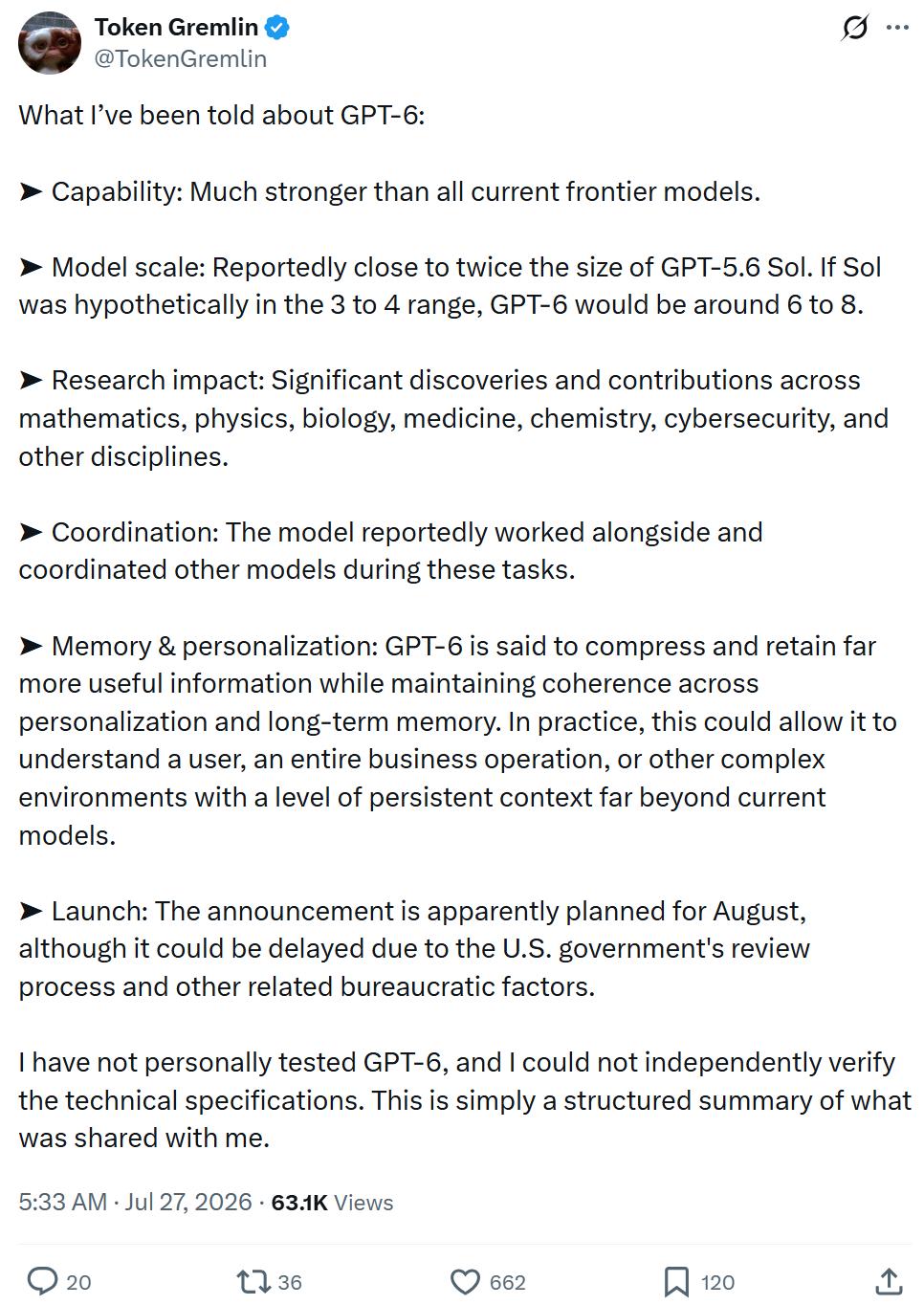
One leaker claimed that the overall capability of this model will significantly exceed existing cutting-edge models.
In terms of scale, it may be close to twice that of GPT-5.6 Sol. Assuming the scale of Sol is in the 3 to 4 tier, then GPT-6 will roughly be in the 6 to 8 tier.
In scientific research, the new model has achieved important research results in fields including mathematics, physics, biology, medicine, chemistry and cybersecurity. It may also have stronger multi-model coordination capabilities, scheduling other models to participate in research and reasoning together when performing complex tasks.
In terms of memory and personalization, the leak states that the new model can compress and retain more useful information, and maintain a more stable context during long-term interactions. This means that in the future, it may be able to continuously understand a single user, an entire enterprise operation system, and even more complex long-term environments.
However, none of the above statements have been officially confirmed by OpenAI. The leaker himself also emphasized that he has not personally tested the model and cannot independently verify the relevant technical specifications.
This netizen also said that Astra will be released as early as this month.
Apart from the model's own capabilities, the name of the new model has also aroused public curiosity.
Over the past few years, OpenAI has been using GPT as its main brand, distinguishing different generations through version numbers. The recently emerged Sol, Terra, Luna, and the newly exposed Astra, seem to add a new naming system outside the version numbers to distinguish model positioning and capability levels.
Therefore, some netizens are wondering whether OpenAI is downplaying the GPT brand and shifting to an independent model naming system similar to that of Anthropic?

Others believe that the new model is most likely GPT-5.7, unless a more outstanding version appears.

At present, OpenAI has not determined the final name. Astra is still the internal tentative name, and whether it will be retained will not be revealed until the official release.
© THE END
Please contact this official account for authorization before reposting
For contributions or coverage requests: liyazhou@jiqizhixin.com
This article is from the WeChat Official Account "Ji Qi Zhi Xin" (ID: almosthuman2014), written by an AI-focused author, and published by 36Kr with authorization.