Wendi Deng's 23-year-old daughter gave up the job offer from Goldman Sachs. Are those top second-generation wealthy people fleeing the financial circle and flocking to the AI industry to gild their resumes?
The trend of top wealthy second-generation individuals "looking for jobs" has changed.
Recently, Wendi Deng posted a master's graduation photo of her second daughter Chloe Murdoch on social media. Her daughter obtained a Master of Science degree in Computer Science from Stanford University in just one year, and Wendi Deng is extremely proud and delighted.
Netizens found that Chloe did not go to the financial institutions where the rich used to gather, but joined an AI startup, which is reportedly selected personally by Wendi Deng for her daughter.
In the past two years, the career planning of the top second-generation billionaires has completely changed. In the past, the second-generation rich would attend top schools, intern on Wall Street, go to investment banks to polish their resumes after graduation, take over the family business after a few years of work, or make investments on their own. Now, they have all flocked to the AI sector. It is a realistic move but easy to understand:
Since it is all about "polishing one's resume with valuable experience", people naturally choose the most glorious and promising field to gain that experience.
01 Wendi Deng's daughter graduated with a master's degree at 23, gave up Goldman Sachs and joined an AI company
It is the university graduation season recently, and Wendi Deng posted the graduation photo of her youngest daughter Chloe Murdoch at Stanford on social media.
Chloe, wearing an academic gown, stood happily on the graduation ceremony stage and received the Master of Science in Computer Science (MSCS) certificate.
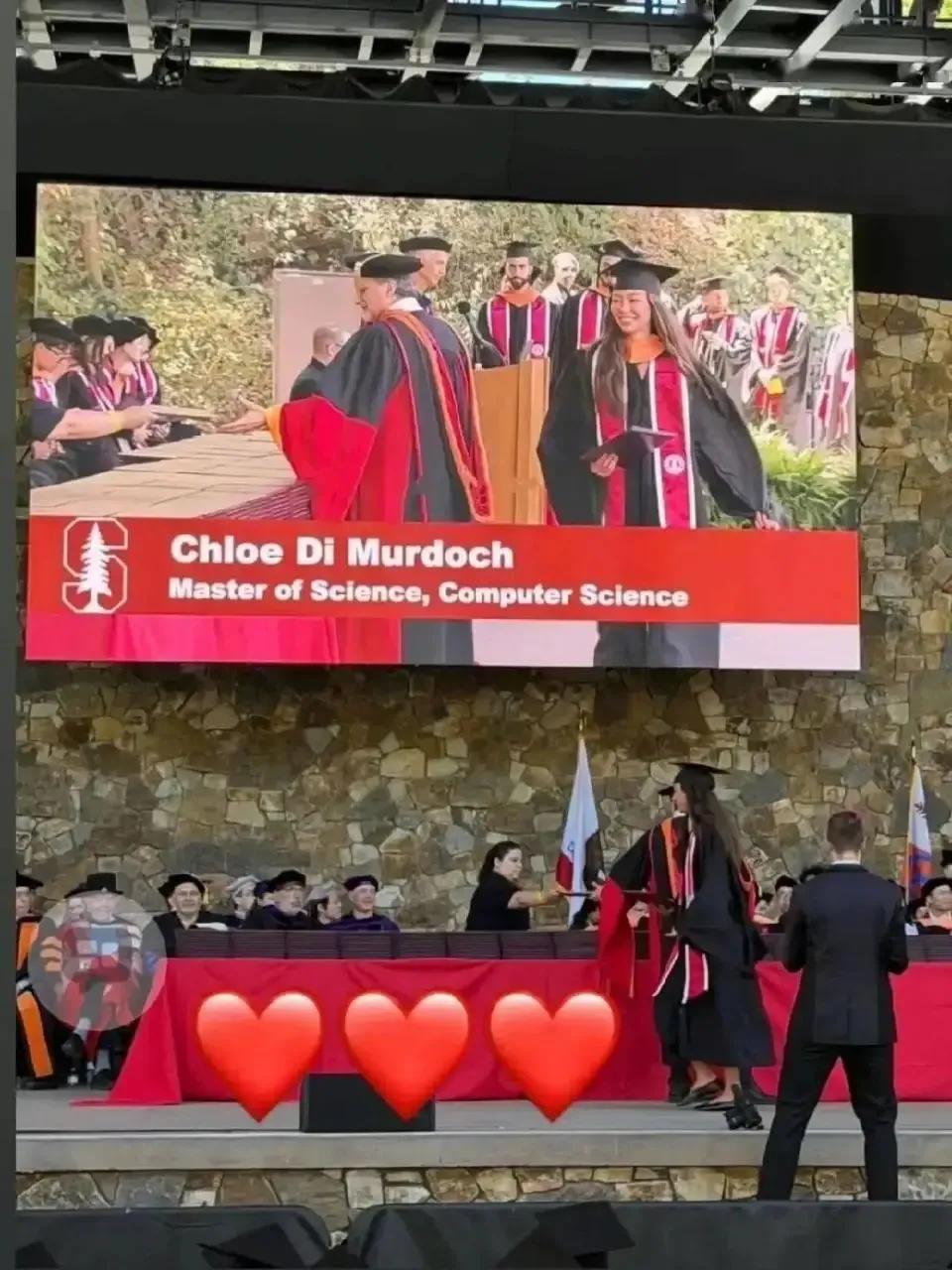
Chloe was born in 2003 and got her master's degree at the age of 23. Wendi Deng said her daughter is her pride, and many netizens commented:
"A strict mother never raises a mediocre child. She is the absolute top tier in both intelligence and family background."

Netizens found that Chloe has already secured her job. She joined an AI startup called Cognition, which developed Devin, the globally popular AI software engineer this year. Chloe has already added this new company to her resume.
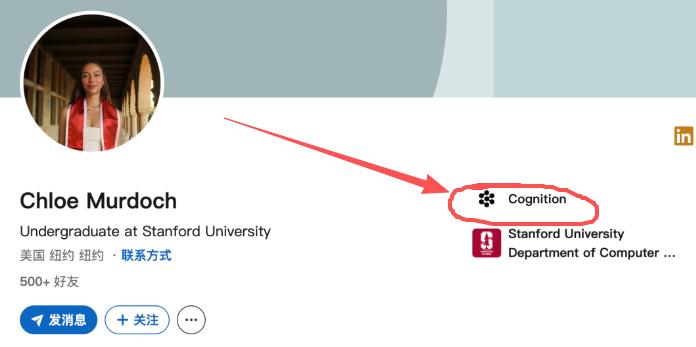
It is said that this job was arranged personally by Wendi Deng for her daughter.
Large established AI giants have rigid organizational structures and highly segmented positions, so employees can only access a certain part of the AI industrial chain. In contrast, Cognition is a startup, where team members can participate in almost all links including technology iteration, financing negotiation, and business implementation. It is an excellent opportunity for newbies to learn the full picture of the AI industrial chain.
In addition, the team of Cognition has many elites, and its founding team holds as many as 10 gold medals in the International Mathematical Olympiad. The company just raised $1 billion in financing this year, with a valuation as high as $26 billion, and its annualized revenue is close to $500 million.
Working in such an enterprise, whether for "learning new skills" or "achieving outstanding results", has huge potential.
Before Chloe joined the company, Wendi Deng called the company's leaders many times to inquire about the job responsibilities. It can be said that Wendi Deng spared no effort to support the career development of her second daughter.
At the end of 2025, after years of "efforts" by Wendi Deng, Murdoch restructured the family trust. The two daughters of Wendi Deng eventually became the beneficiaries of the new trust and obtained the right to distribute future earnings. Although they cannot control the voting rights for operation, the total earnings of each of the two sisters will exceed $1 billion.
With a $1 billion trust fund, a top school degree, and a job arranged by her mother in the most promising industry, Chloe's future is truly infinitely bright.
The children of billionaires "dabbled in unrelated businesses" by opening bars and making desserts, and immediately bet on the cutting-edge AI track once they spotted the trend
The daughter of the newspaper tycoon has gone to the AI industry, and the children of the chip tycoon also want to "inherit their father's career".
Jen-Hsun Huang, the founder of NVIDIA, has two children: his son Spencer Huang is 36 years old this year, and his daughter Madison Huang is 34 years old. The two children are no longer young, and after having enough fun outside, they have been arranged by Jen-Hsun Huang to gain experience in the AI field in recent years.
Spencer Huang was born in 1990, graduated from Columbia College Chicago in the United States in 2012, with a double major in international marketing and cultural studies.
NVIDIA was founded in 1993, and its market cap had exceeded $10 billion by 2012, making it a very outstanding company. But Spencer Huang was not interested in his father's chip business. He insisted on returning to Taiwan, China to study Chinese for a year, and opened a cocktail bar called R&D Cocktail Lab.
This bar integrates oriental aesthetics, filled with elements such as Chinese wood carvings, oil paper umbrellas, and pavilion-style booths, and uses osmanthus and tangerine peel to make cocktails. In its first year of opening, it was shortlisted in the "50 Best Bars in Asia" list and won multiple international awards.
Spencer Huang spent seven or eight years in the bar industry.
As for Jen-Hsun Huang's daughter Madison Huang, her early career path had nothing to do with AI at all.
In 2012, Madison Huang obtained a bachelor's degree in culinary arts and business administration from The Culinary Institute of America, and then went to Le Cordon Bleu Paris in France to study pastry and wine. Later, she worked as a chef in New York and San Francisco.
In 2015, she moved to the luxury industry, joined LV, and served as marketing and development manager.
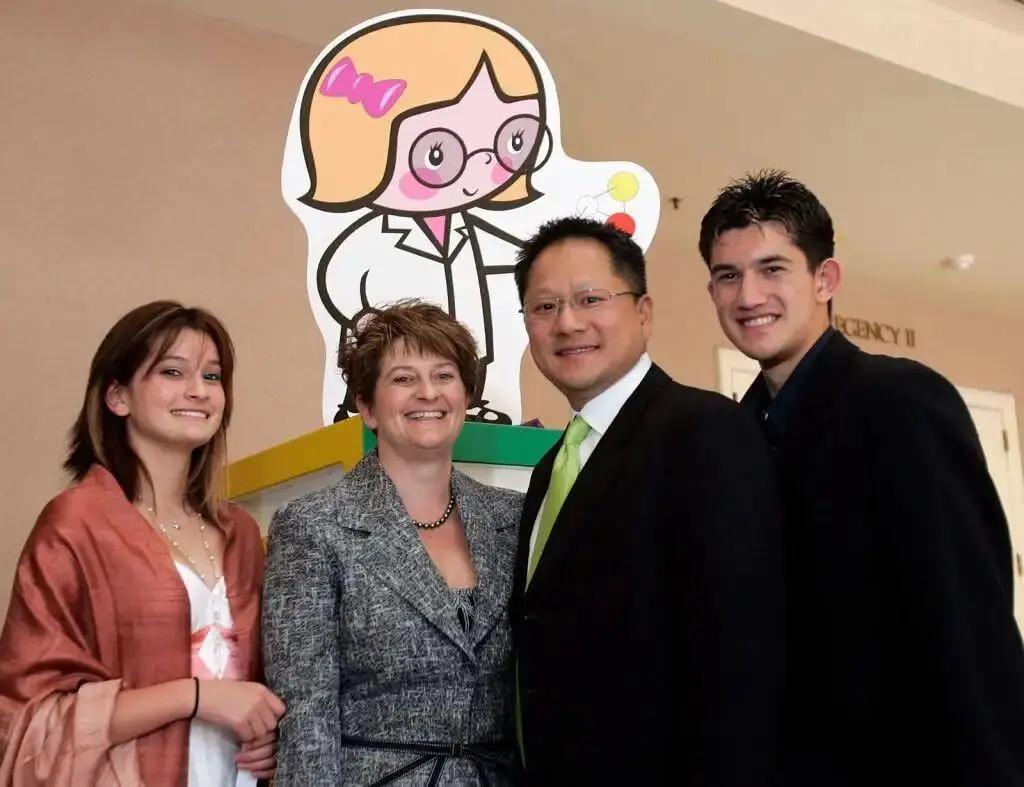
The turning point came in 2019, when both Spencer Huang and Madison Huang left their beloved careers and took a short-term executive course in AI at the Massachusetts Institute of Technology. The elder brother then took a short-term course in human-computer interaction at Harvard Business School, and obtained an MBA degree from New York University in 2022.
After that, both siblings joined NVIDIA.
In 2022, Spencer Huang officially joined NVIDIA, responsible for product management of robot simulation and AI models, focusing on the robotics direction. His annual salary skyrocketed from $530,000 in the previous fiscal year to $1.32 million, with a growth rate as high as 149%.
Madison Huang joined NVIDIA as an intern in 2020. Four months later, she transferred to the simulation software department as an event marketing manager, and then got promoted continuously. Now she is the Senior Director of Product Marketing for Robotics, mainly in charge of Omniverse (the simulation platform), with an annual salary of about $1.2 million.
Why did the two siblings give up their beloved careers in 2019, learn AI-related content, and finally join NVIDIA?
A little thought makes it clear that Jen-Hsun Huang played a huge role in it, and he seized the timing very keenly.
In 2019, deep learning in artificial intelligence had broken through the boundary of general capabilities, and industrial applications were soon put on the agenda. At the same time, NVIDIA also completed its strategic transformation from "hardware-focused to AI software ecology-focused" in this year.
Jen-Hsun Huang allowed his children to "follow their own interests" in the early stage, learning to make cocktails and desserts, but when the AI industry was fully prepared from the overall environment to NVIDIA's own layout, the two children naturally could not refuse such an opportunity to directly reap industry dividends, and joined NVIDIA one after another.
There is another point that Ba Mei reminds everyone to pay attention to.
NVIDIA's most powerful and most profitable products are chips and data. But the jobs that Jen-Hsun Huang's children do at NVIDIA are all related to robots.
Ba Mei remembers that Jen-Hsun Huang has said many times that he believes the next growth driver of AI will come from physical AI and embodied intelligence. And the work his son and daughter are doing now is exactly in these two areas, which is equivalent to a senior high school math teacher secretly teaching his own child calculus, making them several steps ahead of other students.
In previous years, Jen-Hsun Huang said his two children are "low-key" and do not accept interviews. However, there have been more reports about Jen-Hsun Huang's children recently, saying that they have leadership skills, are independent-minded, and care about their subordinates... The two siblings often come out to participate in activities, openly admit that they are the "second-generation of NVIDIA", and do not shy away from appearing on the same stage with their father.
In the past, it sounded not very decent that the children of billionaires worked as bartenders and pastry chefs. Now, their father has reserved for them the most future-oriented and highest-potential industry to "polish their resumes". The two children have broadened their horizons now, exuding the aura of AI industry leaders, so they can naturally do everything openly.
After all, taking over Jen-Hsun Huang's position is only a matter of time.
Is the financial industry no longer attractive? Why do top second-generation rich people all go to the AI industry to polish their resumes?
In the past two years, there have been many other news about top second-generation rich people participating in the AI sector. For example, Phoebe Gates, the youngest daughter of the established billionaire Bill Gates.
In January this year, Ba Mei introduced in the article "Gates' daughter does not rely on her father? She made 1.2 billion yuan from starting a business but 'complained' and was ridiculed by the crowd: Your pocket money is already 500 million..." that Phoebe founded an AI shopping platform called Phia, which raised $30 million in financing in 2025, and the company's valuation directly surged to $180 million, equivalent to about 1.258 billion yuan.
Netizens said she "started a business relying on her father", but she refused to admit it, crying that starting a business was very hard, and she once stayed up until 3 a.m. to fix bugs, claiming that she did not take a penny from her father for her business. In response, netizens directly retorted:
"Staying up one night counts as hard work? Your mother is the business consultant of the company, you get traffic by tying to your father, and you still have 500 million US dollars of pocket money in your card. How can you have the face to say you are independent?"
The previous wave of controversy had just subsided, and recently Phoebe "got into trouble" again, being exposed for suspected commercial fraud.
This AI fashion shopping platform Phia founded by Phoebe can help consumers compare product prices on different websites to find cheaper identical items.
Recently, some e-commerce platforms found during checkout that Phia secretly implanted an invisible hidden page in the background. When netizens check out, this page opens in the background, thus "snatching" the sales commission.
This kind of "underhanded" behavior is not a system bug, but an operation that has been carried out since December 2015. Major e-commerce platforms are furious, claiming that Phia is not satisfied with "taking a small cut from every transaction", but even wants to "take the entire nest away". Now, many e-commerce platforms have suspended their accounts on Phia, and are demanding the previously intercepted commissions.

Leaving aside some of Phoebe's remarks and practices that damaged her public reputation, the idea of the AI fashion shopping platform is quite good. Connecting AI technology with consumer shopping is also a microcosm of AI penetrating into all walks of life.
In addition, many top second-generation rich people have already been active in the AI circle.
Reed Jobs, the only son of Apple founder Steve Jobs, founded an oncology investment institution, one of whose important investment directions is "AI-driven drug R&D".
Guo Mengwei, the eldest grandson of the Malaysian sugar king Robert Kuok, is currently the CEO of a digital company, leading a 5.3 billion euro project to build an AI computing power data center in Italy.
Alexandre Arnault, the second son of the LVMH group, is currently working as a global executive at Tiffany while managing the family's AI venture capital fund, making in-depth layouts in the generative AI and fashion AIGC tracks...
As we all know, in the past, the career path of top second-generation rich people was to attend top schools, go to Wall Street investment banks to polish their resumes, learn relevant skills for two years, build connections for another two years, then go back to take over the family business, or ask their family for money to make their own investments.
Why is Wall Street no longer attractive now, and everyone is flocking to the AI industry?
The AI industry is on the rise, representing a definite technological revolution with huge room for imagination, and it will be the main line of core assets for decades to come.
Facing such an obvious trend, any second-generation rich person with a little ambition will spare no effort to give it a try. As the old saying goes:
What the rich say may not be credible, but the vision of the rich will never be wrong.
This article is from the WeChat Official Account "Financial Gossip Girl Channel" (ID: baguanvpindao), written by Wu Yanzuo Jia Zhengjing, and published with authorization from 36Kr.