At the age of 25, I posted a 2000% gain, then lost all of it in one go.
The last day of July 2026, the entire Wall Street is talking about the same name.
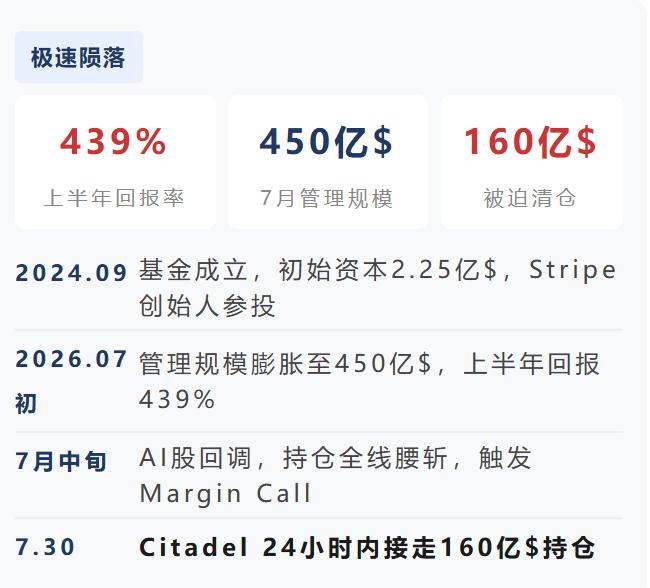
Leopold Aschenbrenner, 25, a former OpenAI researcher. The hedge fund he founded, Situational Awareness, posted a 439% return in the first half of this year, with cumulative returns exceeding 2000% and assets under management swelling to 45 billion USD. Then, in 72 hours, everything collapsed completely.
The young man dubbed "the Peter Lynch of the AI era" by Bloomberg Businessweek triggered multiple rounds of margin calls amid the tech stock pullback and was forced to liquidate all positions. The $16 billion position was fully taken over by Citadel. This is not a story of the bursting of the AI bubble, but a story of faith, leverage and human nature.
01 The Origin of the Prodigy
Aschenbrenner graduated from Columbia University as valedictorian at the age of 19, joined OpenAI's Superalignment team and studied under Ilya Sutskever. A year later, he was fired for "leaking internal security memos". Two months later, he published a 165-page long essay titled *Situational Awareness: The Next Decade*, using the "order of magnitude" methodology to demonstrate that achieving full AGI around 2027 is entirely reasonable, followed by an "intelligence explosion". This essay went viral in Silicon Valley, and some compared it to George Kennan's "Long Telegram" in the early Cold War era — an attempt to awaken the elite to the upcoming drastic changes.
Then he directly turned the logic of this long essay into an investment strategy.
02 Monetizing Faith: Turning Papers into Bets
In September 2024, Aschenbrenner founded the eponymous fund Situational Awareness. Early investors include the founder of Stripe and senior executives of Meta AI. The strategy is simple and crude:
Heavy allocation to AI infrastructure, with 4x leverage.
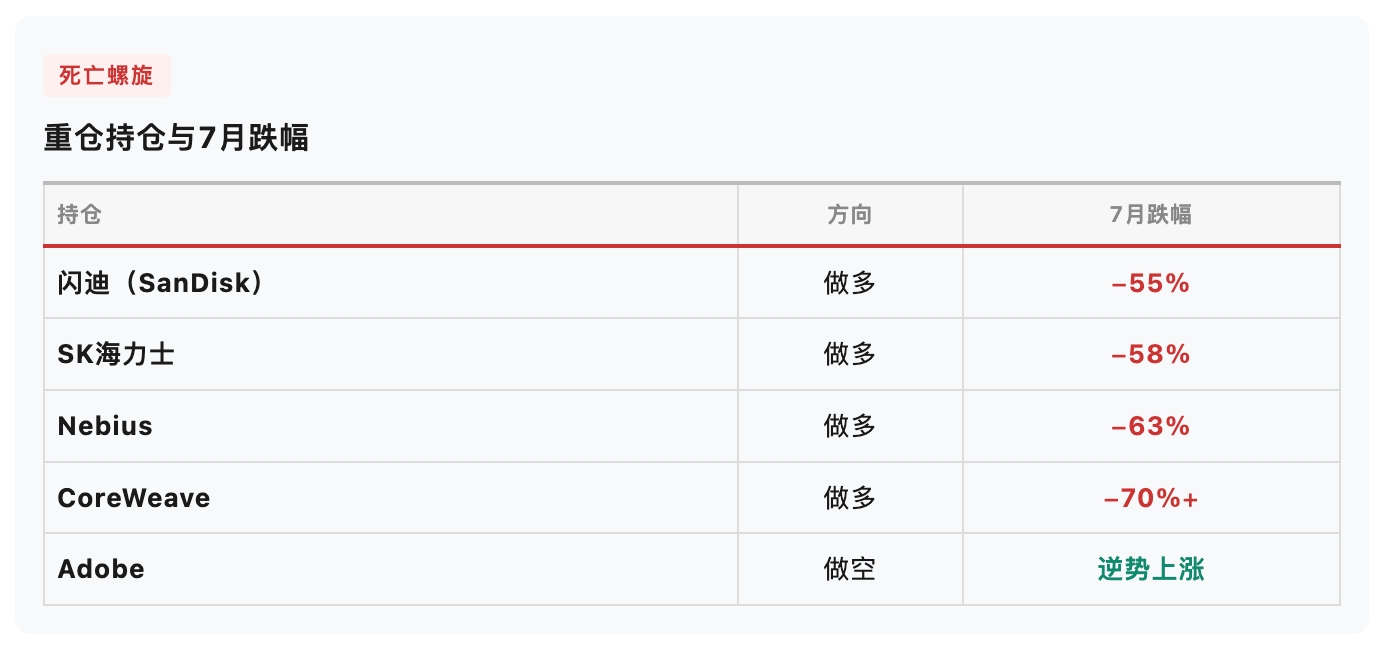
The arrival of AGI is imminent → trillion-dollar computing power infrastructure → GPU, memory chips and data centers are the biggest beneficiaries → leverage is used to amplify returns. He held heavy positions in SK Hynix, SanDisk, Nebius, CoreWeave, and even Bitcoin companies that transformed from mining operations to data centers.
At the same time, he shorted software stocks such as Adobe, betting that AI infrastructure would outperform AI applications.
The direction was correct. Since its establishment, the fund has delivered cumulative returns of over 2000%, and 439% in the first half of this year.
Jane Street Capital, one of the most profitable firms on Wall Street that rarely invests in external fund managers, also backed him.
But a correct direction does not mean a smooth process.
In July, AI stocks pulled back, long positions were halved while short positions also suffered losses. Adobe bucked the trend and rallied, with the floating loss on the short position exceeding 1.2 billion USD in a single day. Getting hit on both sides.
The death spiral of 4x leverage kicked off: position value declined → insufficient margin → forced selling → further downward pressure on stock prices → more margin calls. It is a classic high-leverage liquidation chain, with no way to escape any link.
On July 24, he sent a letter to investors acknowledging significant losses. But on Wall Street, exposing your wounds only attracts sharks. Other hedge funds caught wind and shorted his heavily held stocks, forcing him to further liquidate his positions.
Eventually, the three prime brokerages of Goldman Sachs, JPMorgan Chase and Bank of America launched an orderly position reduction agreement, where the banks directly took over the selling rhythm to ensure priority repayment of their own claims.
03 Who is Laughing: Citadel's Bloodied Bargains
The market immediately sensed the scent of "vulture capital". Ken Griffin's Citadel quickly announced that it would take over most of the remaining $16 billion public market stock positions at a discounted price, specifically the portion of positions that were leveraged through bank financing. This is what Wall Street calls "bloodied chips".

The most dramatic scene: after the news of Citadel's acquisition came out, AI stocks rallied collectively instead. The PHLX Semiconductor Index rose by more than 8%, ending its five-day losing streak. SanDisk surged over 25%, and Micron rose over 17%. Michael O'Rourke, a strategist at Jones Trading, said: "When you know a potential seller is out of the market, that's the moment dip buyers flood in." With the biggest selling pressure gone, the market breathed a sigh of relief.
Aschenbrenner was not completely wiped out. The fund still retains about $5 billion of its own capital and investments in Anthropic. If Anthropic goes public, the value of this asset may far exceed expectations.
04 Leverage is Always a Noose
The most thought-provoking part of this liquidation is that Aschenbrenner's judgment on AI is very likely to be correct. The leap from GPT-2 to GPT-4 is a fact, the trillion-dollar infrastructure race is a fact, and Chinese open-source models account for more than 60% of the global share, which is also a fact. Every point he wrote in *Situational Awareness* is coming true as of 2026.
His mistake was not in the direction, but in the tool.
4x leverage means that if the underlying assets fall by 25%, the principal will be wiped out. Using 4x leverage in the AI hardware track, the most crowded and highest-beta sector in the entire market, is not an investment, but a gamble with one's life. Citadel also sees the value of AI and is buying as well, but the difference is: Citadel uses its own capital, at a discounted price, to pick up positions when others are forced to sell; while Aschenbrenner uses borrowed money, at the highest price, and gets hit by margin calls when everyone else is fleeing. With the same judgment, different tools lead to totally different outcomes.
When the dot-com bubble burst in 2000, many people got the direction right, and the Internet did change the world. But most of those who went long on the Nasdaq with leverage in March 2000 did not live to see the day their judgment came true.
Aschenbrenner is only 25 years old, and he still has time. He retains $5 billion worth of Anthropic equity. Perhaps a few years later, looking back, this is just the beginning of his story, not the end.
But at least in this week of July 2026, the market taught everyone who uses leverage based on faith the same lesson:
You can be right, but you can't run out of money when you are wrong.
05 Conclusion
Ken Griffin of Citadel did not write a 165-page paper, nor did he predict when AGI would arrive. He just did an old thing that Wall Street has been doing for hundreds of years: when others are bleeding, take a basin to catch the bloodied assets.
A 25-year-old prodigy and a 55-year-old Wall Street veteran completed a $16 billion transaction on July 30, 2026. The young man lost his bet, and the veteran picked up the bloodied chips.
This is not a story of the bursting of the AI bubble. This is a story that leverage is always a noose.
This article is from the WeChat official account "Laika Think Tank" (ID: laikazk), author: AA, republished with authorization from 36Kr.