The next competition in the commercial space industry lies in the reuse of second-stage rockets.
In the past few years, almost all the most widely concerned technical keywords in China's domestic commercial aerospace sector have been associated with the first stage of rockets.
Vertical takeoff and landing, engine reverse thrust, "chopstick-clamping" style recovery, sea recovery... From 2015 when SpaceX's Falcon 9 expanded the imagination of reusable rockets, to the current stage where domestic commercial rocket enterprises are intensively promoting first-stage recovery verification, the market seems to have formed a consensus: commercial aerospace has entered a fierce competition stage, the mainstream technical route is increasingly clear, and the entry window for new companies is closing.
But this judgment is being broken by SpaceX's Starship.
First-stage recovery solves the problem of reusing the most expensive part of the rocket, but it has not yet freed launch vehicles from the attribute of "disposable products". The second-stage rocket, which undertakes the tasks of orbit insertion and payload deployment, will still burn up after re-entry upon mission completion. As long as the second stage cannot be reused, it is difficult for rockets to achieve high-frequency, flight-schedule operation like aircraft, and the cost structure of space transportation will not be completely changed.
When almost all domestic commercial rocket enterprises are still striving to catch up with Falcon 9, SpaceX's Starship has emerged unexpectedly: it no longer only pursues the recovery of the first stage, but makes the entire launch system fully reusable, so as to realize ultra-low-cost space round-trip transportation, and further lay the foundation for the grand narrative of Mars immigration.
It is precisely under this background that Space Origin, founded in 2026, did not enter the already relatively crowded first-stage recovery track, but took the lead in targeting the second-stage recovery with higher technical thresholds and few layouts in the industry.
Why has second-stage recovery become the core capability of the next generation of commercial aerospace? Why is the difficulty of this challenge far greater than that of first-stage recovery? Why does a newly established startup dare to bet on this track?
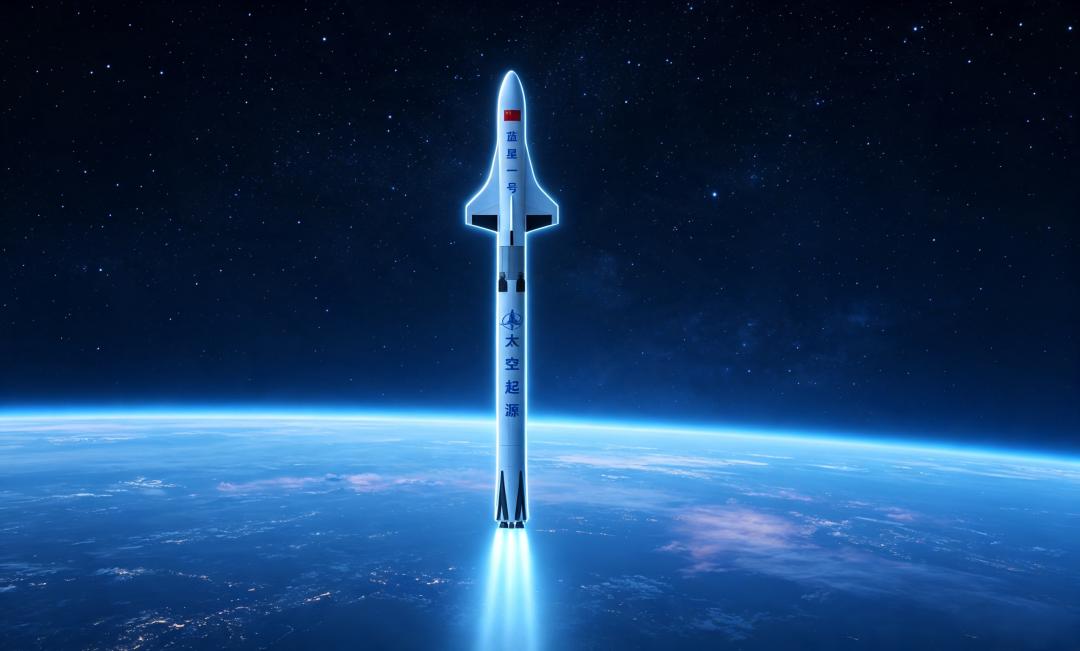
Preview of Space Origin Blue Star No.1
From Falcon 9 to Starship, Quiet Tremendous Changes in Commercial Aerospace
Aerospace is related to national strategy, orbital resources are scarce, and international competition also presents the feature of "first deployment, first occupation".
According to data from the China National Space Administration, China completed 50 commercial aerospace launches and sent 311 commercial satellites into orbit in the whole year of 2025. Compared with the United States, SpaceX alone completed 165 orbital launch missions, sending about 3800 satellites into orbit.
By the end of 2025, there were more than 10,000 satellites in orbit in the United States, and more than 1,000 in China, with a large gap between the two countries. In the future, China plans to launch more than 200,000 satellites, but it is facing the dilemma of "having satellites but no available rockets".
At present, Falcon 9 has achieved 36 reuses of the first-stage rocket, with a launch cost of about 3000 USD/kg. After Starship realizes full reuse of the first and second stages, the launch cost will be greatly reduced to about 600 USD/kg. In contrast, China's commercial rockets are still in the technical research stage of first-stage recovery, the reusable capability has not yet formed large-scale application, and the overall launch cost still has large room for optimization.
Therefore, how to improve the level of reusability and further reduce launch costs has become an important technical direction for global commercial aerospace.
"First-stage recovery is a necessary step that must be crossed, but it is not the final step. What really determines the future of commercial aerospace is whether the entire launch system can be reused." In the view of Tang Jibin, founder of Space Origin, after first-stage recovery, solving the problem of second-stage recovery will be the goal of commercial aerospace in the next five years.
As long as the second-stage rocket still burns up immediately after completing the mission, and each launch requires new manufacturing, the rocket will always be a disposable industrial product, rather than a transport tool that can operate continuously. First-stage recovery reduces the cost of a single launch, while full reusability changes the cost structure of the entire space transportation system.
This is also the reason why the competition in commercial aerospace is changing. In the past, the competition was about how to make a rocket cheaper; in the future, the competition will be about how to make a launch system operate continuously and perform missions repeatedly.
At the overseas level, SpaceX's Starship is advancing the technical verification related to second-stage recovery, and continuously exploring the goal of full rocket reusability. In the domestic commercial rocket track, most enterprises currently focus on the mature route of Falcon 9, and concentrate on first-stage recovery.
Second-stage recovery has greater technical challenges and significant cost reduction potential in the long term, but it is still in the early exploration stage in China, and the industry generally remains wait-and-see.
As a rocket development enterprise that took the lead in laying out the second-stage recovery route in China, Space Origin chose a differentiated entry into the track. Instead of pouring into the increasingly fierce first-stage recovery track, it took second-stage recovery as its core R&D direction.
"We are not competing with peers that lay out first-stage recovery, but hope that more launch vehicles will have full reusable capabilities in the future."
If this direction is established, second-stage recovery may become an underlying capability and infrastructure of commercial aerospace in the future, just like CATL's power batteries and Huawei's intelligent driving systems, separated from the entire rocket system.
More importantly, it determines not only a technical direction, but also whether the entire industry can enter the era of full reusability. And it is precisely this step that is the most difficult technical threshold for commercial aerospace to cross at present.
02 Second-stage Recovery is Not an Upgraded Version of First-stage Recovery
It is not difficult to spot opportunities, but the real difficulty is to turn them into reality.
First-stage recovery and second-stage recovery seem to differ only by one rocket stage, but they face completely different flight environments. When the first-stage rocket completes separation, it has already completed the main acceleration task of passing through the dense atmosphere. When the second-stage rocket returns, it faces hypersonic reentry close to orbital speed, and their thermal environment, flight control and structural load are not at the same technical level.
"You can feel it from a set of data. The return speed of the second stage is as high as 25 Mach, which is about 4 times that of the first stage, the kinetic energy gap is nearly 16 times, and the peak thermal load difference can reach 64 times." Tang Jibin said.
Specifically, when the aircraft cuts into the atmosphere at an ultra-high speed of 25 Mach, the air in front will be violently compressed and heat up rapidly. At this time, what the aircraft faces is not ordinary air, but a layer of high-temperature plasma. The head, leading edge and wing surface of the rocket stage will withstand extreme heat flow impact, with the temperature exceeding 1600 degrees Celsius.
Once the thermal protection system fails partially, material ablation, structural deformation or even complete destruction of the aircraft will occur. Second-stage recovery not only needs to ensure that the aircraft can fly back, but also control the ablation damage degree of the thermal protection material. Otherwise, even if one return is completed, it will be difficult to meet the reuse requirements.
In the middle stage of re-entry into the atmosphere (at an altitude of about 40~80 kilometers), the shock wave at the head of the aircraft ionizes to form a non-uniformly distributed plasma sheath, which causes severe attenuation or even interruption of radio signals, forming a "blackout". During this period, ground communication and satellite navigation will be completely unavailable. The aircraft needs to rely on a high-precision inertial navigation system and pre-loaded guidance law, and rely on the airborne computer to independently complete track deduction, trajectory correction and attitude stabilization, until it leaves the blackout zone and restores external information calibration.
In the process of first-stage rocket recovery, the engine is always the most important control means. It can decelerate through reverse thrust, and can also continuously correct the trajectory. However, after the second-stage rocket completes the orbit insertion mission, if it relies on the engine for reverse thrust deceleration and recovery like the first-stage rocket, it will consume huge amounts of fuel.
The second-stage rocket is more like an unpowered high-speed gliding hypersonic aircraft.
From hypersonic speed of more than 20 Mach down to subsonic speed, the aircraft needs to constantly adjust its angle of attack and attitude for aerodynamic deceleration. If deceleration is too slow, the heat flow and overload may exceed the structural limit; if deceleration is too fast, it may miss the predetermined trajectory and fail to enter the final recovery window.
Aerodynamic shape, control rudder surface and flight control algorithm need to jointly complete this set of actions in extreme environments. These links are coupled with each other, and any change in any parameter may lead to the redesign of the entire system.
It is clear that second-stage recovery is not a natural extension of first-stage recovery, but a brand-new system engineering. At present, there are still only a handful of enterprises in the world that are really laying out second-stage recovery. It is not that the industry does not see its value, but that the technical difficulty is far higher than that of first-stage recovery.
Whoever can cross this threshold first will master not only a recovery technology, but also a key capability of the full reusable space transportation system.
03 With National Aerospace Team Genes, Building a "Chinese Version of Starship"
Why does a startup company established only a few months dare to challenge second-stage recovery?
The first answer given by Space Origin is its team. The core team of the company mainly comes from the aerospace system and the School of Aerospace Engineering of Tsinghua University, with an average working experience of more than 15 years, has developed a variety of aerospace products, and their majors cover key technical fields required for second-stage recovery, including hypersonic aerodynamics, structure and thermal protection, flight control algorithm, general design and rocket supporting systems.
"From the very beginning of its establishment, Space Origin has been determined to do things that are 'reaching for the sky and taking root on the ground'."
The "reaching for the sky" in Tang Jibin's mouth refers to facing the world's cutting-edge technologies and the major national needs, and having the courage to overcome difficulties to become a pioneer for China's commercial aerospace; while "taking root on the ground" refers to breaking through the low-cost commercial emission market based on the core "root technology" of second-stage recovery mastered by the team.
At the same time, the philosophy of the alma mater is also subtly influencing the engineering concept of this Tsinghua-originated team. For them, entrepreneurship is not about burying themselves in technical research, but transforming the technical accumulation from past national mission services into an engineering system suitable for commercial aerospace; not only maintaining continuous exploration of technical boundaries, but also insisting on implementing engineering capabilities into industrial practice.
Tang Jibin said that Space Origin does not simply copy SpaceX's Starship, but hopes to adopt a technical route more suitable for the development of China's commercial aerospace to build a "Chinese version of Starship".
SpaceX's Starship adopts a high angle of attack reentry scheme, uses air resistance to decelerate through the "belly down" attitude, and then relies on the engine to complete the final flip and landing. Behind it is a technical system built on high-thrust engines, sufficient test resources and high-frequency launches.
Space Origin focuses on lower-cost aerodynamic deceleration. It hopes that through the coordination of aircraft configuration, aerodynamic layout and flight control algorithm, it will rely more on air to complete deceleration in the high-speed reentry stage, and reduce the dependence on engine power in the final stage.
The engine can provide more direct control, but it needs to carry more propellant, which will also increase system complexity and maintenance costs. Aerodynamic deceleration uses lift-drag characteristics to decelerate, which can save propellant, but puts forward higher requirements for aircraft configuration, reentry stability and flight control accuracy.
This is not a simple dispute between advantages and disadvantages. The technical route must finally match the industrial environment and engineering capabilities of the company. The "Chinese solution" mentioned by Space Origin is to rebalance aerodynamic deceleration, power control and reuse efficiency under the conditions of China's domestic engine foundation, launch frequency and commercialization status.
The change of technical route also further forces the R&D mode to change.
National aerospace teams pursue absolute safety, and can carry out long-term research around a technical index regardless of cost, while commercial aerospace enterprises must find a balance between safety, cost and efficiency.
It is understood that Space Origin plans to first develop a 10-ton payload class space vehicle, and then gradually evolve to a 100-ton class full reusable launch system. It is expected to carry out the flight test of the scaled verification aircraft next year to verify its independent core technologies.
The core team of Space Origin has led the development of space vehicles and recoverable rockets in the past, and its technical route and engineering capabilities have been verified at the stage. After the flight test of the scaled aircraft, Space Origin will soon enter the development of full-size products.
04 The Real Space Economy Starts from Space Round-trip Transportation
First-stage recovery reduces the cost of entering space, while second-stage recovery may change the industrial form after entering space.
In the past ten years, the core task of commercial aerospace is to send more satellites into orbit. In the future, with the continuous construction of satellite internet and the increasing number of satellites in orbit, demands such as satellite refueling, maintenance and orbital transfer will gradually emerge.
With the technological evolution of SpaceX's Starship, more new business forms will emerge in the space economy. Applications such as space computing power, space manufacturing, space tourism, space cargo return, space exploration, and intercontinental transportation will no longer be a fantasy, and the new era of space economy is accelerating.
The focus of competition in commercial aerospace will also gradually shift from "completing one launch" to "operating a reusable space transportation system".
It is precisely based on this judgment that Space Origin does not define itself as a traditional rocket company, but hopes to become a provider of second-stage recovery systems and reusable space vehicle infrastructure.
According to the plan, Space Origin will continue to carry out R&D around core technologies such as hypersonic aerodynamics, thermal protection, flight control and recovery systems, and explore the standardization of capabilities to adapt to different launch platforms. From single technical verification, to reusability, to commercial delivery and large-scale operation, this is the development path set by the team for itself.
This positioning is also an important reason why the capital market pays attention to Space Origin.
Zhang Yangyang, investor of Space Origin and founding partner of Wanxing Capital, said: "We are not betting on a rocket, but on a team with world-class aerospace engineering capabilities that can participate in the competition of the next generation of space transportation systems."
Behind this investment judgment is not only the confidence in a technology, but also a bet on the marketization of China's aerospace engineering capabilities.
In the past, China's aerospace technology mostly served major national missions. Commercial aerospace provides a new outlet: to transform the capabilities that have been deposited in the aerospace system for a long time into commercial products, and serve commercial launches at lower costs.
The so-called "Chinese solution" is not to follow Starship's technical route, or to compare the level of individual technical indicators. Its more important significance is to form a set of technical paths that can be verified, delivered and continuously operated under China's existing aerospace industrial foundation, supply chain and market conditions, and provide another choice for the global commercial aerospace industry.
Of course, for a cutting-edge enterprise in the commercial aerospace field, whether it is the technical route or the industrial vision, Space Origin still needs time to prove all this.
But what investment institutions value is exactly this long-term value.
When rockets are no longer products that are destroyed after performing one mission, but become assets that can circulate at high frequency and continuously create value, commercial aerospace can truly move from the rocket manufacturing industry to the space service industry with more imagination space.
At that time, what determines the value of a commercial aerospace enterprise will no longer be whether it can send the rocket into space, but whether it can make the same transportation capacity return and restart again and again at lower cost and higher frequency.