Mark Zuckerberg Previews Personal AI Agents, Meta Loses 780 Billion in Market Value Overnight
ZhiDongXi reported on July 30 that in the early hours of this morning, at Meta's Q2 2026 earnings call, Mark Zuckerberg, founder and CEO of Meta, revealed that Meta is developing new personal agents, "These will form the foundation of our next wave of products and revenue streams in the months and years ahead."
Its Q2 2026 financial report shows that in this quarter, Meta's revenue reached 60.801 billion US dollars (about 4.11398 trillion yuan), a 28% year-on-year increase; net profit was 15.848 billion US dollars (about 1.07232 trillion yuan), a 14% year-on-year decline.
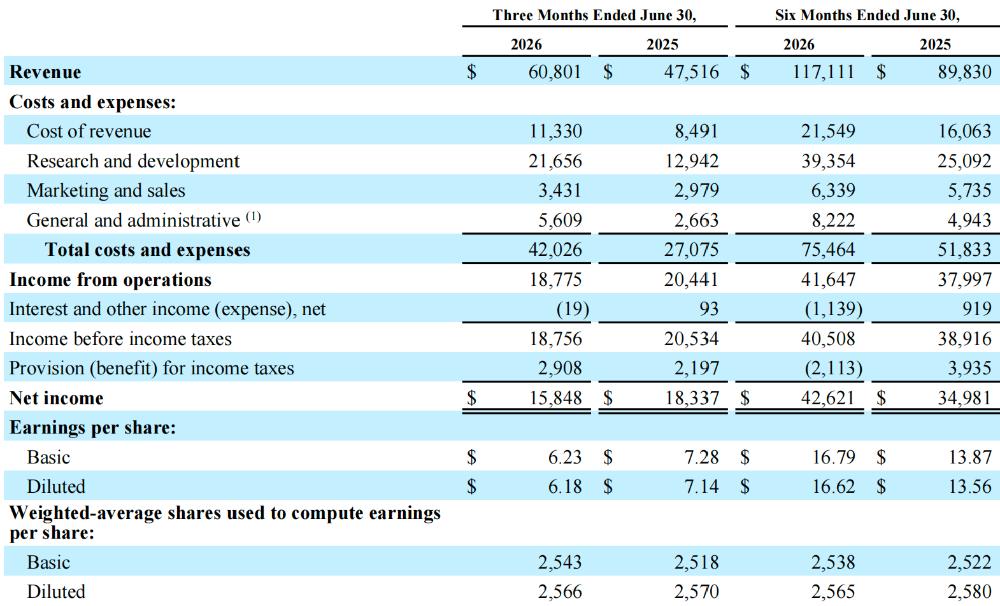
The metaverse business (Reality Labs), which had been losing money continuously before, posted a loss of 4.619 billion US dollars (about 312.54 billion yuan) this quarter, a year-on-year increase of about 2%. Since the second quarter of 2024, over 27 months, Meta's metaverse business has accumulated a total loss of 41.723 billion US dollars (about 2.8231 trillion yuan).
The bulk of Meta's revenue still comes from its Family of Apps, including Facebook, Instagram, Messenger and WhatsApp, with revenue of 60.370 billion US dollars (about 4.08481 trillion yuan), a 28% year-on-year increase; among which the revenue of the advertising business reached 59.363 billion US dollars (about 4.01668 trillion yuan), a 27% year-on-year rise.
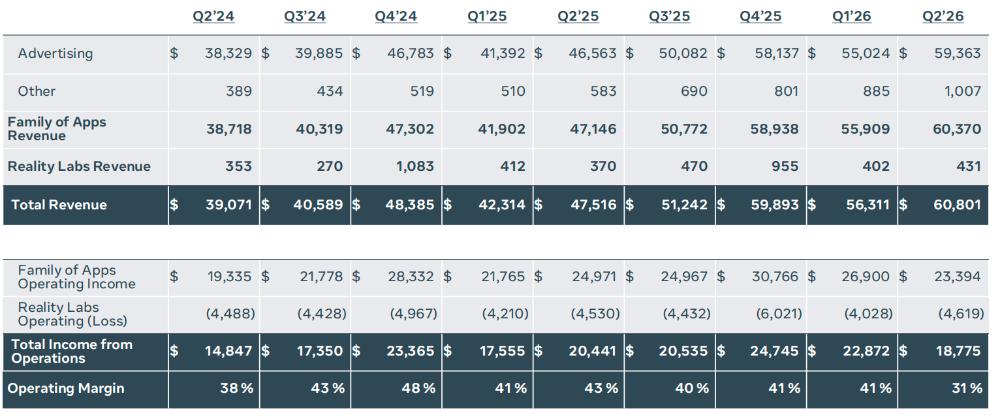
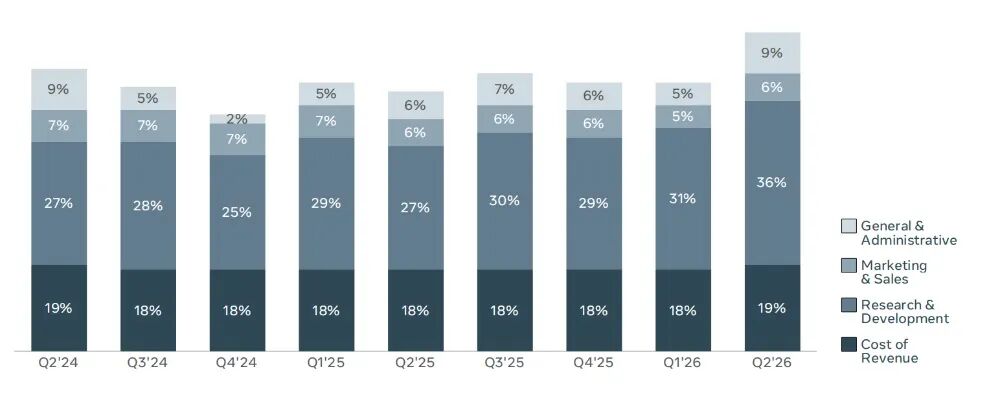
In the second quarter of 2026, Meta's R&D expenditure was 21.656 billion US dollars (about 1.46531 trillion yuan), accounting for 36% of total revenue, a 67% year-on-year increase; capital expenditure reached 31.08 billion US dollars (about 2.10297 trillion yuan), a 83% year-on-year increase. Total costs and expenses amounted to 42.03 billion US dollars (about 2.84388 trillion yuan), a 55% year-on-year increase, including $2.4 billion in expenses related to legal proceedings and $1.18 billion in severance costs related to the layoffs in May 2026.
As of June 30, 2026, Meta had 75,472 employees, a 1% year-on-year decrease. The headcount includes approximately 8,000 employees affected by the May 2026 layoffs, most of whom will no longer be counted in the employee count by the end of the third quarter of 2026.
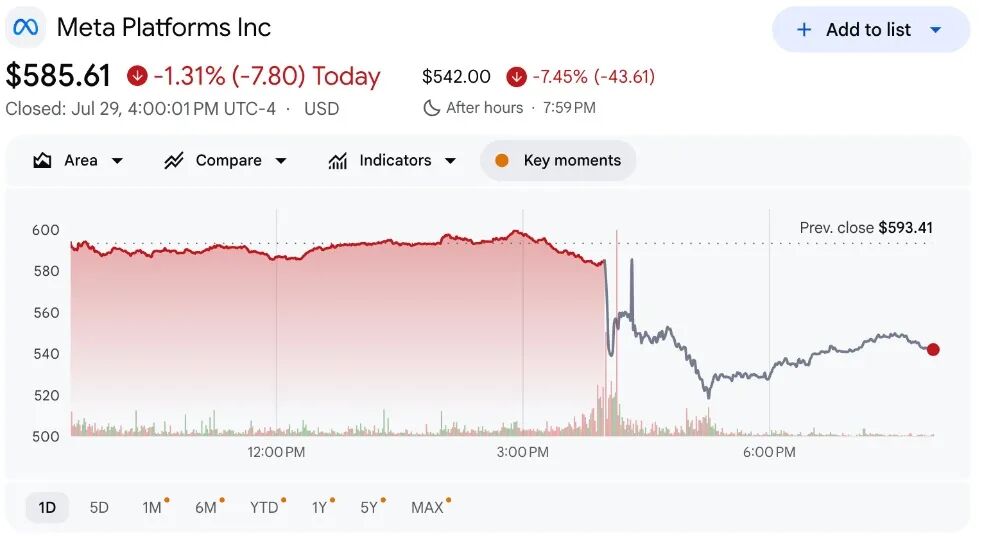
As of the close at 4 a.m. Beijing time on July 30, 2026, Meta's stock price closed at $585.61 (about 3976 yuan), down 1.31% from the previous day's close; after the earnings report was released, the stock price plummeted a further 7.45% in after-hours trading to $542.00 (about 3680 yuan), wiping out about 1.103 trillion US dollars (about 7.831 trillion yuan) in market capitalization.
01. Early sales of smart glasses exceeded expectations, more products will be unveiled at the Connect Conference in September
At the earnings call, Zuckerberg positioned smart glasses as the ideal form of "hardware devices adapted for seamless interaction", believing that they can be used by users around the clock and provide auxiliary services without interrupting the user's current state.
At present, Meta has cooperated with EssilorLuxottica to launch its own Meta Glasses series, including styles co-designed with Kylie Jenner. This series is the first batch of glasses products equipped with Muse Spark out of the factory, which can identify the scenes seen by users and then provide more targeted practical solutions. Zuckerberg revealed that the early sales performance of this series of products is strong, exceeding Meta's expectations.
Regarding the subsequent product layout, Zuckerberg said that he will announce more information about the glasses product line at the Connect event to be held on September 23 this year.
02. Daily interactive users of Muse Spark increased by 60%, large models, agents and data centers advance in parallel
In the second quarter of 2026, Meta's R&D expenditure was 21.656 billion US dollars, a year-on-year increase of 67%. Zuckerberg believes that Meta's current investments in the AI field have comprehensively accelerated the development of all segments of its core business.
In terms of advertising, Meta is using large language models to improve the way its system predicts and ranks the ads displayed. They have expanded the scope of context that can be taken into consideration, combining users' natural activities and advertising activities to judge the relevance of ads, thus significantly improving relevance and conversion rates on Facebook and Instagram.
In terms of model and product iteration, since the establishment of the Superintelligence Lab, Meta has successively launched two AI models - Muse Spark 1.1 and Muse Image, and updated the Meta AI assistant. Zuckerberg disclosed that since the integration of Muse Spark, the number of daily interactive users of its AI assistant has increased by 60%, and it continues to rise week over week.
Muse Spark 1.1 is positioned as an efficient agentic coding model, with capabilities in computer usage, tool calling and multimodal understanding. The model is already open via public API, and Meta is expanding distribution through partner channels and more coding agents. Meta plans to add enterprise-level adaptation features to Muse Spark in the coming weeks to facilitate enterprise adoption.
On the agent product line, Zuckerberg said that Meta plans to launch personal agent products that can perform tasks on behalf of users around the clock, covering areas such as life, health, and finance.
In terms of business agents, Meta has launched services globally on WhatsApp and Messenger. Currently, more than 1 million enterprises use this feature every week to communicate with customers or complete sales, and it is gradually expanding to Instagram. Zuckerberg added that features such as conversation summarization, competitive intelligence and real-time performance analysis will be added in the future, and it plans to eventually build a "one-stop business" platform to assist users in starting and operating businesses using the Meta ecosystem.
At the infrastructure level, Meta announced yesterday that it has reached a new strategic cooperation with BlackRock to develop a 1 GW data center in El Paso, Texas, which is also an important part of Meta's computing power layout (Meta Compute). Zuckerberg expects most of its computing power to be used for training models, developing core businesses, and providing personal agents and new products.
According to statistics from foreign media, Meta currently has 32 data centers in operation or under construction around the world, 28 of which are located in the United States.
03. Conclusion: Meta's AI commercialization is imminent, and capital is losing patience with "spending money for the future"
Meta's AI strategic layout has clearly outlined three paths:
Upward, optimizing the advertising system with AI to consolidate the core revenue base; outward, opening up new revenue streams with personal and business agents; downward, opening up the B-end market with enterprise-level services such as APIs and computing power leasing. At the same time, smart glasses, as a hardware entry point, are verifying the implementation capability of "AI + hardware", and the Muse series of models and enterprise agents are also rapidly rolling out.
This set of strategies is being used by Google, Microsoft, and Amazon, the only difference is who will be the first to run through the commercial closed loop.
The attitude of the capital market has shifted, and its patience with the narrative of technology companies "continuously burning money to bet on long-term visions" is fading. The evaporation of Meta's market capitalization by more than 100 billion US dollars in after-hours trading intuitively reflects that investors are no longer willing to pay for continuous investment with no clear return cycle.
This article is from the WeChat official account "ZhiDongXi" (ID: zhidxc), author: Wang Han, editor: Bing Qian, published with authorization from 36Kr.