Is Demis Hassabis burning his bridges? The AlphaFold team behind the Nobel Prize-winning project has been disbanded.
In 2024, Demis Hassabis won the Nobel Prize in Chemistry for his work on AlphaFold.
Less than two years later, the core team that created this AI scientific miracle has been disbanded.
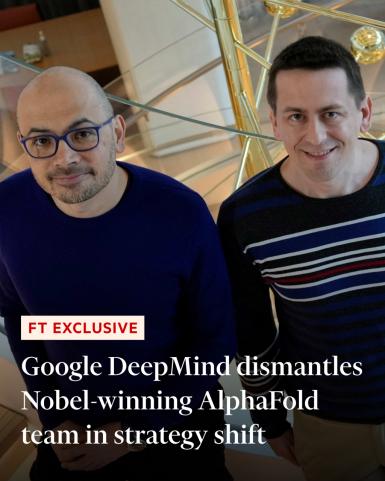
According to a report by the Financial Times on July 29, Google DeepMind has recently disbanded its core AI for Science (abbreviated as AI4S) team responsible for AlphaFold R&D. Over the past year, most of the original authors of AlphaFold papers have been reassigned to other projects, with some researchers shifting to Gemini-related research, and some members moving to Isomorphic Labs, an AI drug discovery company under Alphabet.
Nearly a quarter of the full-time DeepMind authors who initially participated in AlphaFold papers have left the company.
In response, some netizens commented: DeepMind used to be a symbol of UK innovation, but now its heyday is over.

After all, this looks a bit like Demis Hassabis crossing the bridge and tearing it down after winning the award, or DeepMind abandoning its most fundamental AI4S path.
But in a broader context, this is not a choice made by DeepMind alone.
From DeepMind to ByteDance, more and more tech companies are adjusting the positioning of their AI4S teams. As AI competition enters a resource-intensive stage, major tech giants are re-evaluating which directions deserve investment of their core R&D, computing power and talent resources.
AlphaFold, the Representative of DeepMind's Long-termism
Looking back at DeepMind's development over the past decade, AlphaFold is undoubtedly one of the projects that best represents its "long-termism" philosophy.
Back when it was founded in 2010, DeepMind did not focus on a specific product, but on a longer-term vision:
Can artificial intelligence help humans solve problems that were previously unsolvable?
In Demis Hassabis's vision, future Artificial General Intelligence (AGI) should have the ability to understand the complex world, discover new knowledge, and drive scientific progress.
Therefore, scientific research has always been an important direction in DeepMind's strategy.
And AlphaFold is the most representative case among them.
The protein folding problem has plagued the biology community for more than 50 years.
Proteins are composed of amino acid chains, but it is the complex three-dimensional structure that determines their functions. In the past, scientists mainly relied on experimental methods such as cryo-electron microscopy and X-ray crystallography to resolve protein structures, which often took months or even years and cost a huge amount of money.
In 2018, DeepMind began developing AlphaFold, trying to enable AI to directly predict the 3D structure of a protein based on its sequence.
In 2020, in the international Critical Assessment of Protein Structure Prediction (CASP) competition, AlphaFold 2 delivered a breakthrough performance, with prediction accuracy approaching that of experimental methods for the first time, and was recognized as solving the long-standing core challenge in the field of protein structure prediction.
In 2021, DeepMind published the AlphaFold 2 paper in *Nature* and opened the model code. In the same year, DeepMind joined forces with the European Bioinformatics Institute to launch the AlphaFold Protein Structure Database, providing protein structure prediction data for free to researchers worldwide.
Subsequently, the database was expanded to include more than 200 million protein structure prediction results, becoming a critical infrastructure in the life science field.
It can be said that AlphaFold has changed the research paradigm of structural biology: in the past, scientists needed to spend a lot of time and cost to experimentally resolve protein structures; while AlphaFold allows researchers to quickly obtain prediction results, freeing up more energy for follow-up research such as disease mechanism exploration, drug R&D and bioengineering.
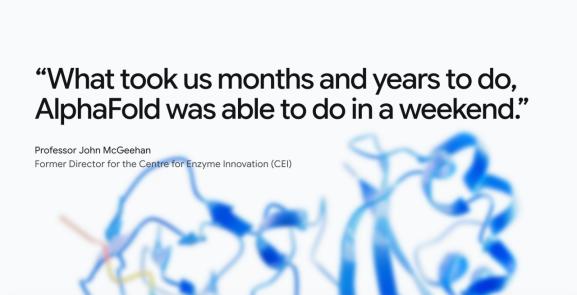
In 2024, AlphaFold ushered in its most glorious moment.
DeepMind launched AlphaFold 3, expanding its capabilities from protein structure prediction to prediction of interactions between proteins, DNA, RNA and small molecules, further stepping into the core links of drug R&D.
In the same year, Demis Hassabis and John Jumper, the core lead of AlphaFold, won the Nobel Prize in Chemistry for this achievement.
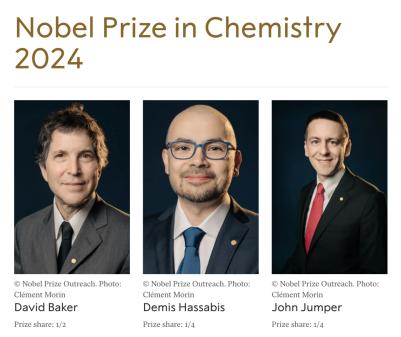
From its launch in 2018 to winning the Nobel Prize in 2024, AlphaFold completed the transformation from a laboratory project to a global scientific research infrastructure.
More importantly, it proved a long-held belief of Demis Hassabis: AI can not only improve efficiency, but also become a new tool to drive scientific discoveries.
This is why AI for Science is of extraordinary significance to DeepMind, fundamentally speaking, it is part of DeepMind's understanding of the value of AI.
But the problem is, as AI competition enters a new stage, DeepMind is facing a new challenge:
Is the previous model of building long-term research teams around major scientific challenges still the company's top priority for resource allocation?
Under Pressure from Gemini, DeepMind Begins to Centralize AI Talents
The adjustment of the AlphaFold team does not mean that DeepMind has abandoned AI for Science. To be precise, it is Google DeepMind reallocating its own AI resources.
In the past few years, DeepMind has long maintained a model of advancing multiple cutting-edge research lines in parallel: exploring scientific breakthroughs like AlphaFold on one hand, developing artificial general intelligence on the other, and deploying cutting-edge fields such as reinforcement learning and robotics at the same time.
However, as AI competition enters a new stage, the pressure of resource allocation is emerging. For Google, the most important issue at present is how to keep Gemini ahead in the model competition with companies such as OpenAI and Anthropic.
While OpenAI continues to advance the GPT series and Anthropic expands rapidly with products such as Claude Code, Google, despite having DeepMind, the world's top AI research institution, is still under huge pressure in the development of Gemini.
In particular, the long-delayed release of Gemini 3.5 Pro, which was once highly anticipated, has kept the public focusing on Google's progress in the frontier model competition.
In addition, there has been obvious talent flow inside DeepMind over the past year.
According to the Financial Times, John Jumper, one of the core leads of AlphaFold who won the Nobel Prize together with Demis Hassabis, was once transferred to the Code Strike team within Google, which is responsible for improving AI coding capabilities.
This change is very symbolic. After AI competition is increasingly focused on large models, coding capabilities and Agents, Google needs not only a top scientist who can solve the protein structure prediction problem, but also his participation in improving Gemini's capabilities in key application scenarios.
Later, Jumper left DeepMind and joined Anthropic.
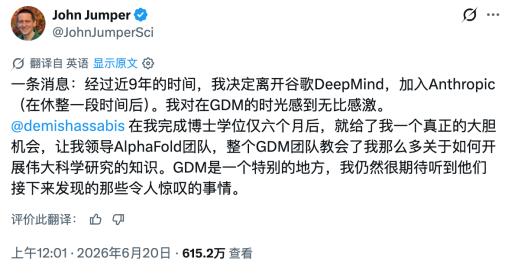
The personnel changes in the AlphaFold core team have also become a microcosm of DeepMind's strategic adjustment.
In fact, DeepMind has explicitly acknowledged that its scientific research strategy is changing.
Pushmeet Kohli, Vice President of Research at DeepMind, said: "For the past nine years, our strategy has been to focus on major challenges... every project is built around a specific goal."
Now this strategy "has evolved".
The report states that DeepMind is expanding the scope of goals for AI for Science. In addition to developing dedicated models for specific scientific problems, it has also begun to explore the use of general models such as Gemini to build AI systems that can assist scientific research.
From this perspective, AlphaFold once represented the way DeepMind proved the boundary of AI capabilities, while Gemini is now becoming the core for DeepMind to reorganize its AI R&D resources.
From AI Discovery to Industrial Implementation, AlphaFold Enters the Next Stage
The good news is that DeepMind has not abandoned AlphaFold.
According to the Financial Times, some AlphaFold researchers have moved to Isomorphic Labs, the AI drug discovery company under Alphabet, to continue promoting the application of AI in the life science field.
The AlphaFold path has not ended with the disbandment of the AI4S team, but has entered the next stage.
The original problem AlphaFold solved was how to use AI to predict protein structures, but for the life science industry, structure prediction is only the first step.
In the next stage, AI needs to further integrate into the workflows of drug R&D and biological research.
To advance this direction, DeepMind founded Isomorphic Labs in 2021.
Different from DeepMind's positioning of focusing on basic research, Isomorphic Labs pays more attention to transforming AI capabilities into industrial value. The company's goal is to use AI technologies such as AlphaFold to reshape the drug R&D process.
In 2024, Isomorphic Labs announced AI drug discovery collaborations with Novartis and Eli Lilly. The collaboration with Novartis initially focused on using AI to discover small molecule drugs targeting multiple highly difficult targets; the collaboration with Eli Lilly centered on the R&D of small molecule therapies for multiple undisclosed targets.
At the same time, Isomorphic Labs is also continuing to develop AI drug design systems that surpass AlphaFold. The company states that its Drug Design Engine aims to push AI further from structure prediction to the complete drug R&D workflow including molecular design and binding prediction.
However, Isomorphic Labs has not yet participated in the launch of any AI-developed drug so far.
This is also a common problem faced by the AI for Science field: whether it is AI pharmaceuticals, AI materials, or other scientific fields, the really difficult part is often not just discovering a theoretical possibility, but completing subsequent experimental verification, engineering transformation and commercial application.
From this perspective, the adjustment of the AlphaFold team is more like a re-division of labor: DeepMind continues to explore more general AI capabilities; while Isomorphic Labs is responsible for promoting the commercial implementation in the life science field.
AlphaFold has not disappeared, it has just transformed from a star project representing DeepMind's scientific breakthroughs into a platform connecting basic research and industrial applications.
However, with the dispersion of the original core team, the AlphaFold 4 that people imagined may not be realized in the original way.
This article is from the WeChat Official Account "Letter AI", written by Yuan Xinyue, published with authorization from 36Kr.