Let AI take the first bite, this nationwide public health challenge now has a solution.
When it comes to scientific weight management, Ant A-Fu has rolled out another major initiative after its strategic investment in Mint Health.
On July 29, Ant A-Fu announced the official launch of its upgraded "AI Food Photo Log" feature. Users only need to take a photo of their food and send it to A-Fu, then the system will automatically estimate nutrition and calorie information, provide personalized healthy diet matching suggestions and exercise consumption plans. It also supports one-click saving to personal health records to create a "calorie account". Users can clearly see whether their diet is proper or excessive at a glance.
The launch of the "AI Food Photo Log" feature by A-Fu is not an isolated action.
A month ago, 36Kr reported that Ant A-Fu launched the "100 Million Jin Scientific Weight Loss Initiative", rolling out three major actions including providing body fat scales at the ultra-low price of 1 cent, upgrading AI functions, and launching a 21-day check-in challenge, to help the public manage weight scientifically and develop daily healthy habits.
The trend brought by this "National Scientific Weight Loss Campaign" has exceeded expectations. More and more people have joined the weight loss group, and figures of A-Fu accompanying users for workouts and trips can be seen in scenarios such as climbing Mount Hua, visiting East Lake, cycling, and doing horizontal bar exercises. At present, nearly 1.5 million netizens across the country have participated in the scientific weight loss campaign, with a total weight loss of over 2 million jin.
Apart from exercise, what to eat and how to eat is often the hardest and most easily overlooked part of weight loss. It is difficult for ordinary people to continuously and accurately record how much they eat, whether their calorie intake exceeds the standard, and whether their diet is properly matched. For the public, what hinders scientific weight loss is not the lack of willingness, but the lack of a user-friendly tool that is professional enough, low-threshold, and supports long-term persistence and feedback.
The weight loss scenario, a national health management use case, is expected to give birth to a "national-level health AI application". Whether this scenario can be deeply and thoroughly developed is the litmus test for the national AI health entry point.
Chemical Reaction of Strategic Investment in Mint Health: "AI Nutritionist" Comes of Age
It is actually no easy task to make AI "understand" Chinese food.
In the AI health management track, digitizing diet has always been a difficult problem. Compared with Western food that follows standardized ingredients, portions and cooking logic, Chinese food boasts a huge variety of cuisines and flexible ingredient combinations. Even for the same dish, the difference in calories and nutrition can be huge due to different cooking heat and ingredients.
This has led to common problems such as category misjudgment in diet recording tools on the market, and the update and maintenance of the database itself is also challenging.
The launch of "AI Food Photo Log" by A-Fu is first and foremost aimed at solving such problems.
36Kr has learned that at the technical level, Ant A-Fu has specially upgraded the multimodal capabilities of its basic model to improve the accuracy of food recognition; the "AI Food Photo Log" feature will also call on the mature localized diet database of Mint Health, which contains 1.6 million food information entries.
The combination of the two provides professional support for every dish recognition and calorie calculation.
In addition, on the basis of ensuring recognition accuracy, A-Fu has also taken into account the user threshold, making daily diet management effortless through the three core functions of "photo taking", "recording" and "editing".
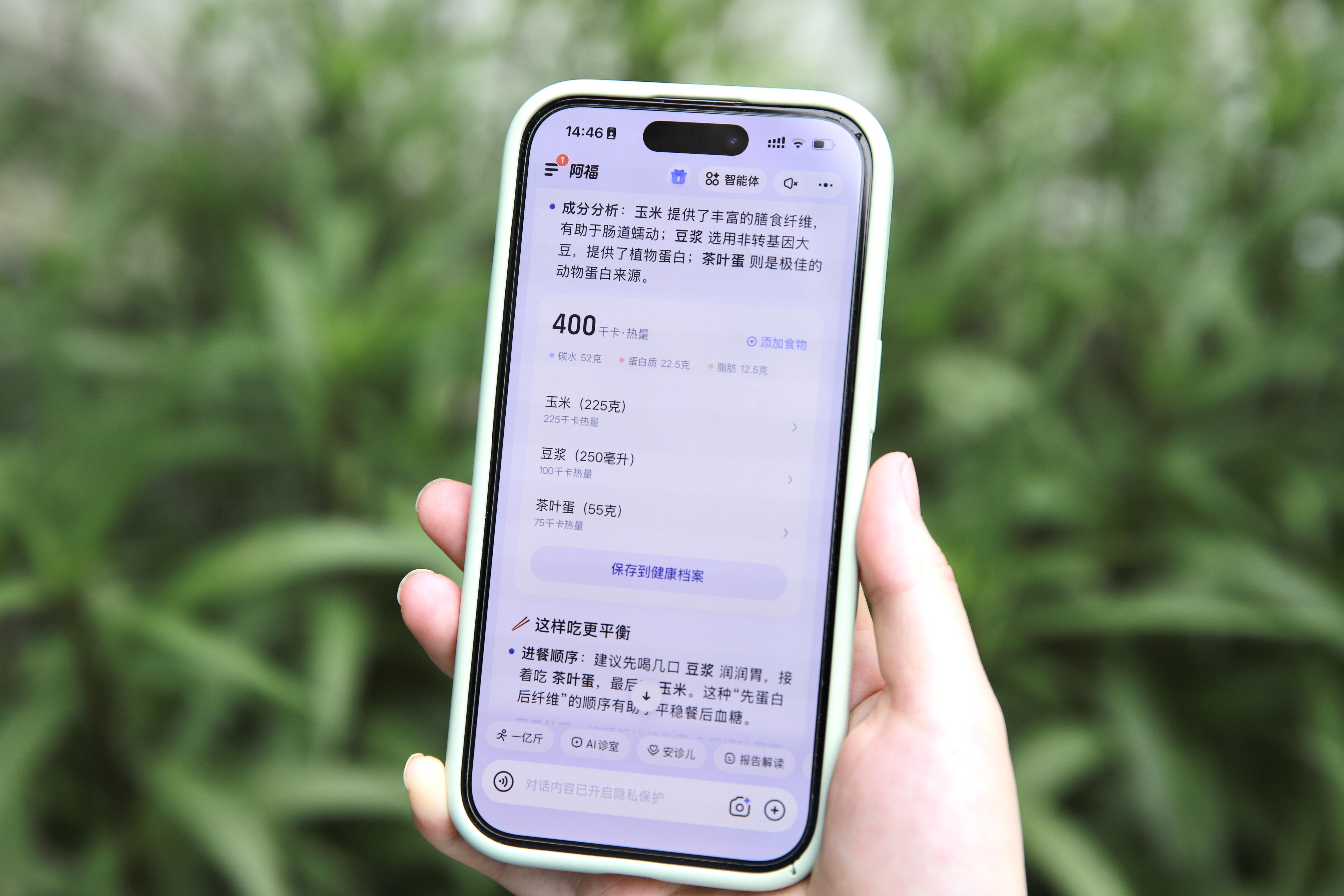
The core of doing a good job in diet management is to understand the nutritional information of each meal, and the action of "taking a photo" greatly lowers the threshold for acquiring professional nutritional knowledge. Users open A-Fu, take a photo of the food, and the system will automatically identify and present the nutritional information, intuitively showing the total calories of the meal, and breaking down the specific values of the three macronutrients: carbohydrates, protein and fat.
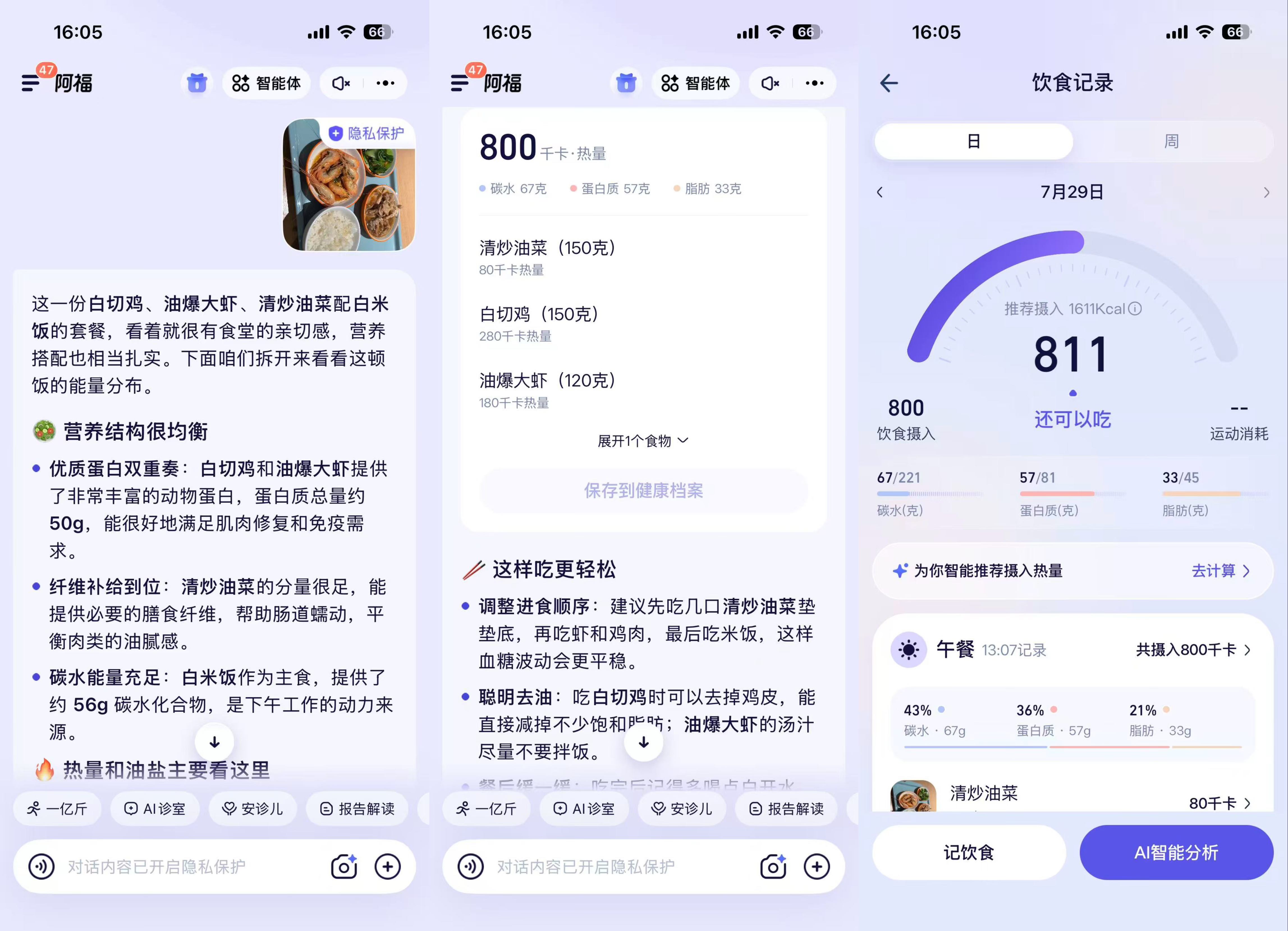
Completing these is only the foundation. To track nutritional intake, users need the "recording" function. Users can save the identified calorie and nutritional data to their personal health records with one click, forming a complete diet progress record. This account will record historical calorie intake, and provide diet optimization plans combined with the standard calorie intake of adults.
For example, the total calorie of a breakfast combination of "corn + tea egg + soy milk" is about 350-430 kcal. But beyond that, A-Fu will also tell you that it is best to add a tomato to supplement vitamin C, and drink 200ml of warm water half an hour after the meal to help digest the crude fiber in corn; or if A-Fu finds that the user has not recorded dinner, it will actively push matching plans to remind users to reduce late-night snacks and avoid excess calorie accumulation from the source.
In addition, considering the recognition deviation of a small number of complex dishes or occasional problems such as leftover food, A-Fu has supplemented the "editing" function. In the process of diet recording, users can flexibly modify information such as the name and gram weight of the food.
This is equivalent to opening an exclusive "calorie account" for everyone, allowing ordinary people to grasp the income and expenditure of dietary calories in real time, adjust the dietary structure in time, and implement scientific diet management in three meals a day.
It is precisely with this part of the capability that A-Fu turns the past tedious and easily interrupted diet recording into a lightweight action that can be completed with one photo and one conversation. Users no longer need to manually search for food calories, calculate nutritional ratios by themselves, or rely on complex professional knowledge to quickly get scientific diet suggestions.
Behind "A-Fu Tries the Food First", the 100 Million Jin Scientific Weight Loss Initiative Becomes More Reliable
Weight management is essentially a health scenario with long chains and multi-link collaboration. Only by connecting multiple links such as measurement, recording, analysis, diet and exercise can we achieve more accurate scientific weight loss and long-term health management.
The starting point of scientific weight loss is to fully understand your own physical indicators.
At the end of June this year, after launching the "100 Million Jin Scientific Weight Loss Initiative", A-Fu first popularized basic weight loss tools by distributing body fat scales at the price of 1 cent, lowering the hardware threshold for scientific weight loss. Many users got the scales and for the first time fully understood their physical conditions such as weight, body fat rate and fat mass.
According to data from Ant A-Fu's Tmall flagship store, the number of AI body fat scales distributed has exceeded 1 million units at present; in addition to body fat scales, A-Fu also supports users to bind mainstream health hardware on the market, including smart bands and watches from Apple, Huawei, Xiaomi, as well as blood pressure monitors and blood glucose meters from Yuwell and Omron. The continuous expansion of the "smart device circle" is also expected to allow users to fully understand their personal health status and truly embark on the path of scientific weight loss.
Since then, more and more netizens and social forces have joined this health campaign, driving a variety of healthy activities such as "fitness craze", "fat-burning tour" and "cycling craze". In gyms, lakesides at village entrances, park sports corners and five famous mountain scenic spots, many ordinary people who joined this "national weight loss campaign" have started to do casual workouts anywhere. Scientific weight loss has changed from a personal behavior to a national health team building activity.

The upgraded "AI Food Photo Log" feature launched by A-Fu has further complemented the most critical and most easily overlooked health link of "eating". In essence, it makes professional and expensive nutritionist services more inclusive, solves the dietary pain points of ordinary people who "don't know how to eat and what to eat", and is equivalent to an exclusive "AI nutritionist", turning tedious and professional diet management into a daily health management behavior that can be recorded, analyzed and adjusted at any time.
Nowadays, more and more people begin to "let A-Fu check the food first". Scientific weight loss is no longer driven by short-term enthusiasm, but forms a long-term healthy lifestyle. Taking a photo before meals and making a record after meals seem to be simple actions, but behind them is the change of diet decision-making mode, and also the beginning of the health management chain integrating into daily life.

From subsidizing body fat scales to lower the weight loss threshold, to providing exercise guidance via AI, and then to diet management services, A-Fu's series of actions are closely linked, which not only gradually forms a closed-loop service of "measurement, exercise, diet" for scientific weight loss, but also makes the seemingly "unrealistic" goal of "losing 100 million jin" more and more "reliable".
National Weight Loss Challenge Is Expected to Give Birth to a "National-level" Health AI Entry Point
If we only understand the "AI Food Photo Log" from the perspective of function upgrade, we may underestimate its long-term value.
What A-Fu wants to do is to start from the high-frequency weight loss demand, help users integrate multi-dimensional health records, extend a clear and in-depth health management path, and make "active health management" move from concept to practice.
At present, there is an obvious problem of service fragmentation in China's health management track. Consumer-level diet recording, fitness and physical examination, and medical-related online consultation and medicine purchase usually belong to different independent products, and services of various platforms are isolated from each other, like isolated islands.
However, human health is an integrated system, and behaviors such as diet, exercise, sleep and physical examination are deeply related. It is difficult to give accurate and personalized health suggestions only relying on single-dimensional information and services.
In the long run, the big health sector needs a more universal "national-level AI entry point". This also means that the rise of professional health AI applications represented by A-Fu has the potential to integrate fragmented and isolated health services, build a personal-centered health service system, and realize "All in One".
First of all, starting from the weight loss sector, it will gradually expand to more daily health management scenarios such as sleep, chronic disease and rehabilitation. Long-term and complete diet and exercise behaviors can build a three-dimensional user health profile, so that when users encounter health problems such as colds, allergies and cardiovascular maintenance and consult A-Fu, A-Fu can give more accurate health suggestions combined with the user's long-term living habits.
We can imagine that in the future, if a user troubled by hyperglycemia and fatty liver shows that he has long preferred refined carbohydrates and insufficient vegetable intake in his daily diet records, and the bound smart band records that his postprandial blood sugar fluctuates greatly. Based on this continuous and cross-verified information, A-Fu will not only advise him to "eat less high-sugar food", but also combine the data of calorie intake and exercise consumption in his personal file to give more detailed choices: for example, replace white rice with brown rice for dinner, match it with a portion of stir-fried seasonal vegetables, and take a 20-minute walk after the meal.
The second level of extension is about the positive cycle of trust and services. The core competitiveness of health products lies in the long-term trust of users. Continuous and complete personal health information can continuously improve the accuracy of AI health Q&A, and accumulate long-term trust from users. On this basis, the platform can further link resources such as weight loss departments of top three hospitals, online consultation channels and supporting health consumption services, and build a complete path from daily health management to professional medical intervention.
In this sense, the underlying logic of the "100 Million Jin Scientific Weight Loss Initiative" is not simply to pursue a numerical target, but to hope that through the weight management, a national-level demand entry point, to help more people develop the awareness of active health management in daily life, start from "what to eat for each meal", understand their own health status better, and gradually reduce the occurrence and progression of diseases.
To a certain extent, only by succeeding in the challenge of weight loss, a national-level difficult problem, can a real national-level health AI entry point be born.