The third largest city in Zhejiang has once again ranked in the forefront of the cities with a GDP exceeding one trillion yuan.
Up to now, among the 29 cities with a GDP exceeding 1 trillion yuan, all have released the latest economic data for the first half of the year, except Nanjing, Wuxi, Nantong, Fuzhou, Hefei and Foshan. Among them, Wenzhou's GDP in the first half of the year exceeded 500 billion yuan for the first time, reaching 514.82 billion yuan, a year-on-year increase of 6.0%, ranking first among the trillion-GDP cities that have released data.
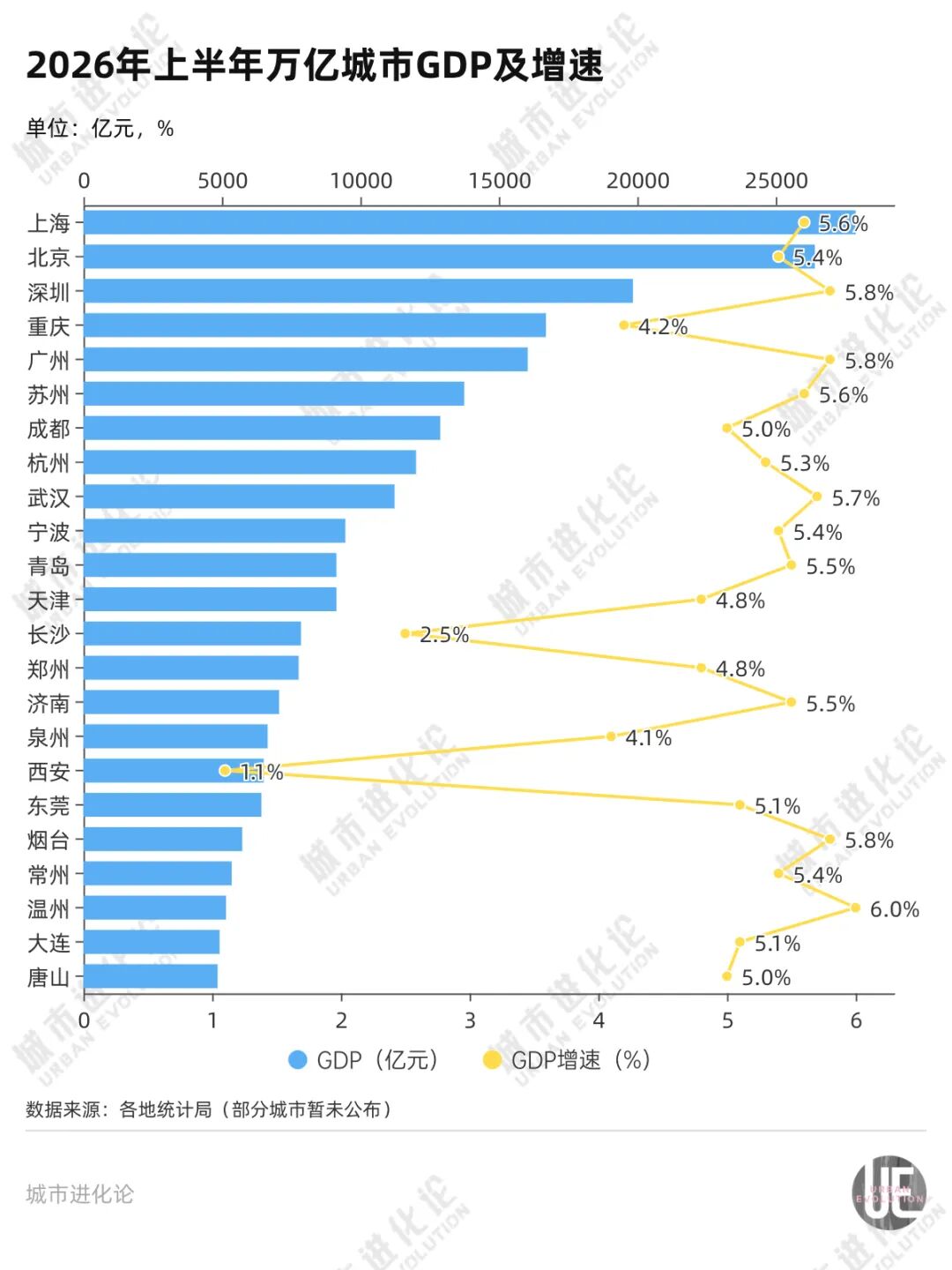
Compared with its own performance, Wenzhou's 6.0% growth rate is the same as the same period last year; compared with the national level, the gap that was 0.7 percentage points higher than the national average last year has expanded to 1.3 percentage points.
Among all sectors, industry is the "ballast stone" for Wenzhou's economic growth. In the first half of the year, the added value of industries above designated size in Wenzhou increased by 11.4% year-on-year, 6 percentage points and 3.4 percentage points higher than the national and provincial averages respectively, and has maintained double-digit growth for 10 consecutive quarters.
As an important birthplace of the private economy, Wenzhou once entered a "long adjustment period" amid the pains of transformation of traditional industries and regional financial turmoil. However, in recent years, Wenzhou has gradually emerged from the downturn and returned to a stable and healthy growth pattern.
In 2025, Wenzhou's GDP exceeded the 1 trillion yuan mark for the first time, evolving from the "third largest city" in Zhejiang to the "third growth pole". In terms of growth rate, Wenzhou's GDP growth rate reached 6.1% in 2025, ranking second among trillion-GDP cities alongside Hefei, only after Tangshan's 6.2%. At the same time, its added value of industries above designated size increased by 10.3%, 4.4 percentage points and 3.4 percentage points higher than the national and Zhejiang provincial averages respectively, ranking first in Zhejiang for two consecutive years.
In the first quarter of 2026, Wenzhou's GDP further accelerated, with a growth rate of 6.5% ranking second among trillion-GDP cities, second only to Hefei's 6.8%.
This growth trend has continued into the first half of the year. In fact, since the second quarter of 2023, Wenzhou's GDP growth rate has remained stable above 6% for 13 consecutive quarters. Looking at specific indicators, the transformation between old and new growth drivers in Wenzhou is particularly prominent —
In the first half of this year, the added value of the manufacturing industry of core sectors in the digital economy and the high-tech industry in Wenzhou increased by 23.4% and 19.6% year-on-year respectively. The added value of the computer and communications industry, as well as the electrical machinery industry increased by 27.5% and 16.1% year-on-year respectively, and the combined contribution rate of the two sectors to the growth of the added value of industries above designated size reached 38.7%.
Behind the impressive data is Wenzhou's forward-looking layout in recent years — actively seizing new tracks such as artificial intelligence, new energy and low-altitude economy, accelerating the construction of pilot zones for future industries including eye-brain health and gene therapy, and striving to build a pioneer city for the innovative development of artificial intelligence.
Last year, Wenzhou established the country's first municipal-level artificial intelligence administration, which demonstrates its remarkable determination. In addition, Wenzhou has also set up a special working group for the innovative development of artificial intelligence, and released the Implementation Plan for Wenzhou to Accelerate the Construction of a Pioneer City for Artificial Intelligence Innovative Development, clarifying that a 100-billion-yuan-level artificial intelligence industrial cluster will be built by the end of 2027.
However, when analyzing the problems in Wenzhou's industrial development earlier, local media also pointed out straightforwardly that "Wenzhou's industrial economy has not yet got rid of its dependence on traditional development paths, the competitiveness of modern industrial clusters needs to be improved, the in-depth integration of scientific and technological innovation and industrial innovation is insufficient, and at the same time, it is faced with the problem of insufficient guarantee of factors such as land, talents and financing."
For Wenzhou, after crossing the trillion-yuan GDP threshold, it is far from the time to "stop and rest".
Just recently, the Southeast Token Operation Center was launched in Wenzhou. It is positioned as a computing power and Token service hub covering southern Zhejiang, northern Fujian and eastern Jiangxi, enabling small and medium-sized enterprises to easily access AI through resource aggregation, intelligent scheduling and operation services.
Wenzhou's local authorities also released a set of data. The Token consumption in Wenzhou's local manufacturing sector saw a 2261% quarter-on-quarter increase in the first quarter of this year, while the Token consumption in the e-commerce live streaming sector and the OPC (One Person Company) sector increased by 1110% and 706% quarter-on-quarter respectively. Getting rid of the "old" label, Wenzhou is constantly refreshing the outside world's perception of it with new achievements.
This article is from the WeChat official account "City Evolution Theory", written by Liu Yanmei, and published with authorization from 36Kr.