What kind of AI smartphones do we actually need?
When the industry no longer obsesses over creating virtual avatars and personas for AI, but shifts to competing for AI Agents that "execute tasks on behalf of users", AI phones are shedding the old shell of "smartphones" and evolving into the entry point that reconstructs the relationship between people and services.
This is no longer a simple competition over model capabilities and computing power, but a power game centered on "who connects users, who distributes traffic, and who controls data".
This July, the AI phone sector has pressed the "restart button".
On one hand, policies are opening up. On July 15, the Cyberspace Administration of China for the first time issued separate approval for "on-device AI on mobile phones", and 7 large models including Apple Intelligence, Huawei Xiaoyi, OPPO AndesGPT, etc. collectively obtained their official operation permits.
On the other hand, regulation is tightening. On the same day, the Interim Measures for the Administration of Artificial Intelligence Anthropomorphic Interactive Services was officially implemented. ByteDance's Doubao, Alibaba's Qwen have successively removed some emotional companion functions, and all attempts to turn AI into your "cyber lover" are being re-examined.
Between the opening up and tightening, the governance logic of domestic AI phones has emerged: It is easy to make AI more human-like, but enabling AI to do things on your behalf is the real challenge.
When the industry no longer obsesses over creating virtual avatars and personas for AI, but shifts to competing for AI Agents that "execute tasks on behalf of users", AI phones are shedding the old shell of "smartphones" and evolving into the entry point that reconstructs the relationship between people and services. In this leap beyond a single device, who on earth will claim the throne of the next-generation intelligent terminal?
Why have AI phones sprung up everywhere overnight?
The just-concluded WAIC can be described as an "AI phone beauty pageant". Right after Honor demonstrated its dancing motorized gimbal, StepX showed off its agent operating system built from scratch. Even ByteDance, an internet company, showcased its unique capability of cross-app automatic operation on a Nubia device.
Beneath the hustle and bustle, it seems that a device can barely call itself a "smartphone" without being equipped with a large model. However, this boom is nothing more than a campfire lit by phone manufacturers in the industry winter.
After screens were upgraded to 120Hz, imaging systems to 1-inch large sensors, and fast charging to 240W, the desire of consumers to replace their old phones is getting lower and lower as parameters hit the ceiling.
Counterpoint predicts that affected by factors such as rising storage prices, global smartphone shipments in 2026 will drop 13.9% year-on-year to 1.08 billion units, hitting an all-time low. The Chinese market is also facing pressure, and multiple institutions estimate that China's smartphone shipments in 2026 will be about 278 million units, still showing a year-on-year downward trend.
In contrast, AI phones are bucking the trend and rising.
Counterpoint forecasts that GenAI smartphones will account for 45% of global shipments in 2026, and the proportion is expected to reach 52% in 2027. IDC predicts that shipments of new-generation AI phones in China will reach 147 million units in 2026, a year-on-year increase of 31.6%, accounting for 53% of the overall market. The AI phone market size is expected to jump from 3.219 trillion yuan in 2025 to 12.2 trillion yuan in 2029.
Behind the collective embrace of AI by capital and manufacturers, there are three "unavoidable accounts" to calculate.
The most direct pressure comes from eroding hardware profits. The price of memory chips has skyrocketed, with the DRAM contract price in the second quarter rising by more than 50% month-on-month, and the NAND price increase approaching 75%. In low-end phones, memory costs already account for 65% of the total machine cost; in mid-to-high-end models, this figure also exceeds 30%. The old path of making profits by selling hardware at a markup is almost no longer viable.
This also forces manufacturers to look for new business models, an entry point that can continuously "generate revenue". Subscription systems, software revenue sharing, data monetization... The premise of all these stories is that AI must be able to "get things done". Chatting with users can extend usage time but cannot be monetized; only by taking over real-money transactions such as hailing taxis, booking tickets, shopping, and transferring money can AI touch the doorknob of a closed commercial loop.
A bigger ambition lies in the competition for discourse power over data. In the past, phone manufacturers were only "transporters" of Apps, and they had no control over which software users used or where they made purchases. But if AI obtains system-level permissions and can perform tasks across Apps, manufacturers will for the first time have the opportunity to hold user behavior data in their own hands. This card is far more attractive than selling hardware.
After calculating these three accounts, you will find that the profit anxiety caused by rising storage prices, the recurring revenue required by the subscription system, and the behavior data desired for data locking cannot be realized through persona agents such as "virtual lover" or "AI bestie".
What's more, such products are stepping on the red line of regulation. With the official implementation of the Interim Measures for the Administration of Artificial Intelligence Anthropomorphic Interactive Services, services that try to establish emotional connections, induce users to get addicted, or even blur the boundary between virtual and reality have become key rectification targets.
The industry needs to tell a practical and implementable commercial story with AI. As a result, companion AI that burns money, bears extremely high compliance risks, and barely generates substantial commercial value has become the target of active clearance.
Having obtained the "pass", they also put on the "tightening hoop"
The exit of persona agents does not mean the cooling down of the AI phone sector. On the contrary, the industry shifts its chips from "chatting with you" to "handling things for you".
The filing announcement on July 15 is exactly the best entry point to understand the current competition landscape.
Prior to that, 988 generative AI services across the country had completed filing, but it was the first time to create a separate list for on-device mobile AI.
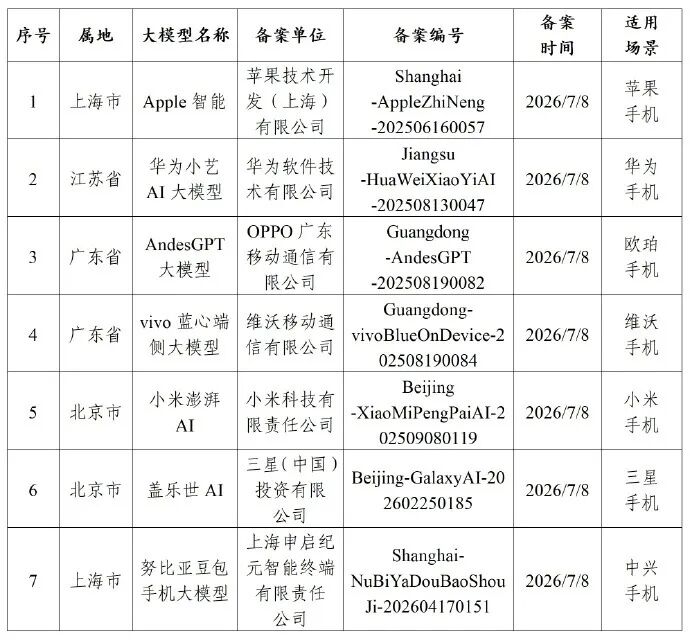
On-device large models run locally, and content generation does not pass through the cloud, so traditional review firewalls cannot reach them. This special filing is equivalent to setting rules for "AI running natively on mobile phones".
After obtaining the filing, manufacturers have received their "passes", but they also put on the "tightening hoop" at the same time.
The Apple Intelligence for Chinese mainland models was delayed for a long time, and now it finally has the qualification to operate legally. Domestic manufacturers have also got reassurance that as long as their technical routes comply with regulations, they can accelerate their development.
However, freedom has boundaries. On-device AI features "local inference, data not uploaded to the cloud", but regulation requires "content can be blocked, behavior can be traced". The current compromise solution is "on-device inference + cloud review": the on-device model has a built-in security filter, abnormal behavior is reported through cloud logs, and model updates must go through filing and review.
In other words, on-device AI is not truly "decentralized". Through OTA updates, regulators and manufacturers still hold the power to control the model's life and death.
An industry analyst pointed out the helplessness behind this: "It does not mean the system can be adjusted just because the model understands the instruction; it does not mean the Apps are willing to open permissions just because the system can be adjusted; even if the Apps open permissions, it still depends on whether payment, performance, and after-sales can be connected together."
In order to balance computing power, privacy and compliance, the industry has packaged "device-cloud collaboration" as the optimal solution that takes into account both experience and security. But in fact, it is only a "structural compromise" under the current technical conditions.
Device-cloud collaboration seems to be the best of both worlds, but it is actually constrained everywhere.
The first challenge is the insurmountable computing power gap. The NPU computing power of 2026 flagship phones exceeds 100TOPS, but running a 7-billion-parameter model to solve a logical reasoning problem takes 3 minutes and may still get the wrong answer; mid-range phones may even freeze for 5 minutes when processing image recognition. If all tasks are processed on the cloud, the cost will crush the profits of manufacturers.
The second is the unsolvable privacy dilemma. The more AI understands you, the more data it needs. But if the data stays locally, AI will become "blind". The current common practice is "hierarchical desensitization": sensitive data remains on the device, and desensitized semantic features are transmitted to the cloud. Apple's Private Cloud Compute is a typical representative, but this is essentially "trusting Apple" rather than "absolute technical security".
The ecological high wall makes it even harder to move forward. If AI is fully on-device, mobile phone manufacturers will be reduced to "hardware pipelines", which runs counter to the commercial ambition of "AI phones". Device-cloud collaboration allows manufacturers to retain their status as cloud entry points and keep the space for data monetization.
As a result, different manufacturers are telling different stories under this framework: Apple talks about privacy, Huawei emphasizes autonomy, OPPO and vivo focus on experience, and StepX pursues control. On the surface, they are all talking about "device-cloud collaboration", but their power demands behind are completely different.
Technical problems may be solved by increasing computing power investment, but the "walled garden" at the application layer is the hardest to cross.
In March this year, Nubia launched the M153 AI phone in cooperation with ByteDance's Doubao, which amazed the audience at the overseas MWC exhibition. Equipped with GUI Agent technology, it does not require Apps to open APIs, and can simulate user operations to complete the whole process of cross-app search, price comparison, and order placement. Taylor Ogan, an American investor, called it "the world's first truly smartphone" after experiencing it on the social platform X.
However, this product ran into obstacles everywhere after returning to China.
The reason is very simple: when AI can perform cross-app operations on behalf of users, it touches the "cheese" of super Apps. WeChat, Taobao, banks... These platforms are all very clear that once AI takes over the entry point, the traffic, user relationships and business models built around Apps in the past will all be reshaped. No one is willing to voluntarily degrade into an "execution node" in the AI call chain.
In June this year, WeChat began to cooperate with multiple mobile phone manufacturers in the A2A (Agent-to-Agent) mode. The mobile assistant can send requests to WeChat, and WeChat completes operations such as sending messages and making video calls with full double authorization. This is regarded as an important breakthrough, but it also proves exactly that: Apps will not be replaced, they are just redefining their own open boundaries.
The ultimate test in the future is to let AI coordinate multiple services such as calendars, maps, ticketing, payment, and socializing to complete long-term tasks like "go to Beijing for a meeting next week, arrange transportation and accommodation, and notify colleagues". But behind each link, there are different platform interests. Who opens permissions, how much to open, and which operations require manual confirmation will directly determine how far AI phones can go.
In the final analysis, this is a competition for "entry point control". In the past, Apps controlled user time, and platforms controlled transaction data; now, AI Agent gives mobile phone manufacturers the opportunity to take back the entry point. If AI can understand a sentence and handle everything for the user, then the entry point will no longer be individual Apps, but the instruction that wakes up the AI.
What follows is a series of questions about the attribution of rights and responsibilities: when AI clicks, places orders, and transfers money on your behalf, who holds the final decision? The mobile phone manufacturer? The model provider? The App platform? Or yourself?
This is no longer a simple competition over model capabilities and computing power, but a power game centered on "who connects users, who distributes traffic, and who controls data".
Three routes, three kinds of future
The answer is not yet determined, but the moves have been made. Recently, Honor, StepX, and Nubia (the second-generation Doubao phone) brought their respective AI phones that claim to be "the world's first" to compete on the same stage at this year's WAIC, staging a preview of "the next generation of AI phones".
Honor Robot Phone, letting the phone "grow hands and feet"
On July 18, Honor officially released the world's first robot phone, the Robot Phone. The biggest difference of this product is that a set of 4-degree-of-freedom titanium alloy motorized gimbal is added to the top of the body. It can not only understand complex instructions and automatically complete continuous cross-app tasks, but also rotate the gimbal to interact and respond, and dance along with music. In the on-site demonstration, with just one sentence, it can complete the "three birthday celebration tasks" of ordering a cake, hailing a taxi to the restaurant, and reserving a KTV private room.
Honor upgraded its operating system to AgenticOS, trying to redesign the phone around the agent from the hardware layer to the ecological layer. Li Xia, CEO of Honor, defined the future of AI as: "The evolution of AI will surely break away from the cold tool attribute, move from the operating system to embodied interaction, and fully advance towards a partner-like humanoid life form, reconstructing the relationship between humans and the physical world."
Honor is betting on changing the physical form of the phone to give AI stronger real-world interaction capabilities.
StepX Neo: Reconstructing the "underlying foundation" of the phone
Yin Qi said bluntly at the press conference that the team knew clearly that the threshold for making hardware was extremely high, and friends in the industry advised StepX not to enter this field. But to create a pure AI-native device, they can only independently develop the hardware to fully release all the capabilities of the large model.
Different from the common development mode in the industry that adds large model plugins to existing operating systems, Step AOS reconstructs the underlying framework from scratch to create a Step AOS that natively adapts to agent operation.
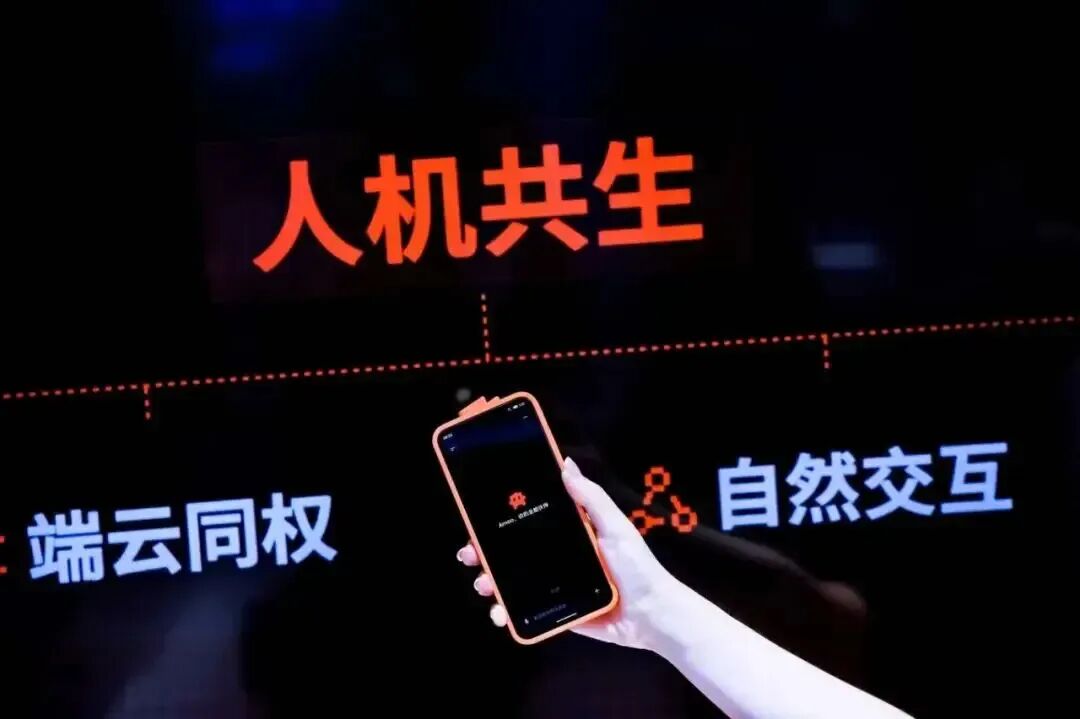
Yin Qi made an analogy: traditional systems only open a small door for AI, and AI is always a "visitor"; Step AOS reconstructs the underlying architecture from scratch, and directly builds a complete operating environment for agents, so AI is a "native resident" in the system. The core logic of this route is: the core unit of future mobile phones will no longer be Apps, but "tasks".
Users put forward demands, and AI schedules resources to complete tasks. STEPX Neo is also the only agent phone that has passed the highest L3 level certification of the "Artificial Intelligence Terminal Intelligence Grading" standard. StepX is betting that the operating system will become the largest new entry point in the AI era.
Nubia NaviX Ultra (the second-generation Doubao phone): "Sailing out by borrowing a ship" in the old ecosystem
Nubia and ByteDance did not take the extreme route of modifying hardware and rewriting the system, but chose to deeply integrate with super Apps. The first-generation M153 used to rely on GUI Agent to simulate clicks to complete cross-app operations, but the second-generation phone has shifted to A2A/MCP protocol collaboration, no longer forcibly operates through the interface, but is executed by the built-in agent inside the App. The advantage of this route is that it is compatible with the mature ecosystem and avoids risk control; the disadvantage is that it is always subject to whether the platform is willing to open permissions and how much to open.