A flexible tactile sensing enterprise has secured a new round of financing, and the company's revenue is expected to increase tenfold in 2026 | HardKr Exclusive
Written by Huang Nan
Edited by Yuan Silai
Hard Krypton learned that Yaole Technology, an enterprise focused on flexible tactile perception, has recently completed a new round of Pre-A+ financing. This round is led by Dinghe Gaoda, with listed company Changshu Auto Decoration and Zulong Entertainment as co-investors, and Yundao Capital acting as the long-term exclusive financial advisor. The raised funds will be mainly used for R&D of flexible fabric sensing technology, product performance iteration and upgrading, accelerating the expansion of data glove production capacity and mass delivery, improving the capabilities of data collection, calibration and interface, and promoting the implementation of scenarios such as embodied intelligence, world model and intelligent cockpit.
Yaole Technology takes flexible fabric sensing as the hardware entry, focusing on the collection and preprocessing of real physical interaction data required by embodied intelligence and world models. Lv Liyun, founder and CEO of the company, once served as the chief architect engineer of Harman, a leading international automotive electronics enterprise, and led the R&D of the multi-modal sensor fusion computing platform. Most of the core team members come from top universities and research institutions such as the Chinese Academy of Sciences, the University of Michigan and Peking University, with full-chain R&D capabilities covering underlying sensing materials to upper-layer intelligent algorithms.
With the breakthroughs in hardware engineering such as humanoid robot body, motor and joint control one after another, the industry competition has entered a new stage, and the deep-seated restriction comes from the structural shortage of data supply. According to the *China Embodied Intelligence Industry Development Report*, as of the beginning of 2026, the total amount of high-quality real physical interaction data worldwide is about 500,000 hours, while the training of a general embodied model with basic generalization ability requires at least 10 million hours of data, with a gap of more than 90%.
Compared with visual and text training materials that can be collected on a large scale through online channels, the tactile modality has unique supply bottlenecks. Tactile signals originate from direct physical contact between entities. The simulation environment can simulate the shape and position of objects, but it is difficult to reproduce the complex mechanical characteristics such as pressure distribution, friction force and material deformation in real scenarios. There is an inherent deviation between the simulation dataset and the real tactile ground truth, so it cannot completely replace the real collected data from real people as high-quality training materials. This also forces the industry to find new ways to obtain data from the physical end.
As a physical interface connecting human operation and robot learning, the data collection glove can not only capture the contact mechanical signals in real operations, but also realize large-scale deployment in a relatively standardized form, which has become one of the key paths to fill the gap of tactile data at present.
The innovation of the data glove to be released by Yaole Technology lies in integrating the sensing function directly into the fabric structure to realize the integration of materials and devices. Lv Liyun, founder and CEO of Yaole Technology, told Hard Krypton that most of the current mainstream data collection glove solutions use printed circuits or thin-film sensors attached to the fabric surface, the sensor layer is separated from the fabric layer, and multi-layer structures are often required to be superimposed.
"This kind of solution can work in a laboratory environment or for short-term demonstrations. Once it enters a real scenario, problems such as displacement, wrinkles and sweat stains caused by the multi-layer structure will directly affect the data quality," said Lv Liyun.
Yaole's solution is to embed the sensing capability directly into the fabric structure itself. Based on the self-developed "metal yarn + sandwich matrix" sensor, the company weaves metal drawn alloy yarn into a conductive network and embeds it into a matrix composed of multi-layer fabrics. The yarn is made of pure metal instead of coating or electroplating process, which has more durable conductivity and consistency. The glove is covered with a high-density sensing array on the palm and knuckles to achieve accurate data collection.
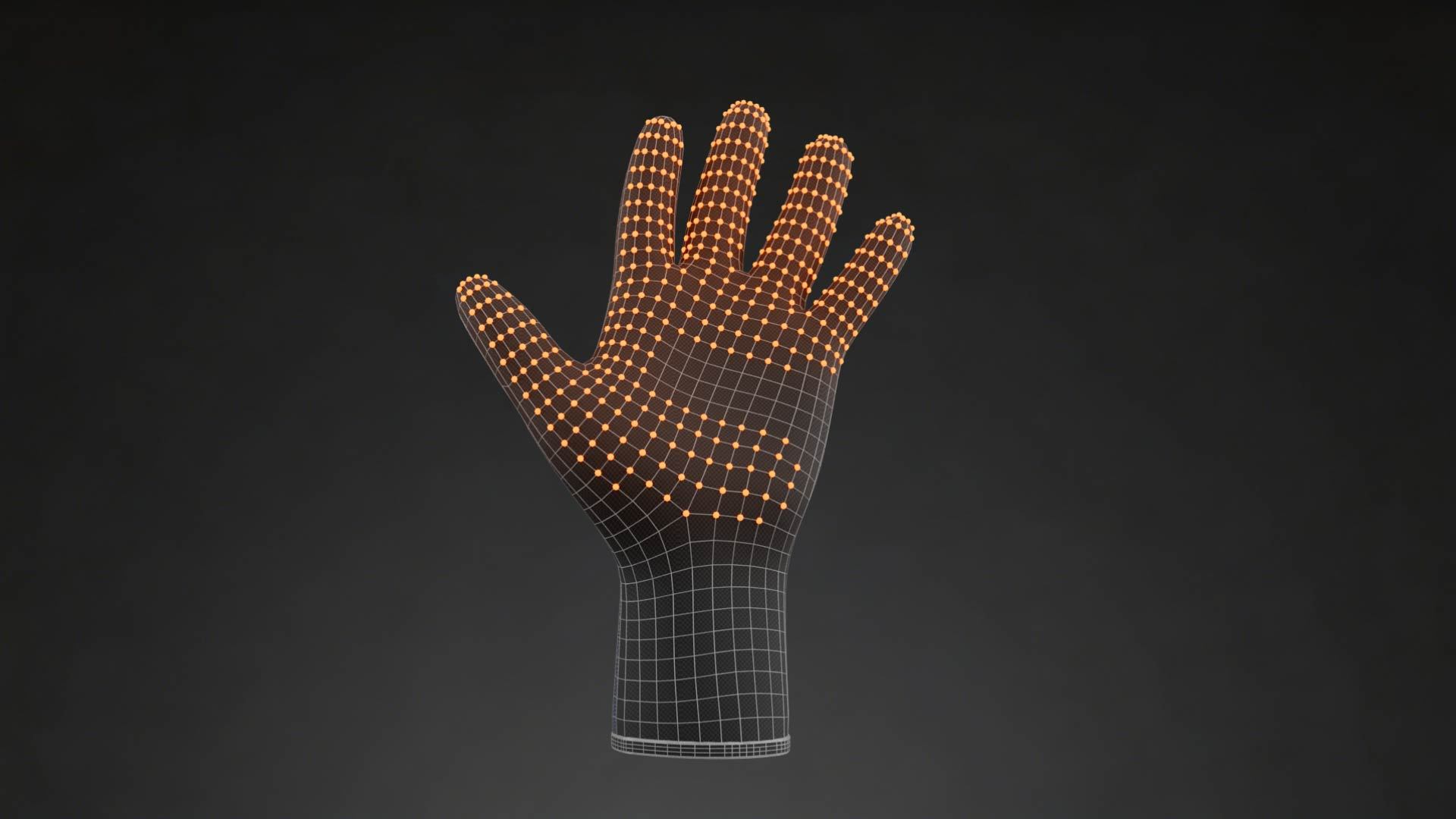
Schematic diagram of distribution of sensing points of data glove (Source: Enterprise)
After integrated weaving and forming, the sensing circuit is integrated with the fabric, without multi-layer lamination or external sensor array. This structure eliminates the signal error caused by interlayer slip of traditional gloves, no relative displacement occurs when fingers bend, and no invalid signal is triggered by fabric wrinkles during empty grasping, which fundamentally improves the reliability of data collection.
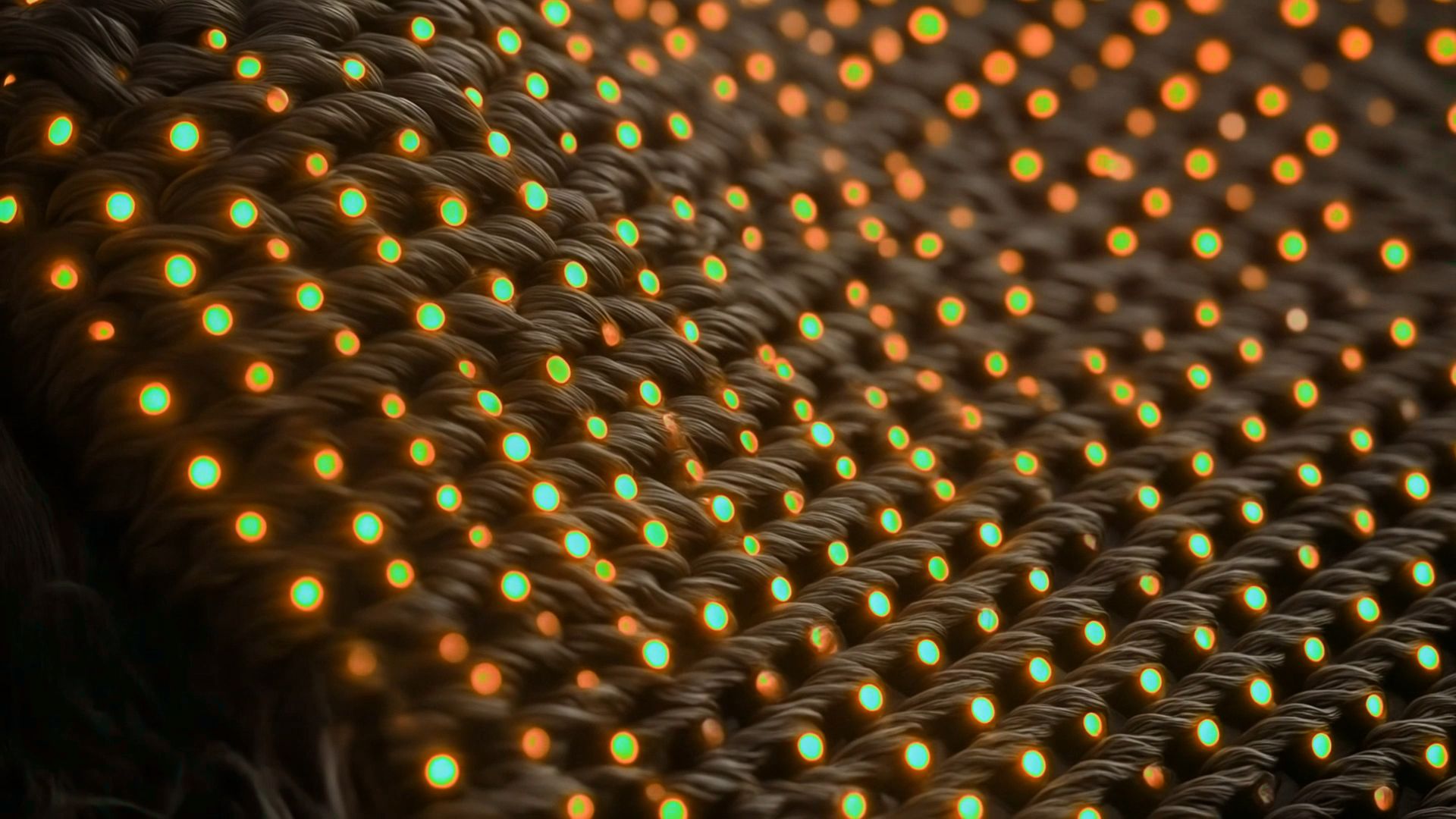
Fabric as the sensor (Source: Enterprise)
When tactile perception evolves from an "optional configuration" to a "basic perception layer" for embodied intelligence, the industrial position of data gloves as a physical interface connecting human operation and robot learning is being redefined. Moving from the laboratory to large-scale deployment, whether the gloves can be used by collectors for a long time, frequently and without burden directly determines the authenticity and sustainability of data acquisition. This is also the value of Yaole Technology's modular design.
The glove collection box integrates power supply, signal processing and storage modules, and the glove body can be replaced and cleaned separately, which not only ensures the continuity of long-term collection tasks, but also reduces the maintenance threshold after failure.
From the perspective of business model, hardware is the entry point, and data is the long-term commercial value. What Yaole Technology delivers to customers is not only gloves, but also preprocessing services such as data collection, cleaning, calibration and timeline alignment. The calibrated sensors have good consistency, no batch difference or deviation between individual gloves, which effectively reduces the data cleaning cost of customers in the model training stage.
Since the beginning of this year, the number of electronic skin glove manufacturers targeting flexible tactile perception solutions in China has grown rapidly, and the technical routes cover multiple directions such as printed thin film, visual-tactile sensing and fabric sensing. The key node of industry competition lies in who can take the lead in achieving large-scale mass production and cost reduction on the premise of ensuring data accuracy.
"Our advantage lies in the accumulated reliability and supply chain management experience in the vehicle-grade scenarios, which gives us the core capability foundation to migrate to robot scenarios. In terms of product positioning, we believe that data gloves are more like a kind of 'consumables'. The sensor itself does not need to work well for ten years. On the contrary, it needs to have accurate data within its service life, be cheap and replaceable, which is more in line with the real needs of users than just pursuing stability and durability," Lv Liyun told Hard Krypton. In 2026, the data glove business of Yaole Technology is expected to account for more than half of the total revenue, and the company's annual revenue is expected to increase by 10 times.
The following is an excerpt of the interview between Hard Krypton and Lv Liyun, founder and CEO of Yaole Technology (slightly edited):
Hard Krypton: According to your observation, what types of data do your industry customers of Yaole mainly demand this year? What are the essential differences in their demands?
Lv Liyun: At present, what the whole industry lacks the most is real human tactile data, and the gap is very large. From the perspective of customer portraits, their demands can be roughly divided into several categories.
The first category is embodied intelligence companies and teams working on world models, which is also the most important customer group of the company at present. What they need is operation data to train dexterous hands or robots to complete specific tasks. Such customers emphasize the "heterogeneity" of data, that is, they cannot only collect the operation mode of one person, nor only target one type of object. The differences in hand shapes, force habits and operation rhythms of different people are critical to the generalization ability of the model. In addition, they have very high requirements for data preprocessing: the timeline needs to be aligned, the sensors need to be synchronized, and the pressure data and image data need to be matched. If these basic tasks are not done well, the practicability of the data in the later stage will be affected.
The second category is large industrial enterprises and logistics companies, such as UPS. Their workers are already wearing labor protection gloves to work on the production line. Their demand is not to train robots, but to conduct labor health risk assessment and efficiency optimization. By collecting hand movement and force data, they analyze which movements are easy to cause strain and which processes have high labor intensity, so as to optimize the operation process. This kind of demand is very common overseas, especially in Europe and Japan, where enterprises have high requirements for employee health compliance and are willing to pay for it. Different from the first type of customers, these enterprises do not need multi-modal fusion or complex calibration, but biomechanical indicators that can be directly read, such as peak joint force and frequency of repetitive movements, and the dimensions of data interpretation are completely different.
The third category is the medical rehabilitation field, such as hand function recovery monitoring and rehabilitation training evaluation for stroke patients. They need fine-grained movement tracking and long-term change trends, requiring the sensors to have good repeatability and consistency. If the drift of the sensor itself is greater than the rehabilitation progress, the data will have no clinical value.
Because the goals of different customers are very different, we don't just sell a standardized glove and finish the work. Instead, we make different configurations and different dimensions of data analysis according to the application scenarios. We prefer to cooperate deeply with customers to help them do part of the data analysis, and share data resources on this basis. The deployment of hardware is only the first step. How to use the data and how to help customers generate value is the longer-term matter.
Hard Krypton: There are many manufacturers of flexible sensors on the market, covering different technical routes such as printed thin film and visual-tactile sensing. What is the reason why customers choose Yaole Technology's solutions?
Lv Liyun: The fundamental reason why customers come to us is that many solutions on the market have problems in data accuracy.
Most of the common electronic gloves on the market are printed thin-film types, which print sensors on thin films, TPU or fabrics, or integrate visual-tactile sensing. However, the problem with this kind of material is that it is not naturally suitable for making gloves. People almost always use gloves in fabric form, and rubber gloves need to be taken off after a short time of wearing because they are not breathable and will cause sweat stains.
At the same time, since the printed thin-film solution usually requires a multi-layer structure with the sensor sandwiched in the middle, the problem brought by the multi-layer structure is that it is too thick and not breathable, and sweat stains will lead to sensor attenuation and drift; the layers are prone to slip during grasping; if the glove is not specially designed for the three-dimensional structure of the hand, the material will wrinkle when the fingers bend, the sensor will be falsely triggered during empty grasping, and so-called "dirty data" or "ghost noise" will appear.
Yaole's approach is to solve these problems from the source. Integrated weaving and forming, no multi-layer structure, the sensing circuit has been woven in when the glove is formed, and there is no interlayer slip problem when the fingers bend.
In addition, we also designed an air layer and support structure inside the glove, so that the sensor only responds when it is really under contact pressure, which reduces invalid signals from the physical level. The wrist main control box also has a built-in wide-angle camera, which can perform double verification against the contact situation. When grasping empty, the camera can confirm that there is nothing in the hand, and the data can be cross-verified.
It can be said that the reason why customers choose Yaole is that we have a deeper understanding of fabric sensors. From materials, processes, weaving methods to mass production, calibration and delivery, we have systematic capabilities to do a good job in the "preprocessing" of data collection, rather than throwing a pile of noisy raw data to customers to clean up by themselves. This is also the irreplaceable value of the fabric sensing route in the data collection scenario.
Views of Investors:
Cao Jishan, Founding Partner of Yundao Capital believes that the primary market is shifting from focusing on "how cool the product body is" to questioning where the real physical interaction data comes from and whether it can be supplied to the model on a large scale. There are many tactile perception companies, but few of them can achieve mass production and delivery. The key is to see whether they have achieved designated supply and mass delivery in high-standard industries such as automotive — because what the world model needs is reusable and trainable data production capacity. The value of Yaole lies not in just another type of sensor, but in turning real human contact into a data entry that can enter the training chain. Hardware is the admission ticket, and data interface and standardization are where the valuation flexibility lies.
Wang Ying, Managing Partner of Dinghe Gaoda said that Hesai, Momenta, 66 Tech and other enterprises in our past investment portfolios all point to the same proposition — to enable machines to better perceive, predict and act on the physical world. What Yaole is doing is the key puzzle of this proposition on the physical interaction data side. Relying on our rich industrial ecosystem matrix, Dinghe Gaoda will provide Yaole with in-depth support from supply chain collaboration to market expansion. This round of investment helped us introduce Changshu Auto Decoration, precisely because we see that overseas automakers are gradually forming rigid demand for OCS (Occupant Classification System). We hope to promote China's vehicle-grade mass production solutions to overseas through investment and empowerment, and fully support Yaole's overseas business expansion.
Li Yi, Chief Financial Officer of Zulong Entertainment said that we firmly believe in the long-term value of Yaole as the tactile data infrastructure, and bet that Chinese enterprises are relying on their ultimate engineering capabilities and rich scenario density in the new round of AI technological innovation, starting from the underlying infrastructure to achieve a unique "China acceleration" in the global Physical AI competition.