Global semiconductor market tops $1.5 trillion for the first time, full interpretation of SIA's latest report
Today, the Semiconductor Industry Association (SIA) of the United States released the report *2026 State of the U.S. Semiconductor Industry*. Semiconductors are the nerve center of the digital world and the cornerstone of the AI revolution. In 2026, chip technology is advancing at an unprecedented pace.
The report highlights several key points:
First, the global chip market has exceeded 1.5 trillion U.S. dollars for the first time. Global semiconductor sales reached 795.6 billion U.S. dollars in 2025, far exceeding early-year expectations and hitting an all-time high. WSTS forecasts that global chip sales will surpass 1.5 trillion U.S. dollars for the first time in 2026, a sharp 90% increase compared to 2025.
Second, AI has become the strongest demand engine. One AI server rack contains more than 4,500 packaged chips, accounting for 95% of the total value of the entire rack; a hyperscale data center houses over 5,000 servers. The SIA-Deloitte report predicts that by 2028, governments and industries worldwide will have invested a cumulative total of more than 4 trillion U.S. dollars in new data center infrastructure, of which spending on semiconductors will reach 2.8 trillion U.S. dollars; the annual revenue of semiconductors deployed in AI data centers is expected to exceed 1.2 trillion U.S. dollars in 2028.
Third, the China region is growing rapidly. Sales in the China region increased by 17.9% year-on-year in 2025. At the R&D level, SIA cited OECD data pointing out that the total R&D expenditure of China's industry and government has exceeded that of the United States, especially in the later-stage development phase. Meanwhile, the report specifically notes that China's export restrictions on critical minerals such as gallium, germanium, indium phosphide, as well as rare earth elements and magnets, are impacting global chip manufacturers.
To help readers fully grasp the full picture of the SIA report, *Semiconductor Industry Insight* specially translates the full text of the report as follows for readers' reference.
Introduction
Semiconductors are the nerve center of our digital world and the cornerstone of the AI revolution.
As we enter 2026, chip technology is advancing at an unprecedented pace — supported by cutting-edge semiconductor research, design and manufacturing processes. The transistors integrated on modern semiconductors are so small that thousands of them can fit side by side on the cross-section of a single human hair. As technology continues to evolve, semiconductors are bringing higher efficiency and stronger performance to the entire economy, and unlocking innovations that will define U.S. economic strength, national security and global competitiveness for decades to come.
Demand for semiconductors has surged dramatically over the past few years. Global chip sales are expected to exceed the 1.5 trillion U.S. dollar mark for the first time this year.
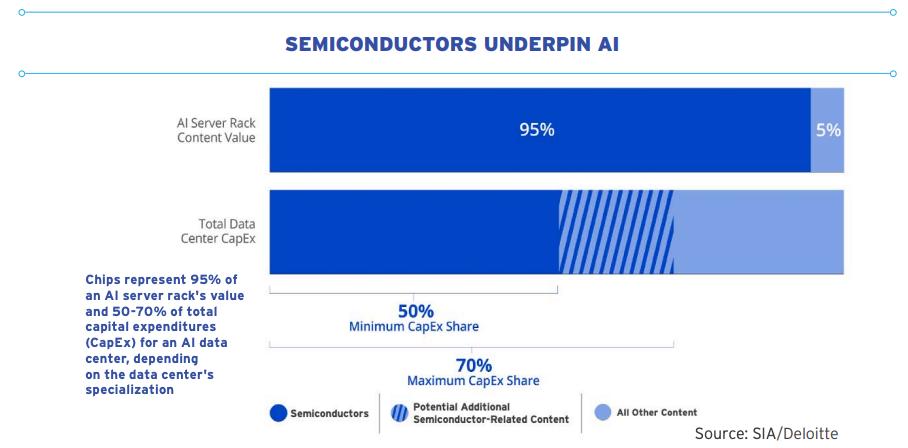
Semiconductors are the enabling technology for artificial intelligence (AI) — AI is reshaping our economy and society, making all industries more productive and innovative, and driving major scientific breakthroughs. The entire semiconductor technology stack, from advanced logic, memory to analog/essential chips, supports the operation of AI. One AI server rack contains more than 4,500 packaged chips, accounting for 95% of the total value of the entire rack. A hyperscale data center houses over 5,000 servers, which together create a historic level of demand for semiconductor technology.
In addition to AI, chips also power many downstream sectors such as communications, transportation, consumer electronics and industrial applications.
Given the growth of the semiconductor industry — and its critical strategic importance to economic security and national security — policymakers should promote relevant initiatives to consolidate the United States' leadership in chip technology. Advancing sound tax, R&D, talent, trade and national security policies is essential to strengthening U.S. semiconductor capabilities, shoring up supply chains and enabling next-generation technological breakthroughs.
This report provides a panoramic snapshot of the 2026 semiconductor industry: the ongoing progress, the challenges ahead, and the urgency of maintaining U.S. leadership in this foundational technology field.
Part 1: Global Semiconductor Market
1.1 Global Semiconductor Sales
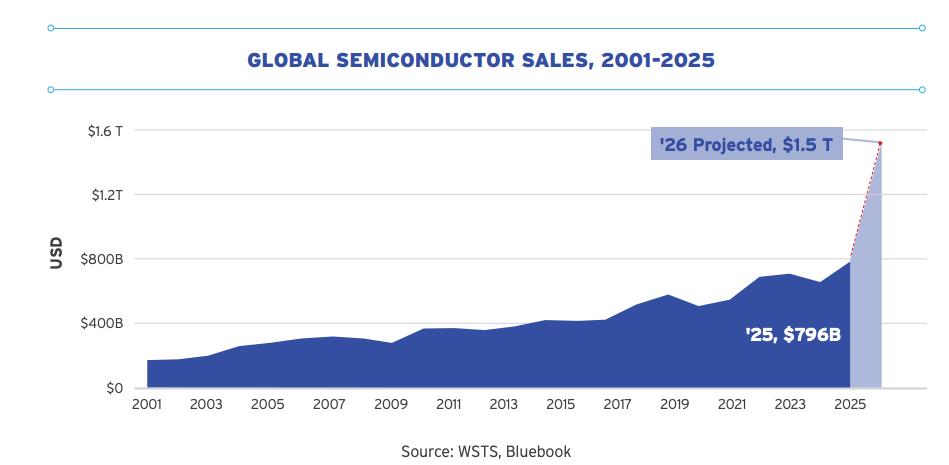
Global semiconductor sales reached 795.6 billion U.S. dollars in 2025, far exceeding early-year expectations and setting a new all-time industry record. The World Semiconductor Trade Statistics Organization (WSTS) predicts that global semiconductor sales will rise sharply to 1.5 trillion U.S. dollars in 2026 — this is the first time industry sales have crossed the 1 trillion U.S. dollar threshold, representing a 90% increase compared to 2025.
Chips that power AI and other advanced applications were the strongest demand engine for semiconductor sales in 2025, and this trend is expected to continue in the coming years.
Total sales of logic chips reached 299.5 billion U.S. dollars in 2025, up 38.8% year-on-year, making them the largest semiconductor category by revenue. Memory products ranked second with 230 billion U.S. dollars, up 39.0% from 2024. Sales of essential chips declined 5.2% from their 2022 peak and remain suppressed; however, unit sales of essential chips posted a modest 6.3% year-on-year increase.
By region, annual sales in 2025 increased year-on-year as follows: Asia Pacific/Other regions +45.4%, Americas +31.4%, China +17.9%, Europe +6.7%; Japan -4.3%.
1.2 U.S. Market Share
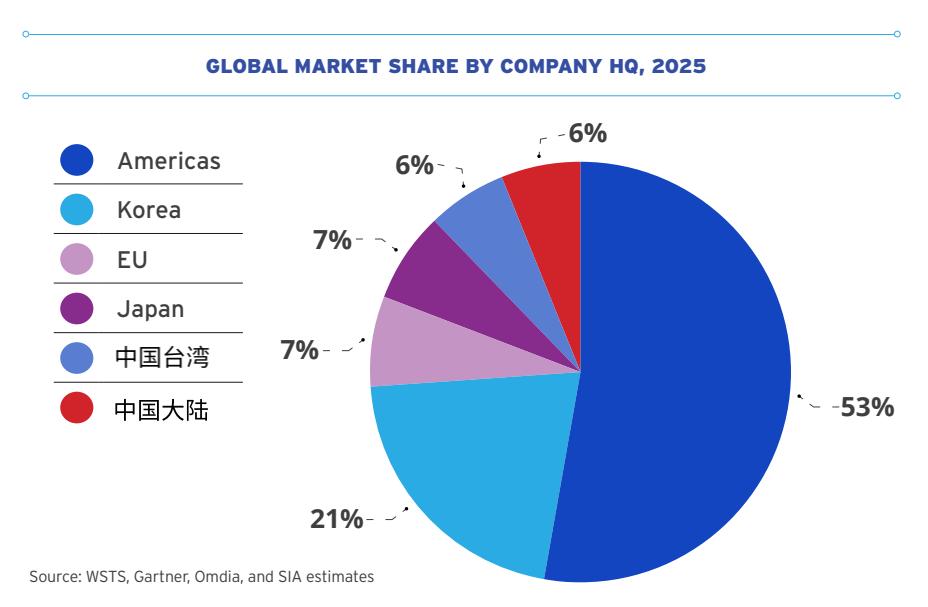
Since the late 1990s, companies headquartered in the United States have consistently ranked first in global chip sales. In 2025, U.S. industry sales reached 425 billion U.S. dollars, accounting for 53.4% of total global sales — the highest share since 1984.
U.S. enterprises continue to maintain top competitiveness across the entire innovation chain, including R&D, chip design and advanced manufacturing. This leadership forms a positive cycle: success in global sales enables them to make large-scale reinvestments in R&D, which in turn spawns next-generation technological breakthroughs, and further consolidates U.S. semiconductor leadership.
1.3 Demand Drivers
Innovation in the semiconductor industry is giving rise to transformative technologies for the future. In turn, demand for numerous innovative technologies such as AI, 5G/6G communications, quantum computing, industrial automation, robotics, medical devices and advanced defense systems continues to drive up demand for chip technology.
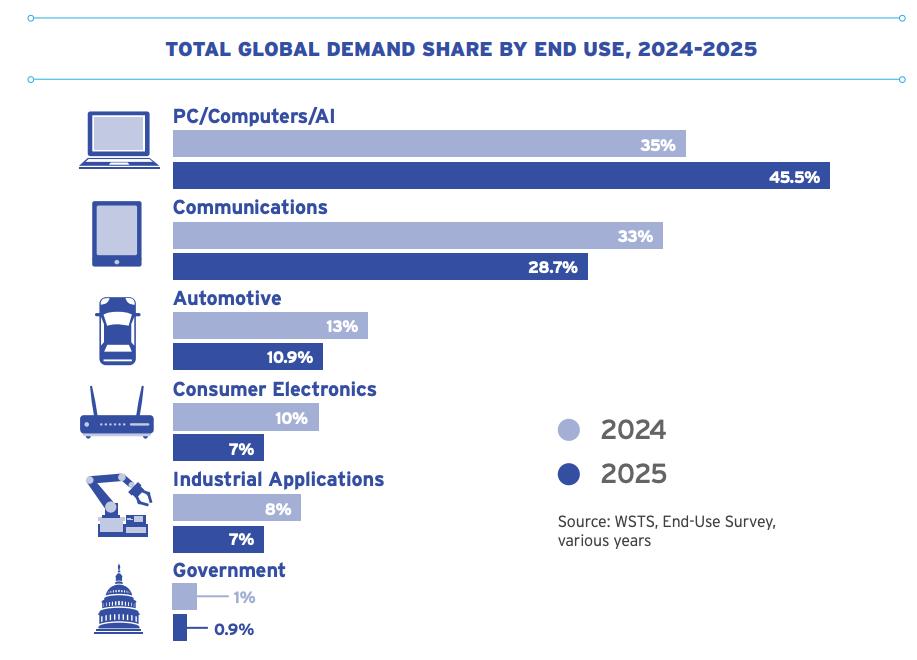
The 2025 semiconductor sales boom was mainly driven by AI infrastructure construction as well as other computing terminals such as PCs and workstations. By revenue, the end-market share of PC/computer and AI applications both increased by more than 10% year-on-year, indicating strong growth potential in the future.
According to a recent joint report released by SIA and Deloitte, to meet the new demand for global AI applications, governments and industries will invest a cumulative total of more than 4 trillion U.S. dollars in new data center infrastructure by 2028, of which spending on semiconductors will reach 2.8 trillion U.S. dollars. In addition, the annual revenue of semiconductors deployed in AI data centers is expected to exceed 1.2 trillion U.S. dollars by 2028 — an almost 10-fold increase in four years.
Although semiconductor sales for end markets including communications, automotive, consumer electronics, industrial applications and government all grew in 2025, their share of total sales declined relatively due to the explosive growth in semiconductor demand in the AI sector.
1.4 AI is Built on Semiconductors
There is no AI without semiconductors. Today's AI systems are built on decades of innovation across the entire semiconductor ecosystem. As chip technology continues to advance, AI will become more powerful, more energy-efficient and more cost-effective. In turn, stronger AI will help improve chip design, optimize manufacturing processes, and further drive demand for all types of semiconductors that support AI.
Chips provide the underlying hardware foundation for modern AI systems and account for a very large proportion of the total value of modern AI servers. According to a recent joint report by SIA and Deloitte, within a modern data center, one AI server rack contains more than 4,500 packaged chips covering all chip technology categories, including:
Advanced logic chips, such as AI accelerators, ASICs (Application-Specific Integrated Circuits), FPGAs (Field-Programmable Gate Arrays), CPUs (Central Processing Units), DPUs (Data Processing Units) and network chips;
Memory chips, such as HBM (High-Bandwidth Memory), DRAM (Dynamic Random-Access Memory), SRAM (Static Random-Access Memory) and NAND (Non-Volatile Flash Memory);
Analog/essential chips, such as power chips, transceivers, controllers and sensors — these chips ensure efficient energy delivery and seamless interconnection within AI servers and across systems.
Semiconductors account for more than 95% of the value of the contents in a leading AI server rack, and more than 50% of the total capital expenditure for AI data center construction and operation (the specific ratio ranges from 50% to 70% depending on the data center's specialization).
As AI continues to scale up, the ability to secure, design and integrate the semiconductor components that make up AI infrastructure will be just as critical as computing power itself.
To promote continued U.S. leadership in semiconductor and AI technologies, policymakers should adopt policies that encourage investment, drive innovation and facilitate trade, to strengthen semiconductor research, design and manufacturing.
Part 2: U.S. Semiconductor Ecosystem
2.1 Overview of the U.S. Semiconductor Ecosystem
The U.S. semiconductor industry is one of the most advanced manufacturing and R&D industries in the world.
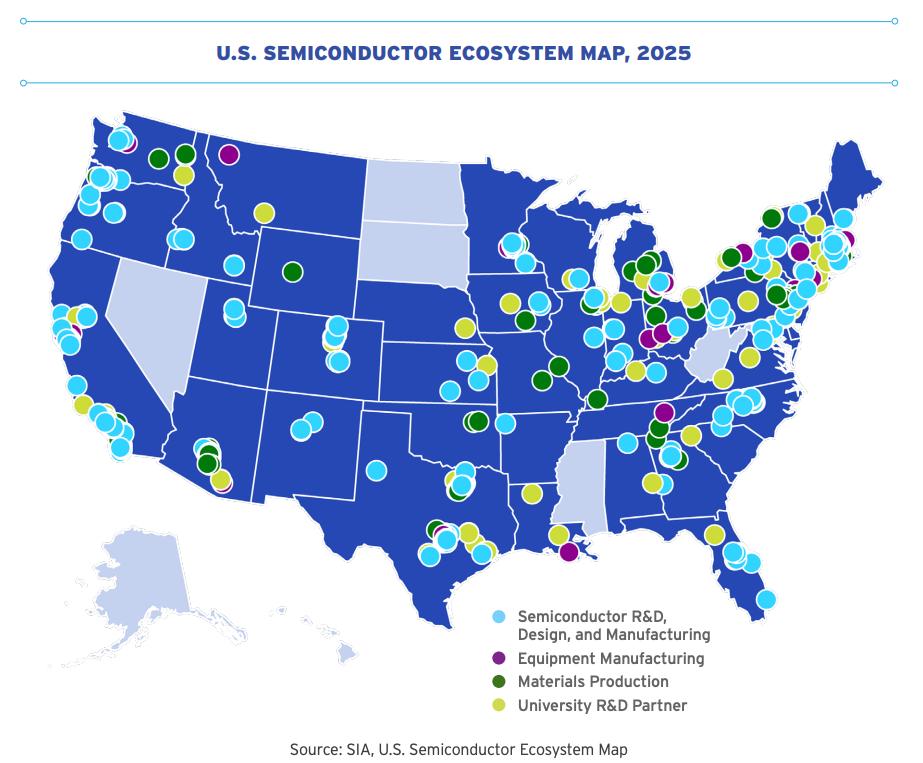
The semiconductor ecosystem is widely distributed across the United States, present in the vast majority of states. Every link in the value chain, from early-stage research and design to manufacturing, equipment and materials, plays a critical role in ensuring the United States can develop, produce and deliver semiconductors that meet the growing needs of downstream customers.
Maintaining and developing this ecosystem in the United States — while working to strengthen complementary supply chains among allies and partner countries — is essential to sustaining U.S. technological leadership, enhancing supply chain resilience, and supporting economic and national security.
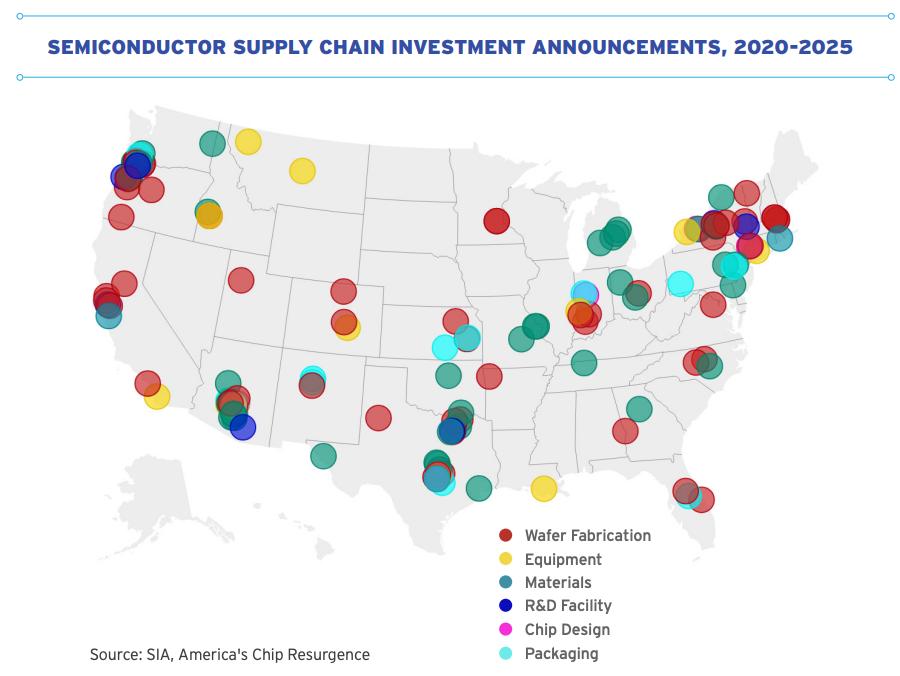
As companies expand semiconductor production capacity and related supply chain scale in the United States, the increase in domestic chip output will strengthen the U.S. economy, enhance supply chain resilience, and reinforce national security. A stronger U.S. chip industry can:
Support high-wage jobs;
Drive broader investment in the technology and manufacturing ecosystem;
Guarantee a reliable supply of semiconductors across sectors from consumer electronics and automobiles to AI systems and critical infrastructure;
Mitigate vulnerabilities caused by supply chain disruptions and geopolitical uncertainties, while complementing the globally interconnected industrial chain.
These corporate investments will collectively ensure that the United States remains the global leader in semiconductor innovation and advanced manufacturing for decades to come.
2.2 U.S. Semiconductor R&D
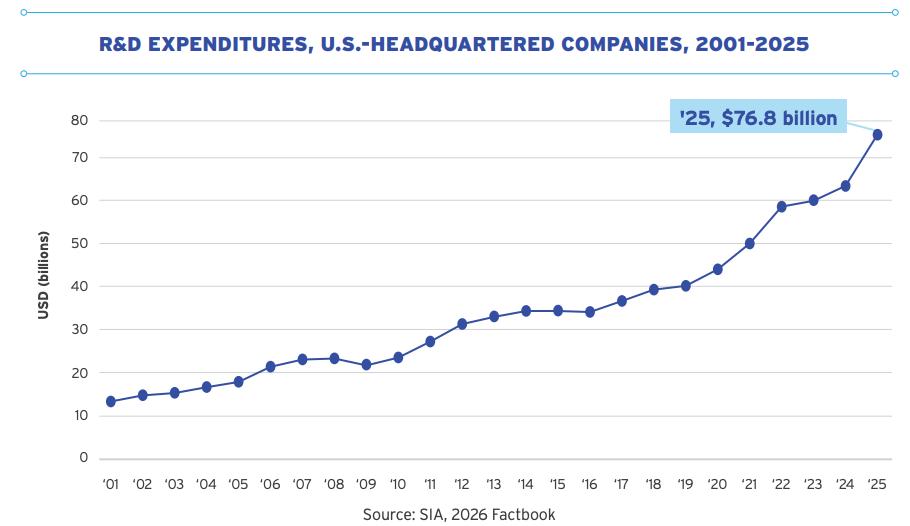
The semiconductor industry is one of the most R&D-intensive industries in the world. U.S. semiconductor companies spent 76.8 billion U.S. dollars on R&D in 2025, a 10.3% increase from 69.6 billion U.S. dollars in 2024.
One of the industry's largest demand engines: AI data center chips put forward higher requirements for accelerator performance, tighter integration of logic and memory chips through advanced packaging, and stronger energy efficiency solutions.
Edge AI is another fast-growing emerging segment, which refers to running machine learning and AI algorithms directly on local hardware devices. It requires a variety of low-power and communication chips to meet nearly endless application scenarios — fitness trackers, smart homes, autonomous driving and Advanced Driver Assistance Systems (ADAS), etc.
This year, the U.S. Department of Commerce CHIPS R&D Office released a Broad Agency Announcement (BAA), targeting ambitious, large-scale commercial R&D projects to support U.S. domestic enterprises in building world-leading computing capabilities across the industry, helping enterprises leap ahead of global competition and secure lasting leadership for the United States.
As demand from new and existing industry segments continues to grow, R&D will become increasingly critical, and enterprises need to keep up with the pace of innovation and maintain competitiveness. In fact, the semiconductor industry has maintained a roughly two-year product iteration cycle for many years, but now enterprises are delivering innovations at an unprecedented speed to meet customer needs.
2.3 U.S. Domestic Semiconductor Talent
The U.S. semiconductor industry directly provides about 342,000 jobs, and indirectly supports nearly 2 million additional jobs across the