Founded by a team of Tsinghua PhDs, this company aims to develop hydrogen-powered "hearts" for aircraft | 36Kr Exclusive
Text | A Zhi
A new revolution is brewing in the aerospace new energy power system sector.
36Kr learned that 「Qing Hydrogen Power」, a supplier of aerospace new energy power system solutions, has completed a tens-of-millions-yuan Angel+ round of financing, led by Red Bird Navigation Fund and Guizhou Tech Innovation Angel Fund, with participation from Tsinghua Alumni Seed Fund, TusStar Venture Capital, Yinghui Venture Capital, Jinyuanhe, and AngelCrub. The new funds will be mainly used for the development and verification of aerospace-grade liquid-cooled fuel cell products, as well as the commercial promotion and application of air-cooled fuel cells across multiple scenarios.
Over the past decade, R&D and industrial application of hydrogen fuel cells have been largely concentrated in the automotive sector, where relatively clear cost reduction paths and mature standards have been established. However, the development of domestic hydrogen energy applications in the aerospace field has not kept pace.
Hydrogen-powered aviation is not a new concept. In fact, as early as the beginning of the 21st century, Europe began to demonstrate the advantages, disadvantages, and path feasibility of different technical routes for aerospace new energy power systems. The core strengths of hydrogen fuel cells lie in their high energy density and stronger environmental adaptability. Compared with power batteries, they can increase the flight range by more than 3 times, with fast energy replenishment and excellent low-temperature performance, making them more suitable for the high-frequency turnover business model of eVTOL "air taxis".
Compared with traditional aviation kerosene and SAF, in the long run, hydrogen fuel has lower cost, offering advantages in balancing performance compliance and economic feasibility.
However, constrained by upstream technology iteration, industrial supporting facilities, and application cost issues, hydrogen-powered aviation remained in a state of unmet industry consensus and emerging demand for a long period in China.
With the vigorous promotion and application of green electricity and green hydrogen in recent years, Zhang Kexun, founder of Qing Hydrogen Power, judges that "the usage cost of hydrogen as a fuel will soon be lower than that of aviation kerosene in China. Hydrogen energy will eventually become the preferred technical route in the aviation industry by virtue of its cost advantage."
As a hydrogen energy industry chain startup incubated by Academician Ouyang Minggao, the core team of Qing Hydrogen Power all come from Tsinghua University. Founder and CEO Zhang Kexun holds a doctorate degree from the Department of Automotive Engineering of Tsinghua University, and has been deeply engaged in R&D and industrialization of new energy power systems since 2002.
Leveraging more than 20 years of technical accumulation and industrial resources of Tsinghua University in the fuel cell field, the project team began detailed technical demonstration of hydrogen energy applications in the aerospace sector back in 2018, and launched its first research project in collaboration with Northwestern Polytechnical University in 2020, to develop China's first 30kW liquid-cooled fuel cell dedicated for aviation use.
"The initial start was actually very difficult, because all components and raw materials (for the first liquid-cooled product) had to be re-customized and developed to meet aerospace-grade standards. The R&D cycle was long, technical difficulty was high, and investment was relatively large. It took about three to four years, which is the background for the establishment of Qing Hydrogen Power."
Zhang Kexun mentioned that the advanced nature of hydrogen-powered aviation was not widely recognized in China in the past, but fortunately, new industry consensus is accelerating to form.
With the successive rise of the low-altitude economy and commercial aerospace trends, the advantages of fuel cells in high power, long endurance, and strong adaptability have begun to attract more attention. Currently, many leading domestic aerospace main engine manufacturers are also accelerating the R&D and verification of hydrogen energy power systems. Before that, Qing Hydrogen Power had been working quietly in this field for several years.
Tackle the "Hard Nut" First
Conquering the first 30kW liquid-cooled fuel cell, this "hard nut", allowed Qing Hydrogen Power to establish a set of engineering cognition different from automotive fuel cell systems in the early stage of entrepreneurship. The difference between aerospace-grade and automotive-grade standards is the key to understanding the company's technical layout.
In Zhang Kexun's view, the capability requirements for aerospace-grade power systems are mainly reflected in three dimensions: extremely high environmental adaptability (such as environments at an altitude of 10,000 meters, low temperature and low pressure, etc.), ultimate reliability (such as a lifespan of tens of thousands of hours, high-safety airworthiness certification requirements), and strict requirements for power density.
Qing Hydrogen Power's technical layout follows a clear vein from capability spillover to scenario convergence.
At present, its product system is developed around two technical routes: liquid cooling and air cooling, which form distinct complementarity in positioning, power, and environmental adaptability.
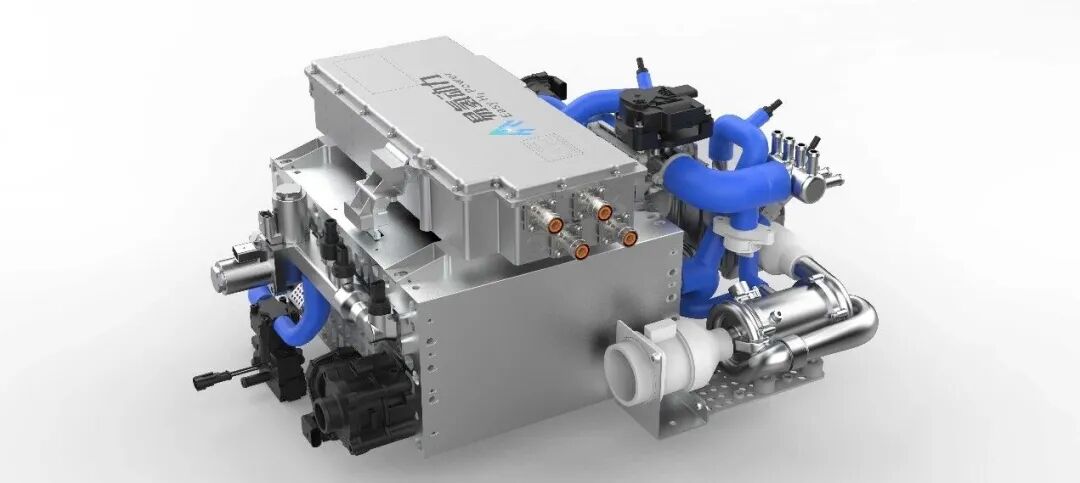
30kW Liquid-cooled Fuel Cell Power System
Liquid-cooled fuel cells are the long-term technical main line that Qing Hydrogen Power has bet on. They are characterized by high power (hundreds of kilowatts level), strong environmental adaptability, capable of supporting harsh working conditions such as 10,000 meters altitude and extreme cold, with a target lifespan of tens of thousands of hours. Starting R&D in 2020, the 30kW liquid-cooled fuel cell has now been iterated to 90-110kW, with future plans to expand to 300kW-level products.
Zhang Kexun mentioned that the liquid-cooled route has basically completed core technical breakthroughs, and is now in the productization stage from 1 to 10. The next core task is to carry out airworthiness-oriented engineering development in cooperation with main engine manufacturers.
In addition to the liquid-cooled technical main line, air-cooled fuel cells are a strategic extension made by Qing Hydrogen Power in 2024 based on the window period of the low-altitude economy.
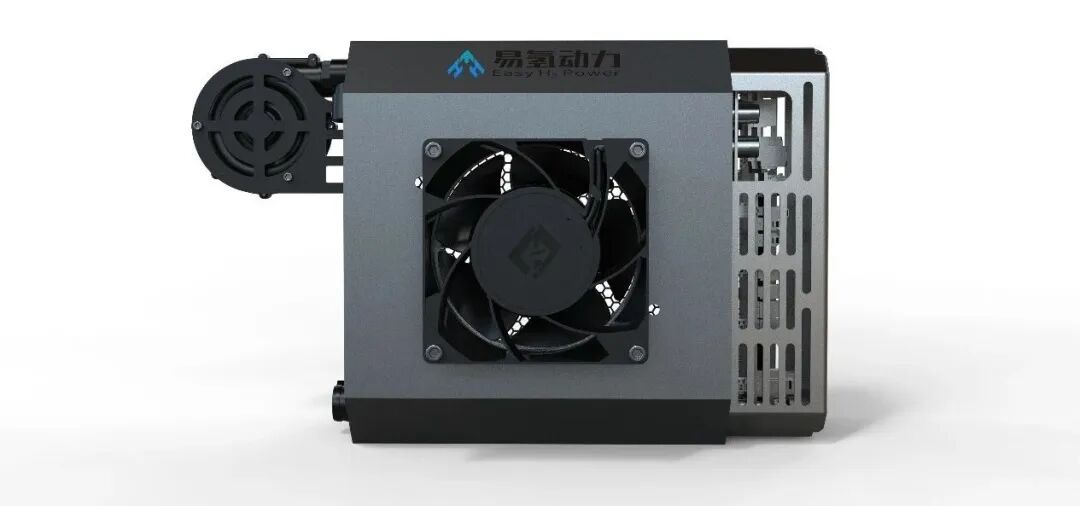
Air-cooled Fuel Cell Power System
Air-cooled fuel cells are characterized by relatively low power (usually below 10kW) and relatively low technical difficulty, but with fast development iteration and short implementation cycle, making them more suitable for scenario applications in the low-altitude economy field dominated by drones.
In less than a year, Qing Hydrogen Power's air-cooled products have completed three rounds of iteration and entered the stage of scenario application expansion.
The strategic division of labor between these two routes is also relatively clear: liquid cooling anchors long-term technical barriers and profit margins, while air cooling undertakes the dual roles of short-term cash flow and technical iteration test platform.
Use shorter-term commercial returns to feed back the longer-cycle technical main line of liquid cooling, to secure long-term pricing power.
Break into the Mainstream
In the liquid cooling direction, an important progress is that Qing Hydrogen Power has now become a cooperative supplier of COMAC in the hydrogen energy power system sector. In addition, Qing Hydrogen Power has also established cooperation with many eVTOL complete aircraft manufacturers to jointly promote the development of their hydrogen-powered models.
Of course, the cycle from verification to mass production of an aerospace-grade product is extremely long. The exploration of airworthiness standards and the complexity of complete aircraft verification determine that liquid-cooled fuel cells can hardly contribute to large-scale revenue in the short term.
The air cooling direction undertakes the expectation of rapid business growth.
In terms of implementation rhythm, in the second half of 2025, Qing Hydrogen Power has completed the development and verification of air-cooled product solutions, and will next focus on promotion in the low-altitude economy sector, to solve the long-endurance scenarios that lithium batteries "cannot reach".
"Power batteries have explored all available scenarios, and the remaining scenarios that cannot be met by batteries, such as long endurance and extremely cold environments, are opportunities for hydrogen energy." Zhang Kexun mentioned that in niche fields such as drone inspection and low-altitude logistics, hydrogen energy solutions can provide 3-4 times the endurance of lithium batteries, expanding the coverage radius from a few kilometers to hundreds of kilometers. Currently, the price of Qing Hydrogen Power's complete air-cooled system solution can basically be on par with the pure electric solution.
A set of data shows that in 2025 and 2026, the high-altitude drone developed by Chengdu Aerospace using Qing Hydrogen Power's system has achieved continuous flight records of 30 hours and 24 hours respectively, using gaseous hydrogen as fuel.
The drone inspection scenario is a key promotion area for Qing Hydrogen Power this year. Its complete air-cooled solution has generated millions of yuan in revenue in the first half of the year, with a 2026 target of achieving tens of millions of yuan in revenue in the inspection scenario.
Low-altitude logistics is its next key promotion direction. The air-cooled product solution for this scenario is currently in the development stage, and verification and promotion will start in the second half of the year.
In terms of rhythm, the task for air cooling this year is to achieve rapid growth, while the large-scale revenue of liquid cooling, as estimated by Zhang Kexun, will gradually appear at least in the next one or two years.
In China, although the airworthiness of hydrogen-powered aviation is still in its initial stage, with a slower pace than Europe and the United States, Zhang Kexun is quite certain about China's late-mover advantages in the hydrogen-powered aviation sector.
At the industrial end, a key signal is the cost advantage of green hydrogen. With the rapid decline in domestic green hydrogen costs, the price advantage of hydrogen energy power systems on the fuel side will be further highlighted. "Once the technology matures, the speed of our market iteration will be much faster than that of foreign countries. Just like electric vehicles, we are likely to achieve overtaking at curves," Zhang Kexun said.
At this crossroads of new and old kinetic energy conversion, as a startup company, Qing Hydrogen Power's solution is not complicated. In the long cycle, use "liquid cooling" to anchor the value of technical scarcity; in the short cycle, use "air cooling" to answer the practical question of "survive first", seize the industrialization window period of hydrogen-powered aviation power systems, and build long-term competitive barriers.