A startup founded by a UCLA PhD team that focuses on developing the foundation model for humanoid robots has secured nearly 500 million yuan in Angel++ round financing | Hard Krypton Exclusive First Release
Author | HUANG Nan
Editor | YUAN Silai
36Kr has learned that Delta Intelligence, a humanoid robot foundation model company, has recently completed a nearly 500 million yuan Angel++ round of financing. Investors in this round include industrial parties from multiple listed companies and leading financial investment institutions. The funds will be mainly used for the continuous iteration of the humanoid robot foundation model, accelerating the mass production of self-developed data collection equipment and the construction of a data closed loop, expanding the core R&D team, and promoting the engineering implementation and verification of technologies in real industrial scenarios.
This is also the sixth round of financing completed by the company within half a year of its establishment. Previously, investors included humanoid robot OEMs such as Beijing Institute of General Artificial Intelligence, Agibot, UBtech, and Unitree, financial institutions such as GL Ventures, Yuanhe Holdings, Fosun RZ Capital, China Merchant Capital, and Lenovo Capital, as well as capital from the automotive and semiconductor sectors.
Delta Intelligence, founded in January 2026, focuses on researching native general-purpose humanoid robot foundation models HFMs (Humanoid Foundation Models), ultimately achieving general-purpose full-body Loco-Manipulation, and promoting the real-world application of embodied intelligence in industrial and household scenarios. Using humanoid robots as a carrier, the company aims to accelerate the arrival of Physical Artificial General Intelligence (Physical AGI).
All three core founders hold PhD degrees from UCLA, with academic backgrounds including undergraduate studies at Tsinghua University and teaching experience at Peking University. The team's technical expertise covers robot learning, large-scale machine learning, robotics systems, and embodied intelligence. Their research and industry experience span Google Robotics, NVIDIA Research, DeepMind, Meta, Peking University, and the Beijing Institute of General Artificial Intelligence, and they have participated in multiple U.S. DARPA, ONR, and NSF robotics projects. Their diverse research directions and cross-academia-industry practical accumulation have enabled the team to develop full-stack software and hardware capabilities from cutting-edge research to technical implementation.
The embodied intelligence track is rapidly evolving from motion demonstrations to physical operations. The founding of the Delta Intelligence team stems from a clear exploration of the technical path: the foundation model for bipedal humanoid robots must be built from the very beginning for "full-body intelligence", rather than being migrated, copied, or patched onto existing frameworks.
An unavoidable fact is that once humanoid robots leave the laboratory, they will face real physical spaces with steps, thresholds, staircases, and other special terrains. In these scenarios, robots need to move, manipulate objects, and continuously maintain balance and make decisions in dynamic environments. To achieve full-body loco-manipulation, the prerequisite is that the equipment has sufficiently precise perception of its surrounding space — this spatial understanding must be three-dimensional, real-time, and unambiguous.
However, in current mainstream embodied intelligence models, spatial cognition is still built on 2D visual representations. When robots enter real and complex environments such as industrial production, energy operation and maintenance, home services, and outdoor inspections, 2D visual representations are prone to issues including missing real spatial depth, ambiguous geometric relationships, and context explosion in large scenes, which in turn restrict the robot's environmental understanding and safe operation capabilities.
For example, when a robot stands in front of a door, 2D representations often struggle to accurately judge the distance to the doorknob, the direction to open the door, and how to adjust its body position to make space for the door to open. As the device enters real scenarios, this ambiguous judgment tends to accumulate and amplify motion errors, resulting in the failure to complete long-sequence continuous tasks.
To eliminate this structural deviation, Delta Intelligence chose to build a native 3D world engine, with 3D representation as the core of the model, which can directly process 3D scene representations such as point clouds and Gaussian splatting, to achieve native 3D understanding, reasoning, and deduction of future environmental states.
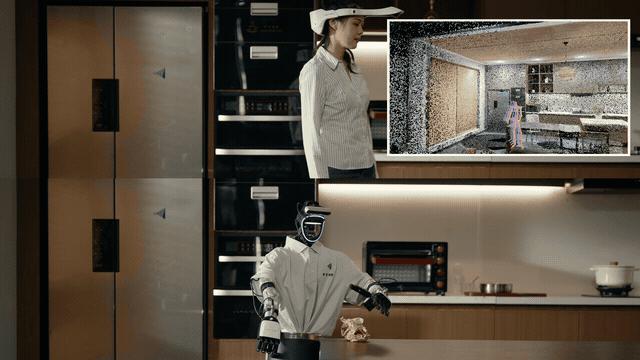
Full-body panoramic human data collection and full-body skill learning (Source / Enterprise)
The operation of the engine requires continuous data supply as a prerequisite. Delta Intelligence has self-developed a full-body panoramic data collection device, which adopts a pure vision collection architecture that can synchronously capture the motion trajectories of human skeleton joints in all dimensions of hands, feet, waist, and shoulders, and reconstruct the global 3D scene incrementally and in real time based on the first-person view video stream.
Among them, a single collection can output two types of core training materials: one is the complete human full-body skeleton data, which restores real interaction logics such as hand-foot coordination, center of gravity switching, and force-assisted manipulation; the second is high-precision 3D scene data, which records physical environmental parameters such as obstacles, steps, and operation countertops.
In terms of collection path design, Delta Intelligence has planned a layered scheme for different development stages, including teleoperation collection mounted on the robot body, and UMI and Ego-centric motion capture modes that do not require a physical robot. Body-free collection is more efficient and has lower hardware costs, making it suitable for large-scale accumulation of general full-body interaction samples; teleoperation collection is used for physical robot fine-tuning and accuracy alignment in the later stage. The combined use of the two modes achieves a better balance between data scale, collection cost, and physical robot adaptation accuracy.
"Most data collection solutions on the market can only capture partial motions such as hand movements. Models trained based on these solutions cannot fully understand the interaction between humans and the environment, nor can they master complex tasks that rely on full-body coordination, such as climbing ladders and pushing heavy doors." According to MA Xiaojian, Founder and CEO of Delta Intelligence, the learning logic of humanoid robots should be aligned with that of humans. It is necessary to fully collect the interaction behaviors between the whole body and the environment to build a world model without cognitive deviation.
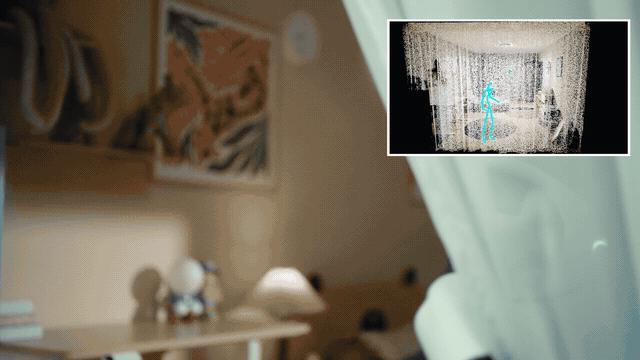
Full-body panoramic data visualization (Source / Enterprise)
Accurately understanding the 3D space is only the foundation of the perception layer. Whether a robot can convert high-level task intentions into precise limb movements at the millisecond level is another core threshold for real-world operations. A high-degree-of-freedom humanoid platform has dozens of linked joints, and a single high-level instruction cannot directly drive full-body balance, force exertion, and displacement. The underlying control link is extremely complex.
A common practice in the past was to directly send the instructions output by the planning model to the underlying controller. This method is feasible for low-degree-of-freedom robotic arms, but for high-degree-of-freedom humanoid robots, the missing full-body coordination adjustment module in the middle will directly lead to motion stuttering, out-of-control force exertion, and even imbalance and falls.
To solve this discontinuity problem, Delta Intelligence has built a three-layer native collaborative architecture of "Brain + Cerebellum + Force-Position Hybrid". The three-layer model has a clear division of labor and operates in a closed-loop linkage. The Brain module, equipped with a self-developed 3D world engine, is responsible for environmental perception, long-sequence task planning, and high-level interaction intention output; the Cerebellum is a neural network trained based on massive simulation reinforcement learning, which receives sparse high-level instructions from the Brain and converts them into fine control signals for dozens to hundreds of hertz of full-body motors, dynamically adjusts the center of gravity in real time, coordinates the exertion of limbs, solves the balance control problem of high-degree-of-freedom platforms, and finally outputs compliant control through the force-position hybrid layer.
The differentiated value of this Brain-Cerebellum layered architecture will be fully released on high-degree-of-freedom devices such as full-size humanoid robots and five-fingered dexterous hands. The Cerebellum continues to iterate based on full-body panoramic interaction data, and can adaptively adapt to various complex full-body tasks.
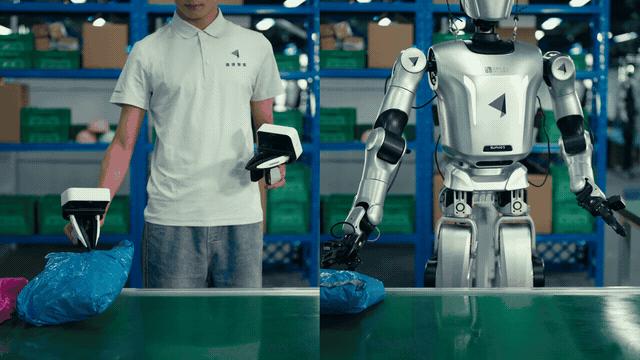
Full-body collection and humanoid robot operations in logistics scenarios (Source / Enterprise)
MA Xiaojian judges that with the acceleration of the industrialization of embodied intelligence, in-depth collaboration between algorithm model enterprises and hardware OEMs will become the mainstream development model. Relying on a complete underlying technical system, the Delta Intelligence team has established long-term cooperation with leading humanoid robot manufacturers such as Agibot, UBtech, Unitree, and XYZ Robotics, and has achieved rapid model migration across different hardware platforms through a standardized platform adaptation process. As a foundation model provider in the humanoid robot ecosystem, the company is committed to providing deployable and scalable full-body intelligent bases for various platforms, becoming a key link connecting hardware platforms and upper-layer applications.
The following is an excerpt from 36Kr's interview with MA Xiaojian, Founder and CEO of Delta Intelligence (edited slightly):
36Kr: Based on the native Brain-Cerebellum architecture, what is the ratio strategy between real data and simulation data? What considerations are behind it?
MA Xiaojian: First of all, about the concept of "ratio" itself, we do not allocate data to the Brain and the Cerebellum from a unified data pool. Instead, we have two completely independent training systems serving different optimization goals. The root cause is that the tasks undertaken by the Brain and the Cerebellum are completely different in nature, and the corresponding physical interaction laws are also different.
The Brain is responsible for global environmental understanding, long-sequence task planning, and full-body manipulation decision-making, and we do not rely on simulation data. The fundamental reason is that the simulation system has insufficient contact modeling capabilities. In real operations such as industrial inspection, material handling, and ladder climbing, humanoid robots will simultaneously generate multi-point composite contacts such as hand gripping, foot load-bearing, and torso force exertion, while it is difficult for the simulator to accurately reproduce complex interactions such as flexible deformation, sliding friction, and multi-contact force.
If the Brain learns task strategies based on distorted simulation signals, it will only learn the operation logic of the simulation world, which is prone to failure when deployed on physical robots. Therefore, Delta's Brain training must rely on native physical robot interaction data.

Long-sequence full-body collaborative task operations in household scenarios (Source / Enterprise)
The Cerebellum is responsible for underlying full-body coordination and dynamic balance control, and the situation is completely opposite: we take the simulation environment as the core training carrier. Balance control is essentially an optimization problem from continuous states to actions, the key of which lies in the accuracy of the gravity model and joint dynamics, and the physics engine has already done a very good job in these two aspects. The Cerebellum conducts massive trial and error through reinforcement learning in the simulator, and only uses a small amount of physical robot motion capture data for calibration and fine-tuning in the final stage.
In short, the Brain needs to learn complex interactive manipulation, which has extremely high requirements for real contact physics, so it can only take physical robot data as the core; the Cerebellum needs to learn dynamic balance, which can iterate by relying on physical rules, and simulation can provide unlimited trial and error samples at low cost. The data links and training goals of the two are naturally separated, and there is no unified ratio standard.
36Kr: The hardware parameters, joint constraints, and dynamic characteristics of various bipedal humanoid platforms vary greatly. How can Delta Intelligence's general-purpose humanoid foundation model achieve rapid cross-platform adaptation?
MA Xiaojian: For humanoid platforms from different manufacturers, we have precipitated a standardized adaptation process, which is divided into four links: full-body motion capture data collection, cross-platform motion retargeting, Cerebellum simulation reinforcement learning, and Brain rapid fine-tuning. Each link has a considerable degree of technical barriers, which is also our continuous accumulation in 3D vision and humanoid full-body coordination for many years.
Taking the retargeting link as an example, the human body has dozens of degrees of freedom, while the degrees of freedom, dimensions, joint limits, and center of gravity distribution of different platforms are different. The hardware differences naturally increase the difficulty of motion mapping.
Delta Intelligence's retargeting algorithm solves this problem based on multi-constraint optimization. On the one hand, all joint motion values must strictly fall within the platform's limit range to avoid collisions and stuttering; on the other hand, the core force exertion logic of the original motion must be fully preserved. For full-body coordinated motions such as door opening with force and ladder climbing, the trajectory of the center of gravity and the hand trajectory cannot deviate, otherwise the robot cannot replicate the human way of exerting force.
After the retargeting is completed, the Brain and the Cerebellum advance separately. The Cerebellum is responsible for full-body balance and limb coordination, and conducts reinforcement learning in the simulation environment without occupying physical robot resources, resulting in high iteration efficiency. The most difficult and uncertain sim2real link benefits from our years of experience accumulation and close collaboration with leading OEMs, enabling faster migration. The Brain is responsible for scene understanding and task decision-making. Relying on the general cognitive capabilities already possessed by our pre-trained base model, it only needs a small amount of physical robot data for fine-tuning when facing a new platform, so as to match the hardware characteristics and quickly implement various household and industrial scenario tasks.
After the whole process, we do not need to re-collect large-scale data and re-train the entire system every time we switch to a different platform, which greatly reduces the adaptation cycle and hardware loss costs.