The strongest provincial capital is making new strides. Guangzhou's GDP exceeded 1.6 trillion yuan in the first half of the year: What is underpinning the 5.8% growth rate?
Thriving commercial hub for a millennium" and "reinvigorating the city's vibrant street life" — these phrases were frequently highlighted at the press conference on Guangzhou's economic performance for the first half of 2026, held on July 24.
Reporters from Time Weekly learned on-site that according to the unified accounting results for Guangdong Province's gross domestic product, the city's GDP reached 1.6045 trillion yuan in the first half of this year, representing a 5.8% year-on-year increase at constant prices. The value added of the primary industry hit 10.8 billion yuan, up 3.2%; the secondary industry contributed 380 billion yuan, growing by 5.6%; and the tertiary industry generated 1.2137 trillion yuan, a 5.9% increase year on year.
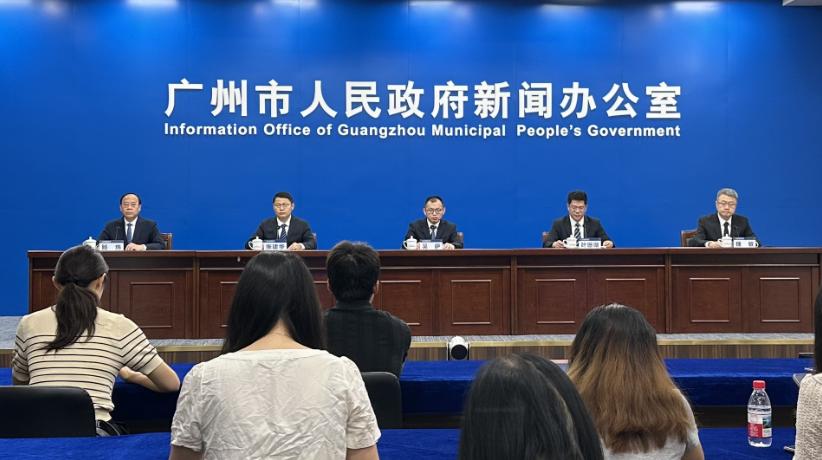
The press conference venue (Photo by Li Guang, Time Weekly)
What does a 5.8% GDP growth rate signify?
This marks the highest half-year growth rate for Guangzhou's economy since 2022, 2 percentage points higher than the same period last year, and exceeds the national and provincial averages. Guangzhou, alongside Shenzhen, ranks first in GDP growth among China's four tier-1 cities (Beijing, Shanghai, Guangzhou, Shenzhen) in the first half of the year.
Synergistic Growth of Old and New Economic Drivers
What is underpinning this 5.8% GDP growth?
Wu Sa, Director of the Guangzhou Municipal Development and Reform Commission, stated that industries form the backbone of the economy. This year, Guangzhou has advanced coordinated development of manufacturing and the service sector, as well as integrated growth of the producer services and advanced manufacturing, enabling the old and new growth drivers to work in tandem and stabilize the economic fundamentals supported by traditional industrial pillars.
In terms of industrial production, the value added of Guangzhou's industries above designated size rose by 6.6% year on year in the first half. Traditional industrial sectors delivered steady performance, with the automotive manufacturing, electronic product manufacturing, and petrochemical manufacturing sectors recording growth rates of 9.1%, 11.2%, and 5.2% respectively.
Meanwhile, emerging industrial tracks have also accelerated their expansion.
In the first half of this year, Guangzhou's new energy vehicle output increased by 53.2%, the value added of integrated circuit manufacturing rose by 73.9%, and the value added of the pharmaceutical manufacturing sector grew by 6.4%; the output of service robots and industrial robots increased by 13.5% and 9.4% respectively. The energy storage industry saw accelerated development, with the output of solar (photovoltaic) batteries surging by 130.1%. A total of 94 artificial intelligence large models have obtained filing from the Cyberspace Administration of China, ranking third in the country.
Strong industrial momentum translates to solid investment confidence. In the first half of the year, 851 key municipal projects completed a total investment of 235.4 billion yuan, exceeding the scheduled progress by 11.9 percentage points, driving the city's total investment to rise by 6.1% year on year, outpacing the national and provincial averages.
On the other hand, the investment structure has been continuously optimized.
In the first half of the year, Guangzhou's industrial investment exceeded 100 billion yuan for the first time, ranking first in total volume across Guangdong Province, accounting for 21.5% of total investment — a 0.7 percentage point increase compared to the end of last year. Investment in high-tech manufacturing grew by 29.5%, making up 9.1% of total investment, up 2.4 percentage points from the end of last year.
"Overall, Guangzhou's economy in the first half of the year has maintained a steady and improving momentum, laying a solid foundation for the start of the 15th Five-Year Plan period," Wu Sa noted.
In the modern service sector, Guangzhou has also demonstrated strong growth. The operating revenue of profitable service industries increased by 16.3% in the first half, with the leasing and business service sector's revenue rising by 24.1%; the internet and software information service sector's revenue grew by 12.4%; and the science and technology service sector's revenue increased by 12.7%.
At the same time, coordinated development of domestic and foreign trade has further enhanced the time-honored business brand of Guangzhou, the millennium-old commercial hub.
In terms of domestic demand, the total retail sales of consumer goods in Guangzhou registered a 2.9% year-on-year growth in the first half, outperforming the national and provincial growth rates. Online retail sales of physical goods above the designated size increased by 7.8%, and online catering revenue rose by 22.2%. By category, green, smart, and fashion-related consumer goods saw rapid growth, with retail sales of new energy vehicles, communication equipment, and cosmetics increasing by 29.2%, 8.1%, and 10.6% respectively.
In terms of foreign trade, the total import and export volume of Guangzhou increased by 5.5% year on year in the first half. Exports of the three new major high-value products — automobiles, ships, and integrated circuits — grew by 73.6%, 66%, and 241.7% respectively, while exports to African and Latin American markets rose by 32.1% and 15.7% respectively.
Notably, Guangzhou recorded a total passenger traffic volume of 187 million person-times in the first half, up 7.6% year on year. The passenger throughput of Baiyun International Airport reached 43.33 million person-times, representing an 8.2% increase. The Guangzhou Municipal Development and Reform Commission confirmed that Baiyun International Airport now ranks first nationwide in passenger throughput.
Sustained Momentum for the Second Half of the Year
For investments to translate into sound industrial development, a high-quality business environment is the core prerequisite. This means Guangzhou must continuously improve its supporting services.
Since the beginning of this year, Guangzhou has rolled out 30 measures to optimize the business environment across six key areas including government services and factor guarantee, and intensified efforts in industrial chain-based investment promotion, scenario-based investment attraction, and strategic planning-driven investment outreach. A large number of enterprises have voted with their feet, and landmark major projects such as STI Semiconductor, SKP at Racecourse, and AstraZeneca have been successfully introduced.
To further deepen the industry-focused business environment reform, Guangzhou has set the goal of "solving one problem, optimizing one set of mechanisms, and benefiting a cluster of enterprises", and launched 250 typical service initiatives including "Durian Fresh Express", "Smart Facial Recognition System", and "Beauty Industry Globalization Fast Track". The city has continued to advance the "Visit 10,000 Enterprises to Solve Problems" campaign to further stimulate market vitality.
These efforts have yielded tangible outcomes. In the first half of the year, the number of enterprises categorized under the "Four Major Statistical Standards" in Guangzhou exceeded 50,000, industrial electricity consumption grew by 7.9%, and industrial technological transformation investment increased by 17.8%, indicating active production operations across enterprises.
When asked about how Guangzhou's economy will maintain its growth momentum in the second half of the year, Wu Sa pointed out that efforts will be focused on three key directions.
The first priority is to ensure projects "kick off quickly" to generate new investment gains as soon as possible. The city will strengthen guarantees for key factors including administrative approval and land supply, ensure all projects scheduled to start in the third quarter break ground on time, and push new projects planned for the fourth quarter to start ahead of schedule. This will help achieve a total annual investment of 380.2 billion yuan for the 851 key municipal construction projects.
In terms of funding, the city will fully implement relevant policies to ensure approved funds deliver tangible results quickly. It will accelerate the utilization of policy-based funds that have been approved in the second half of the year, ensuring funds already in place are promptly allocated to targeted projects. Guangzhou will also continue to secure investment under the central government budget, apply for additional special-purpose bond quotas for local governments, and actively submit applications for new policy-based financial instruments to leverage the multiplier effect and further stimulate private investment vitality.
In addition, the city will ensure robust project reserve planning to support new development with high-quality upcoming projects.
In the second half of the year, Guangzhou will focus on strengthening project reserves across the "six networks" — water conservancy network, new-type power grid, computing power network, next-generation communication network, urban underground pipeline network, and logistics network — as well as five key areas including comprehensive three-dimensional transportation facilities, low-altitude economy infrastructure, "AI +" public infrastructure, education and healthcare public service facilities, and consumer infrastructure. The city will carry out city-wide, full-participation investment promotion campaigns throughout the year to sustain strong investment momentum.
This article is sourced from the WeChat Official Account "Time Weekly" (ID: timeweekly), author: Li Guang, editor: Liang Li, and published with authorization from 36Kr.