Tesla restructures its balance sheet
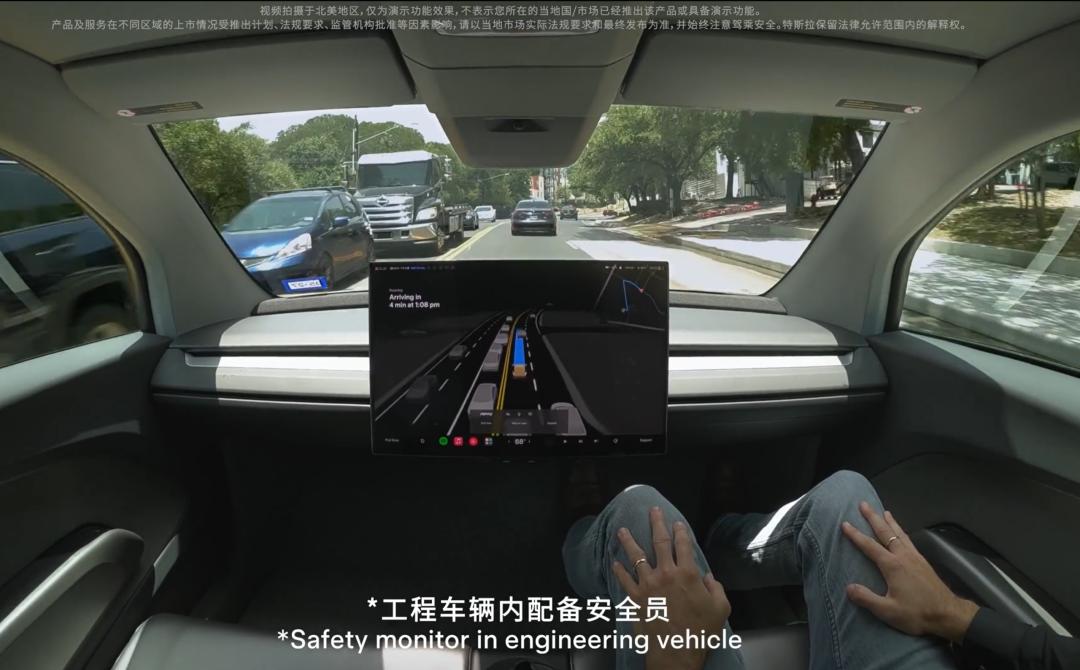
Early morning in Austin, a silver-gray Cybercab glides through the streets along the Colorado River. Its body lines are sleek, with no rearview mirrors, no steering wheel, and the space above the driver's seat replaced by a single panoramic glass panel.
Sunlight streams through the glass into the empty cabin, falling on two rows of seats facing each other. No human hands rest on any controls. The vehicle quietly turns, decelerates, waits for the red light to turn green, and then continues moving forward.
This marks the first day Tesla opened its fully safety-driver-free Robotaxi service to the public — a day promised for a decade and delayed countless times, finally arriving.
On the same day, Wall Street.
Numbers on trading screens flash at a dizzying pace. The Dow fell 0.97%, the S&P 500 dropped 1.21%, and the Nasdaq slid 2.15%. The tech sector was bloodied: Amazon fell over 4%, Meta dropped more than 3%, while Microsoft, NVIDIA, and Apple all declined over 1%. Google fell over 7% in after-hours trading.
The worst hit was Tesla, plummeting 14.52% in a single day, wiping out $214.5 billion in market capitalization — more than the sum of Tesla's net profits over the past eight quarters combined.
Tesla's Q2 2026 earnings report showed an operating profit of $398 million, a year-over-year plunge of 57%; operating margin slid to 1.4% from 4.1% a year earlier; free cash flow hit -$1.09 billion, turning negative for the first time in over two years.
Source: Tesla
The futuristic car on Austin's streets and the reality-reflecting numbers on the New York Stock Exchange screens read like parallel narratives in two separate worlds. Wall Street expected a story of profit recovery, but Tesla delivered a report showing accelerating cash burn.
For the past decade, the market has been accustomed to pre-paying for Elon Musk's promises. This was true during the Model 3 production hell, when the Shanghai Gigafactory broke ground, and after every FSD delay.
The market believes this man can turn the impossible into reality, willing to put money on the table before returns materialize. This almost religious level of trust has created a unique financial phenomenon: the "Musk Premium".
This premium contract has lasted ten years, never once called for early redemption. But the July 22, 2026 earnings report has made some investors hesitate.
Not because they no longer believe in Musk, but because cash on the balance sheet is shrinking, profits are thinning, cash burn is accelerating, and returns from new businesses still need time to validate.
For the past decade, Tesla has been priced based on expectations; over the next ten years, it may need to gradually shift toward pricing based on assets and cash flow.
The cost of this transition is being delivered to investors' mailboxes one by one, in the form of multi-billion-dollar quarterly capital expenditures, narrowing margins, and single-day market cap swings exceeding $200 billion.
The recipients are hesitating whether to keep signing for the deliveries.
I. The "Musk Premium" Begins to Shrink
To understand this drop, one must first grasp Tesla's previous valuation logic.
Toyota sells over 11 million vehicles a year, with profits several times that of Tesla, yet its market capitalization is far lower. This seemingly mismatched pricing is based on a long-accepted market logic: Tesla's core value lies not in selling cars, but in high-margin software revenue from FSD, potential economies of scale from the Robotaxi platform, and the mid-to-long-term market opportunities that Optimus may open up.
This is a narrative framework centered on software and services. Within this framework, cars are seen as carriers, while the real products are autonomous driving software, mobility services, and future robotics solutions.
Tesla does not need to continuously expand its product line or update platform architectures like traditional automakers. Instead, it can gradually monetize software and services as its vehicle fleet grows.
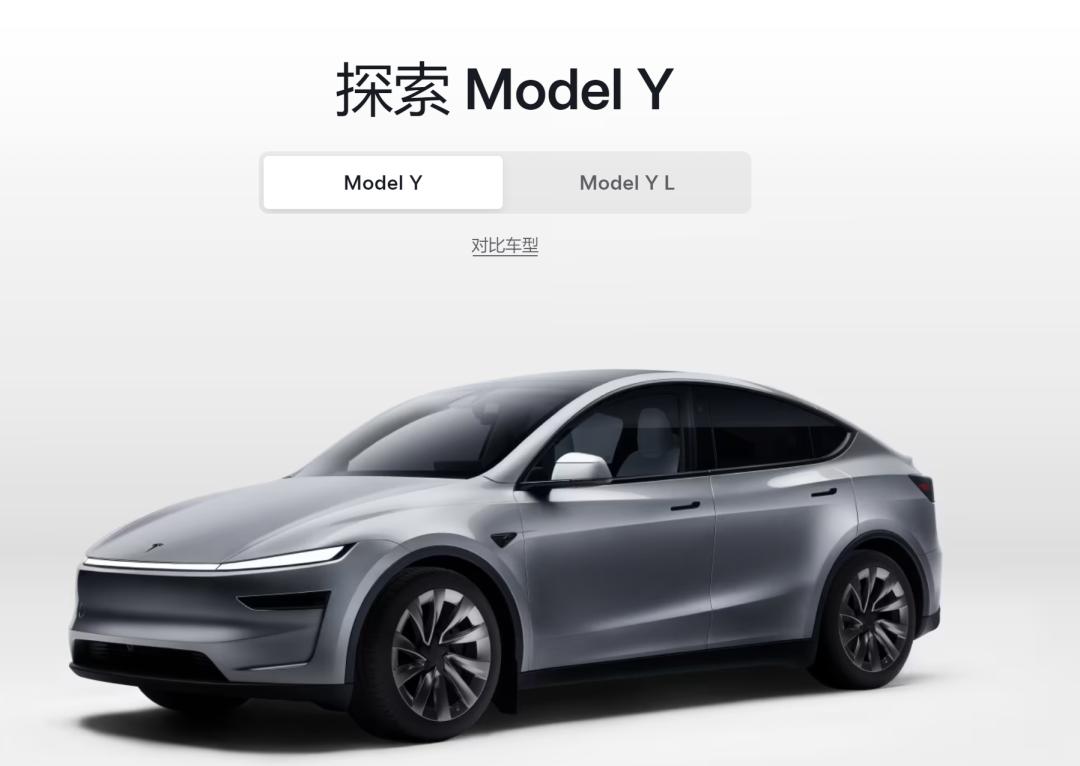
This narrative has gained consistent market recognition over the past decade. Whenever the automotive business faces pressure, Musk's new updates on AI and automation often re-solidify market confidence. The market is willing to believe — after all, this man did push Model 3 into mass production, did build a factory in Shanghai in just one year, and did make Model Y one of the best-selling vehicles in the world.
Source: Tesla
But maintaining trust requires continuous validation. This quarter, several key metrics have triggered the market's re-examination.
The first metric is automotive gross margin.
In Q2, excluding regulatory credits, automotive gross margin stood at 16.3%, down about 3 percentage points from Q1. Per-vehicle revenue dropped from $45,300 to $42,700.
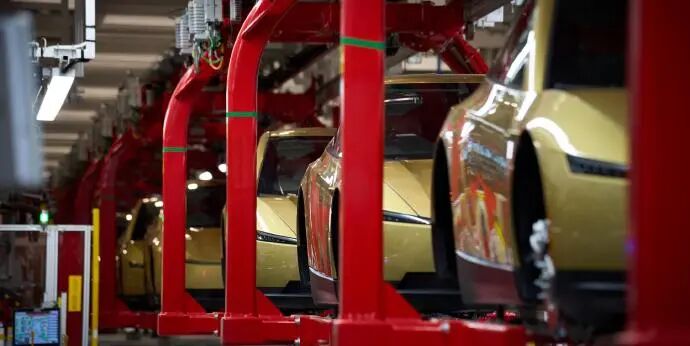
Model 3 and Model Y accounted for over 97% of deliveries. The Model S and Model X production lines have been retrofitted, and the space at the Fremont Factory previously used for flagship models is now being fitted with Optimus production equipment.
This is not a cyclical trough, but a structural setup. Regulatory credit revenue fell from $439 million to $146 million, shrinking nearly 70%, as adjustments to federal emissions penalty rules mean traditional automakers no longer need to buy credits to meet compliance requirements. This once-high-margin revenue stream that generated almost no physical costs is irreversibly declining.
At the same time, Tesla's competitive landscape is changing.
Six years ago, when the Model 3 and Model Y launched, there were few competing pure electric vehicles in their price range. Today, BYD's pure electric sales have surpassed Tesla's. NIO, Li Auto, and Xpeng have built product matrices in the mid-to-high-end market. Xiaomi has entered the space, and European traditional automakers, though at varying stages of electrification transformation, are no longer bystanders in their home markets.
Competition in every segment Tesla operates in is intensifying. Price adjustments are more defensive moves to cope with competitive pressure, rather than proactive pricing strategies.
The second metric is the growth rate of capital expenditures.
Q2 capital expenditures hit $5.79 billion, up 142% year-over-year; full-year guidance exceeds $25 billion, nearly triple the 2025 figure. R&D expenses reached $2.371 billion, up 49% year-over-year; operating expenses were $4.353 billion, up 47% year-over-year.
Operating cash flow was $4.697 billion, but with capital expenditures at $5.789 billion, free cash flow turned negative at -$1.09 billion. Tesla's CFO stated on the earnings call that free cash flow is expected to remain negative until 2029.
This means Tesla not only needs to reinvest all its operating income, but also draw down its existing cash reserves.
Source: Tesla
The third metric is revenue contribution from new businesses.
Paid FSD users reached 1.48 million, up 56% year-over-year. Roughly estimating at a $99 monthly subscription, annualized revenue is around $1.76 billion — while Tesla's Q2 R&D expenses alone were $2.371 billion. Software revenue is growing, but it does not yet cover R&D investment at this stage.
Robotaxi has expanded to 7 cities, with 380,000 miles driven without safety drivers. But public information shows around 20 actual driverless vehicles operating in Austin. The Cybercab has entered production, and Musk has stated that early production ramp-up will be relatively slow.
The Optimus production line, originally scheduled for July, has been delayed to the end of the year. The first batch of products will be used for internal training and not for external sale.
The shared feature of these three businesses is: clear direction, continuous progress, but still some distance away from generating scalable revenue.
The market's 14.56% price adjustment in response to these three simultaneous dimensions, and the $214.5 billion market cap swing, reflects the market reassessing the reasonable range of the "Musk Premium".
II. The Physical World Has Its Own Rhythm
Musk has a characteristic: he tends to set extremely tight timelines, using them to drive the pace of his teams and supply chains.
In 2017, he announced the Cybertruck would enter mass production in two years, but actual deliveries began at the end of 2023. In 2019, he predicted Robotaxi would hit the roads in 2020, but it is still in the expansion phase today. At the 2022 AI Day, when unveiling the Optimus prototype, he mentioned imminent mass production, but the third-generation product's production line is still under construction. In January 2026, he said the Optimus production line would launch in July, but during the Q2 earnings call, he adjusted the timeline to the end of the year.
Every delay has specific reasons: supply chains are not ready, designs need further optimization, safety validation must be fully completed. But when delays become a persistent pattern, the problem may lie not just in execution, but in whether the timeline itself has fully accounted for the objective constraints of manufacturing.
In the software industry, a feature can be decided on Monday, launched on Friday, and iterated the following week based on feedback. Bugs can be fixed, models can be updated, and users have relatively high tolerance for delays.
In manufacturing, the construction cycle for a production line is usually measured in years. Modifying a mold takes weeks, building a supply chain takes years, and getting a component from prototype to high yield requires repeated debugging.
Musk is clearly aware of this. During the Q2 earnings call, he said Optimus is "the hardest manufacturing ramp in Tesla's history", with a typical S-shaped capacity curve, but "the initial phase will be quite gradual and last for a long time".
This tone differs from his usual optimistic style. Manufacturing has its own physical constraints: production lines need time to debug, supply chains need time to mature, and yield rates need time to improve — none of these constraints change just because the timeline is aggressive.
The key point is that when these delays happen in 2026 — a period where cash flow has already turned negative, profit margins are narrowing, and market patience is being tested — the cost of waiting is far higher than it was a decade ago.
The Nasdaq index has fallen about 5% from its June peak. The market is discounting long-term expectations, and Tesla happens to be one of the companies whose valuation relies most heavily on forward-looking expectations.
III. Tesla's Supply Chain Paradox
Tesla has a deeper structural contradiction that is not directly reflected in financial statements, but runs through every product launch, every production line construction, and every procurement contract.
During the Q2 earnings call, Musk said Tesla is undergoing "the fastest industrial scale expansion in the United States since World War II". The Fremont factory's Model S/X lines are being converted to Optimus production, the Texas Gigafactory is building a second robot production line, and Tesla's Austin semiconductor wafer fab has placed equipment orders.
This is a narrative about improving local manufacturing capabilities, but a significant portion of the supply chain that supports this narrative is located in China.
Among Optimus's core component suppliers, many are Chinese companies.
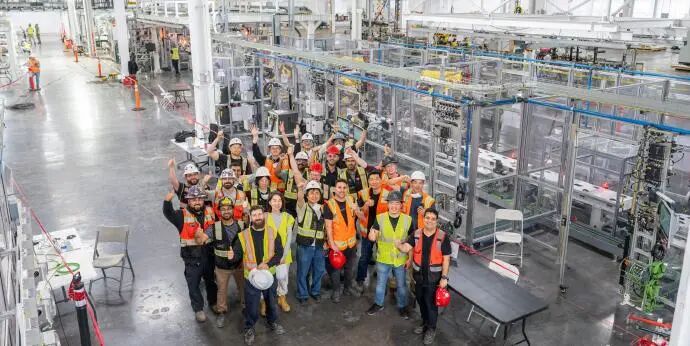
Zhejiang Xinjian Transmission is building a factory with an annual output of 1 million sets of robot ball screws, with a total investment of 2.8 billion yuan. Existing Tesla electric vehicle suppliers such as SANHUA, TUOPU Group, and Xusheng Group have extended their businesses into the robotics sector. One supplier stated that 70% of their factory's capacity is dedicated to Optimus-related products.
Source: Tesla
Tesla has over 400 tier-1 suppliers in China, more than 60 of which have been integrated into its global supply chain system. This creates a notable dynamic: the more factories Tesla builds in the US, the more it relies on China's supply chain to keep those factories running.
The new production lines in Fremont are being built at an accelerated pace, but a significant portion of their components need to be supplied from the western Pacific. The Texas computing center relies on chips, and some key materials for chip manufacturing equipment have only a few global sources — including Chinese suppliers.
A major shift in the supply chain landscape, whether driven by political factors or other reasons, could directly impact Tesla's production rhythm. Reports in recent years have stated that Tesla has been discussing supply chain diversification plans with its suppliers.
But achieving large-scale supply chain relocation would mean higher costs, slower delivery timelines, and a fairly long period of instability.
If this is a tug-of-war, Tesla is standing in the middle of the rope. On one side are the political narrative and localization requirements of "Made in USA", and on the other side are the cost advantages and production flexibility of China's supply chain. Tesla wants both.
But tug-of-war usually ends with the rope breaking, not both sides moving toward the middle. The physical world does not allow "having it both ways", and Tesla needs to find a sustainable balance between the narrative of American manufacturing and the reality of China's supply chain.
IV. Conclusion
Back to that steering-wheel-free Cybercab on Austin's streets. It's a visually striking scene, symbolizing that a certain vision of the future is becoming reality.
But if you take this car apart, trace the origin of every component and the construction cycle of every production line, you will see a more complex story: there are delays, compromises, rising costs, and supply chain games.
Tesla is trying to use the same set of resources to push forward layouts in five areas simultaneously: automotive manufacturing, autonomous mobility, humanoid robots, AI computing power, and energy storage — each of which requires continuous capital and engineering investment.
For a considerable period ahead, Tesla's balance sheet will continue to face pressure.
Most of the cash generated by the automotive business will be reinvested in new businesses. And the scalable revenue from new businesses — whether FSD subscriptions, Robotaxi operations, or Optimus sales — will take time to validate.
This article is from the WeChat official account "IntelliMachina Island", written by Zeng Yi, and published with authorization from 36Kr.