The latest ranking of the AI track has been released: four education products have entered the global Top 100 in terms of growth.
The latest global ranking of AI product traffic growth rates has been released, with four education products making the list.
Recently, EqualOcean Intelligence released the June 2026 global AI Web Products (monthly visits over 100,000) traffic growth ranking, sorted by the month-on-month change in monthly visits. Looking at the overall list, the faster-growing products are mainly concentrated in the fields of agents, visual generation, emotional companionship, and personal services, with overseas products accounting for a large proportion.
Four education products in total from the education sector, namely Hallo, UMU, Alice, and Bites, have entered the ranking. Among them, the four products are ranked from 91st to 98th, with a combined monthly visit volume of about 840,000, and their month-on-month growth rates are all in the 24%–26% range. In addition, in the concurrent global AI Web product monthly visit ranking, the education product Quizlet ranked 20th with about 49.67 million monthly visits. In terms of product types, they include not only language learning, exam preparation, and AI learning tools for individual users, but also training platforms for enterprise clients, representing the main application forms of current global AI education products.

Data source: EqualOcean Intelligence
Statistical scope: Global AI Web products with monthly visits exceeding 100,000;
Ranking criteria: Month-on-month change in monthly visits;
Statistical period: June 2026
01
Hallo:
From a Language Learning App to an AI Language Assessment Platform
In this ranking, Hallo is ranked 91st, with about 220,000 monthly visits in June 2026, a month-on-month increase of 25.48%, making it the fastest-growing product among the four education products.
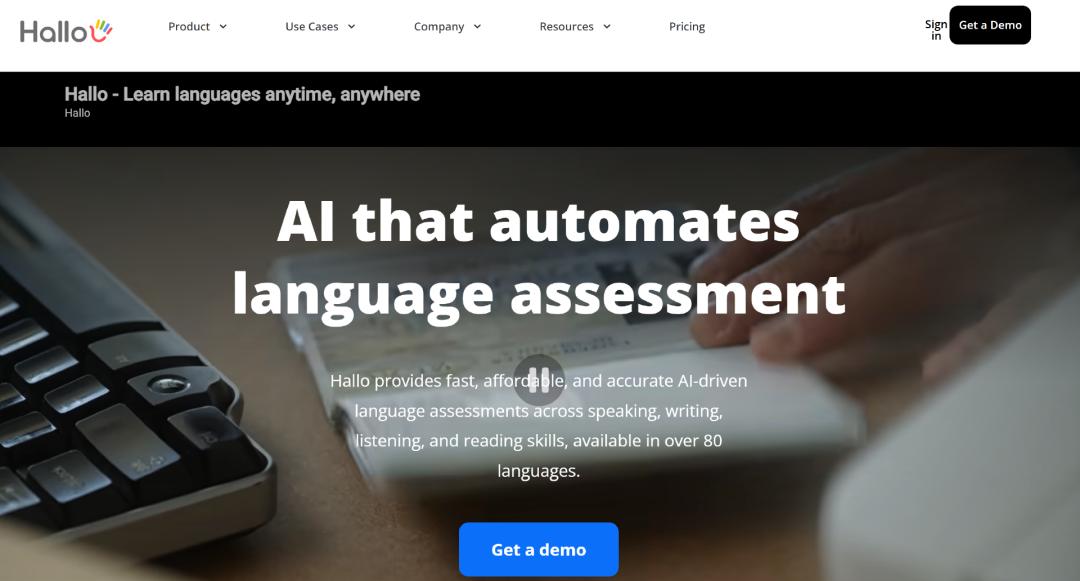
Founded in 2017 and headquartered in Utah, USA, Hallo was launched by Korean-American entrepreneur Joon Beh. Joon Beh once lived in Korea for a long time. After moving to the United States, he found that although he had mastered English grammar and vocabulary, he struggled to have real conversations with native speakers. It was this experience that made him realize the biggest barrier to language learning is not knowledge itself, but the lack of opportunities to practice speaking.
Inspired by Uber's instant matching model, Joon Beh wanted to create a "Uber for language learning". In 2019, Hallo was officially launched. Similar to hailing a ride, users can quickly match with online native teachers for one-on-one or group speaking practice, without waiting for fixed scheduled courses. In February 2023, Hallo launched a Spanish version and continuously expanded its supported languages to multiple other languages.
However, according to the latest official website, Hallo's business focus has shifted. Compared to personal language learning courses, the homepage of the website more prominently highlights its AI language assessment services for enterprises, recruitment platforms, schools, and training institutions. These services cover four core competencies: speaking, writing, reading, and listening, and can be applied to scenarios such as recruitment screening, employee training, language class placement, and global talent management.
Currently, Hallo supports more than 80 languages, covers over 160 countries, and completes more than 7 million language assessments each year. Assessment results can be generated in as fast as 10 minutes. The company states that the overall assessment cost is about 5% of that of traditional language assessments. In terms of business model, the company mainly adopts a B2B pay-per-use pricing model, offering different service tiers based on the customer's monthly assessment volume. Meanwhile, the personal-facing language learning App remains operational, forming two product lines: personal learning and enterprise assessment.
From connecting learners with native teachers to extending AI capabilities to enterprise language assessment, Hallo's development path reflects that the company's business boundaries are continuously expanding.
02
UMU:
Turning Enterprise Training into a Global Business
Among the four education products on this list, UMU is the only one originating from China, and the only product whose core business is enterprise training.
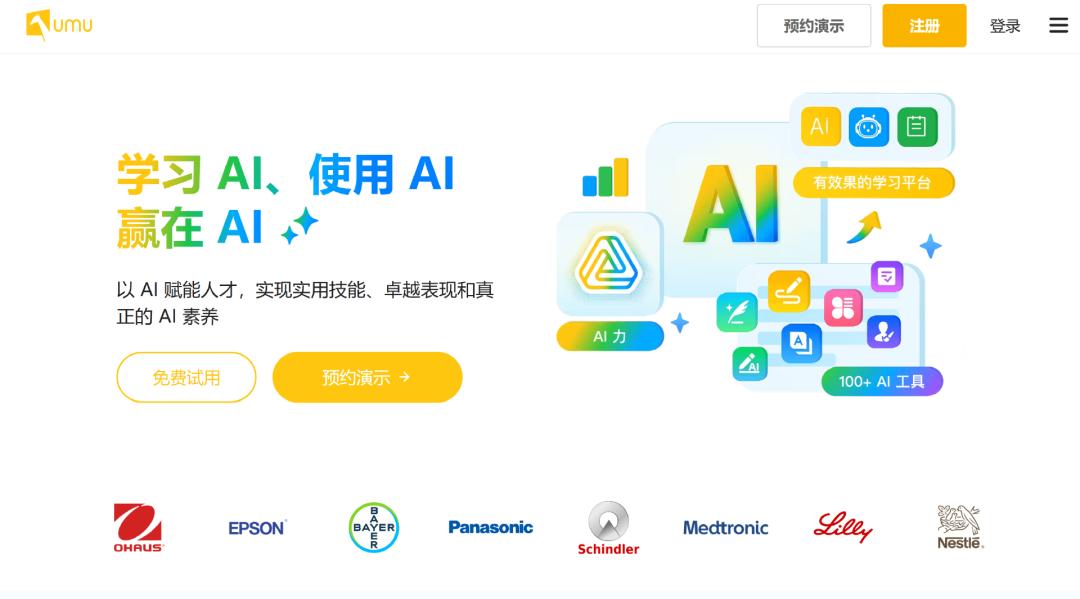
UMU was launched by Beijing UMU Technology. Founded in 2014 and officially established as a brand in 2015, the company's founder is Dongshuo Li. Unlike AI learning products that primarily serve student groups, UMU has targeted the corporate learning market since its inception, providing digital learning solutions for scenarios such as employee training, sales skill enhancement, manager development, and new employee onboarding.
When the product was released in 2015, UMU simultaneously entered the markets of China, the United States, and Japan. In recent years, the company has continuously advanced its global layout, and its customers now cover more than 200 countries and regions, with over 70 million users.
With the development of generative AI, UMU has continuously integrated AI capabilities into enterprise training processes over the past two years. Currently, the platform has launched products such as AI Practice & Feedback, Roleplay Chatbot, and ManaDojo, which can provide real-time feedback on employees' video presentations, sales role-plays, and management communications, and simulate different business scenarios for targeted training.
In terms of financing, UMU completed three consecutive rounds of financing in 2021: in March, it secured 120 million yuan in Series C financing led by Tencent and followed by GL Ventures; in May, it completed a 100-million-yuan-level Series C2 round with investors including 5Y Capital; in November, it raised hundreds of millions of yuan in Series C3 financing led by China Renaissance New Economy Fund, with participation from 5Y Capital. Since then, the company has continued to iterate its products around AI capabilities and overseas markets.
In terms of business model, UMU adopts an enterprise-facing SaaS subscription model, mainly charging annual service fees based on the number of enterprise accounts, which are purchased by enterprises and used by their employees. Compared to other student-focused AI learning products on the list, UMU applies AI capabilities more to corporate talent development, making it the education product with the highest visit volume and most distinct globalization features on this ranking.
03
Alice:
An AI Platform Focused on Exam Preparation Learning
In this ranking, Alice is ranked 96th, with about 120,000 monthly visits in June 2026, a month-on-month increase of 24.84%. Although it has the lowest visit volume among the four education products, it is also the youngest company among the four in terms of establishment time.
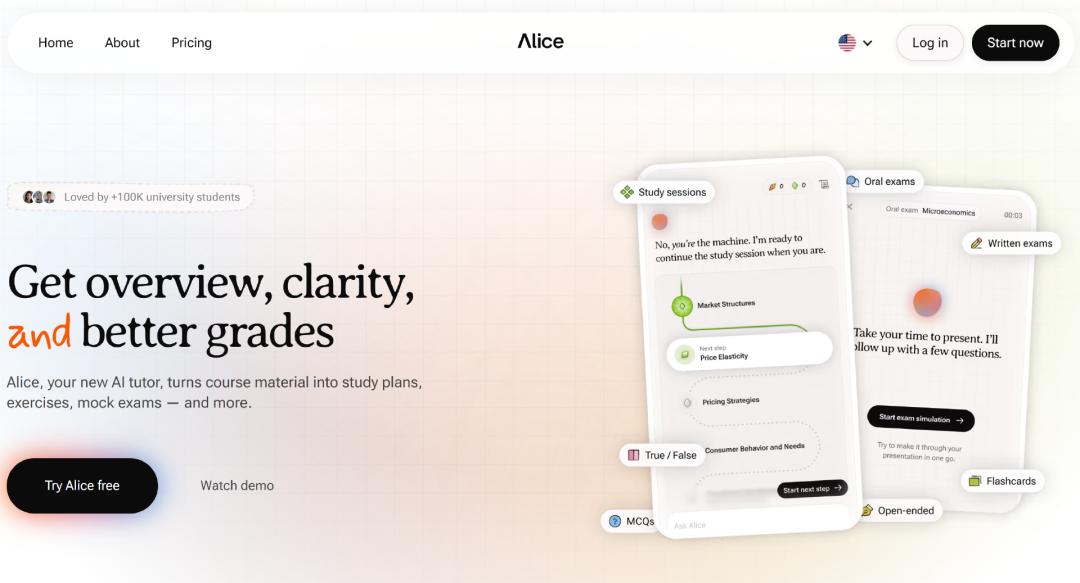
Alice is an edtech company headquartered in Copenhagen, Denmark, founded in 2024 by Kim Rants and Patrick Gadd. Shortly after its establishment, the company joined the Y Combinator W25 accelerator program. In May 2025, Alice completed a $4.8 million financing round led by Cherry Ventures, with participation from Y Combinator, PSV Tech, and other institutions. As of 2026, the company's official website disclosed that its total accumulated financing has exceeded $6 million.
Different from general-purpose AI assistants, Alice builds its products primarily around course learning and exam preparation. After students upload course materials such as textbooks, lecture notes, and class notes, the AI can automatically generate study plans, course summaries, practice exercises, flashcards, mock exams, and mind maps, and provide personalized learning suggestions based on their learning progress. The official website states that the product integrates the capabilities of large models such as ChatGPT, Gemini, and Claude, and has been optimized for education scenarios.
In November 2025, Alice launched the Alice 2.0 version, which redesigned the product interface, integrated functions such as course management, note organization, practice tests, and AI Q&A into a complete learning workflow, and announced further expansion into markets including Sweden, Germany, Norway, and the United States. Entering 2026, the company also released iPhone and iPad applications to further optimize the mobile learning experience.
Up to now, Alice mainly serves university and high school students, while gradually expanding to cover more education stages. Data from the official website shows that as of 2025, more than 100,000 students have used the platform, and its business covers 10 countries and regions. In terms of business model, Alice adopts a "freemium + subscription" model: free users can access core features, while Pro members are provided with services such as unlimited file uploads, AI Q&A, and custom study plans. At the same time, the company is also exploring institutional partnerships with universities and secondary schools.
04
Bites:
An AI Learning Tool Evolved from an Online Course Platform
In this ranking, Bites is ranked 98th, with about 140,000 monthly visits in June 2026, a month-on-month increase of 24.64%. Unlike the other three products on the list, Bites is not an independent edtech company, but an AI learning product launched by Saudi edtech company Shaguf.
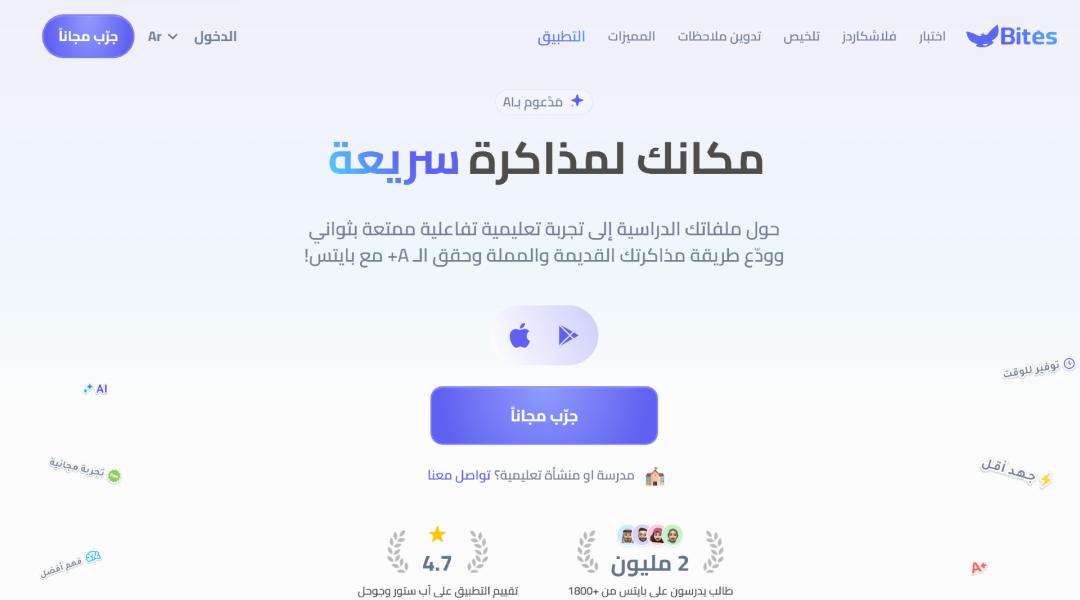
Founded in 2021 and headquartered in Riyadh, Saudi Arabia, Shaguf was launched by Ahmed Alrashed. The company initially built an online learning platform connecting teachers and students, providing teachers with tools such as pre-recorded courses, digital notes, online tests, and question banks, covering multiple learning scenarios including high school, university, proficiency exams, and vocational training. In November 2022, Shaguf completed a 1.5 million Saudi riyal (about $400,000) Pre-Seed round of financing, with funds mainly used for product R&D, onboarding more teachers, and expanding learning content.
Based on its existing education platform, Shaguf later launched the AI learning product Bites. The product is built around students' existing textbooks, lecture notes, and course documents. After users upload learning materials such as PDFs and courseware, the system can automatically generate course summaries, practice exercises, flashcards, knowledge point explanations, and study plans, and help students understand concepts, answer questions, and organize learning content through the AI learning partner "Beto". Meanwhile, Bites also supports iPad handwritten note-taking, file annotation, and AI content organization to further improve the learning experience.
Up to now, Bites' official website discloses that the product has more than 2 million users, covering over 150 countries and regions and more than 1,800 universities, with a combined rating of about 4.7 stars on Apple App Store and Google Play. Currently, Bites has become the core AI learning tool in Shaguf's product system, driving the company to further expand from an online course platform to AI learning services.
As the only education product from the Middle East on this list, although Bites ranks relatively low, it also reflects that Middle Eastern edtech enterprises are continuously expanding into the global market with the help of AI learning tools.
Looking at the development paths of the listed education products, AI education products are forming a common feature: they take mature education scenarios as the entry point, rather than simply overlaying AI capabilities. Niche demands such as language assessment, enterprise training, exam preparation, and knowledge organization are becoming more realistic entry points for AI to enter the education market.
This article is from the WeChat public account "Duojing" (ID: DJEDUINNO), author: Siluo, published with authorization from 36Kr.