Financial developers going global should stop blindly building "comprehensive platforms". The rankings of finance category on the US App Store have verified that vertical segmented scenarios hold huge incremental potential.
According to data monitored by Qimai Data, at 11:00 on July 21, 2026, the top 3 apps on the U.S. iPhone Finance Free Chart are Kalshi, PayPal, and Capital One; meanwhile, the top 3 on the Finance Top Grossing Chart are MileIQ, Rocket Money, and TradingView.
The reference value of this ranking data does not lie in the single-day ranking of a single product, but in clearly distinguishing two completely different growth paths for financial and finance Apps: The free chart is easier to quickly acquire downloads through low-threshold access, hot topics, and highly immediate entry points; the top grossing chart favors products that can continuously deliver practical value to users.
For iOS developers, when expanding financial products overseas, they should not only focus on the short-term ranking improvement effect, but also verify two core questions: What does your product rely on to attract users to download, and what does it rely on to achieve long-term paid conversion?
Almost no overlapping products at the top of the Finance Free Chart and Top Grossing Chart
According to data monitored by Qimai Data, at 11:00 on July 21, 2026, in the Top 10 of the U.S. iPhone Finance Free Chart, sports event prediction platform Kalshi ranks 1st, online payment platform PayPal ranks 2nd, and financial asset management App Capital One ranks 3rd; banking, wallet and payment products such as Polymarket, Cash App, Venmo, and Chase follow closely behind. The sports event prediction platform Kalshi also ranks 9th on the U.S. iPhone Overall Free Chart, and takes 1st place on the Finance Free Chart.
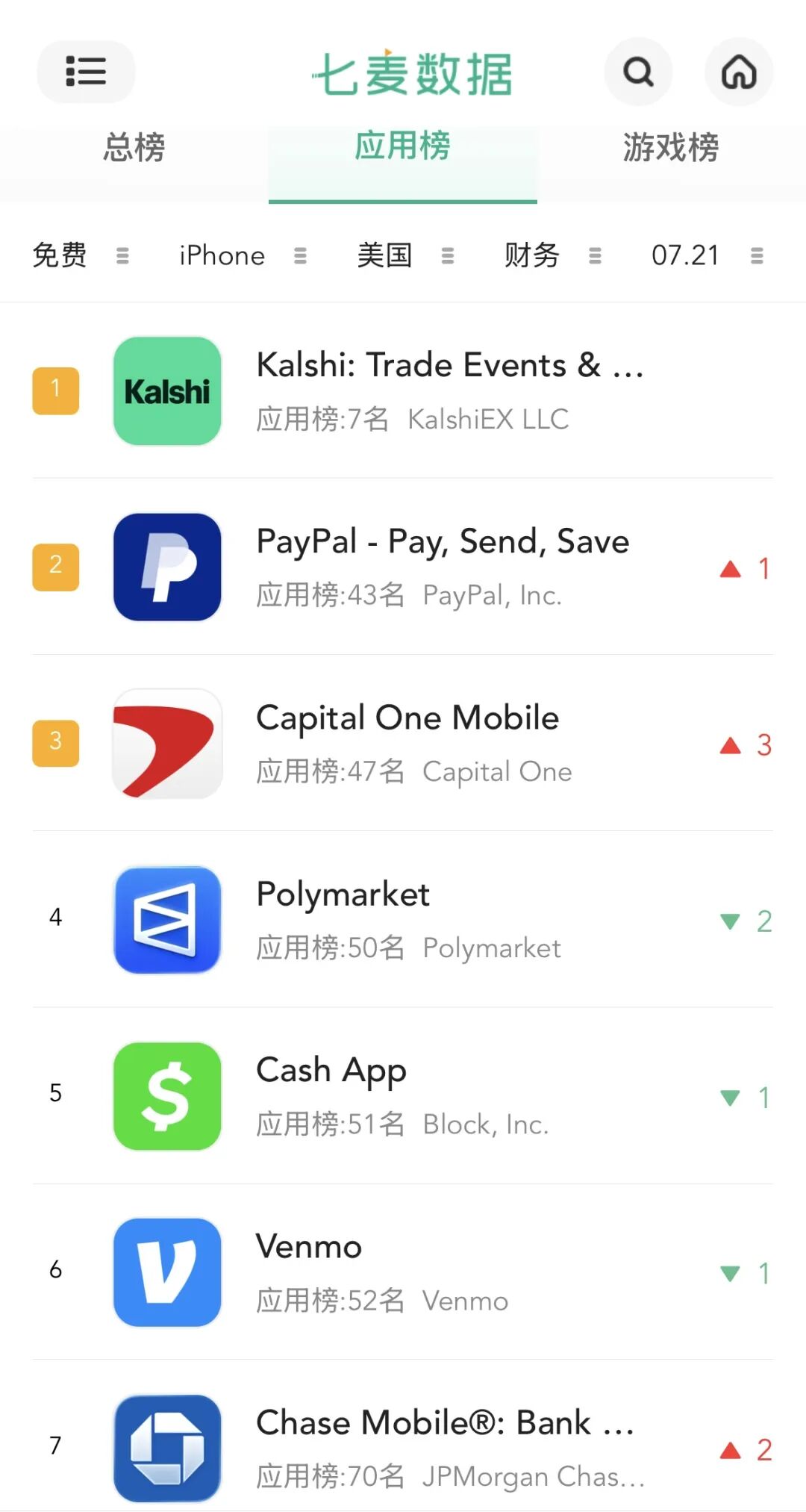
U.S. iPhone Finance Free Chart rankings at 11:00 on July 21
At the same time, the App Store Finance Top Grossing Chart presents a completely different landscape: MileIQ, Rocket Money, TradingView, Copilot, Monarch, and YNAB occupy the top six positions, corresponding to high-frequency tool scenarios such as expense tracking and reimbursement, bill and budget management, market trend analysis, and personal financial management. These products do not all have the same high topicality as the top products on the free chart, but they occupy the core positions on the financial top grossing chart.
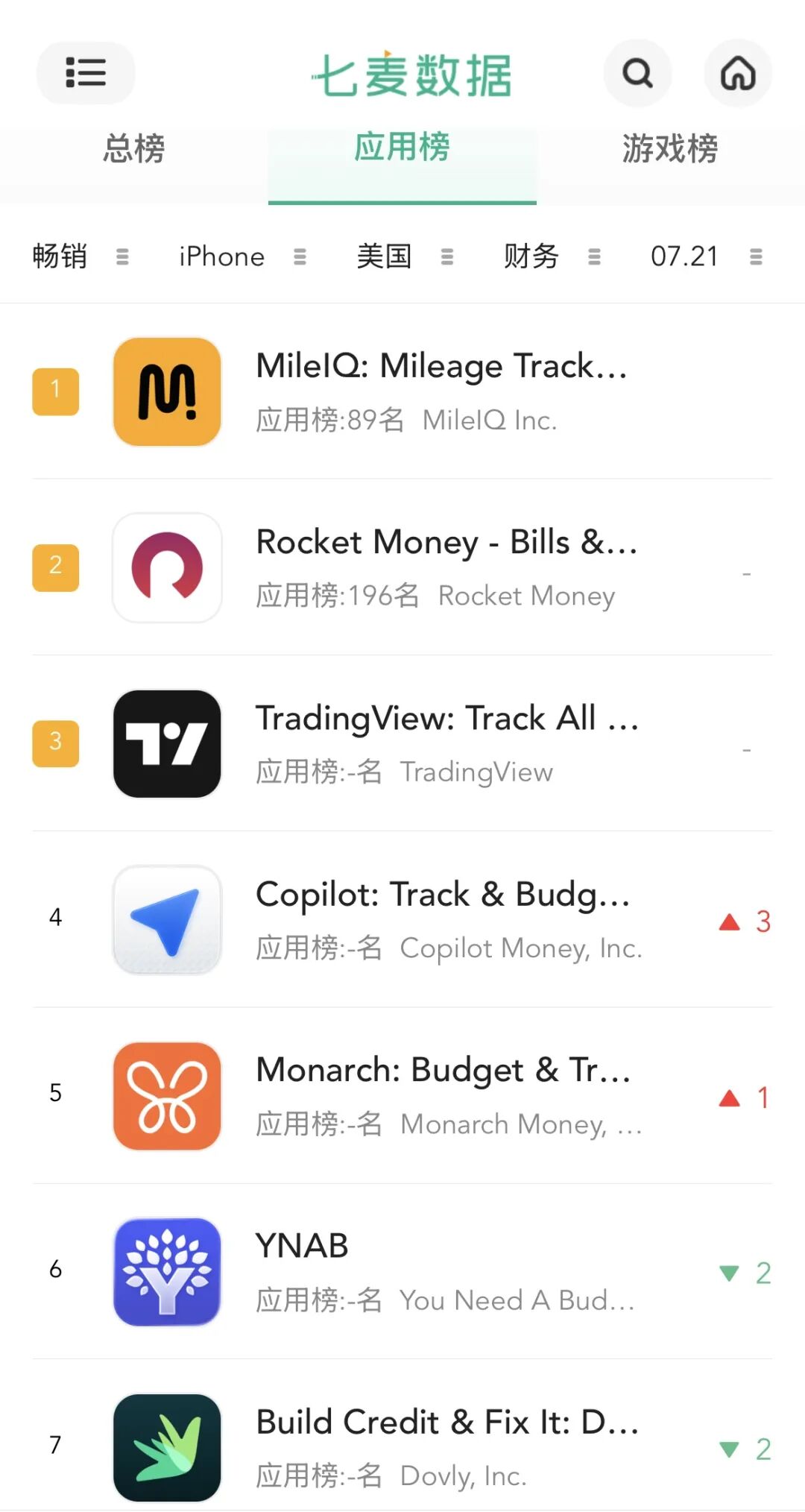
U.S. iPhone Finance Top Grossing Chart rankings at 11:00 on July 21
The free traffic entry points for U.S. financial Apps mainly attract users' attention through hot events, basic payment scenarios, etc.; the paid conversion entry points tend to target products with continuous usage value such as utility tools and investment decision assistance tools.
Hot topics can drive download volume, while high-frequency usage scenarios are better at attracting users to pay
The growth of financial Apps is often misinterpreted as "as long as there is a strong hot topic, it can drive product commercialization". But the current App Store ranking reminds us: Hot topics can bring download volume, but paid conversions usually come from high-frequency scenarios that users need to use repeatedly.
Event prediction, cash rewards, payment wallets, etc., are naturally more suitable for low-cost user acquisition. The product pages of these products need to clearly explain the reasons why users should download immediately, the registration process should be short, and the platform's registration security and trust guarantees should be clearly demonstrated.
However, for products such as expense tracking & reimbursement, budget management, and market trend analysis, the commercialization difficulties are concentrated at the user retention level: whether users actively open the app every week, whether they are willing to submit sensitive personal financial data, whether they can intuitively feel the product value during the trial period, and whether the differences before and after subscribing are sufficiently clear, all directly affect the payment conversion rate.
For overseas growth teams, this means that the free chart and the top grossing chart follow two independent strategies that cannot be mixed. To impact the free chart, you can build custom product pages around hot events, seasons, tax periods, billing cycles, consumption hotspots, etc., and use Apple Ads and short-term hot creatives to quickly harvest exposure; but to improve subscription paid conversion, you need to focus on product page optimization, App analytics, paid guidance copy, trial period design, user retention paths, etc., and cannot simply pursue installation volume.
Conclusion
What is most noteworthy on the current U.S. App Store Finance Chart is not the ranking of a single product, but the stratification that is emerging among financial and finance Apps: One type of product focuses on seizing distribution traffic through immediate hot demands, while the other type stably occupies paid positions by relying on users' high-frequency usage needs.
Looking at the U.S. App Store Finance Chart, the ranking changes in the past seven days, and the current overall structure of the top grossing chart, it is not difficult to see that financial overseas teams need to break down two key issues: First, what are users willing to download your product for the first time for, and second, what are users willing to pay for in the long term. Only solving the customer acquisition problem will easily result in one-time traffic; only focusing on tool functions may face the dilemma of insufficient exposure in the app store, which is especially true for financial and finance products.
For product leaders, there is no need to blindly build an all-powerful "financial super App". Focusing on a single high-frequency financial scenario makes it easier to create differentiation: expense tracking and reimbursement, budget management, investment analysis, household bookkeeping, tax filing, cross-border payments, etc. Each segmented scenario requires separate design for product page descriptions, compliance instructions, data authorization explanations, subscription value proof, etc.
If your financial App has just ushered in a wave of download peaks, the next thing you need to pay attention to is not "how high can the ranking go", but whether this current traffic entry point can precipitate into a long-term path where users actively open the app every week and are willing to continue paying in the next month?
*This article is from Nicole, and the copyright of the article belongs to the original author. The content is for communication and reference only, and does not constitute professional advice.
This article is from the WeChat Official Account"Qimai Research Institute", author: Nicole, published by 36Kr with authorization.