Forum Live | Exploring Quantum Inward and Reaching for Space Outward: A Dialogue at the Starting Point of the "New Computing Power Civilization"

Shanghai, July 18, 2026 — As the physical boundaries of computing power are increasingly approaching, where will human computing civilization head to? On the afternoon of July 18, as one of the flagship special forums of the 2026 World Artificial Intelligence Conference (WAIC), the "Future Computing · Future Computing Power" special forum was held in the Red Hall of the Shanghai World Expo Center. Led by the University of Science and Technology of China and the School of Computing of City University of Hong Kong, the forum was co-organized with Fudan University, Peng Cheng Laboratory, Shanghai Computing Power Network Association and other institutions. It gathered top scholars, academicians, entrepreneurs and investors from the United Nations, China, the United States, Europe and Japan, to carry out in-depth interdisciplinary, cross-regional and intergenerational dialogues focusing on "Reconstructing the Computing Power Paradigm in the Post-Moore Era".
The agenda spanning more than four hours was organized as a six-scene journey from "Where We Are" to "Where We Are Going" — covering coordinate positioning, bottleneck diagnosis, path outlook, industrial verification, to critical thinking and ecosystem launch. The forum kicked off with the release of the first satellite cluster of Shanghai's "StarPivot Initiative" space computing power constellation, and concluded with the release of three major achievements including the Quantum Intelligence Industry Alliance, marking that China has entered a critical stage of moving from laboratory research to industrialization on the three main lines of future computing power: quantum, space, and green.
I. Starting Point: Computing Power Has Reached the Critical Point of "Paradigm Shift"
The core judgment of the forum is a repeatedly reaffirmed consensus — When the growth of computing power hits physical boundaries, the answer lies not in "more", but in "different".
Alexander De Croo, Administrator of the United Nations Development Programme and former Prime Minister of Belgium, reminded in his opening speech that artificial intelligence appears to be digital in nature, but essentially relies on physical infrastructure of energy, water, materials and talent. Without reconstructing the underlying paradigm, the value of AI cannot be truly popularized across the globe. Chang Jin, President of the University of Science and Technology of China and Academician of the Chinese Academy of Sciences, took the "Dark Matter Satellite" as an example and pointed out that Moore's Law is approaching its limit, and energy, materials, heat dissipation, and water resources have become common global boundaries. "The physical limit of computing power cannot be addressed by extending the traditional track, but lies in entirely new directions such as quantum computing, space computing, and new physical principles."
In his opening speech, Wei Mingde, Chairman of the Council of City University of Hong Kong, Member of the National Committee of the Chinese People's Political Consultative Conference, and Member of the Legislative Council of Hong Kong, provided a clear historical coordinate for this judgment — "Advanced computing power and computing are becoming the infrastructure of this era, just like the power grid in the last century and the Internet in the last decade. It truly determines the upper limit of a society's productivity, and also determines how far a civilization can go." He also reminded all attendees that when the infrastructure undergoes transformation, universities, industries, governments, and capital all need to re-answer the roles they play in this civilization-building project.
In the first dialogue session, Gao Wen, Director of Peng Cheng Laboratory and Academician of the Chinese Academy of Engineering, and Guo Yike, Vice President of the Hong Kong University of Science and Technology and Academician of the Chinese Academy of Engineering, held a landmark public discussion on the "China Computing Power Network". As a first-prize achievement of this year's National Science and Technology Progress Award, the China Computing Power Network has for the first time truly engineered and implemented the 20-year-old vision of "grid computing" — "making computing power accessible to thousands of households like electricity", becoming a national-level computing power economic base covering training, inference, and industry applications.
Distinguished Bloomberg Professor at Johns Hopkins University and Academician of the U.S. National Academy of Sciences Professor Daniel Kammen, in his keynote speech titled "The Energy Bottleneck: The First Wall of Computing Power", pushed the issue to a more fundamental level — "The next wall no longer lies in the chips, but on the other side of the power grid scheduling table."
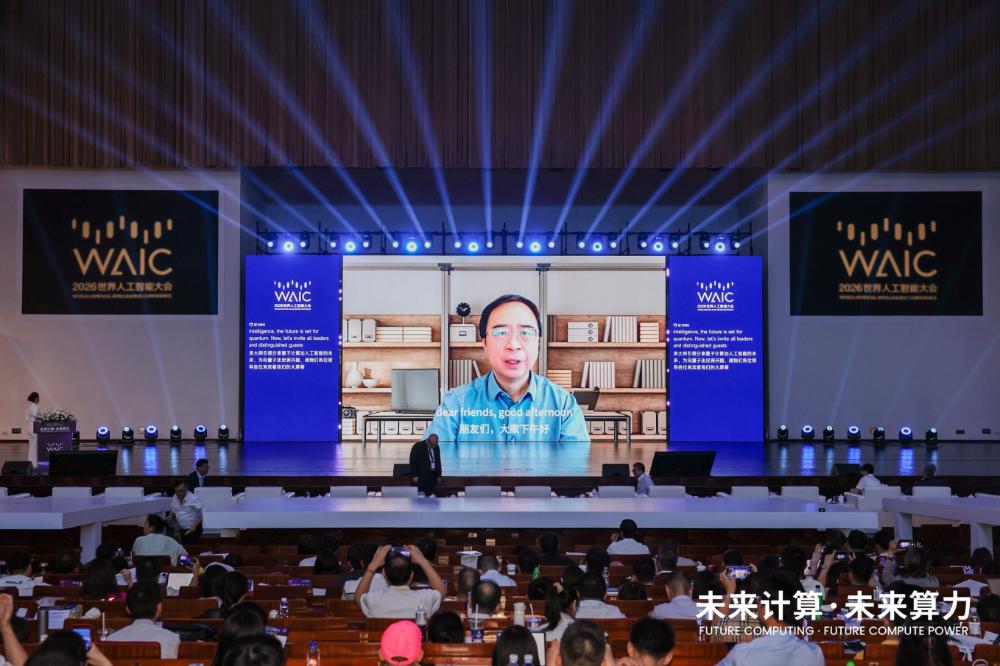
In the master-led session of the third act "Where We Are Going", Pan Jianwei, Academician of the Chinese Academy of Sciences and Executive Vice President of the University of Science and Technology of China, set the tone for the entire section via online video. Starting from the historical coordinate of the 100th anniversary of the birth of Schrödinger's equation this year, Academician Pan Jianwei pointed out that quantum mechanics has spawned many major technologies that have changed human life over the past century, and the vigorous development of emerging quantum information technologies today "may push human civilization to achieve another huge leap". He quoted Feynman's most famous maxim — "If we could pass only one sentence to the next generation, it would be: All things are made of atoms" — to illustrate the scientific origin of quantum computing: all matter is composed of atoms that follow the laws of quantum mechanics, and many-body systems cannot be effectively simulated by classical computers. Quantum computing originated precisely from Feynman's pioneering idea of "using controllable quantum bits to simulate complex quantum systems". Therefore, quantum computing can not only crack certain classical cryptographic systems, but also help humans deeply understand the natural world, promote leapfrog development in fields such as chemistry, materials science, and life sciences, and bring exciting breakthroughs in directions such as sustainable growth of computing power, privacy protection, public safety, and life health.
Academician Pan Jianwei also put forward three calm judgments that set the tone for the quantum narrative of the entire forum: First, although a series of milestone achievements in quantum computing superiority have been made, a general-purpose quantum computer that can quickly solve practical problems with specific value still requires long-term research and development efforts. Second, to achieve this goal, continuous financial investment from both the government and the private sector is essential. Meanwhile, "the academic community has the responsibility to guide the public to view the development of quantum computing rationally and guard against industry bubbles". Third, just like the development of quantum mechanics in the Heisenberg era a century ago, "extensive and active international cooperation and exchanges will surely enable quantum information technologies to benefit all mankind faster".
Shortly afterwards, at the roundtable hosted by Wang Jianping, Dean of the School of Computing of City University of Hong Kong, titled "Exploring the New Realm of Quantum Computing Power, Heading for the Future of Computing", Lu Chaoyang, Professor of the University of Science and Technology of China and core member of the Jiuzhang Quantum Computing Team, pointed out with the latest breakthrough of "Jiuzhang 4" that quantum computing is moving from "laboratory principle verification" to "surpassing classical performance on dedicated problems", marking that another main line of computing has been opened.
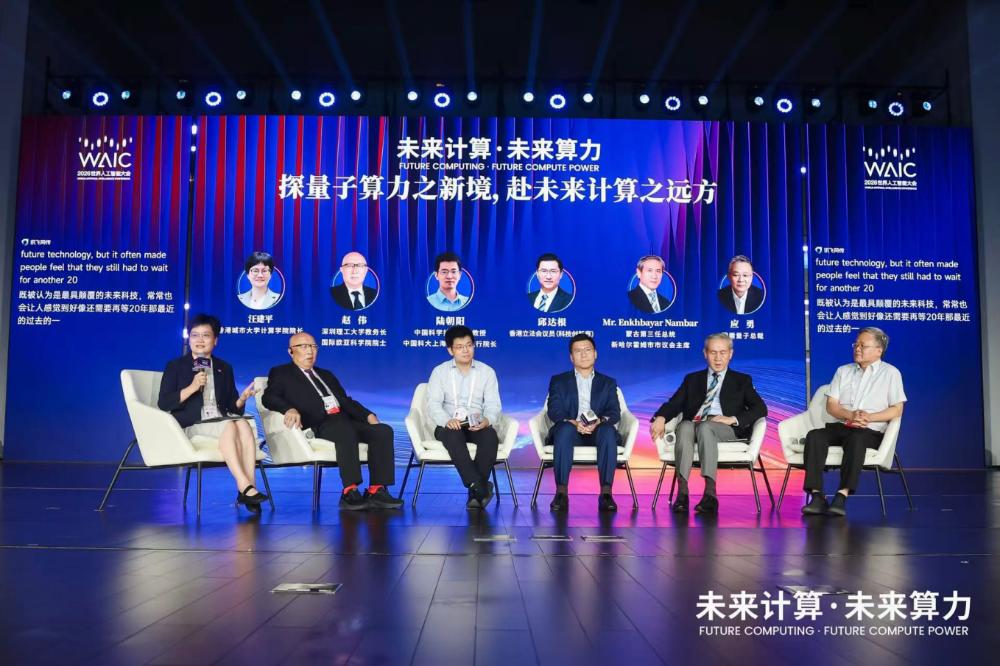
Standing at this coordinate, Lin Jing, academic planner of the forum and Professor of the School of Computing of City University of Hong Kong, pointed out in her opening hosting remarks: "This is not just six sessions, but also an exploration journey." Starting from this path, the forum gathered clear consensus at five levels for the country, education, industry, capital, and applications on how to launch the "new computing power civilization".
II. National Level: Plan Computing Power Holistically as a "New Generation Infrastructure"
If the infrastructure of the 20th century was the power grid, and the infrastructure of the early 21st century was the Internet, then the infrastructure of the next decade will inevitably be an intelligent computing network composed of classical computing power, quantum computing power, space computing power, and green energy.
The first core consensus reached by the forum is: Computing power must be holistically planned as a national-level infrastructure, so that it is "accessible to all and available on demand" just like the power grid.
Top-level planning in advance. The country should, as soon as possible under the 15th Five-Year Plan framework, incorporate new forms of computing power such as quantum computing power and space computing power into the unified layout of the national computing power network, avoiding only chasing progress on the single track of "classical GPU clusters". Shanghai's "StarPivot Initiative" with 1000 space-based computing power satellites, the eight major hubs of the China Computing Power Network, and the State Key Laboratory of Quantum Computing are essentially all components of the new generation infrastructure, which need to be coordinated and promoted on the same national blueprint.
Upgrading infrastructure thinking. The "cloud-native network" four-element model of the China Computing Power Network proposed by Academician Gao Wen — chips, power, communication, and storage — provides a new economic foundation for national computing power infrastructure. The key to computing power infrastructure is no longer "how many racks to build", but "whether it can be scheduled like a power grid, interconnected like a highway, and billed like water and electricity".
Space computing power projects such as "StarPivot" and "StarComputing" require national-level coordination on frequency orbits and standards. Lu Chuan, Chairman of Guoxing Aerospace, reminded at the forum that low-orbit frequency orbit resources are "first-come, first-served and non-renewable". Whoever takes the lead in layout will grasp the initiative of future computing power. This requires strategic guarantees from the national level in spectrum allocation, launch arrangements, and international coordination.
Computing-power and energy coordination and a green foundation. Professor Kammen repeatedly emphasized in his speech that before controllable nuclear fusion achieves breakthroughs, energy is the ceiling for AI. China has already explored a path of moving computing power to areas rich in green power through the "East Data, West Computing" initiative. The next step is to build "green power + energy storage + computing power" into a national standardized product, making green the brand of China's computing power going global.
III. Education and Academia: Plant the "Next Generation Paradigm" into the Soil 20 Years in Advance
The second core consensus of the forum comes from the dual reminders of President Chang Jin and Wei Mingde, Chairman of the Council of City University of Hong Kong — Without the decades-long persistence of universities, there would be no technological frontiers that we can discuss today. Professor Franco Nori, Chief Scientist of RIKEN (Japan) and Academician of the European Academy of Sciences, in his keynote speech titled "The Future of Quantum Computing", used a golden quote to provide an academic footnote to this judgment for the international community — "This is not a 100-meter dash, but a marathon, even a 100-kilometer ultra-marathon." He systematically reviewed the three "winters" that artificial intelligence has experienced since the 1950s, reminding all attendees that technology never develops in a straight line, and a generation of technologies that truly change civilization requires decades of stable investment and academic accumulation.
Moving disciplines forward. Twenty years ago, quantum information and green computing power were still niche disciplines; today they are at the center of the forum, thanks to "that group of young scholars who were willing to sit on the cold bench". The direction of computing civilization in the next 20 years also depends on the young people we start cultivating today. The education system should, as soon as possible, incorporate cutting-edge fields such as quantum science, computational physics, energy system modeling, and AI system architecture into undergraduate basic courses and interdisciplinary construction, instead of treating them as "specialized directions" only at the postgraduate level. Professor Nori particularly pointed out that there are currently four mainstream technical routes for quantum computing: superconducting, photonic, ion trap, and Rydberg atoms. "There is no conclusion yet on which one will win, and it is very likely that at least four platforms will need to coexist in the future" — which means that when cultivating cutting-edge talents, universities must maintain a disciplinary layout with multiple parallel paths, rather than betting on a single direction.
Interdisciplinary collaboration. Chairman Wei Mingde pointed out that "every practical problem in computing and computing power cannot be solved independently by any single discipline" — energy and space require the joint efforts of physics, chemistry, materials science, and policy research; quantum computing requires coordinated progress across theory, engineering, algorithms, and industry. Universities are one of the few places where different disciplines can engage in equal dialogues under the same roof, a value that no corporate laboratory or government agency can replace.
International interface. City University of Hong Kong has been rated as the most international university in the world for three consecutive years, with its average citation rate of academic papers ranking second globally. Chairman Wei Mingde emphasized that Hong Kong's unique value does not lie in how large-scale computing power it can develop on its own, but in its openness and inclusiveness — it can serve as an international interface for national-level hard technology projects, acting as a connection point for talents, capital, and academic cooperation. This judgment is highly consistent with Academician Pan Jianwei's emphasis (citing the Heisenberg era) that "extensive and active international cooperation and exchanges will surely enable quantum information technologies to benefit all mankind faster".
IV. Enterprise Level: Achieve the Utmost of "Pragmatism"
The third core consensus of the forum comes from the collective reflection of frontline enterprises in quantum, space, and AI infrastructure sectors — Beware of exaggeration and "digital performance", and take every step down to earth. This consensus received a direct response from the international academic community: Professor Franco Nori sharply asked in his speech — "If you delete all marketing videos, company press releases, and promotional materials, then ask a very simple question: What exactly has been sold today? What practical, useful, and profitable real-world problems have been solved today?" He frankly stated that quantum computing currently has exciting preliminary achievements, but "its scientific foundation is solid, technological progress is real, and its prospects are of great significance — yet valuations often depend on hype overcoming logical gravity". Such a gap is exactly the reality that all hard technology enterprises need to face.
In the critical thinking session of the fifth act, several academic and industry representatives with the same educational background (Xiong Hui, Associate Vice President of the Hong Kong University of Science and Technology (Guangzhou); Yao Xin, Vice President of Lingnan University; Wang Bingfeng, Co-Chairman of Digital China; Liang Jia'en, Co-Founder of iFlytek's CloudWalk) launched a sharp debate on the "token economy". Vice President Yao Xin's words hit the nail on the head: "The best intelligence is to use the least resources to accomplish the most things." Simply talking about the quantity and cost of tokens without addressing the task value completed per unit token is a form of technological self-indulgence disconnected from real productivity.
The action recommendations for enterprises are clear:
- Do not fabricate numbers for "storytelling". At the forum, many guests implicitly criticized unsubstantiated claims in the industry such as "a certain company's quantum-related business accounts for 40%". There are no shortcuts in the hard technology sector; every exaggerated percentage point will have to be paid back during the engineering phase. Zhu Xiaobo, Professor of the University of Science and Technology of China and Chief Designer of the "Zhaozhi" quantum computing prototype, stated bluntly in his speech : "Do not believe any hype about 'thousands or tens of thousands of qubits'. Without sufficient precision and reduced error rates, even the largest scale is meaningless. Excessive promotion will only bring devastating blows to the entire field." His metaphor that "the target to conquer is Mount Everest, and we are still conducting ground experiments" sets the most straightforward tone for the engineering posture of domestic quantum enterprises.
- Follow the path of "three red lines". Wang Kangman, Partner at 3C Capital,