"The Best Summer in Korea": 1.2 Million People Face Forced Liquidation, Suffering a Massive Loss of 940 Trillion Won

How long does it take to go from the "strongest bull market in history" to a total collapse?
The answer from the South Korean stock market is: less than a month.
At the start of 2026, the wealth-creation myth in South Korea's semiconductor industry spread rapidly across the entire internet.
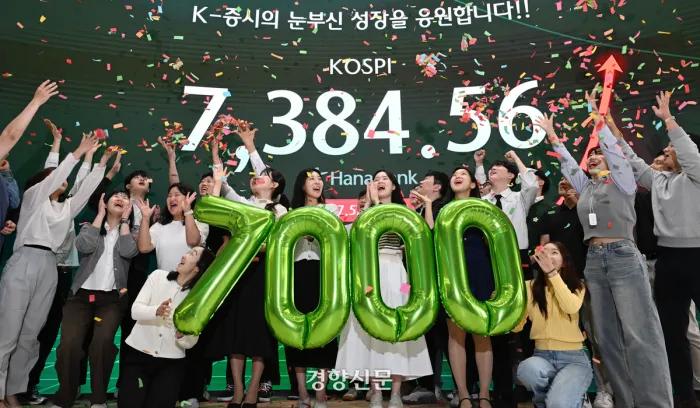
Semiconductor giant SK Hynix announced that it would issue year-end bonuses of over 136 million won to each employee, equivalent to 660,000 yuan.
According to performance forecasts, the average year-end bonus this year will amount to roughly 6.1 million yuan when converted.
Amid this sudden massive wealth, SK Hynix employees saw their social status skyrocket overnight, quickly surpassing doctors and lawyers to become highly sought-after partners in South Korea's dating market.
On South Korean secondhand trading platforms, some people even listed SK Hynix work uniforms on their homepages, with the product description containing only four words: "Dating Battle Outfit".

As Samsung Electronics and SK Hynix share prices surged continuously, more and more South Korean retail investors rushed into the stock market, heavily allocating their holdings to the two companies.
Some emptied all their savings, some borrowed money to trade stocks, and others, feeling the gains were not fast enough, directly used 2x leveraged ETFs.
After reaping this unexpected massive wealth, South Koreans rushed to buy luxury goods and luxury properties, driving up housing prices in the Gangnam district by 15%.
Some say that after South Koreans got rich overnight, no one took the bus anymore, and it was common to see elderly South Koreans who had made money in the stock market treating strangers to meals on the street.

Watched the grand edifice rise, then watched it crumble to the ground.
On June 22, the KOSPI hit an all-time closing high of 9114.55 points;
Then the market took a sharp downturn. In less than a month, the South Korean stock market triggered circuit breakers and temporary halts multiple times, with the index falling by roughly a quarter from its peak.
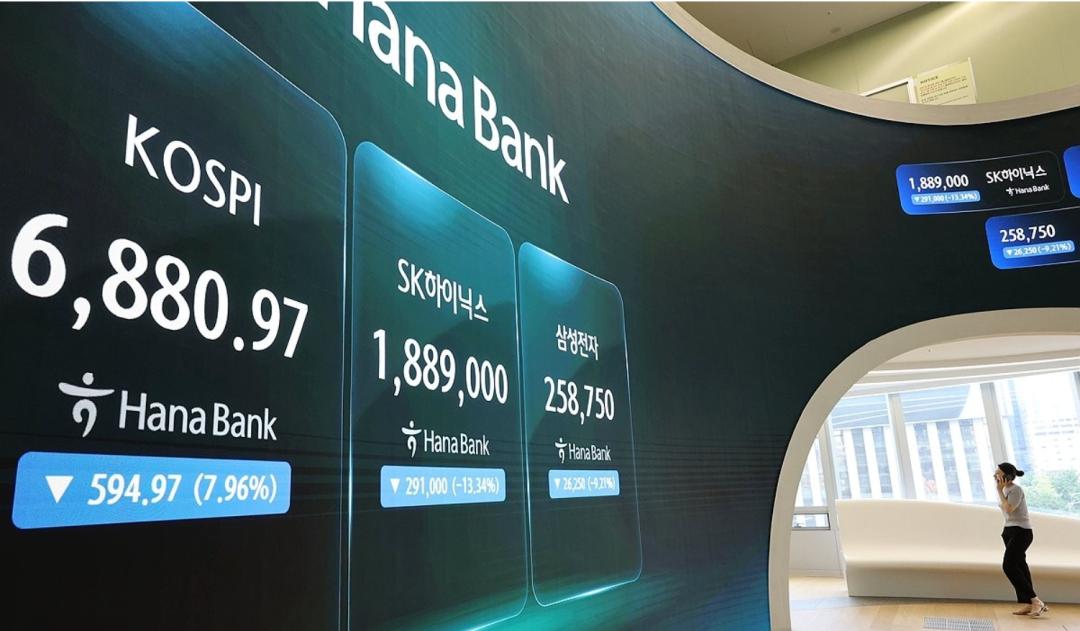
As of press time, the combined market value of the two giants SK Hynix and Samsung has shrunk by a total of 940 trillion won, equivalent to 4.3 trillion yuan.
South Koreans who frantically traded stocks with leverage fell from heaven to hell overnight.
According to Reuters, a 24-year-old South Korean college student borrowed money to invest. His initial principal of about 10 million won rose to 300 million won, then was almost completely wiped out in the crash.
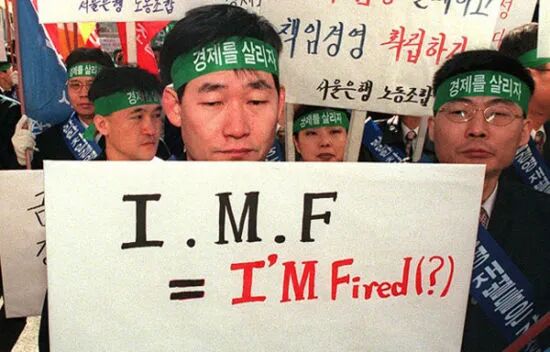
According to data from Goldman Sachs, as of July 13, more than 1.2 million leveraged margin accounts belonging to retail investors in the South Korean market have received margin call notices, and 360,000 accounts have been forcefully liquidated by brokerages.
According to statistics from South Korean media, over 60% of these liquidated investors are young people under 30. They saw their principal wiped out overnight, and even ended up owing money to securities firms.
South Koreans were left with no tears to cry, and some even ended up on the rooftop.

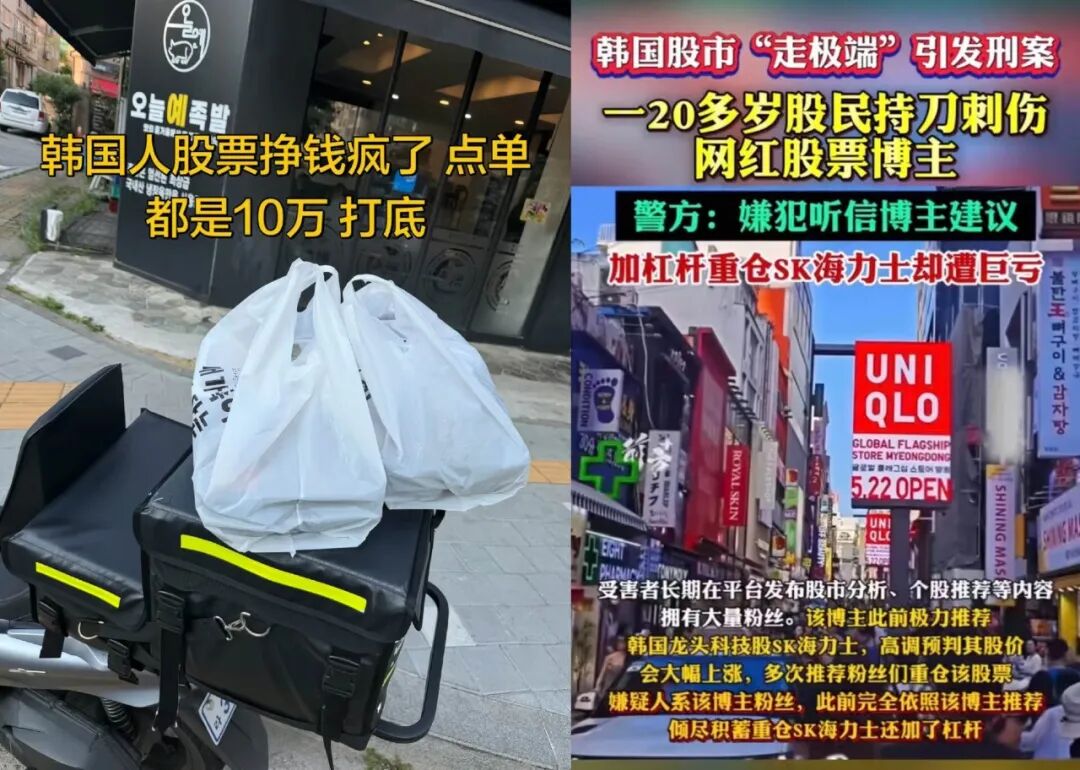
Even a popular stock influencer was stabbed by an investor, because the latter followed his advice to heavily invest in SK Hynix and ended up losing all his money.
How exactly was this "strongest bull market in history" brought down?
01 "South Korea's Best Summer" Has Come to a Complete End
"When a man is destined to destruction, God first makes him mad."
In June, the South Korean stock market was still at an all-time high. A widely shared tweet on the internet read: "A Korean girl earned five years' worth of salary from the stock market... This is humanity's golden age."
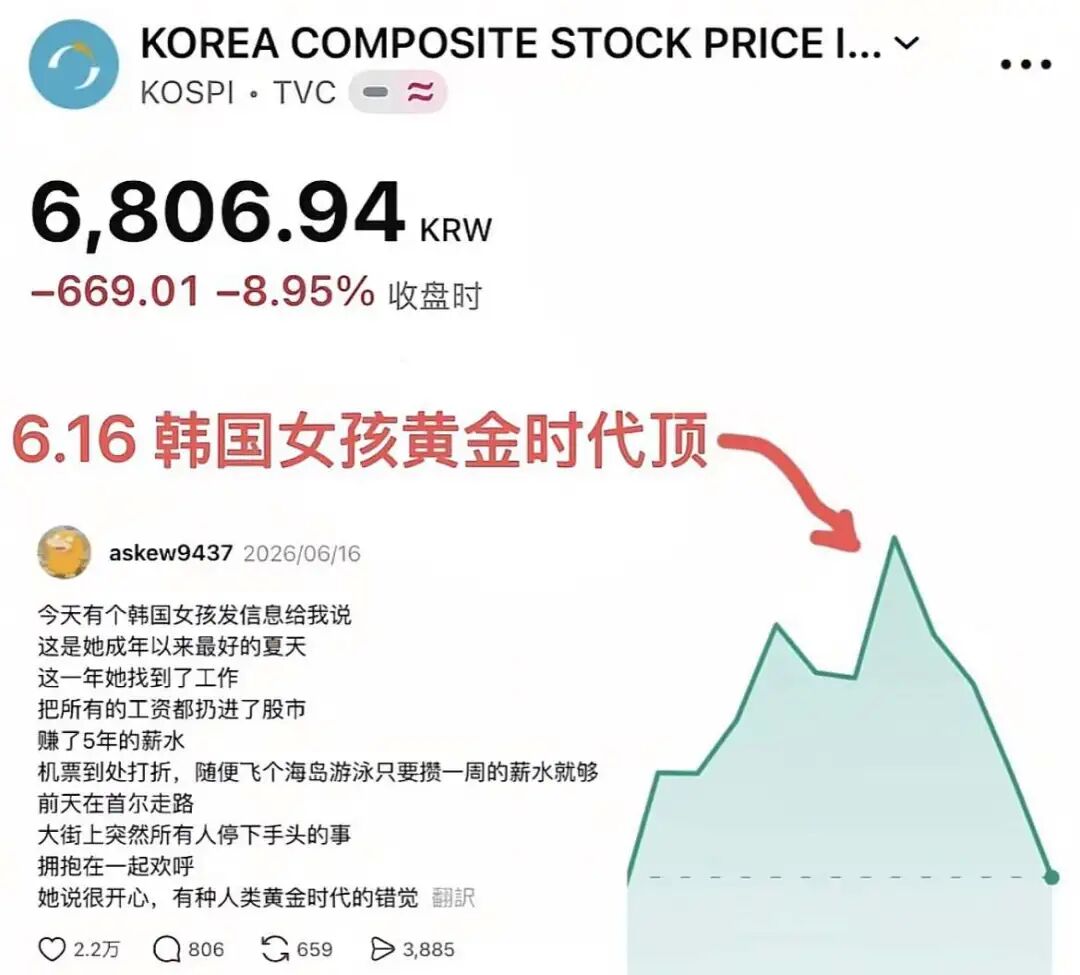
Later, people realized that the "golden age" of South Korea had a shorter shelf life than kimchi.
A rough estimate shows that if that girl had not exited the market in time and remained heavily invested in Samsung Electronics and SK Hynix, she would have lost a year and four months' worth of salary within a month during this pullback.
On overseas platforms, a popular saying circulated among the crypto and stock trading communities: "The South Korean stock market is the world's largest casino."
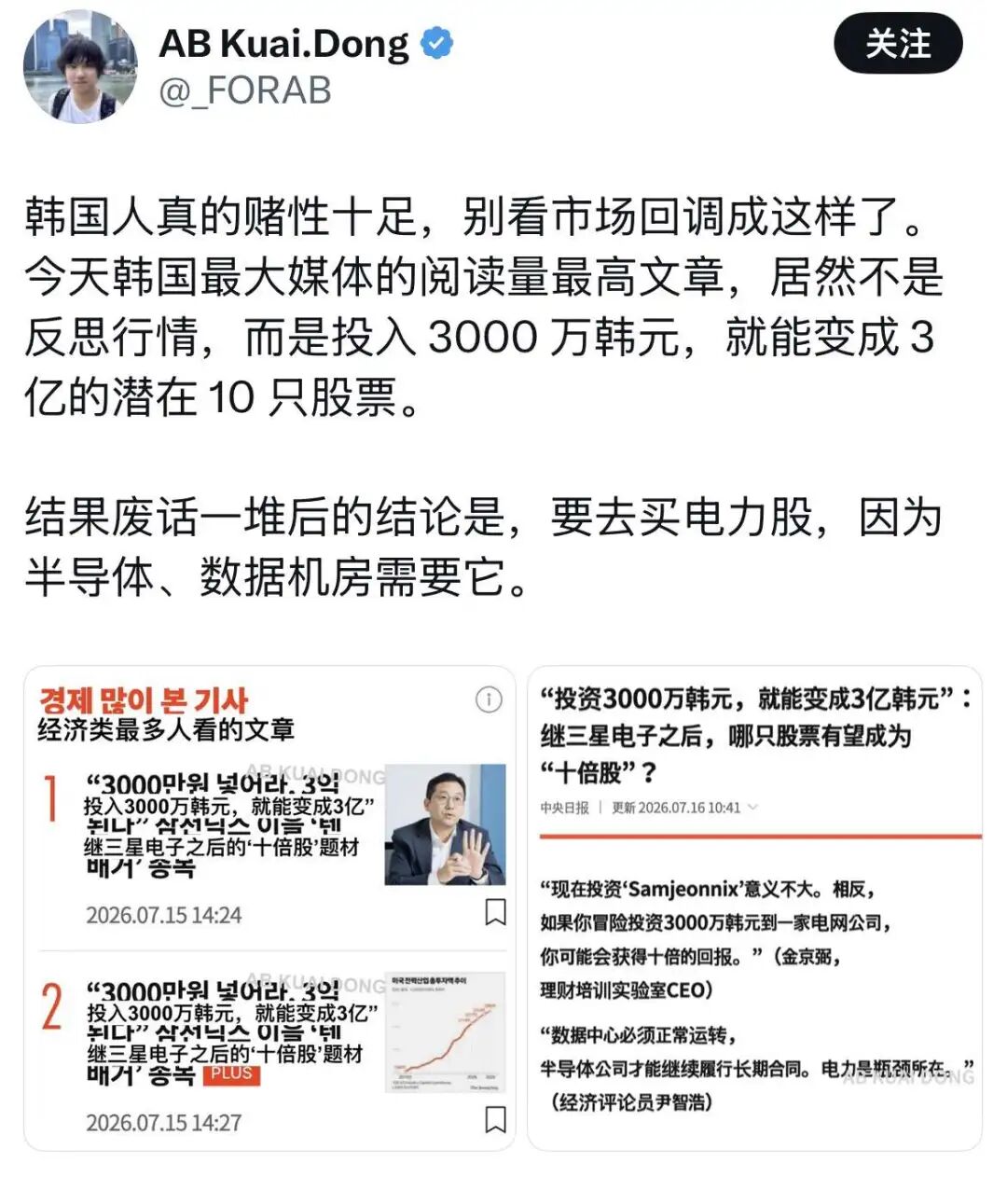
To what extent have South Koreans gone crazy over stock trading?
South Korea, with a population of 52 million, has 109 million active stock accounts, meaning on average, every person has two accounts.
While one person can open multiple accounts across different brokerages, this number still clearly shows that in South Korea, stock trading is no longer just a way to manage finances, but more like a nationwide carnival that no one dares to miss.
There is a Korean word "벼락거지", which translates to "Thunder Poor", describing people who have salaries and savings, but fail to buy real estate or stocks. As they watch others profit from rising asset prices, they end up feeling impoverished by comparison.

What hurts more than losing money yourself is always watching others get rich. Stock trading is no longer just about making money, but about avoiding being left behind by your peers.
This frenzied investment competition has even extended from adults to infants.
Government regulations state that starting in 2023, South Korean parents can directly open securities accounts for their minor children via mobile phones, even for newborns aged 0.
In the first quarter of 2026 alone, Toss Securities opened 180,500 child accounts, 9.6 times the number from the same period the previous year.
South Korean babies may not have learned to call their parents yet, but they already own shares in Samsung or SK Hynix.

If the above two points only demonstrate the frenzy in the South Korean stock market, high leverage is the trigger that turns this frenzy into a crisis.
Enthusiastic South Koreans have long been accustomed to borrowing money to trade stocks. Data from South Korean media shows that margin trading accounts for 35% of total trading volume in the South Korean stock market.
What does this mean? At the peak of China's 2025 bull market, margin trading only accounted for 15% of total volume, and it currently stands at only 2.23%.
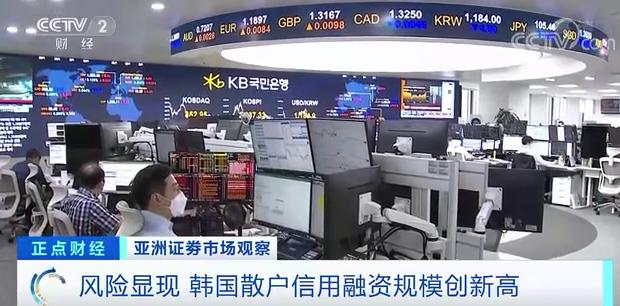
Moreover, the 2x leveraged ETFs in South Korea are even more unbelievably crazy. Trading volumes of Samsung, SK Hynix and their related leveraged ETFs once accounted for over 70% of the total trading volume of the South Korean stock market.
But the problem is that high leverage is a double-edged sword.
When stock prices plummet, ordinary investors can still comfort themselves: "As long as I don't sell, profits and losses are just numbers on paper."
Leveraged investors don't have that luxury. Once stock prices fall below the warning line, brokerages will demand additional margin. If investors can't come up with the money, their accounts will be forcefully liquidated immediately.
Worse still, the 2x leveraged ETFs most popular in the South Korean stock market track daily price fluctuations. The more volatile the market is, the greater the value erosion.
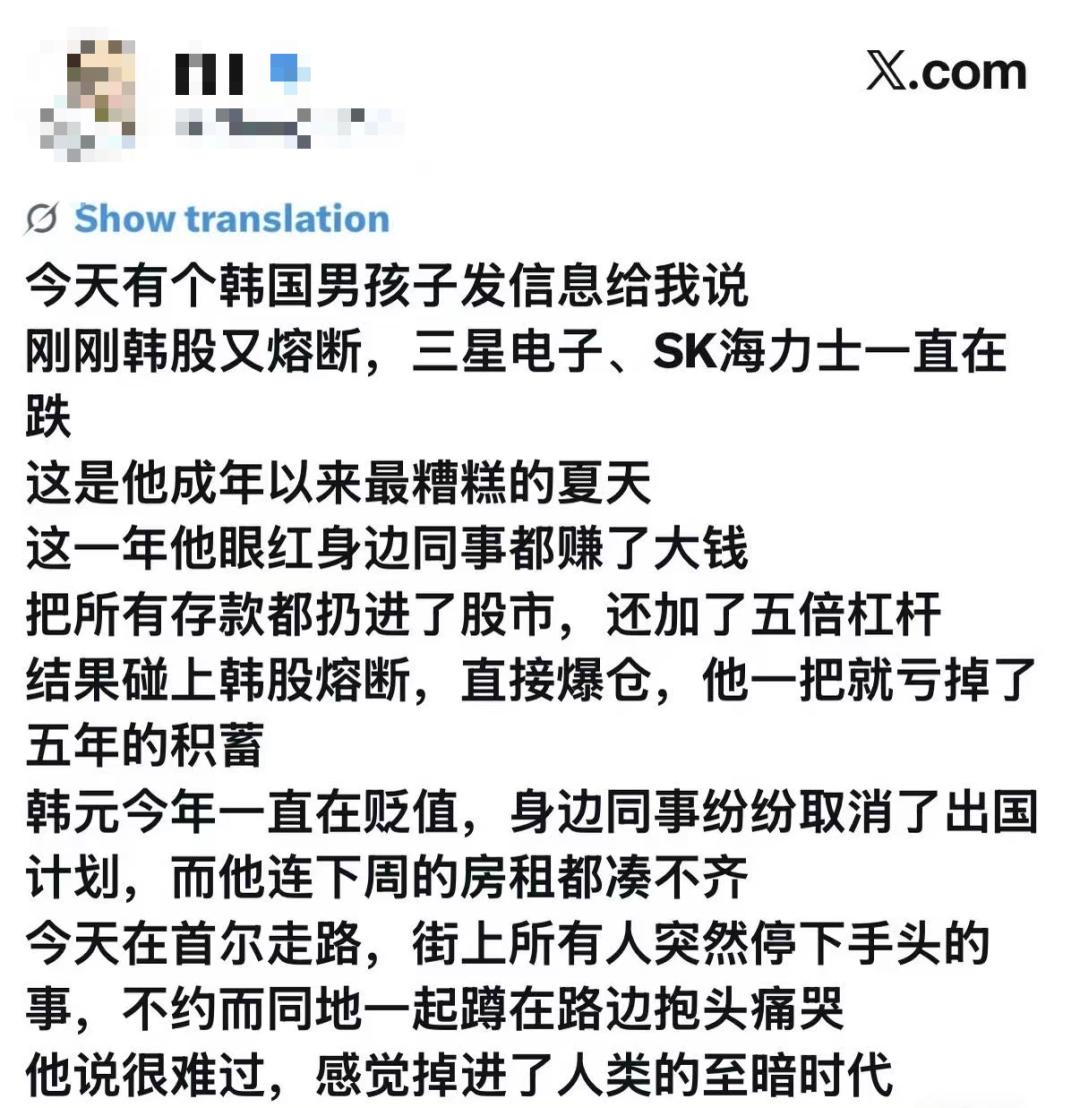
As a result, the decline of Samsung and SK Hynix, which might have originally been just a "technical correction", eventually evolved into a chain stampede across the entire market.
South Korea's golden age has turned into its darkest moment overnight.
02 The Strongest Bull Market in History: Is the Government the Biggest Market Manipulator?
Many people believe that the fluctuations in the South Korean stock market are just accidental events caused by the semiconductor market cycle.
But I believe this is not an ordinary cyclical correction.
The behavior of retail investors chasing rising prices and selling at lows might explain a single market trend, but it cannot explain why this carnival was so intense and the subsequent collapse so rapid.
Behind the extreme "feast or famine" situation in the South Korean stock market lies a policy relay spanning the administrations of Yoon Suk-yeol and Lee Jae-myung.
Although the two administrations fought fiercely in the political arena, they shared a rare consensus on economic goals: South Koreans' money cannot just sit in bank deposits, let alone all flow into real estate and the US stock market. It must return to the domestic capital market.
Mass public stock trading was gradually packaged as a national-level project.
