36Kr Exclusive | HKUST PhDs Develop Full-Body Tactile System for Robots, Backed by HSG, Lingzhi Capital and AGI Bot
Author | Qiao Yujie
Editor | Yuan Silai
36Kr has learned that MoSense, a company delivering full-body multimodal integrated tactile solutions, has recently completed a tens-of-millions-yuan angel round of financing, with investors including Sequoia China, Hillhouse Ventures, and Agibot Robotics. The funds from this round will be mainly used to accelerate R&D, expand the team, increase computing power investment, and build a mass production testing system.
Founded in May 2026, MoSense is headquartered in Shanghai, with an R&D center located in Qianhai, Shenzhen, focusing on the development of full-body multimodal tactile perception systems for robots. Just one month after its official establishment, the company secured joint backing from top-tier U.S. dollar funds and humanoid robot manufacturers.
As humanoid robots gradually move from demonstration scenarios to real and complex task scenarios such as industrial manufacturing, logistics handling, and domestic services, the robots' comprehensive generalized perception capability of the environment has become a key bottleneck restricting their real-world deployment. While vision can capture environmental information, tactile perception is responsible for sensing physical interaction states such as contact, force, and friction, serving as a critical foundation for robots to perform stable operations and make autonomous decisions.
However, most current tactile solutions in the industry are deployed locally on partial areas such as dexterous hands or the fingertips of grippers, which can only meet the needs of local fine manipulation. In complex scenarios, other parts of the robot's body still lack tactile feedback, making it difficult to form a complete physical interaction capability. Meanwhile, many traditional technical routes are constrained by factors such as cost, area coverage, and perceptual modalities, making it challenging to achieve large-scale deployment on large, continuous curved surfaces.
To enhance the comprehensive perception capability of robots, MoSense has launched the MoSkin full-body flexible multimodal tactile system based on electromagnetic meta-mechanics technology, which covers multiple parts of the robot such as hands, limbs, torso, and soles of feet. It can transform the robot's rigid physical boundaries into continuous six-dimensional force field perception, realizing full-body multimodal tactile collection and providing more complete physical information for robot motion control and environmental interaction.
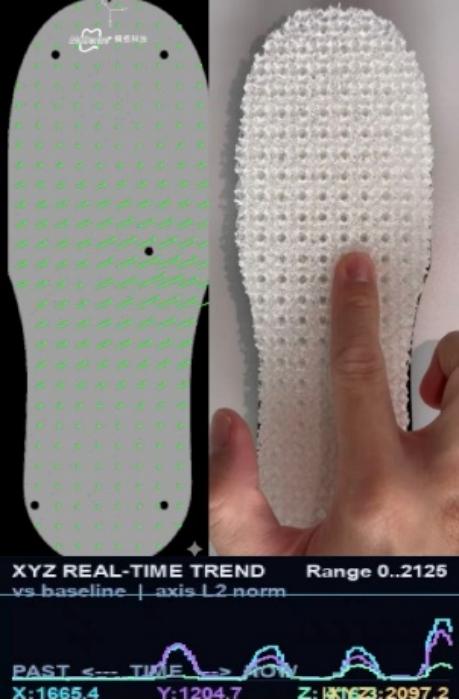
Electromagnetic meta-perception skin (sole of the foot)
To address the problem of single modality in traditional tactile systems, the company's MoSkin solution can integrate various complex modal physical information, such as force perception, temperature, slippage, vibration, and material properties, achieving a perception capability close to that of real human skin. In addition to hardware, MoSense is also simultaneously developing multimodal fusion algorithms.
According to Yan Chaoxu, current world models are already capable of completing policy training in simulation environments, but when the models are deployed to real robots, they still face the Sim-to-Real gap. One important reason for this is that real robots lack complete full-body tactile feedback, which prevents the physical interaction state from being truly mapped.
Based on full-body tactile hardware, the company has developed a world-action tactile prediction model based on the multimodal latent space fusion gating mechanism, which continuously corrects the low-latency decision-making process through high-frequency, multi-dimensional tactile feedback, and uses full-body tactile perception to supplement physical prior information, further narrowing the gap between simulation and real environments.
Taking the handling scenario as an example, when the robot senses that the friction force on its hand or a local part of its body changes, it can judge in advance that there is a risk of the object slipping, and actively adjust the grasping strategy instead of correcting it after the object falls. The company hopes that through full-body multimodal integrated perception, robots can continuously learn and improve during the execution process, further enhancing their generalization ability in real environments.
In terms of the team, Dr. Yan Chaoxu, Co-Founder and CEO, graduated from the Department of Microelectronics at the Hong Kong University of Science and Technology. He has long been engaged in research on high-frequency systems, electromagnetic algorithms, and embodied multimodal sensing, with experience in the industrialization and mass production of microelectronic devices.
Dr. Zhou Hang, Co-Founder and CTO, graduated from the Department of Robotics at the Hong Kong University of Science and Technology. He previously served as a senior algorithm researcher at a domestic automotive-grade autonomous driving company, and has long been engaged in research on end-to-end autonomous driving models, world models, and embodied intelligence algorithms. Yang Mujun, Co-Founder and CFO, holds a Master's degree in Economics from the University of Hong Kong. She has worked at several top financial and technology companies, with rich experience in financial planning and corporate governance.
Chief Scientist Wen Weijia is currently a Chair Professor at the Hong Kong University of Science and Technology and the Dean of the Function Hub at the Hong Kong University of Science and Technology (Guangzhou). He has won the Second Prize of the National Natural Science Award, was selected into Elsevier's "Top 2% of the World's Top Scientists" list, and has experience in continuous entrepreneurship and transformation of scientific and technological achievements.
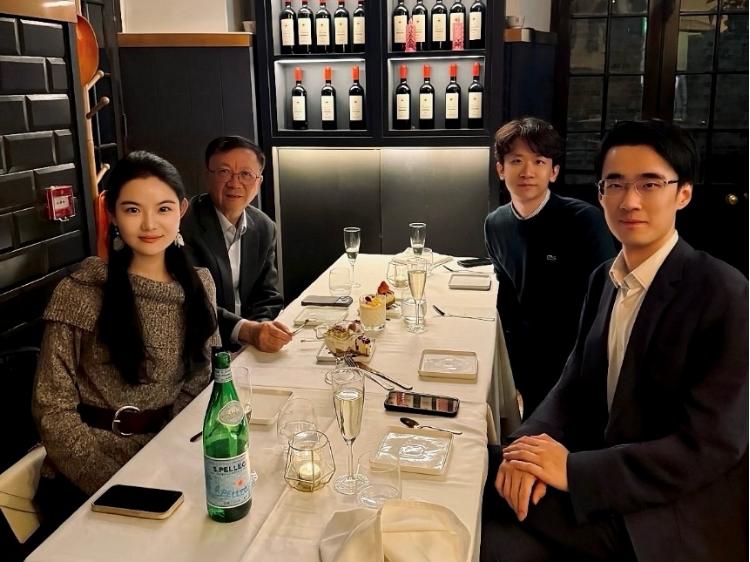
The company's co-founding team and Chief Scientist (Source: Enterprise)
In terms of commercialization, the company's multimodal integrated tactile solution is currently advancing commercial implementation. In addition to humanoid robot-related businesses, it is also expanding cooperation for smart sensor deployment across multiple industries.
The following is an excerpt from the conversation between 36Kr and Yan Chaoxu, Founder of MoSense:
36Kr: What are the company's plans for the future applications of full-body tactile perception?
Yan Chaoxu: There are roughly three stages: The first step is for robots to first learn to perceive physical boundaries, and complete basic functions such as anti-collision, anti-pinch injury, and fine manipulation. As a production tool, safety is more important than functionality for robots.
The second step is to complete various complex tasks with the assistance of full-body tactile perception. For example, how can a robot walk while holding a large box, ensuring that the box does not fall and the robot does not fall over in a complex environment. To take it a step further, for instance, when the robot senses that the box is about to slip, it can use its thigh to push the box, or when it is holding the box and has no free hand to open the door, it can use its foot or hip to push the door open. The robots from Figure AI have already demonstrated similar anthropomorphic behavioral capabilities in household chores.
The third step is the truly most challenging part, directly targeting high-precision human-robot interaction scenarios. Taking elderly care and medical scenarios as an example, even the seemingly simple action of lifting a person with limited mobility out of bed and taking them to the bathroom is almost impossible to complete without multimodal full-body force perception. In other words, even if a robot fails once and drops the person in 100,000 repetitions, the consequences would be unacceptable, which translates to a success rate of over 99.999%.
36Kr: Why is the company advancing world model-related research while developing full-body tactile hardware?
Yan Chaoxu: We insist on doing difficult but meaningful things. As a new player in the tactile industry, MoSense's starting point is to make valuable contributions to the deployment of robots in real and complex scenarios.
Current world models can already complete a large number of training tasks in simulation environments. In the simulator, robots can accurately know their own body boundaries and environmental boundaries, so they can complete complex interactive strategy learning. However, when these algorithms are deployed to real robots, problems arise — because robots lack complete full-body tactile feedback, they cannot determine whether the contact occurs on their arms, shoulders, or other parts of their bodies, making it difficult to map the physical interactions in simulation to the real world, which is also one of the important bottlenecks for Sim-to-Real deployment.
On the one hand, we use full-body tactile hardware to complement the robot's physical perception of the real world. On the other hand, we are also simultaneously developing supporting world models, hoping to give full play to the advantages of the hardware so that the algorithms can be truly deployed on real robots. But this is obviously not enough. Bridging the Sim-to-Real gap still requires using full-body multimodal perception feedback to correct the decision-making process and supplement physical prior information. Therefore, MoSense has also independently developed a world-action tactile prediction model based on the multimodal latent space fusion gating mechanism, hoping to give full play to the advantages of the hardware so that the algorithms can be truly deployed on real robots.
In the future, robot manufacturers will not only need a set of hardware, but a complete solution that can directly demonstrate its value. When customers evaluate a full-body tactile system, they want to see the actual application effects, not just an electronic skin. Adopting our integrated skin-and-algorithm solution directly can save the cost of algorithm development and full-body data collection. We will first optimize most of the functional modules, and the final model will be roughly similar to how automotive companies purchase overall solutions from autonomous driving companies. Therefore, we will complete part of the algorithm and application development in advance to help customers accelerate product verification and deployment.
Our team is not a pure hardware team, but a combination of hardware, sensing, and algorithm teams. We hope that through the collaboration of software and hardware, full-body tactile perception can truly become an important part of robot capabilities, rather than just a sensor product.