Helping Robots "Process Data": Huge Capital and Big Bubble
The data infrastructure for embodied intelligence is emerging as a "upstream battlefield."
At recent AI forums, a set of contrasting data points has been impossible to avoid: LLM pre-training involves tens of trillions of tokens, autonomous driving has tens of billions of hours of data, while the currently publicly available operational data for embodied intelligence is only at the level of hundreds of thousands of hours. Multiple embodied intelligence hardware manufacturers have also publicly stated that data is the biggest bottleneck at present.
On one hand, robots are dancing and somersaulting on the Spring Festival Gala stage, folding clothes in laboratories, and working as 24-hour shop assistants; on the other hand, they frequently malfunction as soon as they step into real homes or factories. Behind this contrast lies the problem of data shortage, which has spawned an independent industry track.
In the past six months, capital has been flowing intensively into data companies: Guanglun Intelligence has completed two consecutive rounds of financing in just two months, with a valuation exceeding 2 billion US dollars, making it the world's first unicorn in the embodied data field; Jianzhi Robotics, founded in 2025, has received investments led by Ant Group, Didi, and Delian; Mifeng Technology quickly completed financing of hundreds of millions of yuan after being spun off independently from Zhiyuan.
It took less than a year for data to evolve from a single variable in the training process to an independent track. Two major signals underlie this shift.
Tian Jibian, an investor in embodied intelligence, explained that first, the generalization bottleneck of the VLA large model has begun to emerge, and data quality is the real ceiling for the robot brain; second, the shipment pace of hardware manufacturers is faster than expected, pushing data demand from R&D exploration to a necessary condition for mass production.
This judgment has been confirmed on the front line. Xingxin Intelligence is a third-party company specializing in embodied intelligence data. Its vice president, Zhu Jun, who interacts with customers every day, has the most direct experience of data shortage. He told "Dingjiao One" that in the past two years, the entire industry was focused on developing hardware such as complete machines and dexterous hands. But when the hardware was finally built, people found that robots could not operate when faced with different objects or environments, and all shortcomings were stuck in data. Manufacturers simply cannot keep up with the model iteration rhythm through internal collection alone, so once the gap is exposed, demand for third-party data naturally rises.
However, this data puzzle is not easy to fill. Real-machine collection is too expensive, scene coverage is scattered, and the scrap rate is high. In addition, each manufacturer collects its own data with incompatible formats, so the total amount of industry data has been slow to increase.
With a sufficiently large gap and a large influx of players, this track is becoming increasingly crowded.
01. Who is Providing Data? Four Production Routes
In 2023, when the embodied intelligence industry was just starting, the problem of data shortage already attracted attention. What makes robot data so difficult to obtain? Why can't it be directly sourced from the Internet like data for large models?
The core of embodied intelligence training is "action". For robots to learn to twist bottle caps, fold clothes, and open drawers, they need a complete closed loop of "what you see - what you do - how much force you apply - how the joints move". This type of data barely exists on the Internet and must be "created", and the way it is created directly determines the cost, quality, and scalability.
At present, embodied intelligence mainly has four major data collection routes, each with its own advantages and disadvantages in cost and fidelity. Leading companies usually do not bet on a single route, but choose to pursue multiple routes in parallel.
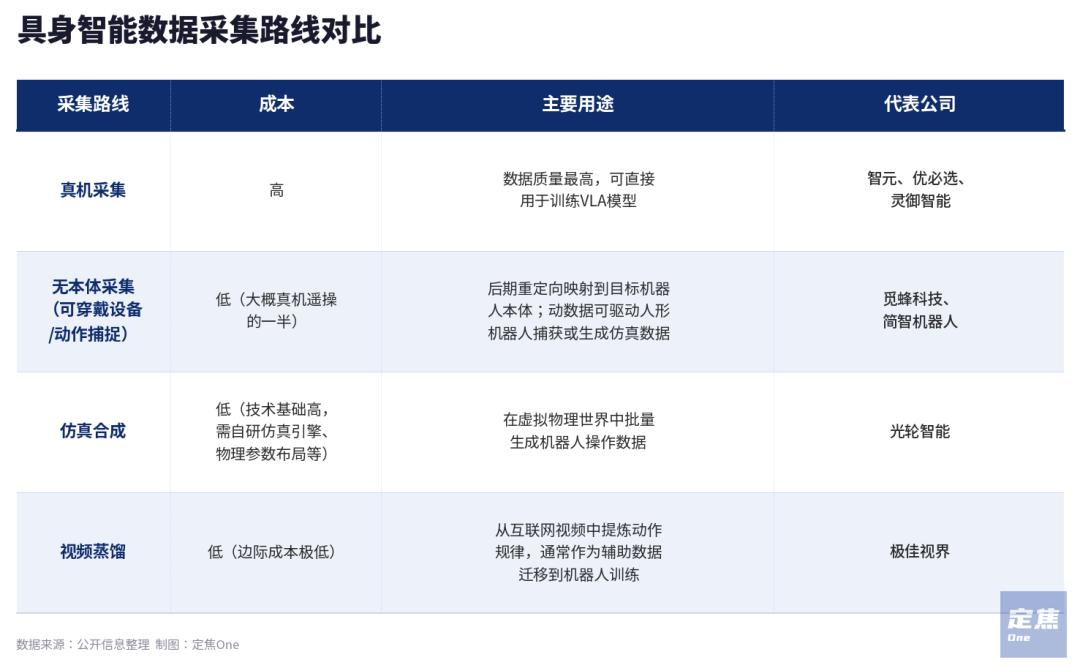
The first is real-machine collection. Operators wear VR or AR headsets to synchronize the view to the robot's camera perspective, and then control every movement of the robot.
The data produced by this method is of the highest quality and can be directly used to train VLA models. Leading humanoid robot manufacturers such as Zhiyuan and Ubtech, as well as Lingyu Intelligence, which was established last year, have all bet on this route.
However, the collection cost of this route is very high, as it requires not only the purchase of real machines, but also specific requirements for operators. Tesla Optimus data collectors earn $25-48 per hour.
An embodied intelligence practitioner said that wearing a VR headset for a long time is not only very dizzying, but also requires operators to judge spatial distance and object position through the VR view, and mistakes are easy to occur if they are not careful. A high scrap rate is the norm. Some practitioners have counted that the general data utilization rate is 60%-70%.
Some domestic companies try to lower the threshold through a "human-arm isomorphic" design, but this design sacrifices the "superhuman performance" of the robot, and the collected data set cannot allow the robot to complete tasks in special scenarios such as drilling through narrow gaps.
The second category is ontology-free collection.
This route does not require a robot ontology. The collected motion data is later mapped to the target robot ontology through retargeting, and the cost is about half or even lower than that of real-machine teleoperation. It is mainly divided into wearable devices and motion capture. Representative companies include Mifeng Technology and Jianzhi Robotics.
The representative of wearable device collection is UMI (Universal Manipulation Interface), where people hold special grippers to directly operate objects and synchronously record trajectories and visual data. Motion capture collection involves people wearing motion capture devices to record whole-body or hand movements, which can be used to drive humanoid robots or generate simulation data.
However, this type of collection method has two major limitations.
First, when people operate with grippers on their hands, they can only know whether they "grasped" or "failed to grasp", but cannot feel how much force is applied or how the force changes. Therefore, for delicate tasks that require "adjusting the force while feeling", such as twisting bottle caps and inserting USB drives, the trained model may seem to perform the correct action, but it often applies the wrong force when actually operating. Second, when human movements are "translated" to robots, a large amount of information is lost.
The third category is simulation synthesis, which mainly generates robot operation data in batches by simulating the virtual physical world.
This route has very high technical requirements, especially in narrowing the gap between virtual and reality, which requires capabilities such as self-developed simulation engines and physical parameter calibration. Take Guanglun Intelligence as an example. It has self-developed a simulation system that can "simulate, measure, and generate", delivering a total of over 1 million hours of human behavior data with a resale rate of over 10 times, making it the largest company in the simulation route at present.
However, the shortcomings of this route are also obvious. In the simulation environment, all attributes of objects, such as the weight of the cup and the smoothness of the surface, are set as fixed values. But in real scenarios, the cup may contain water, and the hand may be wet. These subtle changes are difficult to fully simulate, leading to operational failures.
The fourth method is video distillation, which has been adopted by more and more companies recently.
It directly extracts existing first-person or third-person operation videos on the Internet (such as Ego4D, YouTube cooking videos, etc.), uses the model to infer "what actions the person performed", produces structured data (such as hand pose, object trajectory, joint-level actions), and then transfers it to the robot.
For example, a video of a person twisting a bottle cap can not only record the joint angle of a certain action, but also extract the general rule that "when the hand reaches this position and applies force in this direction, the bottle cap will rotate". This method does not involve action collection, only screening and cleaning, so the marginal cost is extremely low and the amount of data is huge. In the past year, this technology has received industry attention, mainly due to the maturity of the world model, which has brought the extraction accuracy to a commercial level. The representative company is Jiajing Vision, which has raised a total of about 3.5 billion yuan in three months, with a valuation of 10 billion yuan.

Screenshot of the Ego4D website
However, the disadvantage is that the video only contains visual information, no motion details such as joint angles and applied force, and the human hand is significantly different from the robotic arm, so it cannot be directly used for end-to-end training, and is usually only used as auxiliary data.
It should be pointed out that now all companies are adopting a strategy of multiple parallel routes. For example, Guanglun Intelligence, which focuses on simulation data, has also begun to collect human data. Galaxy General, which used to be a firm simulation advocate, has also released a whole-body teleoperation system. Kaiwang Data, which started with autonomous driving data annotation, even covers multiple routes, and can undertake ontology-free, real-machine teleoperation, and simulation synthesis tasks.
Zhu Jun summarized that the capital market currently prefers synthetic simulation and full-link platforms, followed by wearables, while the real-machine route is rarely favored. However, offline customers still have a rigid demand for real-machine data, and simulation can only play an auxiliary role. The convergence of routes has become a clear trend: simulation manufacturers build data management platforms with real-machine data calibration; wearable companies add synthetic data to expand samples; real-machine collection teams develop their own simulation and video distillation tools to reduce costs.
02. Revenue of Millions, Valuation Soaring to Billions
Creating data is just the starting point. Whether the data can be sold, to whom, and whether it can be sold continuously is the key to the viability of this track.
According to Tian Jibian's research estimates, there are very few data customers in China with continuous procurement capabilities. At present, they are mainly divided into three categories: robot ontology manufacturers, embodied model teams (VLA and world models, etc.), and universities and scientific research institutions. Considering that many customers are still in the verification stage, there may be only dozens of customers with real large-scale procurement capabilities.
Moreover, the willingness to pay of these dozens of customers is also unstable. An embodied intelligence data manufacturer said that current ontology manufacturers purchase external data mainly because "they cannot collect enough by themselves". Once their own data collection system is up and running, external procurement may be significantly reduced.
Zhu Jun admitted that many customers "buy a batch of data for trial use first, and then set up their own teams to replicate it after the process is proven". Their response is to support customers with exclusive collection tools, scene processes, and iteration solutions. Moreover, "by continuously updating data standards with customers, the comprehensive cost and cycle for customers to replicate the system themselves are very high, so it is still difficult for them to completely replace us."
As for monetization methods, there are mainly three types, each with different entry barriers and moats.
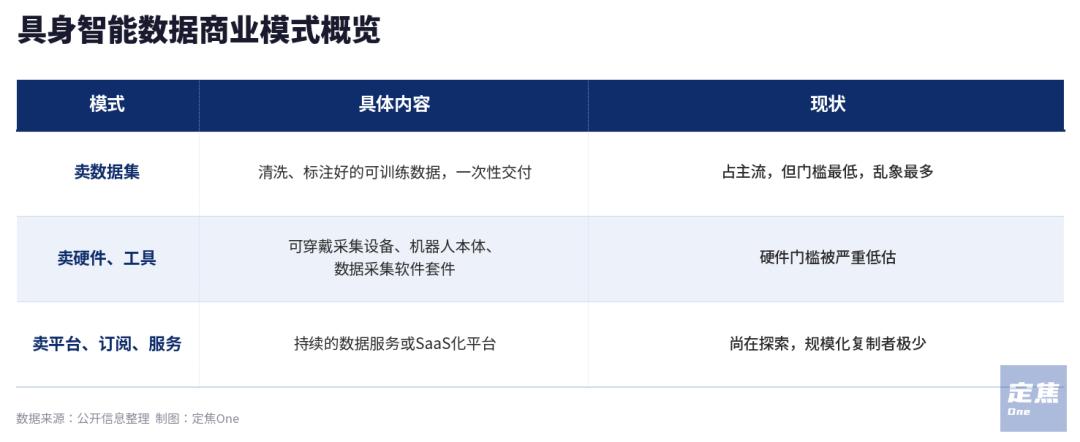
Among them, one-time buyout of data sets is the mainstream, and it is also the most fiercely competitive business model.
Take the EGO wearable collection route as an example. Many small teams on the market now buy modified headsets + wrist cameras + open-source calibration codes, and can set up a collection workstation with tens of thousands of yuan. However, calibration drift, occlusion, and frame loss during synchronization often lead to a scrap rate of around 30%, resulting in uneven data quality. The reason why one-time buyout of data sets is mainstream is that it is the simplest, but also the easiest to replicate.
The second category is selling hardware, such as wearable collection devices, teleoperation workstations, and even dedicated collection robots. The barriers lie in hardware design, supply chain, and production capacity. The risk is that after the hardware is sold, customers can completely organize their own manpower to collect data.
The third category is selling platforms, subscriptions, and services, which has the highest barrier but the most difficult start. It requires customers to have formed a large-scale data consumption habit, but the current market has not yet reached this stage, and only a few companies are testing the waters.
Zhu Jun revealed that their current revenue mainly comes from the sale of standardized data sets and customized project collection. The comprehensive gross profit margin is not high, with manpower as the largest cost, and the expenses of annotation, collection, and algorithm R&D personnel account for the highest proportion, followed by the depreciation of collection hardware, while the computing power cost accounts for the lowest proportion. Their long-term goal is to bind customers' long-term iteration needs and reduce one-time data set sales.
In Tian Jibian's view, the business model of the embodied intelligence data industry is still in the exploratory stage. "Although several leading data players have obtained stable framework orders and revenue contracts from domestic and foreign customers, few of them can achieve large-scale replication."
Nevertheless, the valuations of embodied intelligence data companies have been rising. Some companies have an annual revenue of only millions, but their valuations have reached billions. Tian Jibian told "Dingjiao One" that the huge market demand for embodied intelligence data is one of the main reasons for the short-term surge in the valuations of data companies.
An investor focused on early-stage hard technology investment said, "When investing in embodied data now, we don't look at PE or even PS, but at single customer value × number of potential customers × data barrier coefficient. Guanglun Intelligence's new orders in a single quarter reached 550 million yuan, which set a standard for the industry. If a company can obtain 10% of Guanglun's order share, its valuation can be estimated according to this proportion."
03. Who Can Define the Data Rules for Embodied Intelligence?
At present, the industry has not reached a consensus on "what kind of data is the most valuable".
"Is it simulation data or real data? Third-person perspective or first-person perspective?" A practitioner who switched from autonomous driving to embodied intelligence believes that "by 2018, the autonomous driving industry had at least reached a consensus that the fusion of LiDAR and cameras was the mainstream direction, but the embodied intelligence industry has not even reached a consensus on the collection route, making it difficult for customers to place continuous orders."
This has led to a serious dilution of the total data volume in the industry, with models being fixed on a single ontology, and the alignment of data formats has become the most headache issue. The current mainstream VLA models are trained with data from a specific robot, and the learned operation methods are only adapted to that robot. Once you switch to a different brand or model, with different data formats, joint configurations, and sensor layouts, the previously trained model cannot be directly migrated, and has to be re-collected, re-annotated, and re-trained.
However, leading model manufacturers are also trying to break this deadlock. For example, overseas embodied brain company Skild AI focuses on cross-ontology general foundation models; Ant Group's Lingbo recently launched LingBot-VLA 2.0, which is claimed to be trained with 60,000 hours of data and can adapt to more than 20 types of robots. But Tian Jibian pointed out that although the current cross-ontology general models on the market can "achieve cross-ontology migration" in actual implementation, they still need to be adapted and fine-tuned for specific models, and the technical threshold in this industry remains very high.
Many embodied intelligence data companies have also begun to try to "set rules", among which three are more active: Guanglun Intelligence, Mifeng Technology, and Jianzhi Robotics, each with different focus directions. Guanglun Intelligence has launched the industrial-grade evaluation platform RoboFinals, which mainly involves evaluation standards; Mifeng Technology promotes MEGO hardware and a full-paradigm platform, and is exploring the establishment of cross-ontology data format standards; Jianzhi Robotics focuses on industrial-grade data formats.
