Interpretation of "2026 China Small and Micro Enterprises Industry Finance and Tax Intelligence Report"
Recently, iResearch released the Report on the Intelligent Development of Business, Finance and Taxation for Small and Micro Enterprises in China. The report points out that as the full implementation of the Golden Tax IV drives the formation of the "tax governance through digitalization" regulatory system, coupled with generative AI technology accelerating the reconstruction of the underlying logic of enterprise services, the business, finance and taxation management of small and micro enterprises in China is ushering in a generational leap from "basic accounting tools" to "intelligent decision support systems".
Based on the core content of the report, this paper systematically dissects the development status and future trends of the intelligent business, finance and taxation track for small and micro enterprises from three dimensions and 12 sub-items: the underlying industry logic, market growth pattern, and capability benchmarking of mainstream vendors.
I. Dual Resonance of Regulation and Technology Pushes Business-Finance-Tax Intelligence into the Fast Lane of Development
As the capillaries of the national economy, the depth of digital transformation of small and micro enterprises directly determines the development vitality of the real economy. The core transformation of the current industry stems from the dual drive of regulation and technology:
On the regulatory side, the full implementation of Golden Tax IV has completed the paradigm upgrade from "tax control via invoices" to "tax governance through digitalization". In the past, Golden Tax III only verified the authenticity of invoices, and enterprises could meet compliance requirements by building their own separate financial and tax systems; today, tax authorities have connected full-dimensional data from industry and commerce, banks, logistics, and social security to realize cross-verification. The traditional management model that separates business operations from finance can no longer adapt to regulatory requirements, forcing small and micro enterprises to upgrade to integrated business-finance-tax management that links business, finance, taxation, banks, and archives.
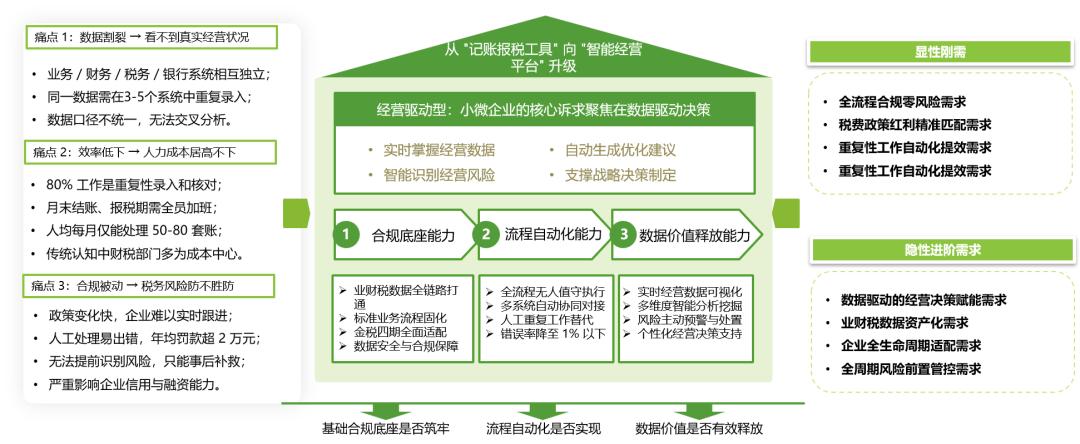
On the demand side, the business, finance and taxation demands of small and micro enterprises have shifted from "passive compliance" to "active operation". Survey data from the report shows that small and micro enterprises are currently facing three core pain points: first, data fragmentation across multiple systems, where the same data needs to be re-entered in 3-5 systems with inconsistent calibers, making it impossible to support business analysis; second, low efficiency of manual processing, with 80% of work being repetitive entry and verification, leading to high labor costs; third, passive compliance risks, as policies iterate rapidly and manual processing is prone to errors, resulting in an average annual tax fine of over 20,000 yuan for enterprises, with risks that can only be remedied after the fact.
Against this backdrop, surveys show that about 92% of small and micro enterprises take "full-process compliance with zero risks" as their core demand, while more than 60% of enterprises hope to use business-finance-tax data to guide operations, reduce costs and increase efficiency. The essence of the demand has upgraded from "bookkeeping and tax filing tools" to "intelligent operation platforms". The full penetration of generative AI provides technical support for this demand upgrade. By 2025, AI has evolved from a "value-added feature" in business-finance-tax services to a "standard underlying infrastructure", deeply covering all scenarios including financial bookkeeping, tax declaration, risk warning, and business analysis. The report also emphasizes that the release of AI value must rely on a mature business-finance-tax SaaS carrier. The real operational data and complete business scenarios accumulated by SaaS are the necessary foundation for AI implementation; the adoption rate of isolated AI functions separated from SaaS is less than 20%, while the user adoption rate of deeply integrated AI capabilities exceeds 85%. The symbiosis rather than substitution of the two is the core consensus of industry development.
II. Accelerated Market Scale Expansion, Demand Structure Leaps from "Compliance Necessity" to "Operational Value-Add"
Driven by three factors: mandatory policy compliance, AI technology empowerment, and enterprises' demand for cost reduction, the small and micro business-finance-tax track has entered a high-speed growth cycle, with profound changes taking place simultaneously in market scale and demand structure.
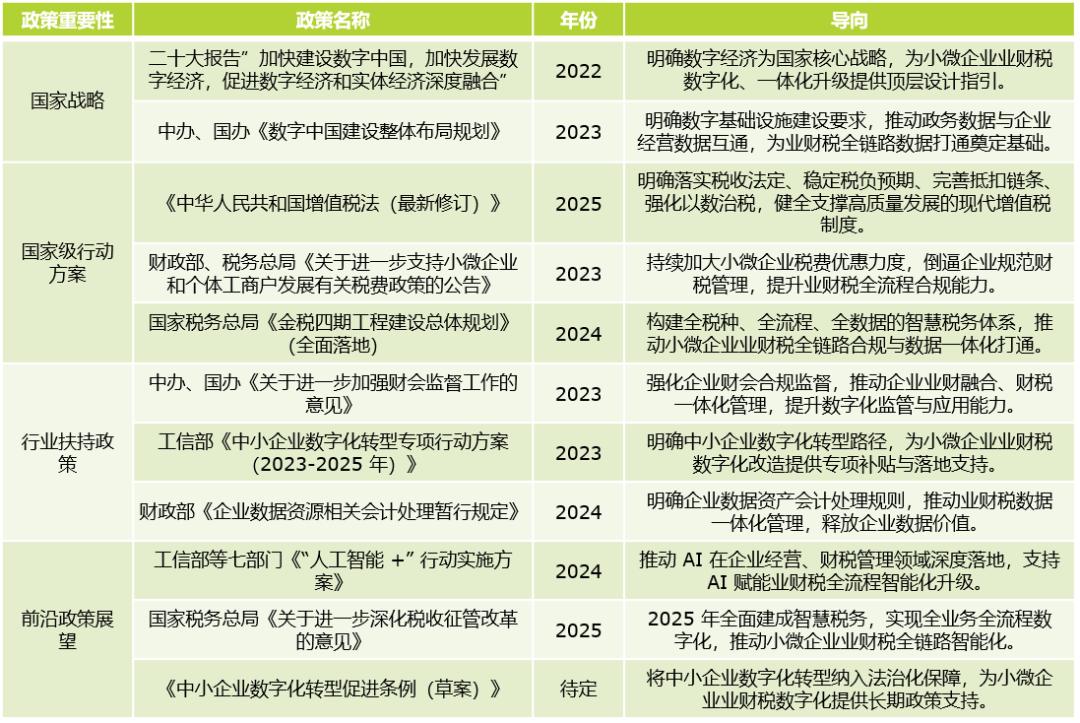
From a policy perspective, under the guidance of the top-level strategy of Digital China, the state has built a full-dimensional policy system around smart tax construction, digital transformation of small and micro enterprises, and the integration of AI and the real economy. The policy orientation has upgraded from "single compliance control via invoice-based tax governance" to "full-link digital capability building driven by digital tax governance". Taking Golden Tax IV as the core starting point and AI technology as the core empowerment method, it has consolidated the policy foundation for the integrated and intelligent upgrade of business, finance and taxation for small and micro enterprises, while forming a gradient difference between national top-level design and local implementation, which directly drives the differentiation of regional digital penetration rates.
From the growth data perspective, from 2023 to 2025, the market size of SaaS subscription revenue for business, finance and taxation of small and micro enterprises in China grew from 24 billion yuan to about 40 billion yuan, with a CAGR of 27.8%; during the same period, the digital penetration rate of business-finance-tax increased from 32.5% to 45.8%, a 13.3 percentage point increase in two years. At the current growth rate, the industry penetration rate is expected to exceed 70% by 2028, and the overall market size will reach the 100-billion-yuan level.
More iconic than the scale growth is the fundamental reversal of the demand structure. In 2020, 82% of the industry's demand was concentrated on basic compliance, with intelligent decision-making demand accounting for only 1%; by 2026, the proportion of basic compliance demand will drop to 35%, and the proportion of intelligent decision-making demand will rise to 42%, surpassing compliance for the first time to become the largest demand. This means that the evaluation criteria of small and micro enterprises for systems have shifted from "can it do bookkeeping and tax filing" to "can it support operations and create value".
III. Tiered Differentiation of Vendor Capabilities, the Dual Threshold of "Integration + AI" Reshapes the Competitive Landscape
Based on the three core dimensions of "business-finance-tax integration capability, AI intelligent technology capability, and intelligent value release", the report constructs an evaluation system for the intelligent maturity of business, finance and taxation for small and micro enterprises, and conducts a full-dimensional benchmarking evaluation of mainstream domestic service providers. The results show that the industry as a whole is at a critical stage of transition from L3 rule-based intelligence to L4 integrated intelligence, but leading vendors with both integrated and AI capabilities are scarce, and the market is accelerating concentration towards top players.
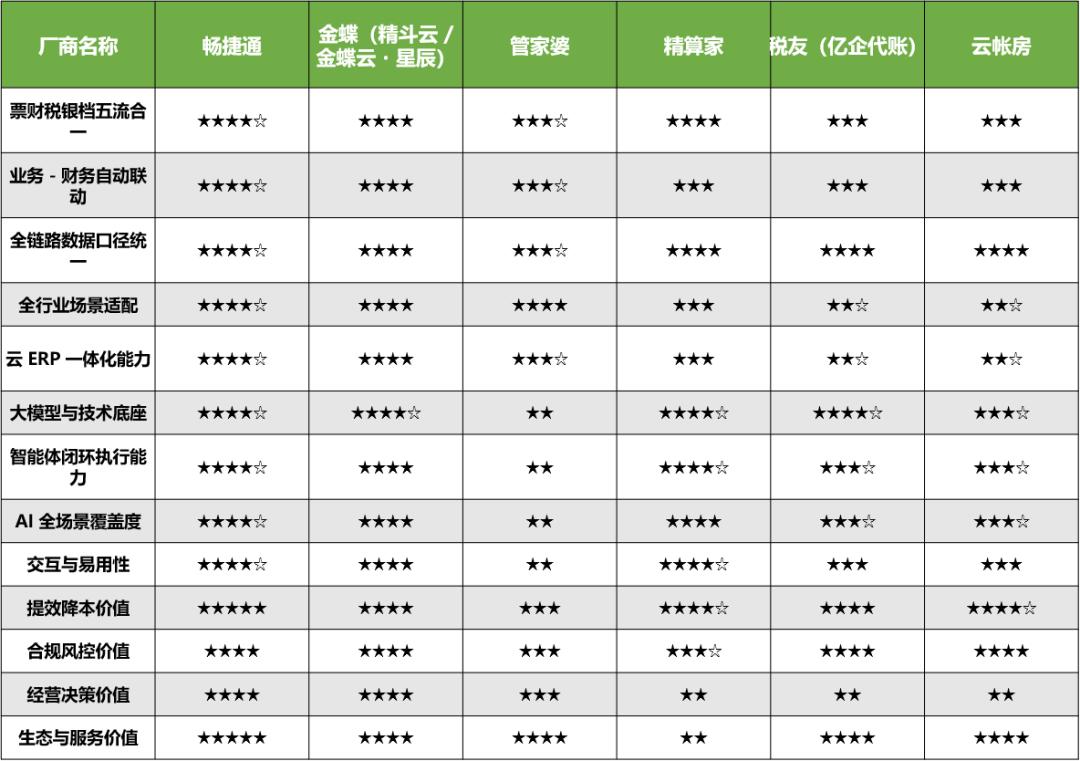
Overall, mainstream vendors have formed a clear three-tier echelon:
Tier 1: Leading Comprehensive Capabilities, Entering the Integrated Intelligence Stage
As an L4-level integrated intelligent vendor, Chanjet ranks at the leading position in the industry across all comprehensive dimensions. As the leading cloud service provider for small and micro enterprises under Yonyou, Chanjet had a total of 961,000 paying users in 2025, occupying a leading market share. Its core advantages lie in full-link integration capabilities and in-depth AI implementation capabilities: at the integration level, it has taken the lead in realizing the unification of five flows: invoice, finance, taxation, banking, and archives, with 95% coverage of automatic voucher generation from business documents, and top-tier data caliber consistency in the industry; at the AI level, it has built a dual intelligent engine architecture of "Xiao Chang + Chang Xia", deployed 58 full-scenario business-finance-tax agents, supported cross-scenario multi-agent collaboration, and the efficiency of AI-powered accounting personnel has exceeded 3000+. By the end of 2025, Chanjet has completed the product implementation of full-scenario business-finance-tax agents, launched the R&D and internal testing verification of Agentic ERP architecture for small and micro enterprises, and is in a leading position in the industry on the technical route of "business-finance-tax integration + AI agents".
Tier 2: Highlighted Characteristic Advantages, Deep Cultivation in the Rule-Based Intelligence Stage
Kingdee and Jingsuanjia are in the L3+ rule-based intelligence echelon, forming differentiated advantages in the general market and AI-native track respectively.
Relying on the base of the Cangqiao large model, Kingdee covers all customer groups from individual industrial and commercial households to growing small and micro enterprises with the dual product matrix of "Jingdou Cloud + Kingdee Cloud · Xingchen", with outstanding adaptability in industrial and commercial, as well as retail scenarios, excellent customer net retention rate, and its comprehensive capabilities steadily rank at the top of the industry's second tier.
As a representative vendor in the AI-native track, Jingsuanjia has self-developed the "Deep Blue Finance Whale" special large model for finance and taxation, focusing on full-process unattended automation. Pure natural language interaction greatly reduces the operation threshold, significantly improves the efficiency of financial and tax processing, and is especially suitable for the needs of technology-based, light-asset start-ups.
Tier 3: Deep Cultivation in Vertical Tracks, Building Barriers in Segmented Scenarios
The three vendors: Suiyou, Yunzhangfang, and Guanjiapo, focus on segmented tracks and have built their own competitive barriers in vertical fields.
Suiyou (Yiqidai Zhang) and Yunzhangfang are both deeply engaged in the bookkeeping agency track: Suiyou relies on its background as a tax system service provider, with exclusive tax-bank direct connection resources, leading policy adaptation speed in the industry, and outstanding tax compliance risk control capabilities; Yunzhangfang is driven by the dual technologies of "RPA+AI", leading the industry in batch accounting processing efficiency, with the number of account sets served per person ranking at the forefront of the industry.
Guanjiapo focuses on the vertical field of commercial retail and the sinking market. Its inventory management functions are deeply aligned with the operational habits of physical merchants, with more than 3,000 offline service outlets covering a wide range, leading in penetration rate in county-level commercial markets.
IV. Future Outlook of the Track: Four Trends Define the Next Growth Cycle
The report judges that the intelligent business-finance-tax track for small and micro enterprises will enter a new reconstruction cycle from 2026 to 2029, presenting four core development trends:
First, full-cycle coverage of compliance intelligence. Compliance management will shift from "remediation after the fact" to full-cycle prevention and control of "pre-warning and in-process interception". The system policy response time will be shortened from 7 days to less than 24 hours, helping enterprises reduce more than 90% of financial and tax compliance risks.
Second, agents evolve from feature superposition to system-native. Multi-agents will realize cross-scenario collaborative operations, and more than 80% of standardized financial and tax processes can be completed independently by agents; natural language interaction will become the core operation entry, greatly lowering the software usage threshold.
Third, the scope of collaboration extends from inside the enterprise to the industrial chain. Core enterprises will drive upstream and downstream small and micro enterprises to realize real-time synchronization of financial and tax data, unifying the four flows of invoices, orders, logistics, and capital, to achieve industrial chain-level automated settlement.
Fourth, financial and tax data transforms from operational records into monetizable assets. With the deepening of the policy of including data assets in financial statements, financial and tax data will become the core credit asset of enterprises, which can directly connect to scenarios such as bank credit loans and government procurement. It is expected that 30% of small and micro enterprises will obtain financing through compliant financial and tax data by 2027.
For small and micro enterprises, the selection of business-finance-tax systems is no longer a simple tool procurement, but a long-term investment in operational infrastructure. It is recommended that enterprises prioritize integration capabilities as the core criterion, take into account the depth of AI intelligence and ecological openness, and select platform-based products that can grow with the whole life cycle of the enterprise, balancing current compliance needs and long-term operational value-added. The industry as a whole is at a critical node of leaping from rule-based intelligence to integrated intelligence. Vendors with both integrated and AI capabilities will continue to expand their advantages, and track integration and head concentration will become the core theme in the next few years.
This article is from the WeChat public account "iResearch" (ID: iresearch-), author: iResearch, published with authorization from 36Kr.