A family calendar app that has been launched for 20 years, can its monthly revenue still hit millions of US dollars?
In 2005, a housewife in Seattle, USA, stood in front of supermarket shelves and opened an application called "Cozi". She first glanced at what time her children would finish school that day, then followed the pre-made shopping list in the app to place items one by one into her shopping cart.
Twenty years later, this outdated, barely-smart product still remains on the phones of American families. What's more unusual is that the product has managed to push its monthly revenue to millions of dollars around Mother's Day for two consecutive years.

"Cozi" monthly revenue changes over the past 5 years | Source: AppMagic
In an era where everyone is eager to add AI to almost everything, this old, "not-smart-enough" app is far less replaceable than people might think. Behind this stability lies a thought-provoking question.
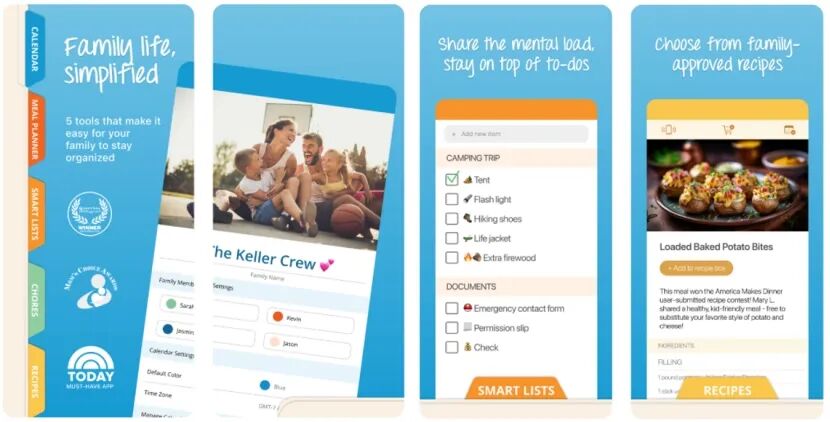
App screenshot | "Cozi"
The "Invisible" Burden, and the Opportunity That Was Seen
Different from our previous observations of the Japanese market, family schedule synchronization apps meet the demand for "low-disturbance, asynchronous communication" between spouses. (For details, see our previous article "Targeting 'Family Social': Some Products Have 10 Million MAUs, Others Reach Monthly Revenue of Millions".) In the US, families are larger, there are more members, and commutes are longer, so the cost of a mistake in pickup and drop-off arrangements is higher.
At the same time, the American middle class invests heavily in their children's extracurricular activities. Moreover, most of these families live in suburban areas, so mothers' days almost revolve around their kids—driving them to and from school, sports practices, and rehearsals every day. A specific term, "soccer mom", was coined to describe this lifestyle.
*Note: "Soccer mom" originally specifically referred to mothers who drive their children to soccer games or training, and later broadly refers to mothers who devote a great deal of time to their children's growth and extracurricular activities.
Frictions often hide in ordinary weekends. Your son's soccer game is on Saturday morning, your daughter's cheerleading performance is at the end of the month, and these days usually require the whole family to be present. But when planning, it's hard to figure out everyone's free time. If there's even a small oversight in coordination, the mother who puts in the most effort will end up feeling guilty because of her children's disappointment.
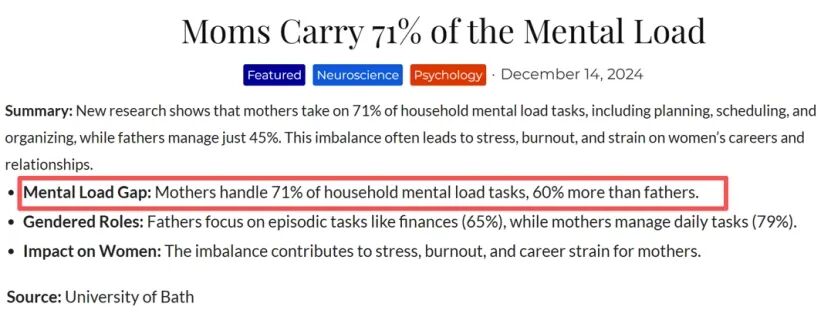
Mental load | Source: Neurosciencenews
This "invisible" burden on mothers became the entry point for "Cozi".
In 2005, former Microsoft employees Robbie Cape and Jan Miksovsky founded "Cozi". The core logic is very simple: put family schedules, to-do items, shopping lists, and recipes in a shared space so that all family members can see them.
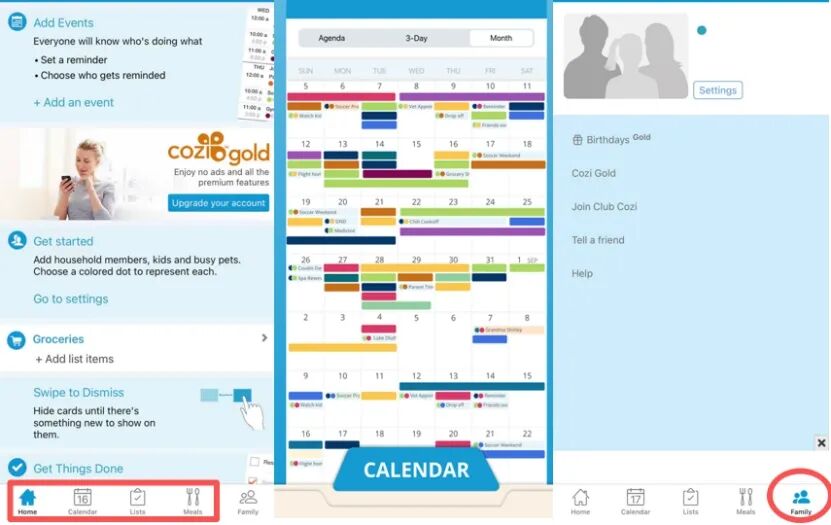
The four main sections in the red box (the to-do section is further divided into three sub-sections: shopping, specific members' to-dos, and miscellaneous items); the middle part shows what the shared schedule looks like; the family section in the red circle allows you to invite members to share information | Source: "Cozi"
The value of information being "seen" is that mothers no longer have to repeatedly ask "What time will you be back tomorrow?" or "Who will pick up the kids?" Instead, they can plan ahead and assign tasks directly.

Some users shared on home management blogs that "Cozi" effectively helped avoid scheduling conflicts between family vacations and children's competitions, and prevented family members from buying milk twice | Source: kxan.com
Lay Out All the Trivial Things on a Visible Whiteboard
"Cozi" went a step further on the basis of "visibility" by assigning a specific person in charge to each task, sharing part of the decision-making pressure.
In the Home section, users can choose different colors when creating tasks, and these colors correspond one-to-one to different family members; after creation, the tasks will automatically sync to the Calendar and List sections.
Before this, mothers almost had to take on "decision-making, coordination, and execution" all by themselves. Through "Cozi", mothers can arrange things in advance and share part of the execution pressure. More importantly, the clear color labels and pre-shared schedules, while not completely eliminating the burden, can at least prevent the most common buck-passing behavior among family members: "I didn't know about this arrangement."

The creation page after entering the Home interface, and the weekly schedule after creating multiple tasks | Source: "Cozi"
As for the daily dilemma of "What's for dinner tonight?", "Cozi" has dozens of built-in recipes. Users can directly select a week's menu, and the app will automatically generate a shopping list. Mothers can share the list with fathers, who can pick up the items on their way home from work. Later, "Cozi" also added the AI Recipe Creator, which can generate exclusive recipes based on users' preferences.
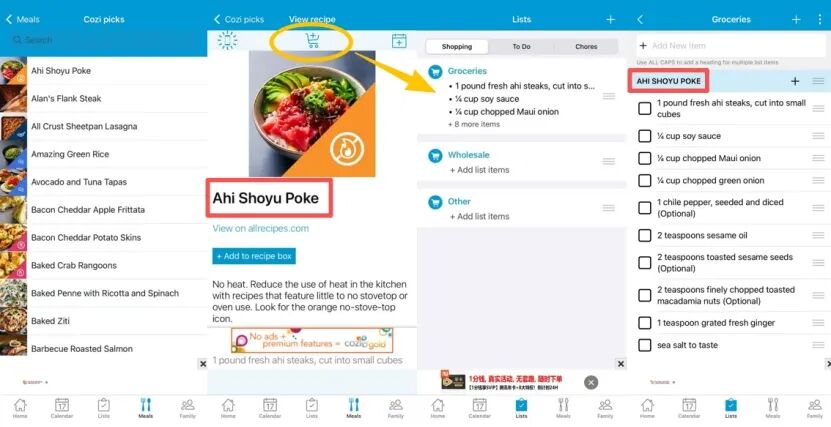
Among the dozens of cooking tutorials, there are even thoughtful quick home-cooked meals that can be made within 45 minutes. Click the shopping icon (second from the left) in the yellow circle, and the app will automatically jump to the to-do section to create a shopping list (right) | Source: "Cozi"
None of these features are stunning, but when those trivial, almost unnameable household chores are gathered in a visual interface that connects to the next step and links other family members, mothers who were once overwhelmed by scattered information regain a sense of control. It is precisely because these features are so close to daily life that "Cozi" became one of the best parenting apps in 2021.
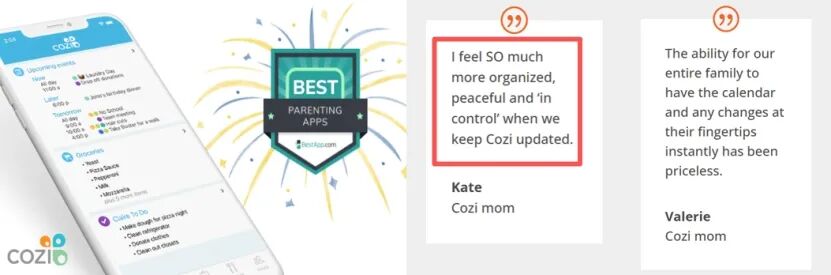
Source: bestapp.com, Cozi
If a family has used "Cozi" for years to arrange schedules, share shopping lists, and record recipe preferences, the cost of switching to another app is not just downloading new software—it means rebuilding the entire family's information system from scratch. This "migration cost" has become "Cozi"'s deepest moat. Its stable performance over nearly 20 years since launch also shows that once users start using "Cozi", they find it very hard to leave.
"Cozi" Catching Up in the AI Era Is More Like a "Patch"
In 2025, "Cozi" didn't stand still—it launched Cozi Max at $79 per year, adding three new AI features: AI Recipe Creator (the recipe feature mentioned earlier), AI Meal Planner (generates a full-week meal plan based on the schedule), and AI Event Import (automatically imports email invitations and event information). Paired with Mother's Day promotions, its monthly revenue nearly hit a million dollars for the first time that month. The same scenario repeated in May 2026, with monthly revenue approaching a million dollars again.
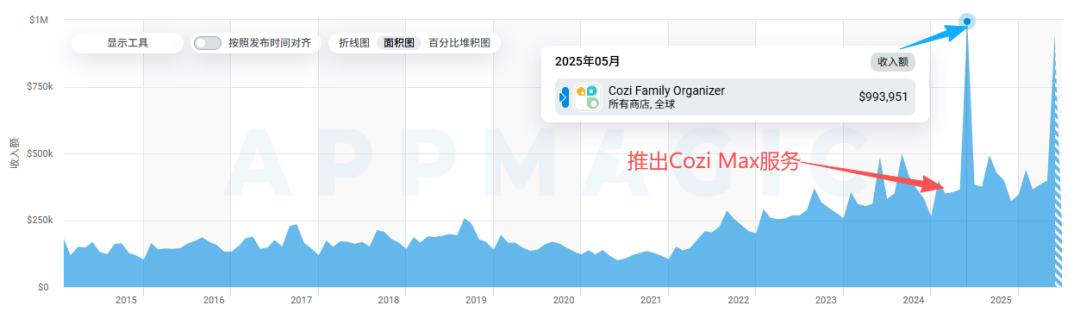
"Cozi" monthly revenue changes over the past 10 years | Source: AppMagic
However, it's worth noting that the proportion of Cozi Gold subscriptions is much higher than that of Cozi Max. This shows that users are willing to pay for core features, while AI features are not as attractive as people might think. (Cozi Gold is priced at $39 per year, with benefits including ad-free access across all devices, schedule search, monthly view, and more.)
Looking at "Cozi"'s reviews from the past year, users rarely mention the AI features. Most positive reviews focus on basic experiences such as "simple and easy to use", "prevents schedule conflicts between kids and parents", and "avoids duplicate purchases". A user who has used it for three or four years wrote: "I don't mind adding AI to let me quickly voice-input events, but I can still use it normally without those fancy features."
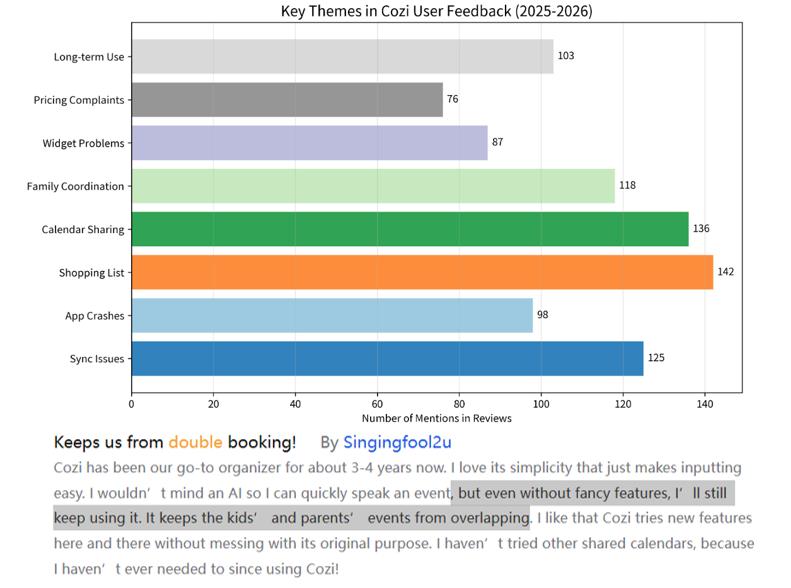
Very few users mention AI features, and basic features remain the main factor attracting users | Data source: "Cozi" user reviews from the past year
Instead of Making a Better "Cozi", Find a New Path to Break Through
If you follow the idea of "making a better 'Cozi'" to create a similar product, the migration cost of the long-established "Cozi" can block most latecomers. But Nori, which appeared in early 2026, wants to take a different path—redefining the way families collaborate.
Nori was developed by a team with backgrounds from ByteDance and Samsung. It covered more than 100,000 families within one month of beta testing, topped the App Store productivity chart on its launch day, and even surpassed Google Calendar for a time. (For details, see our previous article "Penetrating 100,000 Families in 30 Days: How Nori Quietly Seizes the 'Last Piece of the Puzzle' for AI".)
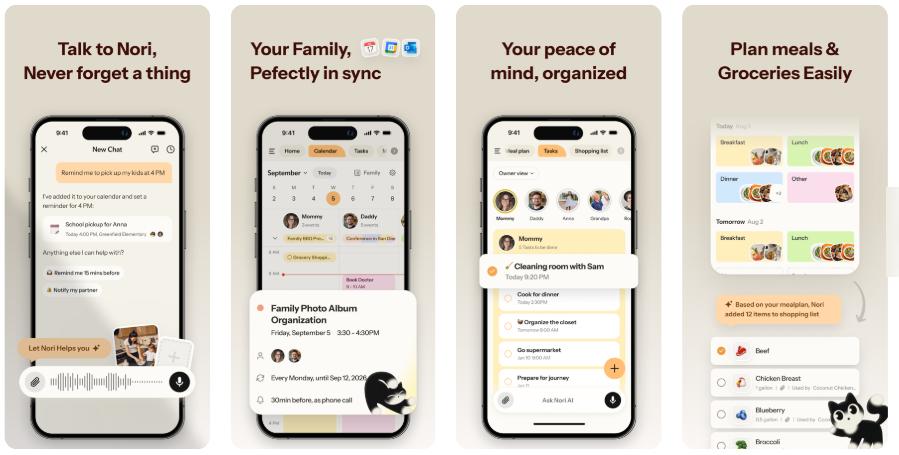
App screenshot | Nori
The root of the difference between the two lies in who does the work. Unlike "Cozi", which follows the logic of "users fill in the content", Nori uses AI to "let the system understand the content".
This difference becomes clearer when applied to a specific "weekend" scenario.
In "Cozi", the mother needs to manually enter her son's soccer game and daughter's cheerleading performance on the weekend into the calendar, fill in the time and location, check the free time of other family members, and then coordinate one by one who is responsible for dropping off and picking up whom. The whole process relies on users to actively input and manage information.
In "Nori", the mother only needs to upload screenshots of the notifications for the two events, or directly input them via voice. The AI will automatically extract event information, identify family members with free time, and propose coordination plans and specific arrangements, such as "Dad takes the son to the game, Mom takes the daughter to the performance, and Grandpa picks up the kids after it ends".
One is like a ledger that waits for users to record their lives, while the other is a family housekeeper that actively arranges life. In the AI era, family apps are evolving toward a direction where they can understand context and actively handle complex scenarios.
But even then, "Cozi" could still catch up by "upgrading". However, the team with experience from Samsung and ByteDance has successively launched SupreNori, a proactive family AI Agent that actively identifies matters that may need attention within the authorized context and asks before taking action. In recent days, they have also opened pre-orders for the hardware Nori Family Hub—it's not just a large electronic screen calendar, but also "listens and remembers" when placed in the living room.
Closing Thoughts
Twenty years ago, "Cozi" identified the pain points of mothers, making users willing to try this app. Years of product accumulation and established family usage habits have made it the default life recording tool for many families, a position that is hard to shake.
Today, 20 years later, when the family scenario is redefined as "a life system that can be processed by AI at any time", the stability of "Cozi"'s moat has become a question mark. Although Nori's performance in the half year since launch is not enough to pose a threat to "Cozi", it seems that simply adding AI feature patches to the product is far from enough for "Cozi" at this stage.