Is 20,000 cheaper than 6,000? When it comes to the "high cost" and "low cost" of dexterous hands, maybe we have all calculated the accounts wrongly.
In the first quarter of 2026, the total financing for dexterous hand-related enterprises has approached 5 billion yuan, nearly 70% higher than the full-year total of 2025.
Among them, Lingxin Qiaoshou has completed seven consecutive rounds of financing, reaching a valuation of 3 billion USD, with the target valuation in its new financing round directly jumping to 6 billion USD (approximately 41 billion yuan), which is close to the latest valuation of Unitree Robotics in the primary market.
"The valuation of a single dexterous hand now even exceeds that of a full humanoid robot," a CTO of a humanoid robot OEM remarked with a sigh.
Meanwhile, another set of data paints a completely different picture: the dexterous hand of Tesla Optimus has a service life of only 6 weeks in express sorting training, while the unit cost exceeds 6,000 USD. Adding other vulnerable components, the annual part replacement cost for a single deployed robot alone is close to 100,000 USD.
On one side is the frantic pursuit from capital, and on the other side is the arduous progress of engineering implementation. The dexterous hand industry is caught in a seemingly unsolvable dilemma — the "Impossible Triangle" of performance, cost, and reliability.
Pursuing high performance means more sensors, more electric joints, and higher degrees of freedom, which inevitably leads to a sharp rise in cost; pursuing low cost makes it difficult to even guarantee basic grasping functions; pursuing high reliability requires simplifying the design and reducing failure points, which in turn greatly compromises performance.
Under the framework of this "Impossible Triangle", a fundamental question has been repeatedly raised: Is there real market demand for high-precision yet high-priced dexterous hands?
The answer is yes, and the demand is accelerating its release.
High price does not equal "expensive" — when we expand the measurement scope from "initial procurement cost" to "full life cycle cost", and upgrade the evaluation dimension from "can it move" to "can it get the job done well", the economic calculation of high-precision dexterous hands will present a completely different picture.
The "Impossible Triangle" of Dexterous Hands: Why High Precision Inevitably Comes with High Price
Why are dexterous hands so expensive?
To understand the pricing logic of high-precision dexterous hands, we must first clarify their cost structure.
A dexterous hand consists of three major systems: actuation, transmission, and perception, accounting for approximately 14%-18% of the total cost of a humanoid robot. According to estimates from relevant institutions, a link-type dexterous hand with 16 actuators and 5 sensors has a BOM cost of around 51,800 yuan, with actuation and transmission accounting for 64% and perception accounting for 35%. Data from Morgan Stanley shows that dexterous hands account for 17.3% of the BOM cost of Tesla Optimus.
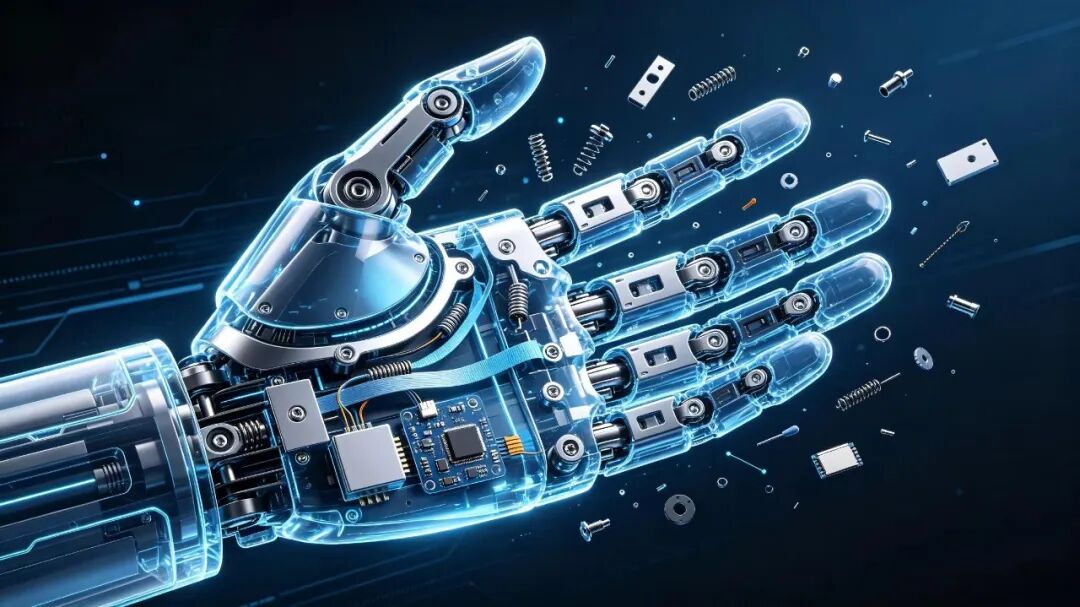
Specifically, hollow cup motors are the mainstream in the actuation side, paired with micro harmonic reducers and bionic tendon cables; the perception side needs to integrate joint position sensors, torque sensors, fingertip tactile sensors, and even 6-axis force sensors. These core components are inherently high-cost — the unit price of laboratory-grade high-precision tactile sensors once reached 100,000 yuan — and the integration and signal processing further increase the complexity and cost.
More critically, dexterous hands face the physical bottleneck where "high output force, high precision, and light weight" cannot be achieved simultaneously.
Compressing sensors, high-precision bearings, precision wiring and other components into the smallest space of a robot — the dexterous hand — will inevitably lead to increased assembly man-hours and reduced yield. In the research report *The Last Machine of Humanity: An In-Depth Analysis of Humanoid Robot Hardware*, four authors including Sourish Jasti pointed out that these problems will not disappear with process maturity or supplier price cuts.
In the short term, it is indeed difficult for dexterous hands to simply rely on production volume to dilute costs like ordinary components — the reliance of precision assembly on skilled workers and the complexity of sensor calibration cannot be solved instantly by a large purchase order.
But if we extend the timeline to 5 or 10 years, with the development of dedicated assembly equipment and the reconstruction of the supply chain, scale will still play a role, except that the slope of this cost curve is much gentler than most people imagine.
Facing the "Impossible Triangle", engineers have made different trade-offs, forming three major technical routes: direct drive, link drive, and tendon drive.
The direct drive scheme installs the motor directly inside the fingers, with almost no energy loss and extremely high precision, but the built-in motor leads to a larger volume, prominent heat dissipation pressure, and higher overall hand weight.
The link drive scheme has a high load capacity, making it suitable for industrial scenarios.
The tendon drive scheme can achieve higher degrees of freedom — Tesla uses the tendon drive scheme to achieve an astonishing 25 degrees of freedom — but at the cost of high cost and high wear.
The differentiation of these technical routes itself illustrates a fact: within the current engineering boundaries, high precision and high degrees of freedom are inevitably accompanied by high cost.
This is not a pricing strategy issue of a certain manufacturer, but an objective reality determined by the laws of physics and engineering.
"Expensive" vs. "Not Expensive" from the Perspective of Full Life Cycle Cost
The story of Tesla's dexterous hand precisely demonstrates the value logic of high-precision products from the opposite side.
According to reports, the dexterous hand of Tesla Optimus has a service life of only 6 weeks when used in express sorting training. The unit cost exceeds 6,000 USD (about 42,000 yuan), and the hand needs to be replaced 8 to 9 times a year. Adding other vulnerable components, excluding electricity costs, a single robot costs nearly 100,000 USD (about 710,000 yuan) per year just for part replacement.
That amount of money can hire two automotive assembly workers in the United States.
What is the essence of the problem? It is not the high initial procurement cost, but the excessively high unit usage cost. Spending 6,000 USD on a hand that only lasts 6 weeks, what is the cost per grasp? If a high-precision dexterous hand is priced at 20,000 USD but can last for 2 years, which one has the lower "real cost"?
This problem becomes even more acute in industrial application scenarios.
Factories have extremely high requirements for the service life of robotic equipment, and frequent replacements must be avoided. The long-term stable operation of robots is the basic premise for their application in factory scenarios.
Currently, the average service life of dexterous hands on the market generally ranges from 1,000 to 2,000 hours, far below the standards of industrial-grade robots. The service life of most commercial dexterous hands is around 200,000 grasps. In contrast, leading enterprises are already pursuing a single chain cycle life of over one million times.
Service life itself is part of the cost. Even if the unit price of a high-precision dexterous hand that can last for a million grasps is several times that of low-end products, its per-use cost may be lower. This is the first layer of meaning of "high price does not equal expensive" — the measurement should not only look at the procurement cost, but also the usage cost over the full life cycle.
Maintenance cost is a hidden expense that has been overlooked. Apart from replacement frequency, maintenance cost cannot be ignored. As a mechanical structure, dexterous hands will wear out due to friction after long-term operation and require regular lubrication. The more precision components there are and the higher the precision, the higher the complexity and cost of maintenance.
But conversely, high-precision design itself can also reduce maintenance costs. Taking the chain drive scheme as an example, high-precision design can achieve no obvious elongation or wear, maintain precision at the 0.1 to 0.2 millimeter level, keep the transmission efficiency above 95% for a long time, resulting in lower full-life-cycle maintenance costs.
This means that in the triangle of "precision - service life - maintenance cost", high precision and long service life often go hand in hand. Customers who are willing to pay for precision are essentially paying for a longer stable operation period and lower maintenance burden.
Precision Determines "Whether the Job Can Be Done Well"
The key reason why customers are willing to pay for dexterous hands lies in their ability to solve practical problems. And the core of "solving practical problems" is precision.
Traditional industrial grippers and suction cups can only perform pre-set single tasks, and their limitations become obvious when facing irregularly shaped objects or operations requiring precise force control. Only by equipping robots with hands that can grasp flexibly and perform precise force control like human hands can robots truly break away from pre-defined scenarios.
Yin Zhouping, an academician of the Chinese Academy of Sciences, pointed out that current humanoid robots have achieved motion capabilities such as fast walking and running, but the real breakthrough lies in dexterous manipulation and natural interaction.
The most intuitive manifestation of precision's impact on economic calculation is the "completion rate".
The Xiaomi robot operated autonomously for 3 consecutive hours at the self-tapping nut loading station in the die-casting workshop, using a 5-finger dexterous hand to achieve a 90.2% success rate for simultaneous bilateral installation. What does a 90% completion rate mean? It means that 1 out of every 10 operations fails, requiring manual intervention or re-operation.
What if a high-precision dexterous hand can raise this figure to 99%?
In industrial production, a single failed operation may lead to: scrapped workpieces (material cost), production line shutdown (time cost), manual intervention (labor cost), and rescheduling (management cost).
The sum of these hidden costs far exceeds the price difference of the dexterous hand itself.
The economic value of high-precision dexterous hands does not lie in the fact that they "can move", but in the fact that they "can get the job done well" — and can do it stably every time. The gap between a 90% completion rate and a 99% completion rate may be the dividing line between whether a production line can be profitable or not.
The improvement of tactile perception capability is amplifying this value. The F-TAC Hand increases the grasping success rate from 53.5% to 100% through full-hand high-resolution tactile perception. For enterprises, the gap from 53.5% to 100% is not a matter of "whether it works well", but a matter of "whether it can be used at all".
Of course, not all scenarios require dexterous hands with the highest precision. Research from Huachuang Securities clearly divides the dexterous hand market into four price ranges:
Products priced below 10,000 yuan are mainly educational kits and open-source DIY solutions, with low degrees of freedom and no tactile feedback, which can only be used to "demonstrate possibilities" rather than "realize productivity";
The 10,000 to 50,000 yuan range is the most active "volume-price equilibrium point" at present, where products evolve from "movable toys" to "usable tools", supporting scenarios such as university research, commercial service robots, and light collaborative assembly;
The 50,000 to 200,000 yuan range represents the technical high ground, with products generally equipped with 12-20 degrees of freedom, a multi-modal tactile sensing system, and a service life of millions of grasps, capable of supporting scenarios with extremely high reliability requirements such as precision assembly in automotive and 3C production lines, special operations, and military applications;
Products priced above 200,000 yuan correspond to extreme scenarios such as medical-grade and space-grade applications.
This price stratification itself illustrates that the market is not a binary choice of "whether to pursue high precision or not", but a gradient distribution of "what precision is required for what scenario".
The highest-precision products serve the highest-value scenarios, and each price range has its own underlying business logic for existence.
The Market's Verdict: Capital Votes with Its Feet
If theoretical analysis is not persuasive enough, then the actual actions of the market may give a clearer answer.
In 2025, the global market size of multi-fingered dexterous hands for robots was approximately 272 million USD, and it is expected to reach 9.67 billion USD by 2032, with a compound annual growth rate of 67.5%.
Another set of data shows that in 2025, the global market size of dexterous hands for embodied intelligence robots was about 267 million USD, and it is expected to reach 10.35 billion USD by 2032, with a compound annual growth rate as high as 70%.
The growth of the domestic market is even more rapid. In 2025, the sales volume of dexterous hands in China was about 19,200 units, which is expected to reach 70,200 units in 2026 and exceed 430,000 units by 2030.
The reaction from capital is equally enthusiastic. In the first quarter of 2026 alone, the total financing for dexterous hand-related enterprises has approached 5 billion yuan. Inspire Robotics exceeded 10,000 units in dexterous hand deliveries in 2025, with a 2026 target of 30,000 to 50,000 units, and the company has been operating at full capacity all the time.
Sharpa presents a completely different picture. At the end of last year, this dexterous hand priced at 50,000 USD was marked with "no available inventory". Customers are not complaining about high prices — they simply cannot get their hands on the products. A practitioner went to Sharpa's Shanghai office to use their equipment for experiments, and later posted a line in the industry group: "This is the best hand you can get your hands on right now." Sharpa's customers focus on extreme performance — in fields such as military applications, special operations, and aerospace pre-research, where a single piece of equipment costs tens of millions of yuan, spending tens of thousands of extra USD on a hand is a trivial expense.
At the lower end, Inspire Robotics has pushed the price down to the 10,000-50,000 yuan range, precisely targeting the "volume-price equilibrium point". Their products are mainly supplied to university laboratories and research institutions, with non-ultimate precision but guaranteed stability, easy integration, and reasonable pricing. The order backlog is full, and the production line is always running at full capacity.
Robot OEMs are also investing heavily in in-house R&D. Agibot, DeepMotion, and Pulsion follow the same logic as Tesla — the hand is the ceiling of the robot's body capabilities, and they cannot afford to not control it on their own. Pulsion focuses on the tactile route, and upstream suppliers such as Taishan Technology (tactile chips) and Tactile Robotics (visual-tactile sensors) are also seeing their order volumes surge alongside this boom.
Every player has a different strategy and calculation method. But one thing is shared: real demand never relies on praise — it is measured by how many people are willing to pay and wait in line.
If high-precision dexterous hands really "have no demand", how can we explain all these numbers?
Of course, there are also sober voices in the market. Some industry insiders pointed out that "in fact, many industrial scenarios do not necessarily require dexterous hands, and two-finger or three-finger actuators can solve more than 80% of the problems". The value of dexterous hands should be reflected in their ability to replace humans in completing operations in complex, harsh, and even dangerous environments.
This view precisely confirms that the demand for high-precision dexterous hands does exist, but it is not universal or omnipotent — it serves high-value scenarios where "there is no alternative".
In those scenarios, precision is productivity, and productivity is worth paying for.