A "major pig farming enterprise" with a market value of 200 billion yuan is facing widening losses despite increasing sales, as its half-year pre-loss exceeds 5.7 billion yuan.
Amid the industry downturn, Muyuan Foods, a 200-billion-yuan "leading pig breeder", has fallen into the awkward situation of "selling more while losing more".
According to the latest performance forecast disclosed by Muyuan Foods, the company's attributable net profit for the first half of this year is expected to record a loss of 5.7 billion yuan to 6.7 billion yuan, representing a year-on-year decline of 154.14% to 163.63%.
In response, Muyuan Foods stated that although the company has reduced pig breeding costs by strengthening management capabilities, its performance in the first half of the year suffered losses due to the impact of falling pig prices.
According to the sales bulletin, in the first half of this year, the company sold a total of 38.615 million market pigs, a year-on-year increase of 0.58%; the cumulative sales revenue reached 50.145 billion yuan, a year-on-year decrease of nearly 30%.
However, while the breeding business is under pressure, Muyuan Foods' slaughtering and meat processing segment has achieved continuous profitability. According to Qin Muyuan, CEO of Muyuan Meat, the company's slaughtering and meat division recorded profits in both the first and second quarters of this year.
It is worth noting that shortly before the release of this performance forecast, Muyuan Foods had just completed a "leadership transition". The company's founder Qin Yinglin applied to resign from his positions as director, chairman, and president upon reaching the stipulated retirement age, with veteran executive Cao Zhinian taking over as the new chairman.
Beyond the performance pressure, Muyuan Foods was recently embroiled in controversy again over the "Ode to Pigs". In response, Muyuan stated, "This is the output of the company's existing cultural values, and the public is welcome to engage in objective discussions after understanding the full cultural context."
Notably, in the "2026 New Fortune 500 Richest List" unveiled in June, the couple Qin Yinglin and Qian Ying, the actual controllers of Muyuan Foods, re-entered the ranking with a fortune of 1.5172 trillion yuan.
Predicted Loss Over 5.7 Billion Yuan in Half a Year: The Leading Pig Breeder Is "Losing More as It Sells More"
On July 10, Muyuan Foods released its semi-annual performance forecast, predicting that the company's attributable net profit for the first half of the year will shift from a profit of 10.53 billion yuan in the same period last year to a loss ranging from 5.7 billion yuan to 6.7 billion yuan, with a year-on-year decline of 154.14% to 163.63%.
During the same period, the company's basic earnings per share are expected to drop from a profit of 1.96 yuan per share in the first half of last year to a loss of 1.03 yuan to 1.21 yuan per share.
Muyuan Foods stated that during the reporting period, the company deepened the health management and production management of pigs, improved refined management capabilities, and reduced pig breeding costs compared to the same period of the previous year.
However, due to a significant year-on-year decline in pig sales prices, with the average sales price of market pigs at approximately 10.4 yuan per kilogram, down about 28% year-on-year, the company's operating performance in the first half of the year recorded losses.
The June sales bulletin previously disclosed by Muyuan Foods shows that since January this year, the price of the company's market pigs has generally declined all the way: the price in January was still 12.57 yuan per kilogram, but by June it had dropped to 9.69 yuan per kilogram.
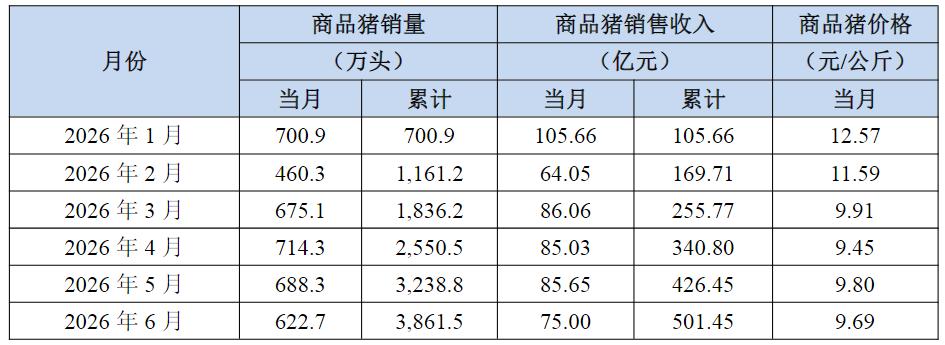
Although Muyuan Foods revealed on the investor interaction platform that the full cost of pig breeding in June was controlled at around 11.7 yuan per kilogram, it was still about 2.01 yuan per kilogram higher than the market pig price in the same period, leaving the company trapped in the awkward situation of "the more it sells, the more it loses".
From January to June this year, Muyuan Foods sold a total of 38.615 million market pigs, a year-on-year increase of 0.58%, but sales revenue plummeted from 70.868 billion yuan in the same period of 2025 to 50.145 billion yuan, a decrease of nearly 30%.
Muyuan Foods emphasized in the aforementioned performance forecast that if the market price of pigs drops sharply in the future, the company's performance may continue to decline.
However, according to the Investment Times, since the end of June this year, domestic pig prices have rebounded rapidly. On July 9, the price of external three-way crossbred pigs rose to 11.33 yuan per kilogram, an increase of 18.89% compared to the price on June 28.
But various securities institutions have put forward different views on the future trend of pig prices. Orient Securities stated that combined with capacity cycle indicators, the number of newborn piglets has shown a clear downward trend since the beginning of the year, which corresponds to a trend upward movement of pig prices in the third quarter of 2026. In addition, considering the elimination of sow capacity and sluggish production sentiment amid the deep losses of the industry in the first half of 2026, the trend of decreasing piglet supply is expected to continue. Based on this, Orient Securities judges that the phased rebound in pig prices since the end of April is gradually evolving into a more sustained reversal market.
Huaan Securities, on the other hand, predicts that as the number of secondary fattening pigs continues to increase, pig prices will fall. Calculated from the inventory of breeding sows, the total capacity reduction from July 2025 to March 2026 reached 3.4%, which corresponds to a possible resumption of the upward channel for pig prices in the second half of 2026. However, considering that only 0.2% of capacity was eliminated in the third quarter of 2025 and the improvement in production efficiency, pig prices in the second half of 2026 may continue to fluctuate at low levels.
It is worth noting that this loss-predicted semi-annual report is also the first "major test" faced by Muyuan Foods' new leader Cao Zhinian since taking office.
At the beginning of June, Muyuan Foods issued an announcement on management changes: the company's founder Qin Yinglin applied to resign from his positions as director, chairman, member of the Strategic Committee and Sustainable Development Committee, and president upon reaching the stipulated retirement age.
After stepping down, Qin Yinglin will serve as the dean of Muyuan Pig Breeding Research Institute, continuing to focus on technological innovation and breakthroughs in the pig breeding industry to support the company's long-term high-quality development.
At the same time, the company's board of directors elected Cao Zhinian as the chairman of the 5th Board of Directors, and appointed Gao Tong as the company's president and chief financial officer.
Continuous Profitability of Slaughtering Business Serves as a Profit Safety Cushion
Tianyancha information shows that Muyuan Foods Group Co., Ltd. (referred to as "Muyuan Foods") was founded in 2000, and is a listed enterprise focusing on the entire pig industry chain, with business covering feed processing, pig breeding, farming, and slaughtering and processing.
Against the backdrop of pressure on the pig farming business, the continuous profitability of the slaughtering and meat processing segment has become a highlight of Muyuan Foods' performance in the first half of the year.
According to Qin Muyuan, CEO of Muyuan Meat, the company's slaughtering and meat division has continued its profitable state from 2025 this year, recording profits in both the first and second quarters.
"Overall, the proportion of pigs slaughtered by the company itself is still relatively low, which represents the profit potential of the slaughtering business in the future. We expect the slaughter volume to increase by 20% this year," Qin Muyuan further stated.
Lei Da Finance learned that Muyuan Foods began to deploy its slaughtering and meat processing business in 2019. The "Opinions on Stabilizing Pig Production and Promoting Transformation and Upgrading" issued that year encouraged local slaughtering of pigs to achieve matching between farming and slaughtering, as well as smooth connection between production and sales.
To this end, Muyuan Foods started building slaughterhouses to adapt to the trend shifting from "transporting live pigs" to "transporting pork products". In 2019, Muyuan Foods launched three slaughterhouse projects in Neixiang County, Zhengyang County, and Shangshui County in Henan Province respectively, with a total designed capacity of 6 million pigs.
In 2020, Muyuan Foods further expanded its slaughtering and meat processing business. By the end of that year, Muyuan Foods had established 15 slaughtering subsidiaries across the country, with a planned annual slaughter capacity of approximately 40 million pigs.
At the same time, Muyuan Foods gradually established a national fresh pork sales network. By the end of 2020, the company's slaughtering division had set up multiple sales regions, with more than 1,500 customers including agricultural wholesale markets, supermarkets, key accounts, and other types of clients.
From 2021 to 2024, Muyuan Foods continuously accelerated the construction of supporting slaughtering capacity in its main farming regions. The pig slaughter volume increased from 2.899 million in 2021 to 12.5244 million in 2024; the revenue of the slaughtering and meat processing segment also jumped from 5.42 billion yuan to 24.274 billion yuan.
However, in 2024, the revenue of Muyuan Foods' slaughtering and meat processing business only accounted for 19.72% of total revenue, with a gross profit margin of merely 1.03%, making a relatively small contribution to the company's overall performance.
In 2025, after years of development, Muyuan Foods' slaughtering and meat processing business welcomed good news: the segment recorded annual profitability for the first time.
Financial reports show that in 2025, Muyuan Foods slaughtered 28.663 million pigs throughout the year, a year-on-year increase of 129%; the annual capacity utilization rate of the slaughtering and meat processing segment reached 98.8%, contributing 45.228 billion yuan in revenue to the company, representing a year-on-year increase of 86.32%.
For the new year, Muyuan Foods stated that the company will accelerate the construction of slaughterhouses and cutting centers, while building three cutting centers in Suzhou, Langfang, and Beijing.
In addition, the company will continue to optimize its sales channels and product structure, increasing the proportion of segmented meat products.
Some analyses point out that the continuous profitability of Muyuan Foods' slaughtering and meat processing business in the first half of the year means that it has become a profit safety cushion to hedge against fluctuations in the farming cycle.
"Ode to Pigs" Faces New Criticism, Muyuan Responds to Controversy
Beyond the massive loss in performance, Muyuan Foods was recently pushed to the forefront of public opinion again due to the "Ode to Pigs".
It is reported that this article was written by Qin Yinglin, the former chairman and founder of Muyuan Foods. He used about 800 words to describe the contributions of pigs to humanity, with statements such as "We are also willing to dedicate everything we have as calmly as pigs" sparking heated discussions among internet users.
Some internet users criticized that the article implies a guiding principle of "requiring employees to make unconditional sacrifices", which constitutes "workplace PUA". At the same time, comparing employees to pigs that dedicate their entire lives is inconsistent with modern workplace culture.
However, some other internet users stated, "Farmers revere the land, fishermen revere rivers and seas, so it is only natural for pig farmers to revere pigs. This simple sentiment for the industry should not be stigmatized."
As public opinion continued to ferment, a staff member of Muyuan Foods responded to the media that the "Ode to Pigs" is not a new document, but an internal training material and cultural display content that was written in 2012 and has existed for more than ten years, which has been publicly available on the company's official website, cultural walls, and during external receptions.
The aforementioned staff emphasized that the article "does not simply ask employees to dedicate themselves for free, burn themselves out, or give everything they have - there is no such statement at all, nor is it such a stance. The dedication that Muyuan advocates is to create value and serve society, which is also the company's core value."
Lei Da Finance found through investigation that the article is still posted on Muyuan Foods' official website as of now.
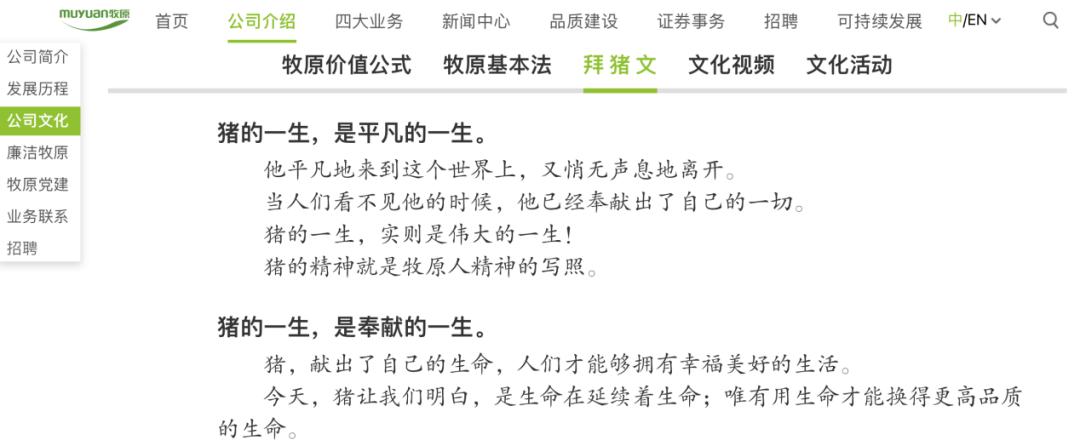
The note at the end of the article also mentions, "The 'Ode to Pigs' was written in 2012, as a reflection and insight gained from 20 years of pig farming practice, reminding ourselves to respect the pig farming industry. From the phenomenon of pigs fighting over food during the breeding process, we realized that in the course of business operations, enterprises should not seize by force or take reckless risks, but rely on their own strength to create value in a down-to-earth manner."
The note also states that "creating value and serving society", as the value pursuit of Muyuan employees, guides them to focus less on calculating personal gains and losses and more on dedication in work and life, continuously create value, help customers succeed, and promote social progress.
In response to the controversy surrounding the article, Muyuan Group stated, "This is the output of the company's existing cultural values, and the public is welcome to engage in objective discussions after understanding the full cultural context."
Lei Da Finance will continue to follow up on the subsequent development of Muyuan Foods.
This article is from the WeChat official account "Lei Da Finance", author: Zhou Hui, editor: Meng Shuai, published with authorization from 36Kr.